

| Citation: |
Jin Wen, Hong-Bo Zheng, Xin-Yi Liu, Xue-Juan Ren. INVERSE COEFFICIENT PROBLEM FOR THE FOURTH-ORDER BEAM EQUATION BY THE METHOD OF VARIATIONAL IMBEDDING[J]. Journal of Applied Analysis & Computation, 2026, 16(2): 724-741. doi: 10.11948/20250075

|
INVERSE COEFFICIENT PROBLEM FOR THE FOURTH-ORDER BEAM EQUATION BY THE METHOD OF VARIATIONAL IMBEDDING
-
Abstract
This paper presents an inverse problem related to a fourth-order beam equation, where the coefficient at the zeroth-order term is unknown. Based on the simple approximation lemma, we employ a technique known as the method of variational imbedding to establish the existence and uniqueness of a weak solution for a variational problem. Finally, we provide several numerical examples using the finite difference method to demonstrate the efficiency and accuracy of our proposed approach.
-

-
References
[1] V. Barcilon, Inverse problem for the vibrating beam in the free-clamped configuration, Philosophical Transactions of the Royal Society of London, Series A, Mathematical and Physical Sciences, 1982, 304(1483), 211-251. [2] V. Barcilon, Sufficient conditions for the solution of the inverse problem for a vibrating beam, Inverse Problems, 1987, 3(2), 181. doi: 10.1088/0266-5611/3/2/005 [3] J. Cheng, Z. Yang and X. Zheng, Inverting mechanical and variable-order parameters of the Euler-Bernoulli beam on viscoelastic foundation, J. Inverse Ill-Posed Probl., 2024, 32(2), 261-275. doi: 10.1515/jiip-2023-0084 [4] C. Christov, A method for identification of homoclinic trajectories, in Proc. 14-th Spring Conf, Sunny Beach, Union of Bulg. Mathematicians, Sofia, Bulgaria, 1985, 571-577. [5] C. Christov, et al., Identification of heat-conduction coefficient via method of variational imbedding, Mathematical and Computer Modelling, 1998, 27(3), 109-116. doi: 10.1016/S0895-7177(97)00269-0 [6] C. I. Christov and T. T. Marinov, Method of variational imbedding for the inverse problem of boundary-layer thickness identification, Mathematical Models and Methods in Applied Sciences, 1997, 7(07), 1005-1022. doi: 10.1142/S0218202597000505 [7] P. Drábek and G. Holubová, On the maximum and antimaximum principles for the beam equation, Applied Mathematics Letters, 2016, 56, 29-33. doi: 10.1016/j.aml.2015.12.009 [8] P. Drábek and G. Holubová, Positive and negative solutions of one-dimensional beam equation, Applied Mathematics Letters, 2016, 51, 1-7. doi: 10.1016/j.aml.2015.06.019 [9] P. Drábek, G. Holubová, A. Matas and P. Nečesal, Nonlinear models of suspension bridges: Discussion of the results, Applications of Mathematics, 2003, 48, 497-514. doi: 10.1023/B:APOM.0000024489.96314.7f [10] U. Durdiev, Inverse problem of determining the unknown coefficient in the beam vibration equation in an infinite domain, Differential Equations, 2023, 59(4), 462-472. doi: 10.1134/S0012266123040031 [11] U. Durdiev, A time-nonlocal inverse problem for the beam vibration equation with an integral condition, Differential Equations, 2023, 59(3), 359-370. doi: 10.1134/S0012266123030060 [12] I. Ge, et al., On the determination of a differential equation from its spectral function, American Mathematical Society Translations: Series 2, 1955, 1, 253-304. [13] H. Hochstadt, The inverse sturm-liouville problem, Communications on Pure and Applied Mathematics, 1973, 26(5-6), 715-729. doi: 10.1002/cpa.3160260514 [14] S. Kumarasamy, A. Hasanov and A. Dileep, Inverse problems of identifying the unknown transverse shear force in the Euler-Bernoulli beam with Kelvin-Voigt damping, J. Inverse Ill-Posed Probl., 2024, 32(1), 75-106. [15] R. Lattès, J. L. Lions and R. E. Bellman, The Method of Quasi-Reversibility: Applications to Partial Differential Equations, Modern Analytic and Computational Methods in Science and Mathematics, No. 18, American Elsevier Publishing Co., Inc., New York, 1969. Translated from the French edition and edited by Richard Bellman. [16] A. C. Lazer and P. J. McKenna, Large-amplitude periodic oscillations in suspension bridges: Some new connections with nonlinear analysis, SIAM Review, 1990, 32(4), 537-578. doi: 10.1137/1032120 [17] A. Lerma and D. Hinestroza, Coefficient identification in the Euler-Bernoulli equation using regularization methods, Applied Mathematical Modelling, 2017, 41, 223-235. doi: 10.1016/j.apm.2016.08.035 [18] D. Lesnic, An inverse coefficient identification problem in a dynamic plate model, in The 5th International Conference on Inverse Problems in Engineering: Theory and Practice, (ed. D. Lesnic), Leeds University Press, Leeds L, 2005, 5. [19] D. Lesnic, L. Elliott and D. Ingham, Analysis of coefficient identification problems associated to the inverse Euler-Bernoulli beam theory, IMA Journal of Applied Mathematics, 1999, 62(2), 101-116. doi: 10.1093/imamat/62.2.101 [20] D. Lesnic and A. Hasanov, Determination of the leading coefficient in fourth-order Sturm-Liouville operator from boundary measurements, Inverse Probl. Sci. Eng., 2008, 16(4), 413-424. doi: 10.1080/17415970701256528 [21] B. D. Lowe and W. Rundell, An inverse problem for a sturm-liouville operator, Journal of Mathematical Analysis and Applications, 1994, 181(1), 188-199. doi: 10.1006/jmaa.1994.1013 [22] T. T. Marinov, C. I. Christov and R. S. Marinova, Novel numerical approach to solitary-wave solutions identification of Boussinesq and Korteweg–de Vries equations, International Journal of Bifurcation and Chaos, 2005, 15(02), 557-565. doi: 10.1142/S0218127405012211 [23] T. T. Marinov and R. S. Marinova, Coefficient identification in Euler-Bernoulli equation from over-posed data, Journal of Computational and Applied Mathematics, 2010, 235(2), 450-459. doi: 10.1016/j.cam.2010.05.048 [24] T. T. Marinov, R. S. Marinova and C. I. Christov, Coefficient identification in elliptic partial differential equation, in International Conference on Large-Scale Scientific Computing, Springer, 2005, 372-379. [25] T. T. Marinov and A. S. Vatsala, Inverse problem for coefficient identification in the Euler-Bernoulli equation, Computers & Mathematics with Applications, 2008, 56(2), 400-410. [26] J. McLaughlin, On constructing solutions to an inverse Euler-Bernoulli problem, Inverse Problems of Acoustic and Elastic Waves, 1984, 341-347. [27] V. G. Papanicolaou, The spectral theory of the vibrating periodic beam, Communications in Mathematical Physics, 1995, 170(2), 359-373. doi: 10.1007/BF02108333 [28] V. G. Papanicolaou and D. Kravvaritis, An inverse spectral problem for the Euler-Bernoulli equation for the vibrating beam, Inverse Problems, 1997, 13(4), 1083. doi: 10.1088/0266-5611/13/4/013 [29] J. Radová and J. Machalová, Parameter identification in contact problems for Gao beam, Nonlinear Analysis: Real World Applications, 2024, 77, 104068. doi: 10.1016/j.nonrwa.2024.104068 [30] M. Raissi, P. Perdikaris and G. E. Karniadakis, Physics-informed neural networks: A deep learning framework for solving forward and inverse problems involving nonlinear partial differential equations, J. Comput. Phys., 2019, 378, 686-707. doi: 10.1016/j.jcp.2018.10.045 [31] H. L. Royden, Real Analysis, 6, Krishna Prakashan Media, 1988. [32] A. Tarantola, Inverse Problem Theory and Methods for Model Parameter Estimation, Society for Industrial and Applied Mathematics (SIAM), Philadelphia, PA, 2005. [33] A. N. Tikhonov and V. Arsenin, Solutions of Ill-Posed Problems, 1977. Translated from the Russian, Preface by translation editor Fritz John. [34] L. White, Identification of flexural rigidity in a dynamic plate model, Journal of Mathematical Analysis and Applications, 1989, 144(1), 275-303. doi: 10.1016/0022-247X(89)90373-9 -
-
Figures(5) / Tables(6)

Export File
Citation
Jin Wen, Hong-Bo Zheng, Xin-Yi Liu, Xue-Juan Ren. INVERSE COEFFICIENT PROBLEM FOR THE FOURTH-ORDER BEAM EQUATION BY THE METHOD OF VARIATIONAL IMBEDDING[J]. Journal of Applied Analysis & Computation, 2026, 16(2): 724-741. doi: 10.11948/20250075
Format
Content
 DownLoad:
-
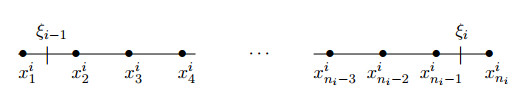
Figure 1.
The mesh.
-
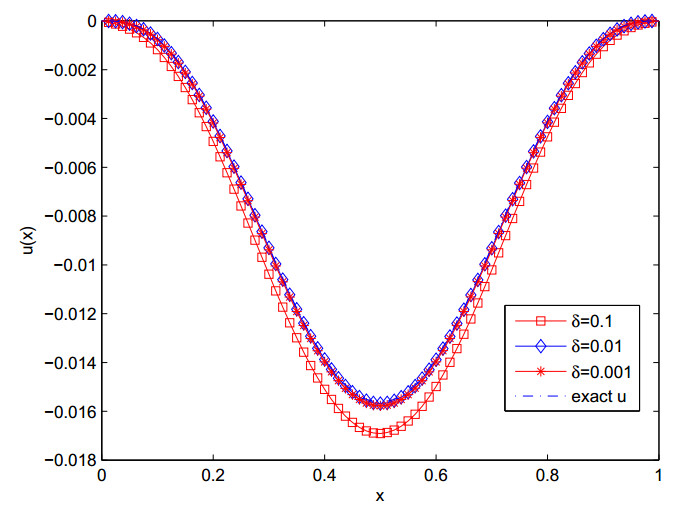
Figure 2.
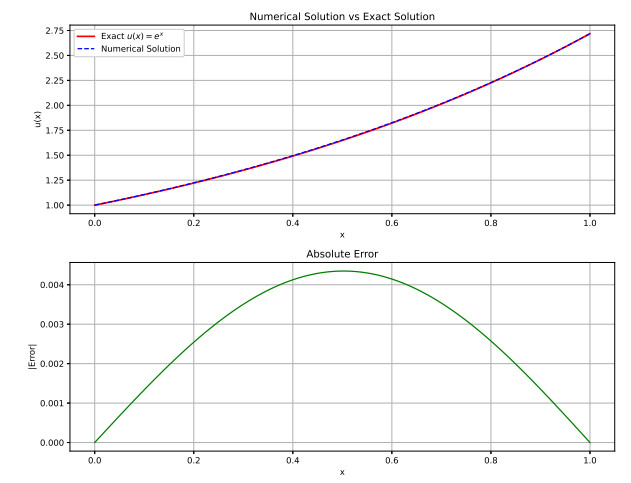
The approximate solutions solved by the FDM scheme for Example 1 when we choose h = 0.025 and ε0 = 10−3 for different values of the relative error of data δ.
-
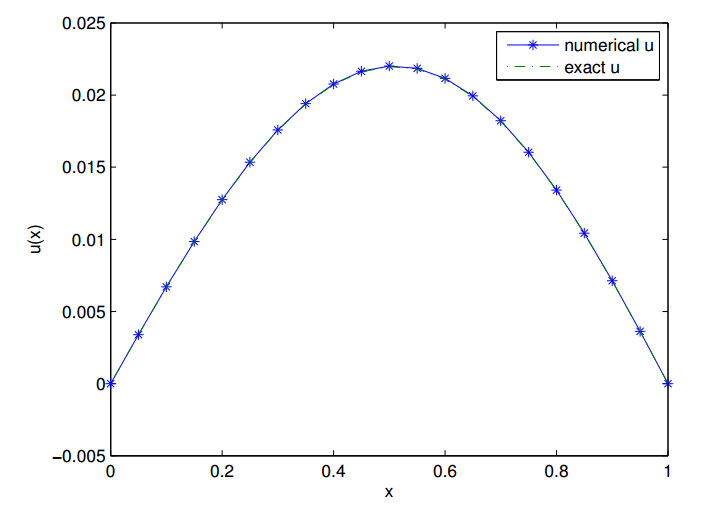
Figure 3.
The approximate solutions solved by the FDM scheme for Example 2 when we choose h = 0.05 and the relative error of data δ = 0.01.
-
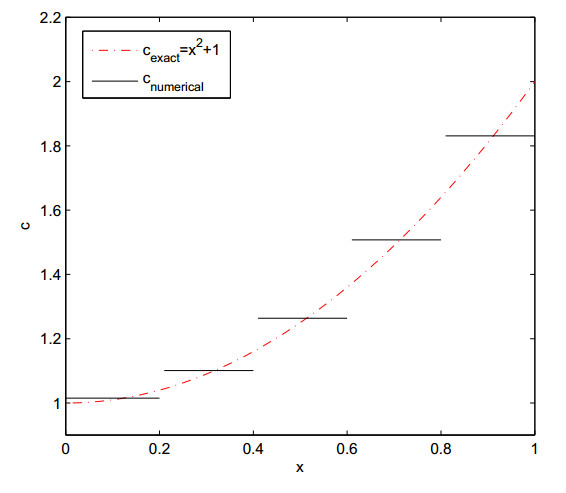
Figure 4.
The approximate solutions solved by the FDM scheme for Example 3 when we choose h = 0.01 in each subinterval and the relative error of data δ = 0.01.
-
Figure 5.
The approximate solutions solved by the FDM scheme for Example 4 when we choose h = 0.01 in each subinterval and the relative error of data δ = 0.01.