

| Citation: |
Zhijun Zeng, Yilin Liu. THRESHOLD DYNAMICS OF A STOCHASTIC SEQIRS MODEL WITH SEMI-MARKOV SWITCHING[J]. Journal of Applied Analysis & Computation, 2027, 17(3): 1677-1695. doi: 10.11948/20250324

|
THRESHOLD DYNAMICS OF A STOCHASTIC SEQIRS MODEL WITH SEMI-MARKOV SWITCHING
-
Abstract
This paper studies the threshold dynamics of a stochastic SEQIRS epidemic model that is subject to two sources of randomness: A white-noise perturbation of the transmission rate and a semi-Markov switching of the environment. The incidence rate has the nonlinear form $ \beta S^{p}f(E) $ with $ p\in\mathbb{N} $, and the sojourn time in each environmental regime is allowed to follow an arbitrary distribution rather than an exponential one. A threshold $ \mathcal{R}_{0}^{s} $ is derived from the stationary distribution of the embedded chain and from the mean sojourn times. The disease dies out almost surely under one of two different extinction mechanisms. The first one combines the threshold requirement $ \mathcal{R}_{0}^{s} < 1 $ with an upper bound on the noise intensity. The second one imposes only a sufficiently large lower bound on the noise intensity and needs no separate threshold assumption, because this lower bound already forces $ \mathcal{R}_{0}^{s} < 1 $. It persists, and the time averages of all five compartments admit positive lower bounds, when $ \mathcal{R}_{0}^{s} > 1 $, the noise intensity lies in a prescribed interval, and (only for $ p\ge2 $) the susceptible class is bounded away from zero for all large times. The threshold tends to the basic reproduction number of the corresponding deterministic system as the noise vanishes, and is never larger than it. Simulations carried out for the Holling type Ⅱ incidence confirm both alternatives. They show in particular that a subsystem with $ \mathcal{R}_{0}^{k} > 1 $ may coexist with extinction of the switched system, so that the sojourn-time distributions cannot be ignored when the fate of an epidemic is assessed.
-

-
References
[1] B. Boukanjime, T. Caraballo, M. El Fatini and M. El Khalifi, Dynamics of a stochastic coronavirus (COVID-19) epidemic model with Markovian switching, Chaos Solitons Fractals, 2020, 141, 110361. doi: 10.1016/j.chaos.2020.110361 [2] L. Boulaasair, H. Bouzahir, R. Sai and M. A. Alaqeel, Analysis of a hybrid SIR epidemic model driven by dual white noises and Markovian switching, Results Phys., 2025, 76, 108385. doi: 10.1016/j.rinp.2025.108385 [3] X. Cao, Semi-Markov decision problems and performance sensitivity analysis, IEEE Trans. Automat. Control, 2003, 48(5), 758–769. doi: 10.1109/TAC.2003.811252 [4] I. I. Gihman and A. V. Skorohod, The Theory of Stochastic Processes, Ⅱ, Springer-Verlag, New York, 1975. [5] A. Lahrouz and L. Omari, Extinction and stationary distribution of a stochastic SIRS epidemic model with non-linear incidence, Stat. Probab. Lett., 2013, 83(4), 960–968. doi: 10.1016/j.spl.2012.12.021 [6] D. Li, J. Cui, M. Liu and S. Q. Liu, The evolutionary dynamics of stochastic epidemic model with nonlinear incidence rate, Bull. Math. Biol., 2015, 77(9), 1705–1743. doi: 10.1007/s11538-015-0101-9 [7] D. Li, S. Q. Liu and J. A. Cui, Threshold dynamics and ergodicity of an SIRS epidemic model with semi-Markov switching, J. Differential Equations, 2019, 266(7), 3973–4017. doi: 10.1016/j.jde.2018.09.026 [8] J. Q. Li and Z. E. Ma, Global analysis of SIS epidemic models with variable total population size, Math. Comput. Modelling, 2004, 39(11–12), 1231–1242. [9] Y. Li, J. R. Chu and X. Y. Liao, On persistence for a stochastic epidemic model with nonlinear incidence, J. Univ. South China (Sci. Technol.), 2023, 37(1), 71–77. [10] N. Limnios and G. Oprisan, Semi-Markov Processes and Reliability, Birkhauser, Boston, 2001. [11] X. Z. Liu and P. Stechlinski, Infectious Disease Modeling: A Hybrid System Approach, Springer, Cham, 2017. [12] M. Mandal, S. Jana, S. K. Nandi, A. Khatua, S. Adak and T. K. Kar, A model based study on the dynamics of COVID-19: Prediction and control, Chaos Solitons Fractals, 2020, 136, 109889. doi: 10.1016/j.chaos.2020.109889 [13] X. Mao, Stability of stochastic differential equations with Markovian switching, Stoch. Process. Appl., 1999, 79(1), 45–67. doi: 10.1016/S0304-4149(98)00070-2 [14] M. A. Bin Masud and M. Ahmed, Optimal control for system of stochastic differential equations with Lévy jumps, Results Control Optim., 2025, 20, 100600. doi: 10.1016/j.rico.2025.100600 [15] T. H. Nguyen, D. H. Nguyen, N. N. Nguyen and T. D. Tuong, Hybrid stochastic SIS epidemic models with vaccination: Stability of the disease-free state and applications, Nonlinear Anal. Hybrid Syst., 2024, 53, 101492. doi: 10.1016/j.nahs.2024.101492 [16] S. Ottaviano, Threshold dynamics of SAIRS epidemic model with semi-Markov switching, Math. Methods Appl. Sci., 2023, 46(9), 10289–10310. doi: 10.1002/mma.9122 [17] M. J. Small and D. J. Morgan, The relationship between a continuous-time renewal model and a discrete Markov chain model of precipitation occurrence, Water Resour. Res., 1986, 22(10), 1422–1430. doi: 10.1029/WR022i010p01422 [18] Q. Q. Sun, D. J. Tan and S. W. Zhang, Epidemic threshold of a COVID-19 model with Gaussian white noise and semi-Markov switching, J. Franklin Inst., 2023, 360(10), 6846–6861. doi: 10.1016/j.jfranklin.2023.04.035 [19] X. Zhang, D. Jiang, A. Alsaedi and T. Hayat, Stationary distribution of stochastic SIS epidemic model with vaccination under regime switching, Appl. Math. Lett., 2016, 59, 87–93. doi: 10.1016/j.aml.2016.03.010 [20] X. Zhao, T. Feng, L. Wang and Z. P. Qiu, Threshold dynamics and sensitivity analysis of a stochastic semi-Markov switched SIRS epidemic model with nonlinear incidence and vaccination, Discrete Contin. Dyn. Syst. Ser. B, 2021, 26(12), 6131–6154. doi: 10.3934/dcdsb.2021010 [21] L. Zu, D. Jiang and D. O'Regan, Conditions for persistence and ergodicity of a stochastic Lotka–Volterra predator-prey model with regime switching, Commun. Nonlinear Sci. Numer. Simul., 2015, 29(1–3), 1–11. -
-
Figures(5)
Export File
Citation
Zhijun Zeng, Yilin Liu. THRESHOLD DYNAMICS OF A STOCHASTIC SEQIRS MODEL WITH SEMI-MARKOV SWITCHING[J]. Journal of Applied Analysis & Computation, 2027, 17(3): 1677-1695. doi: 10.11948/20250324
Format
Content
 DownLoad:
-
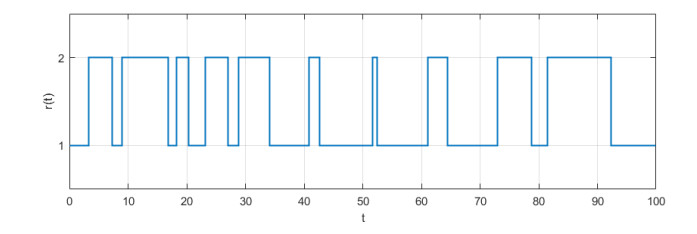
Figure 1.
A sample path of the semi-Markov process
$ \{r(t)\}$ $ \mathcal{M} = \{1, 2\} $ $ \nu_i < 1 $ -
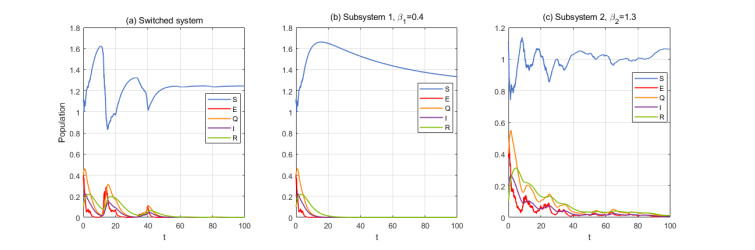
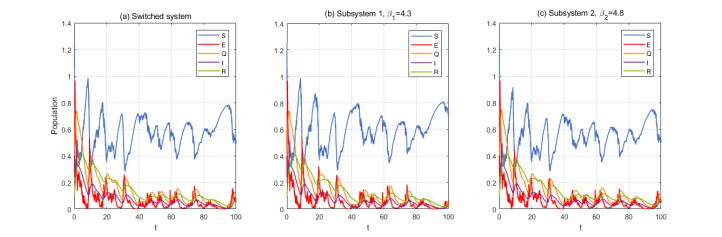
Figure 2.
(a) Sample paths of
$ (S(t), E(t), Q(t), I(t), R(t)) $ -
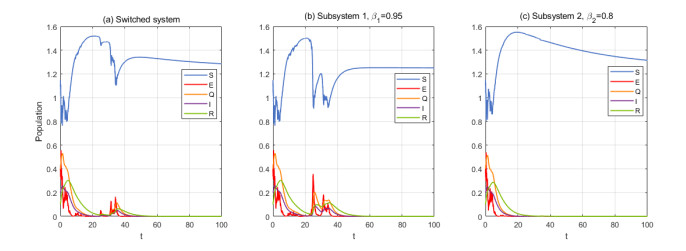
Figure 3.
(a) Sample paths of
$ (S(t), E(t), Q(t), I(t), R(t)) $ -
Figure 4.
(a) Sample paths of
$ (S(t), E(t), Q(t), I(t), R(t)) $ -
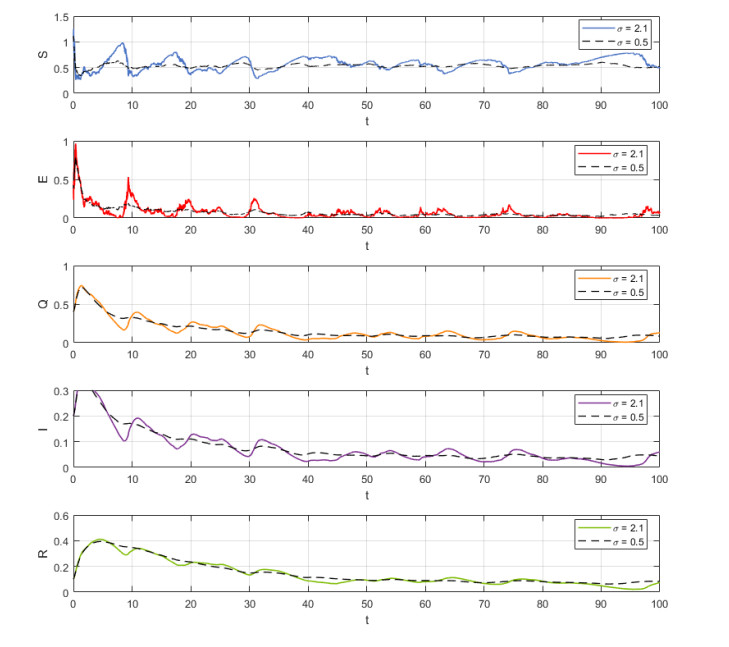
Figure 5.
Simulations of
$ S(t), \, E(t), \, Q(t), \, I(t), \, R(t) $ $ \beta_1 = 4.3 $ $ \beta_2 = 4.8 $ $ \sigma=2.1 $ $ \sigma=0.5 $