

| Citation: |
Yu Shen, Xiangtuan Xiong. A SIMPLIFIED ITERATIVE ALGORITHM WITH RELAXATION FACTOR FOR SOLVING AN ANNULAR INVERSE ELECTROCARDIOGRAPHY PROBLEM[J]. Journal of Applied Analysis & Computation, 2027, 17(2): 1454-1480. doi: 10.11948/20260174

|
A SIMPLIFIED ITERATIVE ALGORITHM WITH RELAXATION FACTOR FOR SOLVING AN ANNULAR INVERSE ELECTROCARDIOGRAPHY PROBLEM
-
Abstract
This paper presents a simplified iterative algorithm with a relaxation factor for solving the Cauchy problem of Laplace equation in an annular domain, with applications to inverse electrocardiography. Building upon the classical Kozlov-Maz’ya iterative framework, we introduce a new simplified iteration algorithm with the relaxation factor to accelerate convergence. Theoretical analysis and numerical experiments demonstrate that the proposed method maintains computational efficiency while significantly improving reconstruction accuracy and numerical stability.
-

-
References
[1] G. Bastay, Iterative methods for ill-posed boundary value problems, 392 of Linköping Studies in Science and Technology, Dissertations, Linköping University, Department of Mathematics, Linköping, 1995. [2] J. Baumeister and A. Leitão, On iterative methods for solving ill-posed problems modeled by partial differential equations, J. Inverse Ill-Posed Probl., 2001, 9(1), 13–29. doi: 10.1515/jiip.2001.9.1.13 [3] F. Berntsson, V. A. Kozlov, L. Mpinganzima and B. O. Turesson, Iterative Tikhonov regularization for the Cauchy problem for the Helmholtz equation, Comput. Math. Appl., 2017, 73(1), 163–172. doi: 10.1016/j.camwa.2016.11.004 [4] Y. G. Chen, F. Yang and Q. Ding, The Landweber iterative regularization method for solving the Cauchy problem of the modified Helmholtz equation, Symmetry, 2022, 14(6), 1209. doi: 10.3390/sym14061209 [5] H. Cheng, P. Zhu and J. Gao, An iterative regularization method to solve the Cauchy problem for the Helmholtz equation, Math. Probl. Eng., 2014, 2014(1), 917972(1–9). [6] H. Diao, X. Fei and H. Liu, On a novel unique continuation principle result and its application to inverse conductive scattering, SIAM J. Math. Anal., 2025, 57(3), 3386–3421. doi: 10.1137/24M1704762 [7] H. Diao, H. Liu and Q. Meng, Dislocations with corners in an elastic body with applications to fault detection, SIAM J. Appl. Math., 2025, 85(5), 2399–2424. doi: 10.1137/24M1710267 [8] H. Diao, H. Liu, Q. Meng and L. Wang, Pattern formations of coupled pdes with transparent boundary conditions in product-type ends and applications, arXiv preprint, 2025. arXiv:2507.14779. [9] R. Gong, M. Wang, Q. Huang and Y. Zhang, A CCBM-based generalized GKB iterative regularization algorithm for inverse Cauchy problems, J. Comput. Appl. Math., 2023,432, 115282. doi: 10.1016/j.cam.2023.115282 [10] M. Haas, T. Grandits, T. Pinetz, et al., Finite element-based space-time total-variation-type regularization of the inverse problem in electrocardiographic imaging, SIAM J. Sci. Comput., 2025, 47(6), B1317–B1342. doi: 10.1137/24M1685055 [11] J. Hadamard, Lectures on Cauchy’s Problem in Linear Partial Differential Equations, Dover Publications, New York, 1953. [12] J. Han, X. Xiong and Y. Shen, The modified Landweber iterative regularization method for a non-characteristic Cauchy problem in multiple dimensions, J. Comput. Appl. Math., 2026,484, 117460. doi: 10.1016/j.cam.2026.117460 [13] D. N. Hào and D. Lesnic, The Cauchy problem for Laplace’s equation via the conjugate gradient method, IMA J. Appl. Math., 2000, 65(2), 199–217. doi: 10.1093/imamat/65.2.199 [14] K. Ito, B. Jin, F. Wang and J. Zou, Iterative direct sampling method for elliptic inverse problems with limited Cauchy data, SIAM J. Imaging Sci., 2025, 18(2), 1284–1313. doi: 10.1137/24M1716756 [15] V. A. Kozlov and V. G. Mazćya, Iterative procedures for solving ill-posed boundary value problems that preserve the differential equations, Algebra i Analiz, 1989, 1(5), 144–170. [16] M. M. Lavrentʹev, V. G. Romanov, S. P. Shishat · skiĭ, Ill-posed problems of mathematical physics and analysis, American Mathematical Society, Providence, RI, 1986. [17] G. Li, X. Xiong, Y. Shen and L. Zhang, Learning two parameters in fractional Tikhonov regularization method via deep neural networks: Application to the inverse problem for the Laplace operator with noisy data, Comput. Math. Appl., 2026,212, 44–61. doi: 10.1016/j.camwa.2026.03.022 [18] Z. Li and X. Xiong, A new iteration algorithm with relaxation factor for the Cauchy problem of time-fractional diffusion equation, J. Appl. Anal. Comput., 2025, 15(5), 2959–2976. [19] Z. Li and X. Xiong, Inverse source problem for the Helmholtz-type equation: A comparison study of Landweber iterative regularization methods, J. Comput. Appl. Math., 2026,486, 117610. doi: 10.1016/j.cam.2026.117610 [20] Y. J. Ma and C. L. Fu, Cauchy problem for the Laplace equation in a radially symmetric hollow cylinder, Bound. Value Probl., 2016, 2016(1), 1–16. doi: 10.1186/s13661-015-0477-3 [21] D. Maxwell, Kozlov-Maz’ya iteration as a form of Landweber iteration, Inverse Probl. Imaging, 2014, 8(2), 537–560. doi: 10.3934/ipi.2014.8.537 [22] F. Mostajeran and S. M. Hosseini, Radial basis function neural network (RBFNN) approximation of Cauchy inverse problems of the Laplace equation, Comput. Math. Appl., 2023,141,129–144. doi: 10.1016/j.camwa.2023.04.026 [23] A. J. Pullan, M. L. Buist and L. K. Cheng, Mathematically modelling the electrical activity of the heart, World Scientific Publishing Co. Pte. Ltd., Hackensack, NJ, 2005. [24] Y. Shen and X. Xiong, Numerical solution and error estimation of Tikhonov regularization method for an annular inverse electrocardiography problem, J. Comput. Appl. Math., 2026,479, 117245. doi: 10.1016/j.cam.2025.117245 [25] J. Sundnes, G. T. Lines, X. Cai, et al., Computing the Electrical Activity in the Heart, Springer-Verlag, Berlin, 2006. [26] A. N. Tikhonov and V. Y. Arsenin, Solutions of Ill-Posed Problems, V. H. Winston & Sons, Washington, DC; John Wiley & Sons, New York-Toronto-London, 1977. [27] T. Wei, Y. G. Chen and J. C. Liu, A variational-type method of fundamental solutions for a Cauchy problem of Laplace’s equation, Appl. Math. Model., 2013, 37(3), 1039–1053. doi: 10.1016/j.apm.2012.03.023 [28] L. Zhang, Z. C. Li, Y. Wei and J. Y. Chiang, Cauchy problems of Laplace’s equation by the methods of fundamental solutions and particular solutions, Eng. Anal. Bound. Elem., 2013, 37(4), 765–780. doi: 10.1016/j.enganabound.2013.01.017 [29] Y. Zhang, Q. He and Z. Fu, A fast Landweber-type iterative regularization method based on Anderson acceleration for nonlinear ill-posed problems, J. Comput. Appl. Math., 2026,483, 117387. doi: 10.1016/j.cam.2026.117387 -
-
Figures(11) / Tables(2)
Export File
Citation
Yu Shen, Xiangtuan Xiong. A SIMPLIFIED ITERATIVE ALGORITHM WITH RELAXATION FACTOR FOR SOLVING AN ANNULAR INVERSE ELECTROCARDIOGRAPHY PROBLEM[J]. Journal of Applied Analysis & Computation, 2027, 17(2): 1454-1480. doi: 10.11948/20260174
Format
Content
 DownLoad:
-
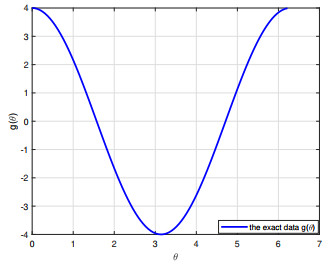
Figure 1.
The input data g(θ) for Example 4.1.
-
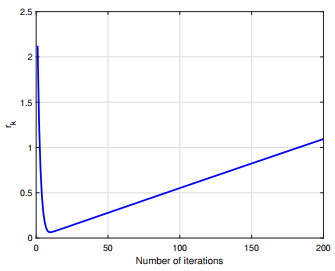
Figure 2.
The convergence error vs number of iterations for Example 4.1.
-
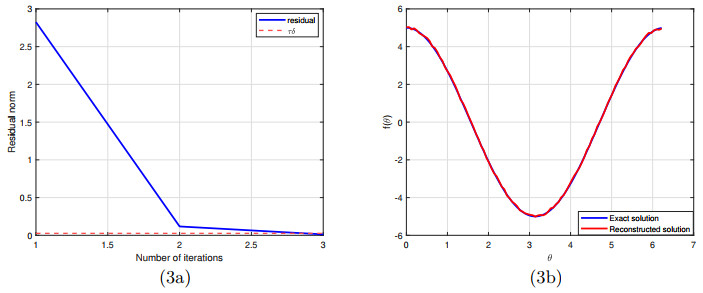
Figure 3.
(3a) The residual norm during the iterative process with ε = 0.01 for Example 4.1; (3b) reconstruction result with ε = 0.01 where RRMSE=0.0131 and iterative step is k = 3 for Example 4.1.
-
Figure 4.
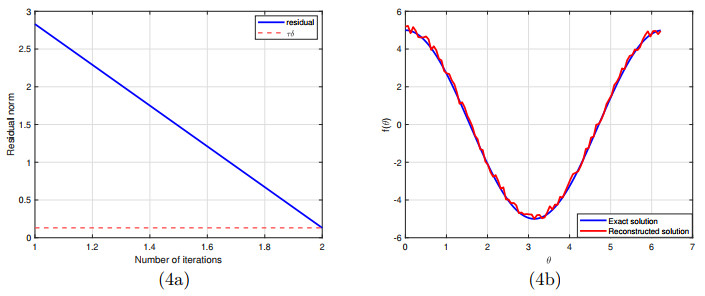
(4a) The residual norm during the iterative process with ε = 0.05 for Example 4.1; (4b) reconstruction result with ε = 0.05 where RRMSE=0.0486 and iterative step is k = 2 for Example 4.1.
-
Figure 5.
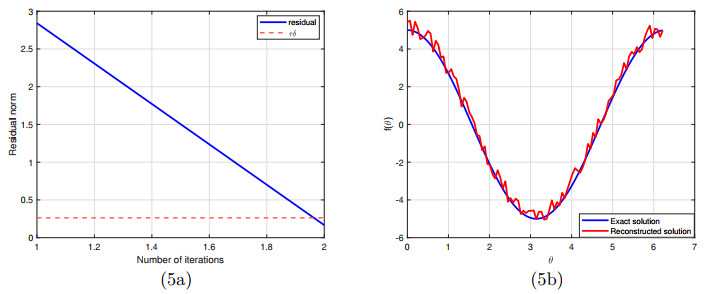
(5a) The convergence error during the iterative process with ε = 0.1 for Example 4.1; (5b) reconstruction result with ε = 0.10 where RRMSE=0.0967 and iterative step is k = 2 for Example 4.1.
-
Figure 6.
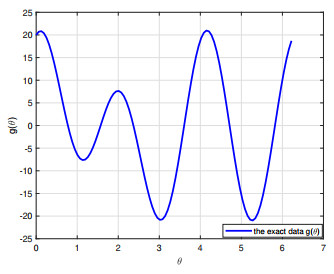
The input data g(θ) for Example 4.2.
-
Figure 7.
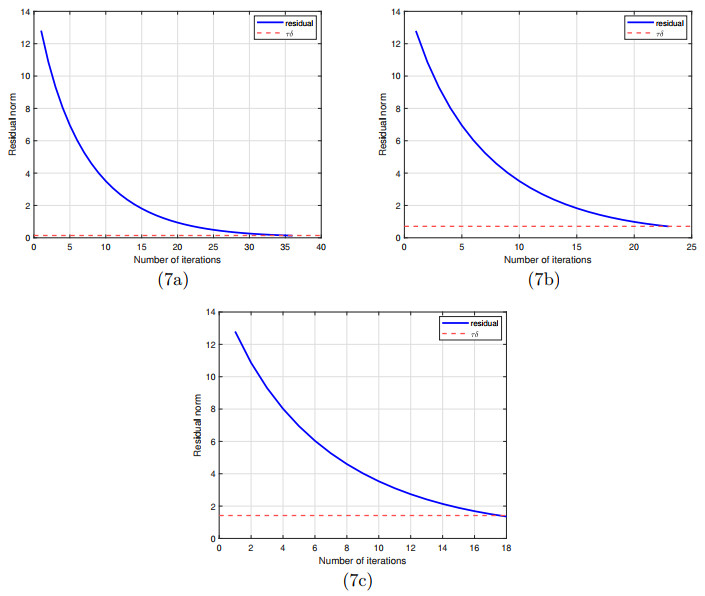
The residual norm during the iterative process for Example 4.2 with relaxation factor c = −0.5 under different noise-amplitude parameters: (7a) ε = 0.01, (7b) ε = 0.05, (7c) ε = 0.10. Stopping iterations: k = 36, 23, 18, respectively.
-
Figure 8.
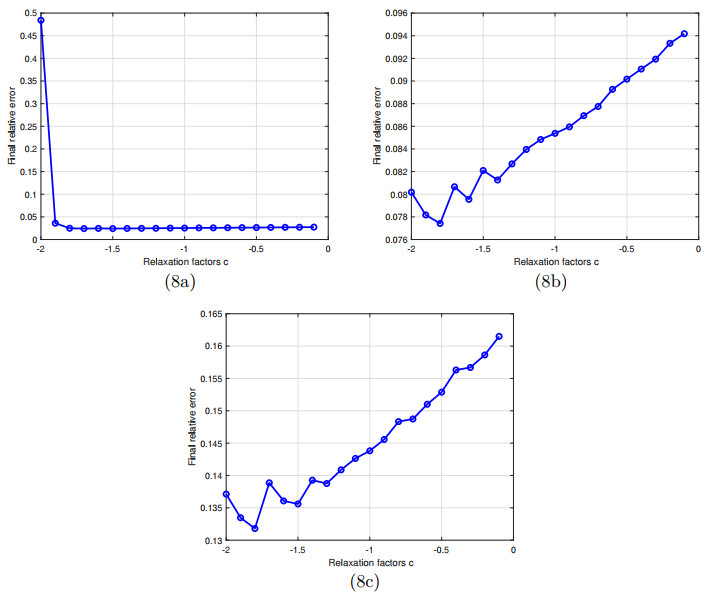
Final relative error (RRMSE) as a function of the relaxation factor c for different noise-amplitude parameters: (8a) ε = 0.01, (8b) ε = 0.05, (8c) ε = 0.10.
-
Figure 9.
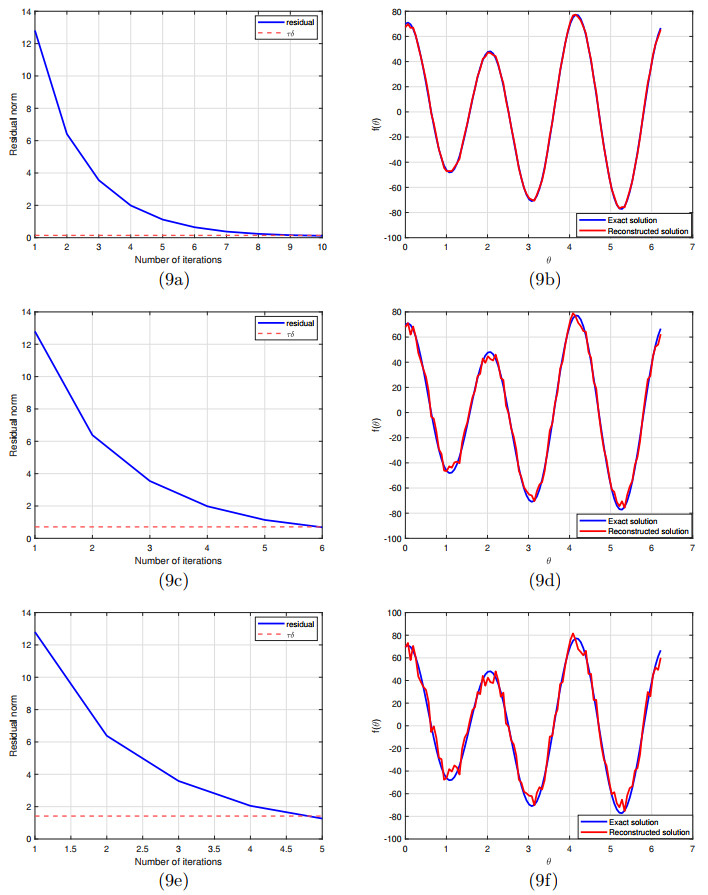
Results for Example 4.2 with relaxation factor c = −1.8. (a,c,e) Convergence error versus iteration number for ε = 0.01, 0.05, 0.10; (b,d,f) corresponding reconstructed epicardial potential distributions at the optimal stopping iterations.
-
Figure 10.
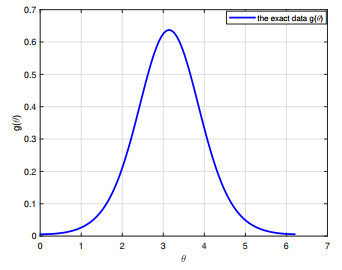
The input data g(θ) for Example 4.3.
-
Figure 11.
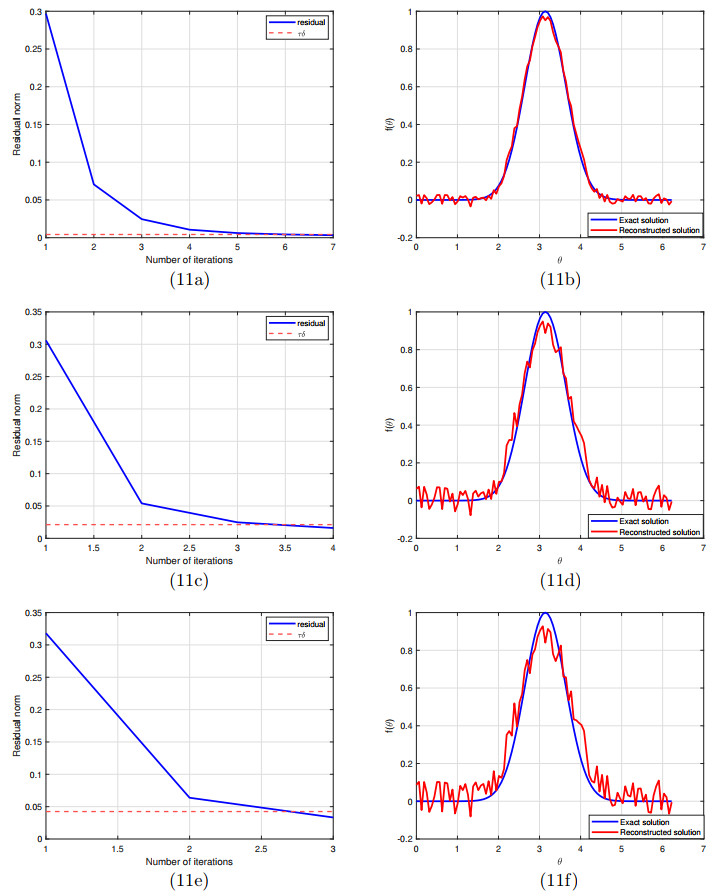
Results for Example 4.3 with relaxation factor c = −1.3. (a,c,e) Convergence error versus iteration number for ε = 0.01, 0.05, 0.10; (b,d,f) corresponding reconstructed epicardial potential distributions at the optimal stopping iterations.