

| Citation: |
Meili Li, Zuolong Li, Junling Ma, Ricardo Fernandes, Manting Wang. NONLINEAR DYNAMICS OF POLITICAL INSTABILITY IN A REDUCED STRUCTURAL-DEMOGRAPHIC MODEL[J]. Journal of Applied Analysis & Computation, 2027, 17(2): 681-705. doi: 10.11948/20260182

|
NONLINEAR DYNAMICS OF POLITICAL INSTABILITY IN A REDUCED STRUCTURAL-DEMOGRAPHIC MODEL
-
Abstract
Political instability often exhibits long-term oscillatory patterns, commonly referred to in Structural-Demographic Theory as secular cycles. Although existing computational approaches, such as the Multi-Path Forecasting framework, can reproduce historical instability trends through high-dimensional simulations, they often lack the analytical tractability needed to clarify the structural mechanisms underlying these oscillations. To address this limitation, we propose a reduced-dimensional continuous-time model consisting of three coupled ordinary differential equations that capture the nonlinear feedback among radicalization, collective violence, and accumulated structural pressure. Using a mean-field approximation for the population reservoir, we derive a minimal dynamical system that preserves the essential structure of the original framework. Stability analysis based on the Routh–Hurwitz criterion shows that equilibrium stability is governed by the rate of exogenous economic decline. We further establish the occurrence of a supercritical Hopf bifurcation, whereby sufficiently severe economic deterioration destabilizes the equilibrium and gives rise to a stable limit cycle representing persistent secular cycles of political violence. Numerical simulations support the analytical results and provide a rigorous mathematical foundation for the endogenous periodicity of social unrest.
-

-
References
[1] R. M. Anderson and R. M. May, Infectious Diseases of Humans: Dynamics and Control, Oxford University Press, Oxford, 1991. [2] S. Ascui Gac, Hypotheses testing for the structural-demographic model for political instability and social unrest, in History & Mathematics: Political, Demographic, and Environmental Dimensions, Uchitel Publishing House, Volgograd, 2024, 166–186. [3] H. Berestycki, N. Rodríguez and L. Ryzhik, Traveling wave solutions in a reaction-diffusion model for criminal activity, Multiscale Modeling & Simulation, 2013, 11(4), 1097–1126. [4] A. Chesler, Environmental displacement and political instability: Evidence from Africa, Journal of Peace Research, 2025, 62(4), 1076–1094. doi: 10.1177/00223433241274979 [5] J. M. Epstein, Modeling civil violence: An agent-based computational approach, Proceedings of the National Academy of Sciences, 2002, 99(3), 7243–7250. [6] L. Bonnasse-Gahot, H. Berestycki, M. -A. Depuiset, et al., Epidemiological modelling of the 2005 French riots: A spreading wave and the role of contagion, Scientific Reports, 2018, 8(1), 107. doi: 10.1038/s41598-017-18093-4 [7] O. M. Georgescu, Commentary on: The 2010 structural-demographic forecast for the 2010–2020 decade: A retrospective assessment by P. Turchin and A. Korotayev, SSRN Electronic Journal, 2023. DOI: 10.2139/ssrn.4391019. [8] O. -M. Georgescu, The structural-demographic theory revisited: An empirical test for industrialized societies, PLOS One, 2023, 18(11), e0287912. doi: 10.1371/journal.pone.0287912 [9] J. A. Goldstone, Revolution and Rebellion in the Early Modern World: Population Change and State Breakdown in England, France, Turkey, and China, 1600–1850, Routledge, London, 2016. [10] C. Gros, Entrenched time delays versus accelerating opinion dynamics: Are advanced democracies inherently unstable?, The European Physical Journal B, 2017, 90(11), 223. doi: 10.1140/epjb/e2017-80341-y [11] J. Guckenheimer and P. Holmes, Nonlinear Oscillations, Dynamical Systems, and Bifurcations of Vector Fields, Springer, New York, 2013. [12] C. Kuehn, Multiple Time Scale Dynamics, Springer, Cham, 2015. [13] C. Lemos, H. Coelho and R. J. Lopes, Agent-based modeling of social conflict, civil violence and revolution: State-of-the-art-review and further prospects, in Proceedings of the 11th European Workshop on Multi-Agent Systems (EUMAS 2013), 1113 of CEUR Workshop Proceedings, CEUR-WS, 2013, 124–138. [14] Y. Lu, Political demography: The political consequences of structural population change, Annual Review of Sociology, 2024, 50, 603–625. doi: 10.1146/annurev-soc-030222-024414 [15] J. E. Marsden and M. McCracken, The Hopf Bifurcation and Its Applications, Springer, New York, 2012. [16] C. C. McCluskey and J. S. Muldowney, Bendixson-Dulac criteria for difference equations, Journal of Dynamics and Differential Equations, 1998, 10(4), 567–575. doi: 10.1023/A:1022677008393 [17] S. Motesharrei, J. Rivas and E. Kalnay, Human and nature dynamics (HANDY): Modeling inequality and use of resources in the collapse or sustainability of societies, Ecological Economics, 2014, 101, 90–102. doi: 10.1016/j.ecolecon.2014.02.014 [18] P. Pirker-Díaz, M. C. Wilson, S. Beier and K. Wiesner, Scaling laws of political regime dynamics: Stability of democracies and autocracies in the twentieth century, Royal Society Open Science, 2025, 12(8), 250457. doi: 10.1098/rsos.250457 [19] L. F. Richardson, Statistics of Deadly Quarrels, Boxwood Press, Pittsburgh, 1960. [20] Seshat: Global History Databank, United States Political Violence Database, Available at https://seshat-db.com/crisisdb/uspvdb/ , 2025. Accessed August 16, 2026.[21] P. Turchin, Historical Dynamics: Why States Rise and Fall, Princeton University Press, Princeton, 2003. [22] P. Turchin, Dynamics of political instability in the United States, 1780–2010, Journal of Peace Research, 2012, 49(4), 577–591. doi: 10.1177/0022343312442078 [23] P. Turchin, Modeling social pressures toward political instability, Cliodynamics: The Journal of Quantitative History and Cultural Evolution, 2013, 4(2), 241–280. [24] P. Turchin and A. Korotayev, The 2010 structural-demographic forecast for the 2010–2020 decade: A retrospective assessment, PLOS ONE, 2020, 15(8), e0237458. doi: 10.1371/journal.pone.0237458 [25] P. Turchin and S. A. Nefedov, Secular Cycles, Princeton University Press, Princeton, 2009. [26] P. Turchin, N. Witoszek, S. Thurner, et al., A history of possible futures: Multipath forecasting of social breakdown, recovery, and resilience, Cliodynamics: The Journal of Quantitative History and Cultural Evolution, 2018, 9(2), 124–139. [27] U.S. Bureau of Labor Statistics, Labor force statistics from the current population survey: Unemployment rate, series LNS14000000, Available at https://data.bls.gov/timeseries/LNS14000000 , 2026. Accessed August 16, 2026. -
-
Figures(3) / Tables(1)
Export File
Citation
Meili Li, Zuolong Li, Junling Ma, Ricardo Fernandes, Manting Wang. NONLINEAR DYNAMICS OF POLITICAL INSTABILITY IN A REDUCED STRUCTURAL-DEMOGRAPHIC MODEL[J]. Journal of Applied Analysis & Computation, 2027, 17(2): 681-705. doi: 10.11948/20260182
Format
Content
 DownLoad:
-
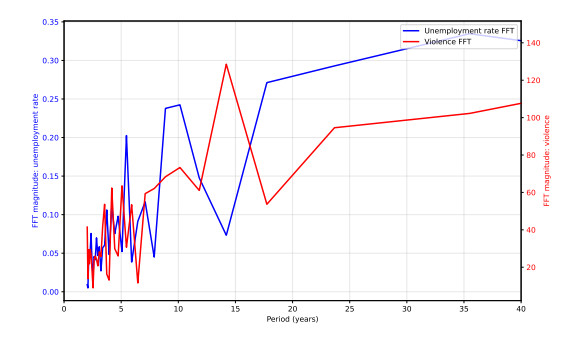
Figure 1.
Spectral amplitude of collective violence and the unemployment rate in the United States over the period 1954-1993 [20,27]. The vertical axis represents the oscillation amplitude obtained from the FFT, while the horizontal axis represents the corresponding cycle period. Oscillations in violence trace those in the unemployment rate, except for a 14-year cycle that appears in the violence data but not in the unemployment data.
-
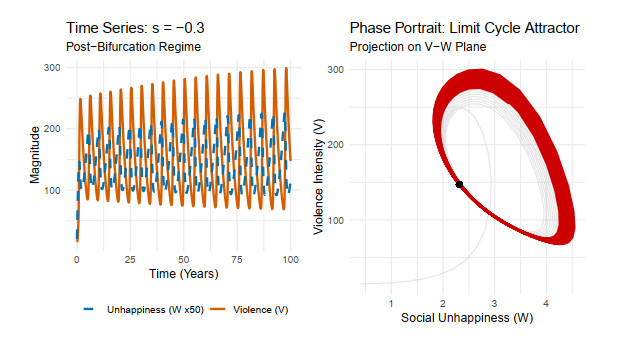
Figure 2.
Numerical simulation of the Hopf bifurcation for
$ s=-0.3 $ $ (W, V) $ -
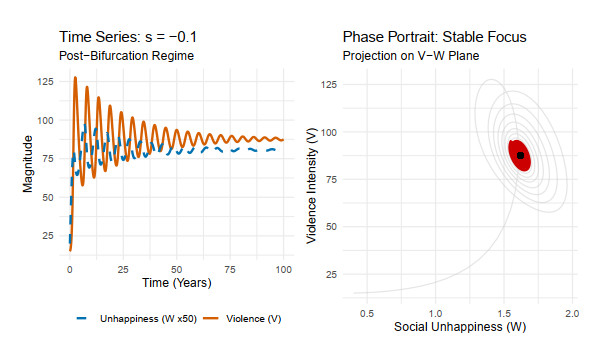
Figure 3.
Numerical simulation for
$ s=-0.1 $ $ (W, V) $ $ E^* $