

| Citation: |
Shaher Momani, Rabha W. Ibrahim. A $ (Q,\tau)$-FRACTIONAL AGING MODEL WITH MEMORY EFFECTS AND ADAPTIVE HEALING DYNAMICS[J]. Journal of Applied Analysis & Computation, 2026, 16(3): 1621-1642. doi: 10.11948/20250185

|
A $ (Q,\tau)$-FRACTIONAL AGING MODEL WITH MEMORY EFFECTS AND ADAPTIVE HEALING DYNAMICS
-
Abstract
We propose a novel $(q, \tau)$-fractional aging model that incorporates memory-dependent physiological decay and healing dynamics through a deformable time structure. The model generalizes classical aging laws by introducing a tunable fractional order $ \alpha $ and deformation parameters $ q $ and $ \tau $, which control the depth and scale of biological memory. External interventions, modeled as healing inputs, are integrated via generalized Mittag-Leffler kernels to capture both cumulative and periodic therapeutic effects. Simulation results demonstrate that composite healing strategies significantly delay decline and improve physiological resilience. Parameter sensitivity analysis reveals that the model flexibly adapts to different aging profiles by adjusting memory and deformation parameters. Using synthetic data, we validate the model's fitting accuracy through numerical optimization, achieving high fidelity with low residual error. The key advantage of the $(q, \tau)$-fractional approach lies in its ability to encode long-term memory effects and nonuniform biological time flow, enabling realistic modeling of aging phenomena beyond exponential decay. The framework is robust under noisy conditions and extensible to data-driven calibration, making it a powerful tool for biomedical aging analysis, intervention design, and longitudinal health forecasting.
-

-
References
[1] A. Abdullah, G. M. Rutten, L. B. Verdijk and M. Demaria, Sport and longevity: An observational study of international athletes, GeroScience, 2024, 1–13. [2] I. Aldawish and R. W. Ibrahim, A new mathematical model of multi-faced COVID-19 formulated by fractional derivative chains, Advances in Continuous and Discrete Models, 2022, 2022(1), 6. doi: 10.1186/s13662-022-03677-w [3] I. Aldawish and R. W. Ibrahim, Distributed-order (q, $\tau$)-deformed Lévy processes and their spectral properties, Frontiers in Physics, 2025, 1647182. $\tau$)-deformed Lévy processes and their spectral properties" target="_blank">Google Scholar
[4] B. Angela, M. Zingales, O. Bursi and L. Deseri, A fractional-order model for aging materials: An application to concrete, Int. J. Solids and Struc., 2018, 138, 13–23. doi: 10.1016/j.ijsolstr.2017.12.024 [5] S. Enas and R. M. El Zafarani, Taylor theory in quantum calculus: A general approach, Quaestiones Math., 2025, 48(3), 377–394. doi: 10.2989/16073606.2024.2396517 [6] S. Hadid and R. W. Ibrahim, Fractional dynamic system simulating the growth of microbe, Adv. Diff. Eq., 2021, 1, 351. [7] S. Hadiseh, M. Zare Kamali, A. Shirazi, M. Khalighi, G. Jafari and M. Ausloos, Fractional dynamics of network growth constrained by aging node interactions, PLOS, 2016, 1(5), e0154983. [8] R. W. Ibrahim, Differential operator associated with the (q, k)-symbol Raina's function, Math. Anal., Diff. Equ. Appl., 2024, 2024, 321–342. [9] R. W. Ibrahim, D. Altulea and R. M. Elobaid, Dynamical system of the growth of COVID-19 with controller, Adv. Diff. Eq., 2021, 1–12. [10] F. H. Jackson, XI. —On q-functions and a certain difference operator, Earth and Environmental Science Transactions of the Royal Society of Edinburgh, 1909, 46(2), 253–281. [11] V. G. Kac and P. Cheung, Quantum Calculus, Vol. 113. New York: Springer, 2002. [12] S. Momani and R. W. Ibrahim, Soliton propagation in optical metamaterials with nonlocal responses: A fractional calculus approach using (q, $\tau$)-Mittag-Leffler functions, Partial Diff. Eq. App. Math., 2025, 101305. $\tau$)-Mittag-Leffler functions" target="_blank">Google Scholar
[13] S. Momani and R. W. Ibrahim, Stability and entropy production in fractional bio-heat transport models via generalized (q, $\tau$)-entropy, Frontiers in Appl. Math. Stat., 2025, 1643121. [14] S. Momani and R. W. Ibrahim, On the mathematical analysis of generalized Quantum-Nabla fractional fluid models with dissipative nonlinearities, Contem. Mathem., 2025, 7181–7213. [15] A. Al-Shamayleh and R. W. Ibrahim, Grapevine disease detection using (q, $\tau$)-Nabla calculus quantum deformation with deep learning features, MethodsX, (2025), 103619. [16] A. M. Shoaib, K. Abodayeh and Y. Nawaz, A finite difference explicit-implicit scheme for fractal heat and mass transportation of Williamson nanofluid flow in quantum calculus, Num. Heat Trans., Part A: Applications, 2025, 86(12), 4038–4060. doi: 10.1080/10407782.2024.2308753 [17] E. Thomas, A Comprehensive Treatment of q-Calculus, Springer Science & Business Media, 2012. [18] L. Villanueva, J. Antonio, P. R. Iturriaga and S. Rodriguez-Bolivar, A fractional-order model for calendar aging with dynamic storage conditions, J. Ener. Stor., 2022, 50, 104537. doi: 10.1016/j.est.2022.104537 -
-
Figures(11) / Tables(6)
Export File
Citation
Shaher Momani, Rabha W. Ibrahim. A $ (Q,\tau)$-FRACTIONAL AGING MODEL WITH MEMORY EFFECTS AND ADAPTIVE HEALING DYNAMICS[J]. Journal of Applied Analysis & Computation, 2026, 16(3): 1621-1642. doi: 10.11948/20250185
Format
Content
 DownLoad:
-
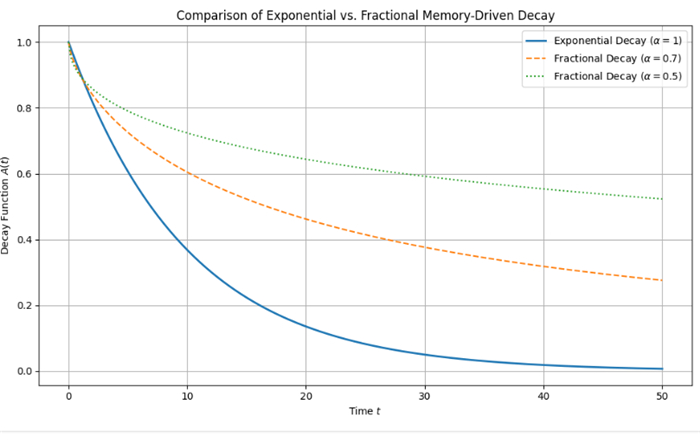
Figure 1.
Comparison of exponential decay (
$ \alpha = 1 $ $ \alpha = 0.7 $ $ \alpha = 0.5 $ -
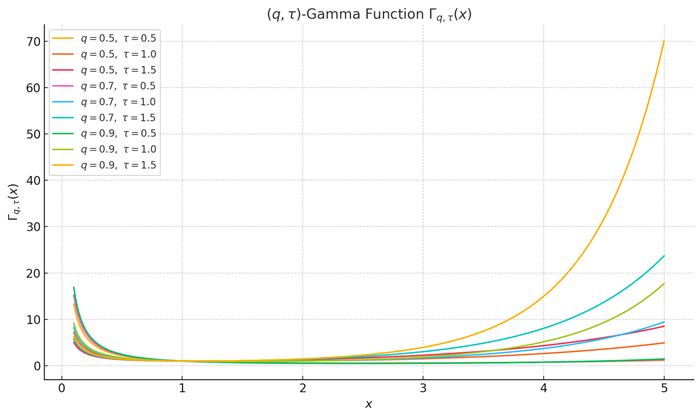
Figure 2.
Plot of the
$(q, \tau)$ $\Gamma_{q, \tau}(x)$ $q \in \{0.5, 0.7, 0.9\}$ $\tau \in \{0.5, 1.0, 1.5\}$ $q \to 1^-$ $\tau \to 1$ $q$ $\tau$ -
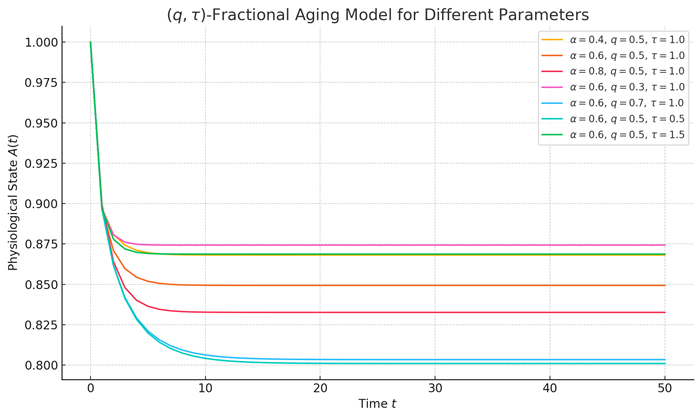
Figure 3.
Decay of physiological state
$ A(t) $ $(q, \tau, \alpha)$ $ \alpha $ $ q $ $ \tau $ -
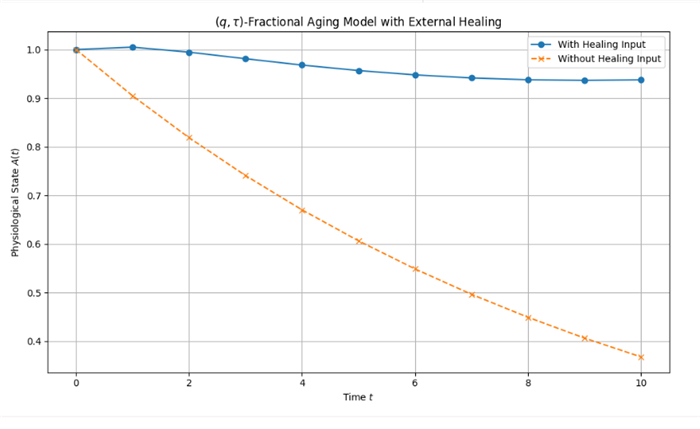
Figure 4.
Comparison of aging trajectories with and without external healing term
$ f(t) = 0.3 e^{-0.05 t} $ -
Figure 5.
Comparison of
$(q, \tau)$ -
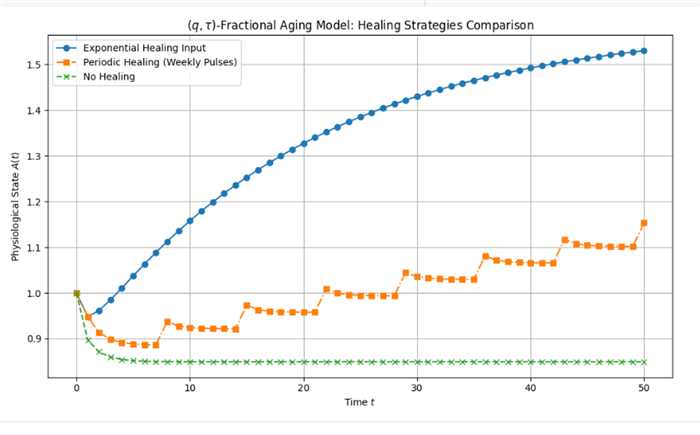
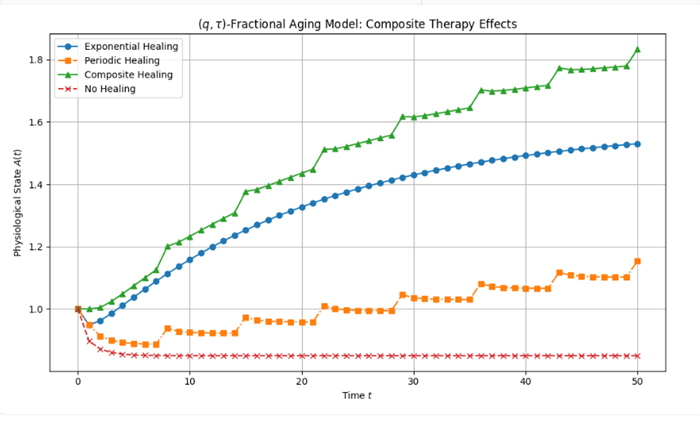
Figure 6.
Simulated trajectories of physiological state
$ A(t) $ -
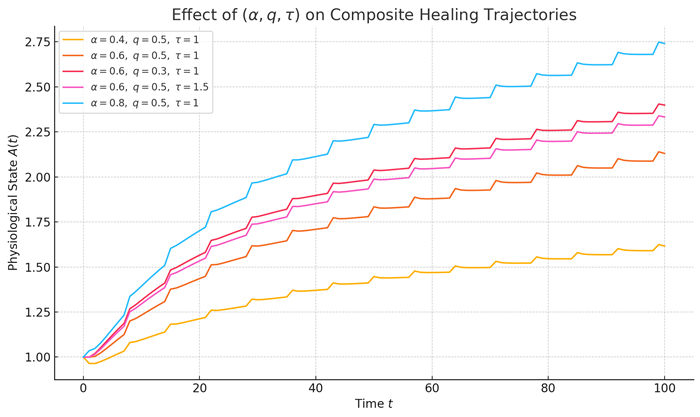
Figure 7.
Time evolution of physiological state
$ A(t) $ $(\alpha, q, \tau)$ $\alpha$ $ q, \tau $ -
Figure 8.
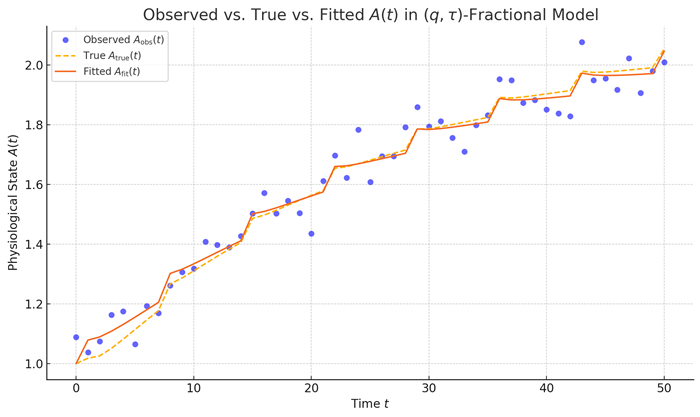
Comparison of observed (blue dots), true (dashed), and fitted (solid) physiological state
$ A(t) $ $(q, \tau)$ -
Figure 9.
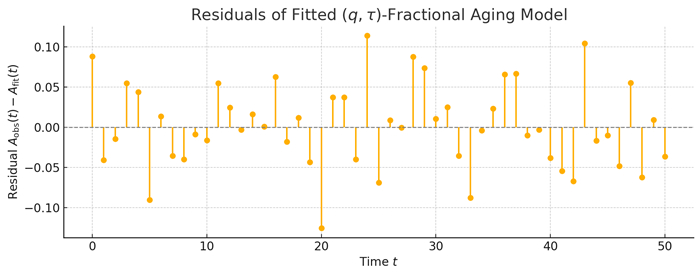
Residuals of the fitted
$(q, \tau)$ $ A_{\mathrm{obs}}(t) - A_{\mathrm{fit}}(t) $ -
Figure 10.
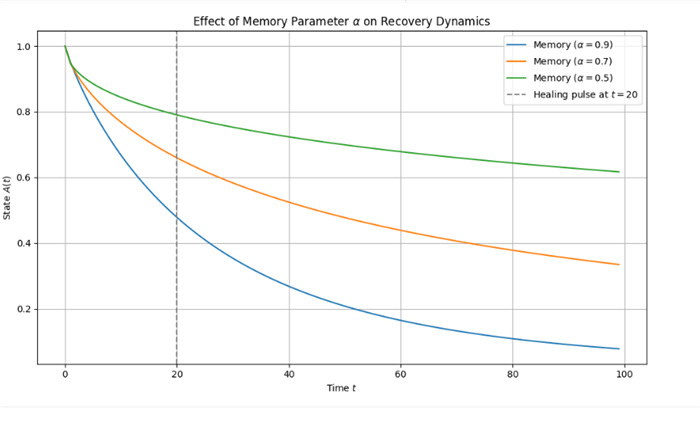
Simulation of recovery dynamics under different memory parameters
$ \alpha $ $ t = 20 $ $ \alpha = 0.5 $ $ \alpha = 0.9 $ -
Figure 11.
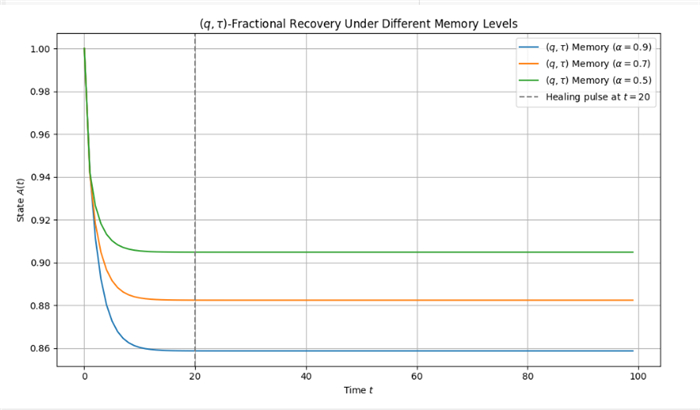
Recovery dynamics under the
$(q, \tau)$ $ t = 20 $ $ \alpha \in \{0.9, 0.7, 0.5\} $ $ q = 0.7 $ $ \tau = 1.2 $ $ \alpha $