

| Citation: |
Ahmed Ramady, Hamdy M. Ahmed, Khadiga A. Ismail, Wafaa B. Rabie. EXPLORING SOLITON FAMILIES IN $ \beta $ FRACTIONAL COUPLED NLSES WITH VARIABLE COEFFICIENTS USING IMPROVED MODIFIED EXTENDED TANH-FUNCTION METHOD[J]. Journal of Applied Analysis & Computation, 2026, 16(5): 2264-2286. doi: 10.11948/20250191

|
EXPLORING SOLITON FAMILIES IN $ \beta $ FRACTIONAL COUPLED NLSES WITH VARIABLE COEFFICIENTS USING IMPROVED MODIFIED EXTENDED TANH-FUNCTION METHOD
-
Abstract
This research presents a groundbreaking analytical investigation of optical soliton dynamics within the framework of variable-coefficient coupled higher-order nonlinear Schrödinger equation (NLSE) incorporating $ \beta $-fractional derivatives. The study introduces a novel application of the improved modified extended tanh-function (IMETF) method to derive exact analytical solutions that capture the complex interplay between fractional derivatives, variable coefficients, and higher-order nonlinear effects. Our methodology enables the systematic transformation of the intricate fractional NLSE system into mathematically tractable forms, yielding an unprecedented spectrum of soliton solutions including bright, dark, singular, periodic, Jacobi elliptic, rational, and hyperbolic wave structures. The incorporation of $ \beta $-fractional derivatives introduces fundamentally new propagation characteristics and non-local effects that significantly enhance soliton controllability and stability. Through comprehensive numerical simulations and graphical analysis, we demonstrate how fractional-order parameters and variable coefficients collectively govern soliton dynamics, enabling precise manipulation of wave properties in inhomogeneous media. This work makes substantial contributions to both theoretical and applied nonlinear optics by establishing a robust analytical framework for solving complex fractional NLSE systems, revealing novel soliton behaviors with enhanced stability properties, and providing practical insights for advanced applications in optical communications, photonic device engineering, and nonlinear wave control technologies. The results demonstrate the IMETF method's exceptional capability in addressing challenging nonlinear wave phenomena while opening new avenues for soliton manipulation in fractional-order systems with variable parameters.
-

-
References
[1] E. H. Abdullah, H. M. Ahmed, A. A. Zaghrout, A. I. A. Bahnasy and W. B. Rabie, Effect of higher order on constructing the soliton waves to generalized nonlinear Schrödinger equation using improved modified extended tanh function method, J. Optics, 2024, 1–11. [2] E. H. Abdullah, H. M. Ahmed, A. A. Zaghrout, A. I. A. Bahnasy and W. B. Rabie, Dynamical structures of optical solitons for highly dispersive perturbed NLSE with $\beta$-fractional derivatives and a sextic power-law refractive index using a novel approach, Arabian J. Math., 2024, 1–14. [3] M. A. Akbar, F. A. Abdullah, M. T. Islam, M. A. Al Sharif and M. S. Osman, New solutions of the soliton type of shallow water waves and superconductivity models, Results Phys., 2023, 44, 106180. doi: 10.1016/j.rinp.2022.106180 [4] N. Alessa, H. U. Rehman, S. Muneer and I. Iqbal, Optical engineering perspectives on fractional analysis: A comprehensive study of the conformable Gross–Pitaevskii equation in the Bose–Einstein condensation, Mod. Phys. Lett. B, 2025, 39(13), 2450491. doi: 10.1142/S0217984924504918 [5] M. H. Ali, H. M. El-Owaidy, H. M. Ahmed, A. A. El-Deeb and I. Samir, Optical solitons and complexitons for generalized Schrödinger–Hirota model by the modified extended direct algebraic method, Opt. Quantum Electron., 2023, 55(8), 675. doi: 10.1007/s11082-023-04962-y [6] G. Arora, R. Rani and H. Emadifar, Soliton: A dispersion-less solution with existence and its types, Heliyon, 2022, 8(12), 1–12. [7] S. Boscolo, J. M. Dudley and C. Finot, Solitons and coherent structures in optics: 50th anniversary of the prediction of optical solitons in fiber, Opt. Commun., 2024, 131107. [8] D. Chou, S. M. Boulaaras, H. U. Rehman, I. Iqbal and K. Khushi, Fractional nonlinear doubly dispersive equations: Insights into wave propagation and chaotic behavior, Alexandria Eng. J., 2025,114,507–525. doi: 10.1016/j.aej.2024.11.097 [9] D. Chou, I. Iqbal, A. F. Aljohani, S. Althobaiti and H. U. Rehman, Exploring novel analytical methods for solving the heisenberg ferromagnetic-type fractional Akbota equation: Comparative graphical analysis, Fractals, 2025, 33(8), 1–14. [10] D. Chou, I. Iqbal, H. U. Rehman, O. H. Khalil and M. S. Osman, Heat conduction dynamics: A study of lie symmetry, solitons, and modulation instability, Rend. Lincei - Sci. Fis. Nat., 2025, 36(1), 315–336. doi: 10.1007/s12210-025-01302-y [11] J. M. Escorcia and E. Suazo, On blow-up and explicit soliton solutions for coupled variable coefficient nonlinear Schrödinger equations, Mathematics, 2024, 12(17), 2694. doi: 10.3390/math12172694 [12] O. González-Gaxiola, Y. Yildirim, L. Hussein and A. Biswas, Quiescent pure-quartic optical solitons with Kerr and non-local combo self-phase modulation by Laplace-Adomian decomposition, J. Optics, 2024, 1–10. [13] A. Hasegawa, Soliton-based optical communications: An overview, IEEE J. Sel. Top. Quantum Electron., 2002, 6(6), 1161–1172. [14] A. Hasegawa, New trends in optical soliton transmission systems: Proceedings of the symposium held in Kyoto, Japan, Springer Science & Business Media, 2012, 5, 18–21. [15] A. Hasegawa, Optical soliton: Review of its discovery and applications in ultra-high-speed communications, Front. Phys., 2022, 10, 1044845. doi: 10.3389/fphy.2022.1044845 [16] M. F. Ismail, H. M. Ahmed and W. B. Rabie, Construction of exact wave solutions for coupled thermoelasticity theory with temperature dependence using improved modified extended tanh-function method, Contin. Mech. Thermodyn., 2025, 37(5), 77. doi: 10.1007/s00161-025-01408-6 [17] A. J. A. M. Jawad, Y. Yildirim, A. Biswas and A. S. Alshomrani, Optical solitons for the dispersive concatenation model with polarization mode dispersion by Sardar's sub-equation approach, Contemp. Math., 2024, 1966–1989. [18] L. Kaur and A. M. Wazwaz, Bright–dark optical solitons for the Schrödinger-Hirota equation with variable coefficients, Optik, 2019,179,479–484. doi: 10.1016/j.ijleo.2018.09.035 [19] A. Khalid, I. Haq, A. Rehan and M. S. Osman, Developing and applying cubic spline method for the solution of boundary value problems in complex physical and engineering systems, Partial Differ. Equ. Appl. Math., 2025, 101224. [20] X. Liu, Q. Zhou, A. Biswas, A. K. Alzahrani and W. Liu, The similarities and differences of different plane solitons controlled by (3+1)–dimensional coupled variable coefficient system, J. Adv. Res., 2020, 24,167–173. doi: 10.1016/j.jare.2020.04.003 [21] A. I. Maimistov, Solitons in nonlinear optics, Quantum Electron., 2010, 40(9), 756. doi: 10.1070/QE2010v040n09ABEH014396 [22] N. Nasreen, A. R. Seadawy, D. Lu and M. Arshad, Optical fibers to model pulses of ultrashort via generalized third-order nonlinear Schrödinger equation by using extended and modified rational expansion method, J. Nonlinear Opt. Phys. Mater., 2024, 33(4), 2350058. doi: 10.1142/S0218863523500583 [23] K. S. Nisar, A. Ciancio, K. K. Ali, M. S. Osman, C. Cattani, D. Baleanu, A. Zafar, M. Raheel and M. Azeem, On beta-time fractional biological population model with abundant solitary wave structures, Alexandria Eng. J., 2022, 61(3), 1996–2008. doi: 10.1016/j.aej.2021.06.106 [24] W. B. Rabie and H. M. Ahmed, Cubic-quartic solitons perturbation with couplers in optical metamaterials having triple-power law nonlinearity using extended F-expansion method, Optik, 2022,262, 169255. doi: 10.1016/j.ijleo.2022.169255 [25] W. B. Rabie, H. M. Ahmed, M. Mirzazadeh, M. S. Hashemi and M. Bayram, Retrieval solitons and other wave solutions to Kudryashov's equation with generalized anti-cubic nonlinearity and local fractional derivative using an efficient technique, J. Optics, 2024, 1–9. [26] H. U. Rehman, S. M. Boulaaras, M. A. El-Rahman, M. Umair Shahzad and D. Chou, Exploring fluid behavior with space-time fractional-coupled Boussinesq equation, Fractals, 2025, 33(4), 2540090. doi: 10.1142/S0218348X25400900 [27] M. S. Saleem, S. Ahmad, Y. Alrashedi, T. Alrashdi and H. U. Rehman, Fractional optical solitons in the coupled fokas system: White noise effects and sensitivity analysis, Int. J. Mod. Phys. B, 2025, 39(25), 2550238. doi: 10.1142/S0217979225502388 [28] S. Sarker, G. S. Said, M. M. Tharwat, R. Karim, M. A. Akbar, N. S. Elazab, M. S. Osman and P. Dey, Soliton solutions to a wave equation using the $(\phi.\prime/\phi)$–expansion method, Partial Differ. Equ. Appl. Math., 2023, 8, 100587. doi: 10.1016/j.padiff.2023.100587 CrossRef $(\phi.\prime/\phi)$–expansion method" target="_blank">Google Scholar
[29] M. F. Shehab, H. M. Ahmed, S. Boulaaras, M. S. Osman and K. K. Ahmed, Analyzing the impact of white noise on optical solitons and various wave solutions in the stochastic fourth-order nonlinear Schrödinger equation, Alexandria Eng. J., 2025,127, 1049–1063. doi: 10.1016/j.aej.2025.06.040 [30] S. Tarla, K. K. Ali, T. C. Sun, R. Yilmazer and M. S. Osman, Nonlinear pulse propagation for novel optical solitons modeled by Fokas system in monomode optical fibers, Results Phys., 2022, 36, 105381. doi: 10.1016/j.rinp.2022.105381 [31] H. Yi, X. Li, J. Zhang, X. Zhang and G. Ma, Effective regulation of the interaction process among three optical solitons, Chin. Phys. B, 2024, 33(10), 100502. doi: 10.1088/1674-1056/ad6b87 [32] U. Younas, J. Ren and M. Bilal, Dynamics of optical pulses in fiber optics, Mod. Phys. Lett. B, 2022, 36(5), 2150582. doi: 10.1142/S0217984921505825 -
-
Figures(4)

Export File
Citation
Ahmed Ramady, Hamdy M. Ahmed, Khadiga A. Ismail, Wafaa B. Rabie. EXPLORING SOLITON FAMILIES IN $ \beta $ FRACTIONAL COUPLED NLSES WITH VARIABLE COEFFICIENTS USING IMPROVED MODIFIED EXTENDED TANH-FUNCTION METHOD[J]. Journal of Applied Analysis & Computation, 2026, 16(5): 2264-2286. doi: 10.11948/20250191
Format
Content
 DownLoad:
-
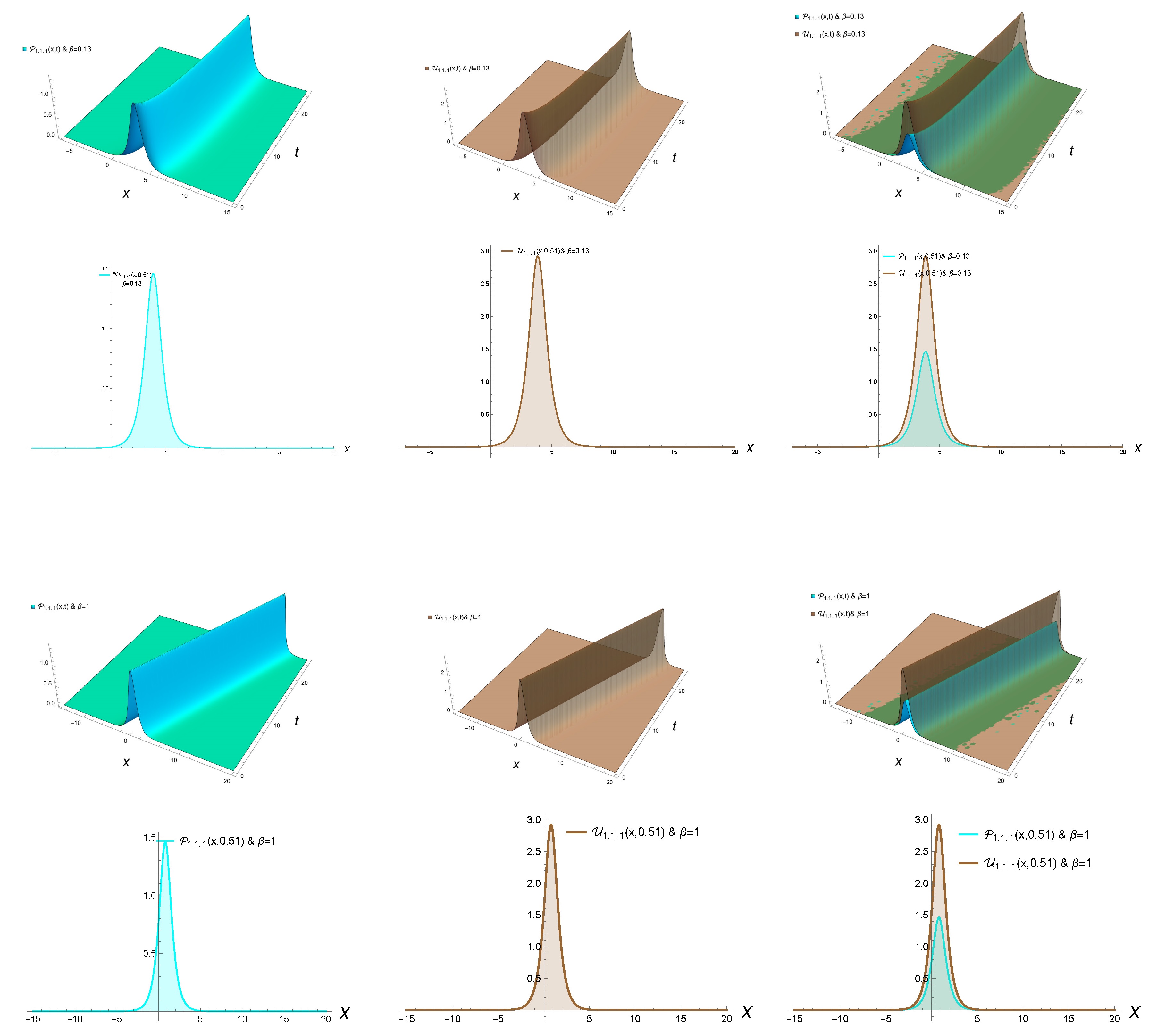
Figure 1.
Diagrams in both two and three dimensions illustrate the bright soliton solutions obtained from Eqs. (3.11) and (3.12).
-
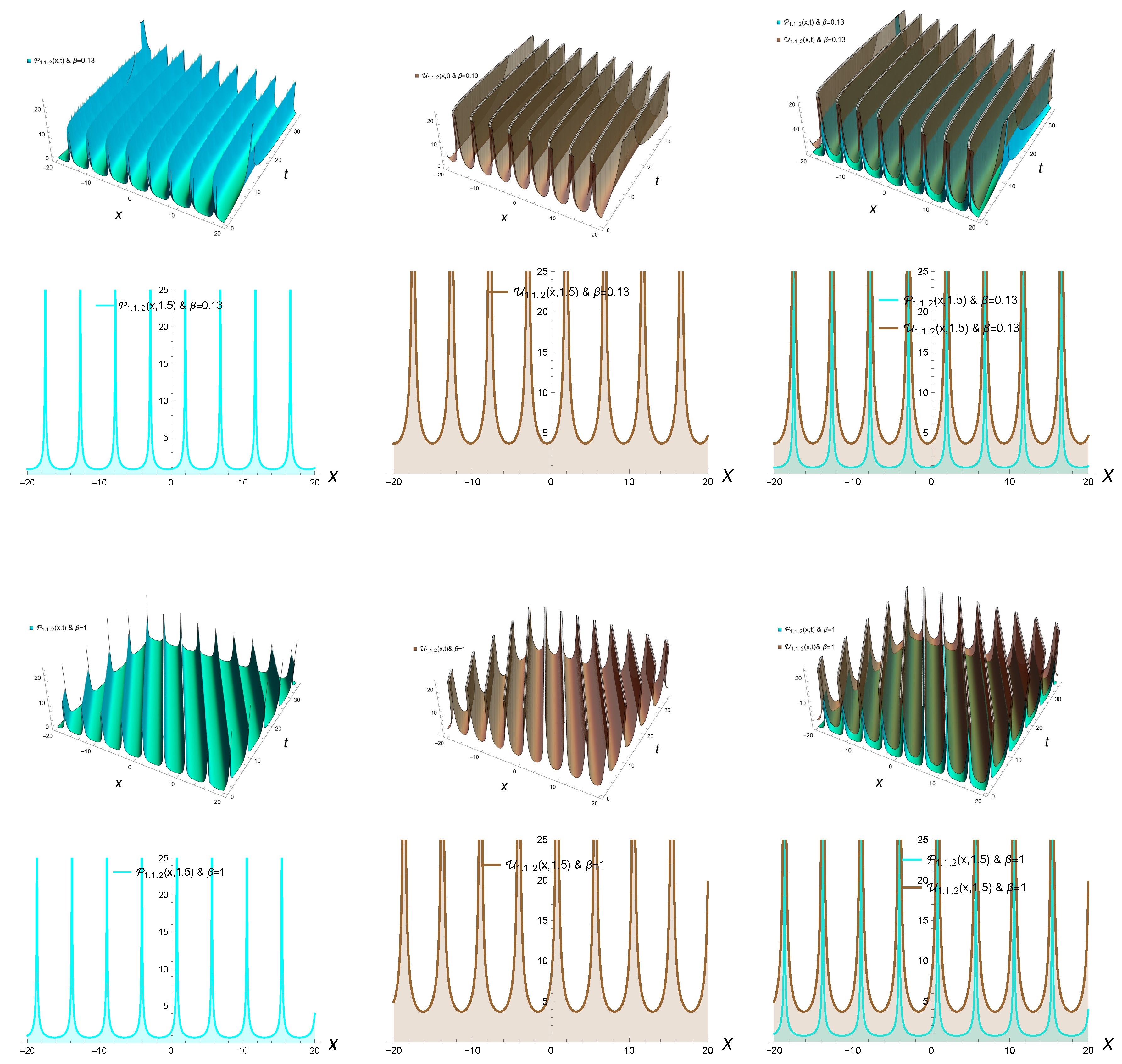
Figure 2.
Diagrams in both two and three dimensions illustrate the singular periodic solutions obtained from Eqs. (3.13) and (3.14).
-
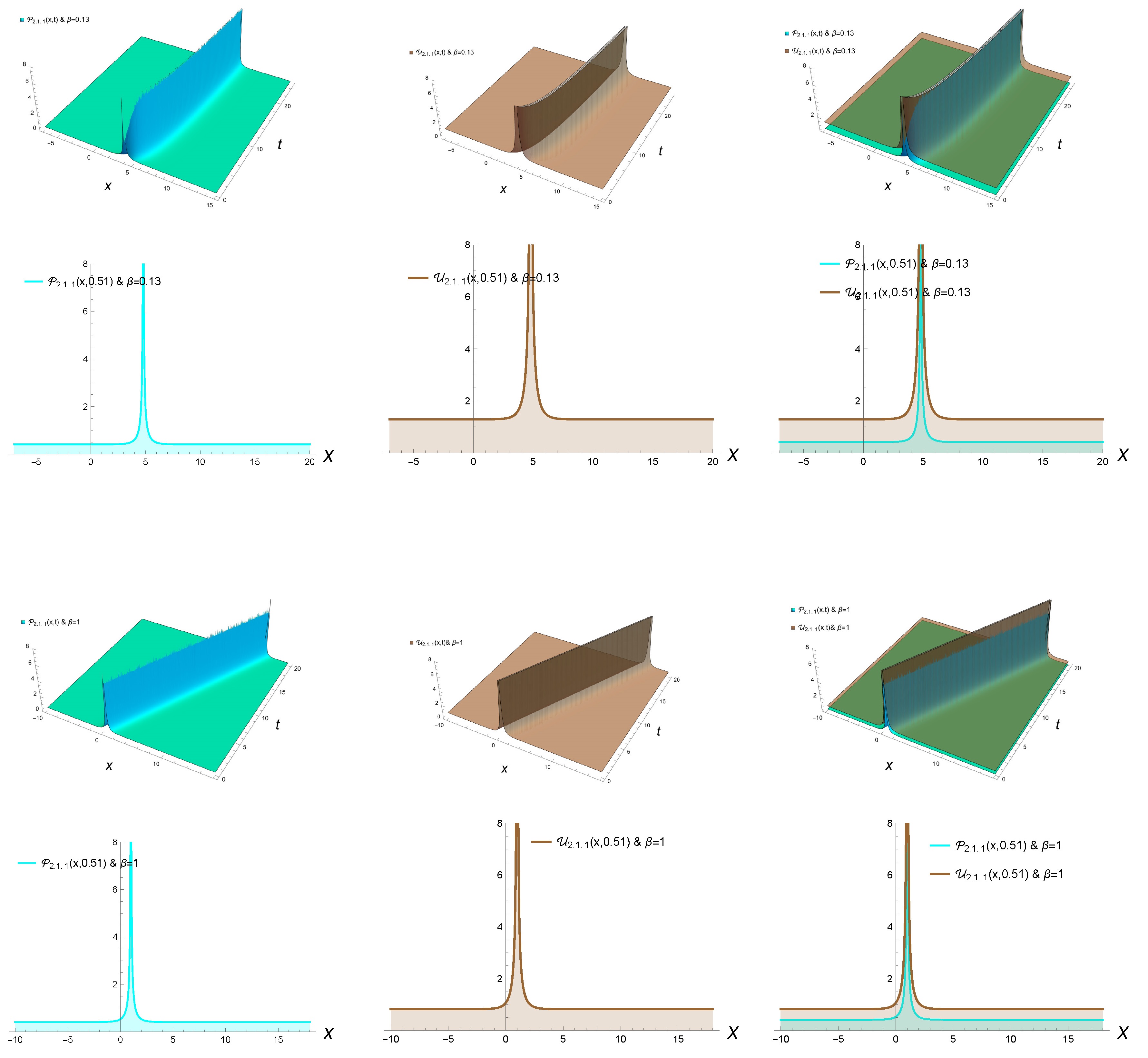
Figure 3.
Diagrams in both two and three dimensions illustrate the singular soliton solutions obtained from Eqs. (3.23) and (3.24).
-
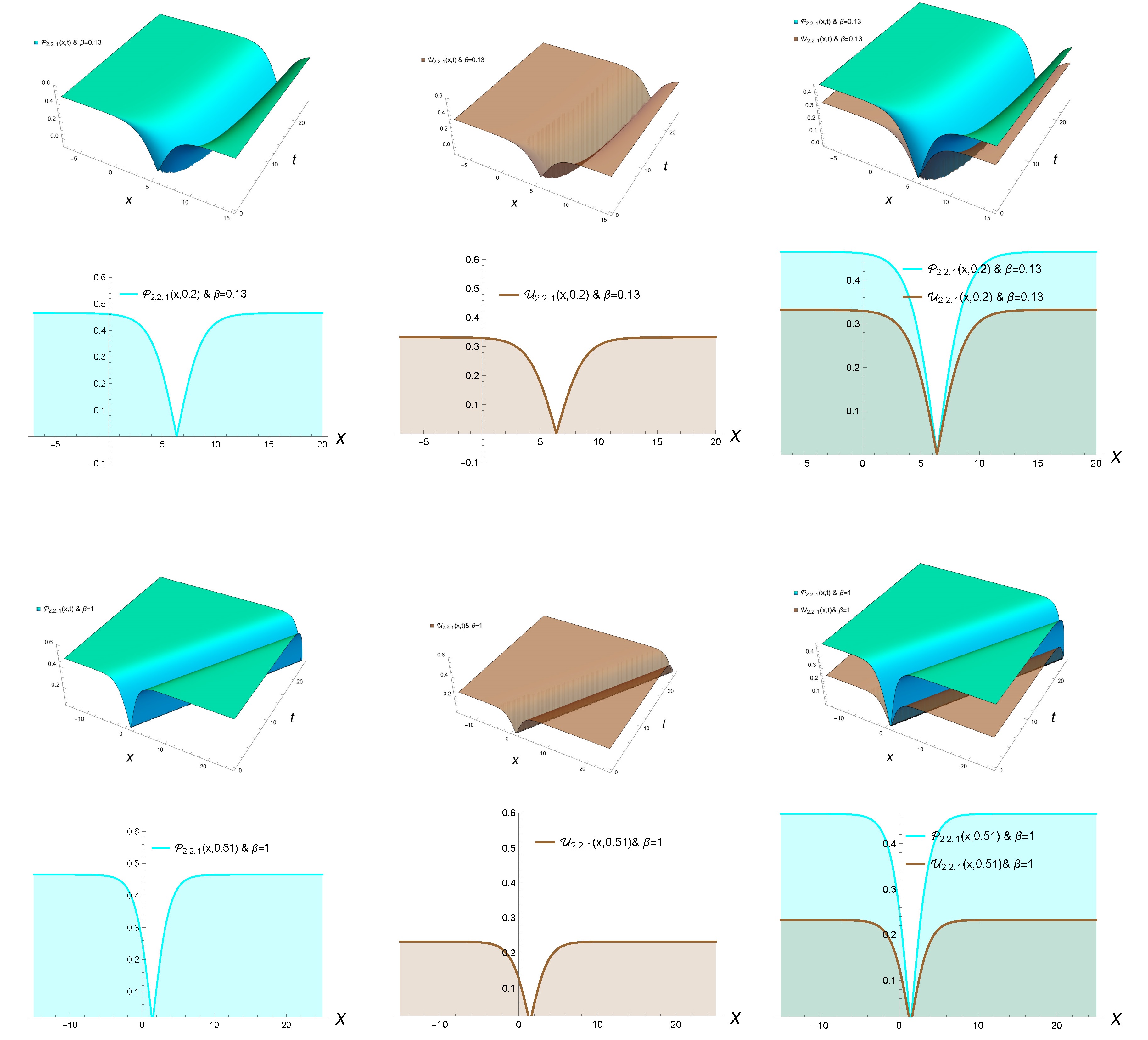
Figure 4.
Diagrams in both two and three dimensions illustrate the dark soliton solutions obtained from Eqs. (3.27) and (3.28).