

| Citation: |
Jie Zhang, Wen Deng, Shuxin Wang. THE PROJECTION NEURAL NETWORK METHOD AND THE EULER METHOD FOR SOLVING THE SDLCP[J]. Journal of Applied Analysis & Computation, 2026, 16(5): 2392-2414. doi: 10.11948/20250277

|
THE PROJECTION NEURAL NETWORK METHOD AND THE EULER METHOD FOR SOLVING THE SDLCP
-
Abstract
This work introduces an innovative neural network based on projection techniques to address the Semi-Definite Linear Complementarity Problem (SDLCP). The SDLCP arises frequently in fields such as optimization theory, economic modeling, engineering computations, and operational analysis. From a theoretical standpoint, it is proven that, under appropriate assumptions, the developed method guarantees both the existence and uniqueness of solutions, alongside ensuring asymptotic and exponential stability. The continuous-time model is discretized using the explicit Euler scheme, and its convergence properties are rigorously established. To validate the proposed projection-based neural network approach and the discretization scheme, various MATLAB numerical tests are conducted. The designed neural network presents a viable and effective strategy for tackling SDLCP, showcasing considerable promise for practical deployment across disciplines.
-

-
References
[1] N. Abdessemed, Resolution of Semidefinite Linear Complementarity Problem (SDLCP) Using New Interior Point Methods Based on Kernel Functions, University of Batna 2, Batna, 2023. [2] J. H. Alcantara and J. S. Chen, A new class of neural networks for NCPs using smooth perturbations of the natural residual function, J. Comput. Appl. Math., 2022, 407, 114092. doi: 10.1016/j.cam.2022.114092 [3] C. Dang, L. Qi and K. Yamamoto, Neural networks for nonlinear and mixed complementarity problems and their applications, Neural Netw., 2004, 17(2), 271–283. doi: 10.1016/j.neunet.2003.07.006 [4] T. L. Friesz, K. Han, T. Y. L. Zhang and R. L. Tobin, Day-to-day dynamic network disequilibria and idealized traveler information systems, Oper. Res., 1994, 42(6), 1120–1136. doi: 10.1287/opre.42.6.1120 [5] M. Fukushima, Equivalent differentiable optimization problems and descent methods for asymmetric variational inequality problems, Math. Program., 1992, 53, 99–110. doi: 10.1007/BF01585696 [6] J. K. Hale, Ordinary Differential Equations, Wiley-Interscience, New York, 1969. [7] R. A. Horn and C. R. Johnson, Matrix Analysis, Cambridge University Press, Cambridge, 2012. [8] B. Hou, J. Zhang and C. Qiu, A neural network for a generalized vertical complementarity problem, AIMS Mathematics, 2022, 7(4), 6650–6668. doi: 10.3934/math.2022371 [9] Y. F. Ke, Convergence analysis on matrix splitting iteration algorithm for semidefinite linear complementarity problems, Numer. Algorithms, 2021, 86(1), 257–279. doi: 10.1007/s11075-020-00888-8 [10] D. Kinderlehrer and G. Stampacchia, An Introduction to Variational Inequalities and their Applications, SIAM, Philadelphia, 2000. [11] C. E. Lemke and J. T. Howson, Equilibrium points of bimatrix games, J. Soc. Ind. Appl. Math., 1964, 12(2), 413–423. doi: 10.1137/0112033 [12] H. Li, S. Shao, S. Qin and Y. Yang, Neural networks with finite-time convergence for solving time-varying linear complementarity problem, Neurocomputing, 2021, 439, 146–158. doi: 10.1016/j.neucom.2021.01.015 [13] L. Z. Liao, H. Qi and L. Qi, Solving nonlinear complementarity problems with neural networks: A reformulation method approach, J. Comput. Appl. Math., 2001, 131(1–2), 343–359. doi: 10.1016/S0377-0427(00)00262-4 [14] L. Z. Liao and H. D. Qi, A neural network for the linear complementarity problem, Math. Comput. Model., 1999, 29(3), 9–18. doi: 10.1016/S0895-7177(99)00026-6 [15] F. Liu, Y. Xia, X. Su and Z. Wang, A discrete-time projection neural network for solving convex quadratic programming problems with hybrid constraints, Int. J. Control Autom. Syst., 2023, 21(1), 328–337. doi: 10.1007/s12555-021-0236-4 [16] Y. Maeda, Euler's discretization revisited, Proc. Japan Acad. Ser. A Math. Sci., 1995, 71(3), 58–61. [17] J. M. Ortega and W. C. Rheinboldt, Iterative Solution of Nonlinear Equations in Several Variables, SIAM, Philadelphia, 2000. [18] R. T. Rockafellar, Convex Analysis, Princeton University Press, Princeton, NJ, 1970. [19] P. Tseng, Merit functions for semi-definite complementarity problems, Math. Program., 1998, 83(1), 159–185. [20] Y. Xia and G. Feng, A new neural network for solving nonlinear projection equations, Neural Netw., 2007, 20(5), 577–589. doi: 10.1016/j.neunet.2007.01.001 [21] Y. Xia, H. Leung and J. Wang, A projection neural network and its application to constrained optimization problems, IEEE Trans. Circuits Syst. I, 2002, 49(4), 447–458. doi: 10.1109/81.995659 [22] Y. Xia and J. Wang, A recurrent neural network for solving linear projection equations, Neural Netw., 2000, 13(3), 337–350. doi: 10.1016/S0893-6080(00)00019-8 [23] Y. Xia and J. Wang, A general projection neural network for solving monotone variational inequalities and related optimization problems, IEEE Trans. Neural Netw., 2004, 15(2), 318–328. doi: 10.1109/TNN.2004.824252 -
-
Figures(12) / Tables(2)

Export File
Citation
Jie Zhang, Wen Deng, Shuxin Wang. THE PROJECTION NEURAL NETWORK METHOD AND THE EULER METHOD FOR SOLVING THE SDLCP[J]. Journal of Applied Analysis & Computation, 2026, 16(5): 2392-2414. doi: 10.11948/20250277
Format
Content
 DownLoad:
-
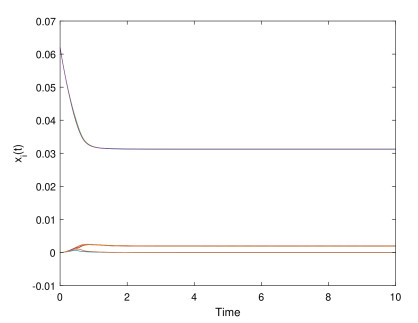
Figure 1.
The evolution of
$ x_i(t) $ $ \alpha=0.02 $ -
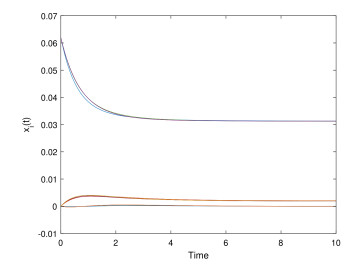
Figure 2.
The evolution of
$ x_i(t) $ $ \alpha=0.0005 $ -
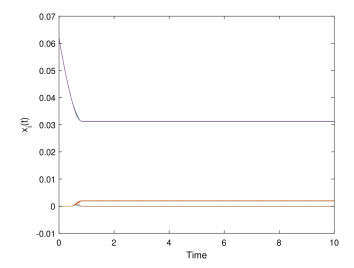
Figure 3.
The evolution of
$ x_i(t) $ $ \alpha=0.1 $ -
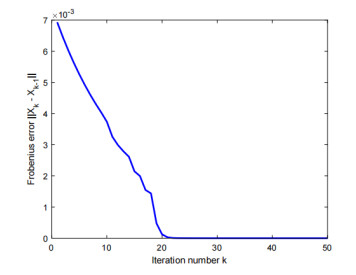
Figure 4.
Frobenius error
$ ||X_k - X_{k+1}|| $ -
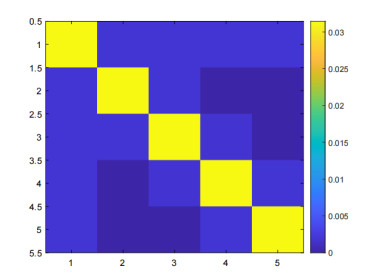
Figure 5.
Heatmap visualization of the system.
-
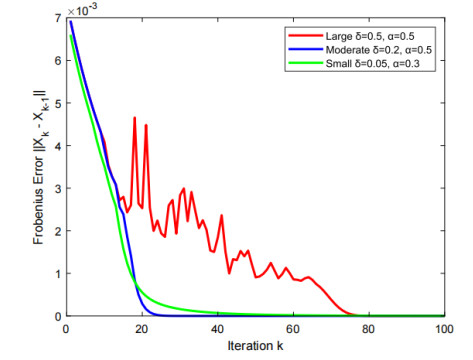
Figure 6.
Frobenius error ||Xk − Xk+1|| over iterations with varying δ and α.
-
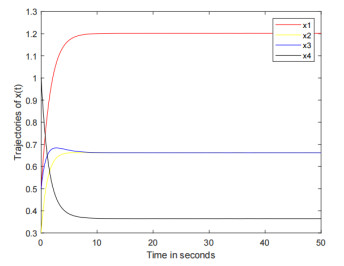
Figure 7.
Trajectories of x(t) over time.
-
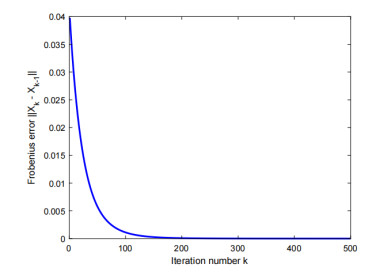
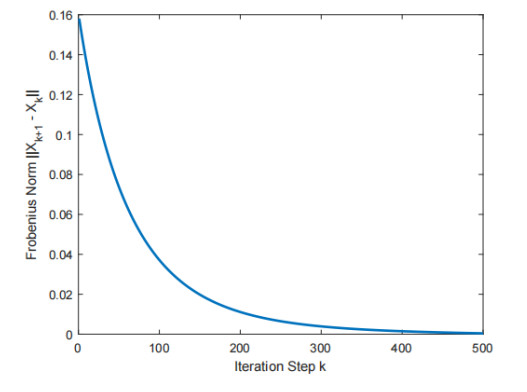
Figure 8.
||Xk − Xk+1|| over iterations.
-
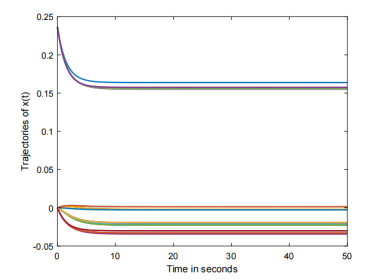
Figure 9.
Trajectories of x(t) over time.
-
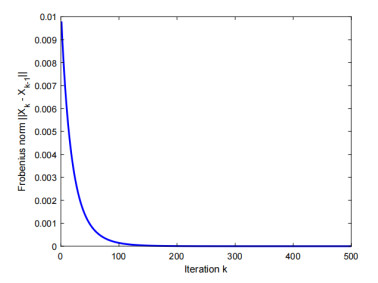
Figure 10.
||Xk − Xk+1|| over iterations.
-
Figure 11.
Frobenius error ||Xk − Xk+1|| over iterations with varying δ and α.
-
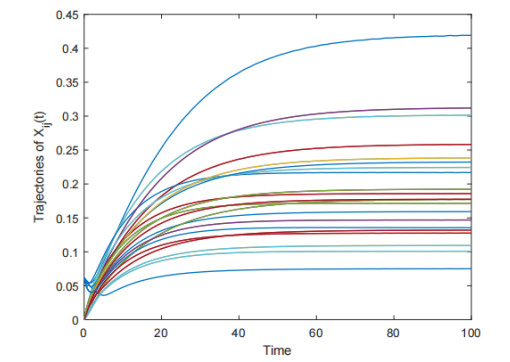
Figure 12.
Trajectories of the components of X(t).