

| Citation: |
Yuxi Li, Fuxiang Li. GLOBAL DYNAMICS OF A TIME-DELAYED ZIKA VIRUS MODEL WITH INCUBATION PERIOD[J]. Journal of Applied Analysis & Computation, 2027, 17(1): 349-373. doi: 10.11948/20260018

|
GLOBAL DYNAMICS OF A TIME-DELAYED ZIKA VIRUS MODEL WITH INCUBATION PERIOD
-
Abstract
Zika virus (ZIKV), primarily transmitted by Aedes mosquitoes, can cause severe neurological complications and has triggered multiple outbreaks worldwide in recent years. In this paper, we develop a time-delayed transmission model incorporating the human incubation period and an exposed host compartment. The basic reproduction number $ R_0 $ is derived, and the local asymptotic stability of both the disease-free and endemic equilibria is established. By constructing suitable Lyapunov functionals, the global asymptotic stability of both equilibria is further demonstrated. Numerical simulations further illustrate the theoretical results, showing that the disease dies out when $ R_0 < 1 $ and persists when $ R_0 > 1 $. Furthermore, an optimal control framework involving five intervention measures is formulated and analyzed. Numerical results show that the proposed control strategies effectively reduce disease transmission, with vaccination and treatment exhibiting the greatest impact among the considered interventions. In addition, sensitivity analysis reveals the relative influence of model parameters on $ R_0 $. Overall, this model enhances our understanding of ZIKV transmission dynamics and provides theoretical support for the design of effective control strategies.
-
Keywords:
- Zika virus /
- time delay /
- global stability /
- Lyapunov functional /
- optimal control
-

-
References
[1] R. Buathong, L. Hermann, B. Thaisomboonsuk, W. Rutvisuttinunt, C. Klungthong, P. Chinnawirotpisan, W. Manasatienkij, A. Nisalak, S. Fernandez, I. K. Yoon, P. Akrasewi and T. Plipat, Detection of Zika virus infection in Thailand, 2012–2014, Am. J. Trop. Med. Hyg., 2015, 93, 380–383. doi: 10.4269/ajtmh.15-0022 [2] D. Denu and H. Son, Analysis and optimal control of a deterministic Zika virus model, J. Nonlinear Sci. Appl., 2022, 15, 88. [3] D. Diallo, A. A. Sall, C. T. Diagne, O. Faye, O. Faye, Y. Ba, K. A. Hanley, M. Buenemann, S. C. Weaver and M. Diallo, Zika virus emergence in mosquitoes in Southeastern Senegal, 2011, PLoS ONE, 2014, 9, e109442. doi: 10.1371/journal.pone.0109442 [4] G. W. A. Dick, S. F. Kitchen and A. J. Haddow, Zika virus (I). Isolations and serological specificity, Trans. R. Soc. Trop. Med. Hyg., 1952, 46, 509–520. doi: 10.1016/0035-9203(52)90042-4 [5] P. van den Driessche, Reproduction numbers of infectious disease models, Infect. Dis. Model., 2017, 2, 288–303. [6] P. van den Driessche and J. Watmough, Reproduction numbers and sub-threshold endemic equilibria for compartmental models of disease transmission, Math. Biosci., 2002, 180, 29–48. doi: 10.1016/S0025-5564(02)00108-6 [7] M. R. Duffy, T. -H. Chen, W. T. Hancock, et al., Zika virus outbreak on Yap Island, Federated States of Micronesia, N. Engl. J. Med., 2009, 360, 2536–2543. doi: 10.1056/NEJMoa0805715 [8] D. Gao, Y. Lou, D. He, et al., Prevention and control of Zika as a mosquito-borne and sexually transmitted disease: A mathematical modeling analysis, Sci. Rep., 2016, 6, 28070. doi: 10.1038/srep28070 [9] L. Göllmann, D. Kern and H. Maurer, Optimal control problems with delays in state and control variables subject to mixed control-state constraints, Optim. Control Appl. Methods, 2009, 30, 341–365. doi: 10.1002/oca.843 [10] S. Guo, M. He and F. Li, Threshold dynamics of a time-delayed dengue virus infection model incorporating vaccination failure and exposed mosquitoes, Appl. Math. Lett., 2025, 161, 109366. doi: 10.1016/j.aml.2024.109366 [11] J. Gutkes, N. P. Krabbe, K. Ausderau and E. L. Mohr, Macaque models of prenatal and postnatal Zika virus exposure and developmental outcomes, J. Pediatric Infect. Dis. Soc., 2025, 14, piaf024. doi: 10.1093/jpids/piaf024 [12] J. Hale and S. M. V. Lunel, Introduction to Functional Differential Equations, Springer, New York, 1993. [13] M. Jamal, S. Batool, I. Ahmed, et al., Mathematical modeling of Zika virus with vertical transmission in the presence of Wolbachia-infected mosquitoes, J. Appl. Math. Comput., 2025, 71, 605–625. doi: 10.1007/s12190-024-02236-8 [14] Y. Kuang, Delay Differential Equations with Applications in Population Dynamics, Academic Press, Boston, MA, 1993. [15] R. S. Lanciotti, O. L. Kosoy, J. J. Laven, J. O. Velez, A. J. Lambert, A. J. Johnson, S. M. Stanfield and M. R. Duffy, Genetic and serologic properties of Zika virus associated with an epidemic, Yap State, Micronesia, 2007, Emerg. Infect. Dis., 2008, 14, 1232–1239. doi: 10.3201/eid1408.080287 [16] J. P. Romero-Leiton, E. K. E. Laisón, R. Alfaro, E. J. Parmley, J. Arino, K. R. Acharya and B. Nasri, Exploring Zika's dynamics: A scoping review journey from epidemic to equations through mathematical modelling, Infect. Dis. Model., 2025, 10, 536–558. [17] F. Li and X. -Q. Zhao, Global dynamics of a reaction–diffusion model of Zika virus transmission with seasonality, Bull. Math. Biol., 2021, 83, 43. [18] E. R. Krow-Lucal, B. J. Biggerstaff and J. E. Staples, Estimated incubation period for Zika virus disease, Emerg. Infect. Dis., 2017, 23, 841–845. doi: 10.3201/eid2305.161715 [19] F. N. MacNamara, Zika virus: A report on three cases of human infection during an epidemic of jaundice in Nigeria, Trans. R. Soc. Trop. Med. Hyg., 1954, 48, 139–145. doi: 10.1016/0035-9203(54)90006-1 [20] A. R. Plourde and E. M. Bloch, A literature review of Zika virus, Emerg. Infect. Dis., 2016, 22, 1185–1192. doi: 10.3201/eid2207.151990 [21] R. Rakkiyappan, V. Latha, R. Preethi and F. A. Rihan, A fractional-order model for Zika virus infection with multiple delays, Complexity, 2019, 2019, 4178073. doi: 10.1155/2019/4178073 [22] R. F. Relich and M. Loeffelholz, Zika virus, Clin. Lab. Med., 2017, 37, 253–267. doi: 10.1016/j.cll.2017.01.002 [23] Y. Saito, T. Hara and W. Ma, Necessary and sufficient conditions for permanence and global stability of a Lotka–Volterra system with two delays, J. Math. Anal. Appl., 1999, 236, 534–556. doi: 10.1006/jmaa.1999.6464 [24] D. P. Shutt, C. A. Manore, S. Pankavich, A. T. Porter and S. Y. Del Valle, Estimating the reproductive number, total outbreak size, and reporting rates for Zika epidemics in South and Central America, Epidemics, 2017, 21, 63–79. doi: 10.1016/j.epidem.2017.06.005 [25] H. L. Smith, Monotone Dynamical Systems: An Introduction to the Theory of Competitive and Cooperative Systems, American Mathematical Society, Providence, 1995. [26] H. Song, S. Jin, G. J. Yang, N. W. H. Lim, J. T. Lim and B. L. Dickens, Modelling the impact and cost-effectiveness of upcoming Zika virus vaccines on congenital Zika syndrome, Vaccine, 2025, 48, 126728. doi: 10.1016/j.vaccine.2025.126728 [27] J. Tognarelli, S. Ulloa, E. Villagra, et al., A report on the outbreak of Zika virus on Easter Island, South Pacific, 2014, Arch. Virol., 2016, 161, 665–668. doi: 10.1007/s00705-015-2695-5 [28] J. Tran and W. A. Woldegerima, Singular perturbation analysis of a two-time scale model of vector-borne disease: Zika virus model as a case study, Chaos Solitons Fractals, 2025, 194, 116209. doi: 10.1016/j.chaos.2025.116209 [29] X. Wang, M. Shen, Y. Xiao and L. Rong, Optimal control and cost-effectiveness analysis of a Zika virus infection model with comprehensive interventions, Appl. Math. Comput., 2019, 359, 165–185. [30] Y. Wang, Q. Yan and L. Liu, Multi-scale modeling and analysis of vaccine prevention and control strategies for Chikungunya disease, Adv. Contin. Discret. Models, 2026, 2026, 4. [31] Z. Wang, S. Cai, G. Chen, et al., Dynamics of dengue fever transmission model with multi-stage and fluctuations, Mathematics, 2024, 12, 2491. doi: 10.3390/math12162491 [32] Y. Wu, Z. Zhang, L. Song and C. Xia, Global stability analysis of two strains epidemic model with imperfect vaccination and immunity waning in a complex network, Chaos Solitons Fractals, 2024, 179, 114414. doi: 10.1016/j.chaos.2023.114414 [33] W. Zhang and C. T. Sandamali, Modeling and analysis of low-level transmission ZIKV dynamics via a Poisson point process on sexual transmission route, J. Appl. Anal. Comput., 2025, 13, 1044–1069. [34] X. -Q. Zhao, Dynamical Systems in Population Biology, Second Edition, Springer-Verlag, New York, 2017. -
-
Figures(5) / Tables(2)
Export File
Citation
Yuxi Li, Fuxiang Li. GLOBAL DYNAMICS OF A TIME-DELAYED ZIKA VIRUS MODEL WITH INCUBATION PERIOD[J]. Journal of Applied Analysis & Computation, 2027, 17(1): 349-373. doi: 10.11948/20260018
Format
Content
 DownLoad:
-
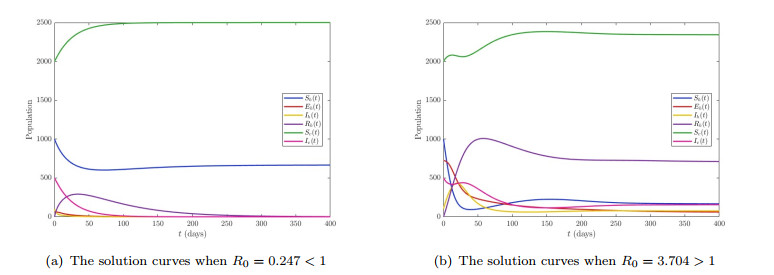
Figure 1.
The solution curves of system (2.1).
-
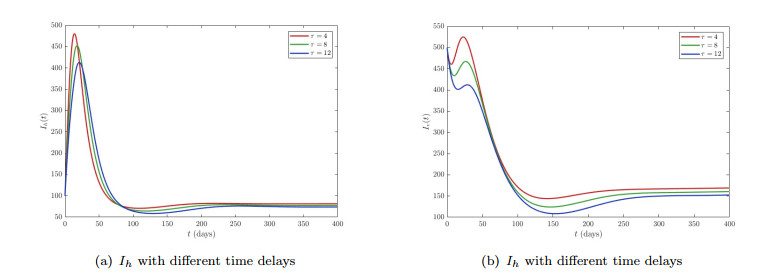
Figure 2.
Dynamics of
$ I_h $ $ I_v $ -
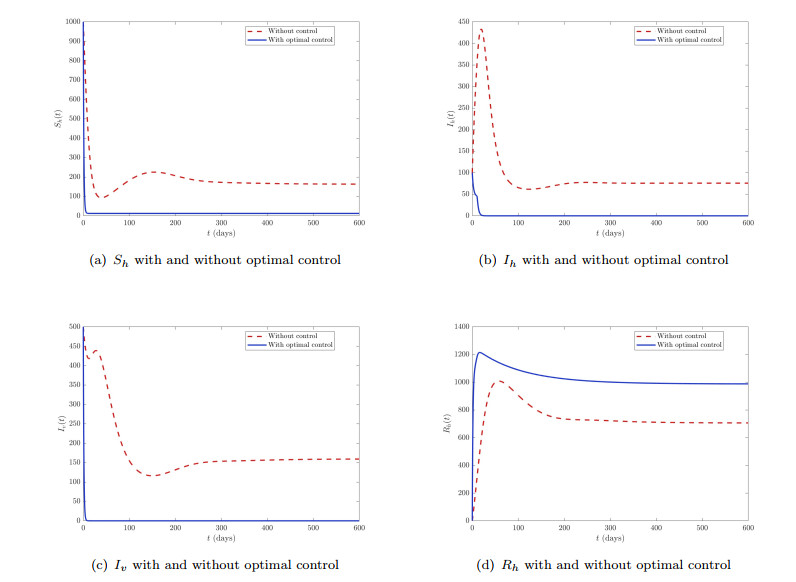
Figure 3.
Dynamics of main compartments with and without optimal control.
-
Figure 4.
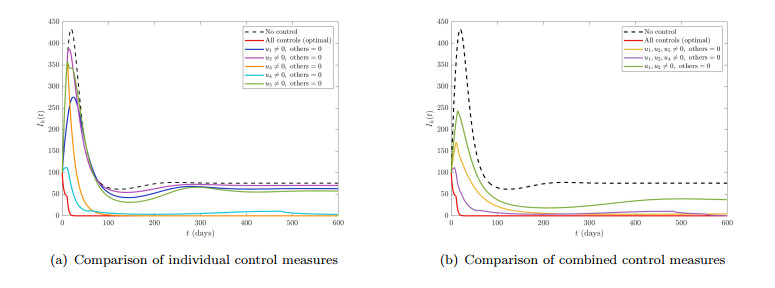
Dynamics of infected human population with non-global optimal control.
-
Figure 5.
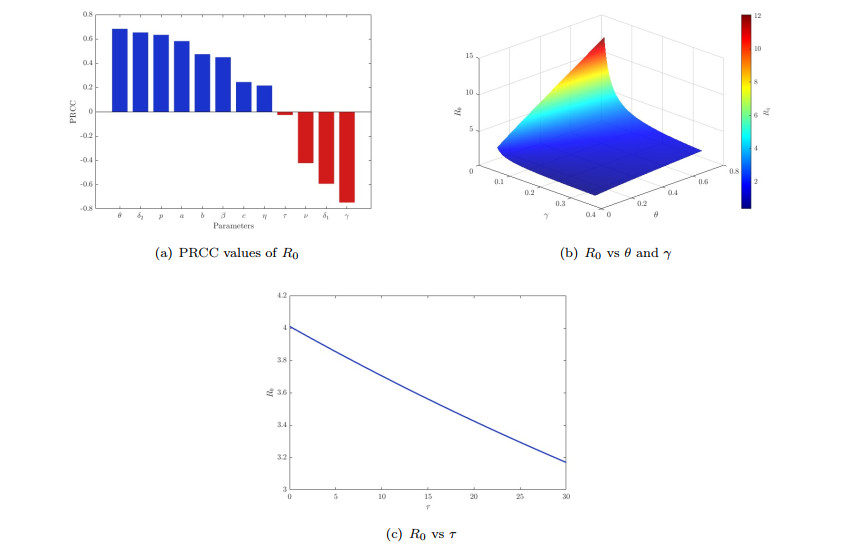
Sensitivity analysis of
$ R_0 $