

| Citation: |
Rahman Ullah Khan, Ioannis Argyros, Taha Radwan, Yousif Altayeb. CAPUTO FRACTIONAL STOCHASTIC SYSTEMS WITH RANDOM IMPULSES AND POISSON JUMPS: NUMERICAL SIMULATION AND NEURAL APPROXIMATION[J]. Journal of Applied Analysis & Computation, 2027, 17(3): 1989-2010. doi: 10.11948/20260236

|
CAPUTO FRACTIONAL STOCHASTIC SYSTEMS WITH RANDOM IMPULSES AND POISSON JUMPS: NUMERICAL SIMULATION AND NEURAL APPROXIMATION
-
Abstract
This paper develops a fractional-order extension of random impulsive stochastic functional differential equations with finite delay, Brownian perturbations and compensated Poisson jumps. The proposed model is formulated in the Caputo sense with order $ \alpha\in(0, 1) $, while the stochastic terms are treated through a fractional mild solution. This formulation is necessary because Brownian motion and Poisson random measures do not possess classical time derivatives, and a direct symbolic replacement of the first-order differential by a fractional derivative would not give a rigorous model. Under Lipschitz, linear-growth and bounded random impulse assumptions, we prove the existence and uniqueness of a mild solution by constructing a contraction operator on a suitable $ L^p $ phase space. The proof separates the deterministic fractional integral, the Brownian stochastic convolution, the compensated Poisson integral and the random impulse products, which clarifies the role of the fractional kernel in the stability estimates. Continuous dependence on the initial history and Hyers–Ulam stability are then established in the $ p $th moment. A scalar example verifies the hypotheses of the abstract results. To complement the theoretical analysis, a fractional finite-difference scheme is derived for a representative test problem and a feed-forward neural-network surrogate is trained to approximate the computed mean-square response. The numerical tables and plots show bounded moment behavior, grid refinement consistency and accurate neural approximation of the finite-difference data.
-

-
References
[1] A. Anguraj and K. Ravikumar, Existence and stability of impulsive stochastic partial neutral functional differential equations with infinite delays and Poisson jumps, Discontinuity Nonlinearity Complex, 2020, 9(2), 245–255. doi: 10.5890/DNC.2020.06.006 [2] A. Anguraj, K. Ramkumar and E. M. Elsayed, Existence, uniqueness and stability of impulsive stochastic partial neutral functional differential equations with infinite delays driven by a fractional Brownian motion, Discontinuity Nonlinear Complex, 2020, 9(2), 327–337. doi: 10.5890/DNC.2020.06.012 [3] A. Anguraj and A. Vinodkumar, Existence uniqueness and stability results of random impulsive semilinear differential equations, Nonlinear Analysis: Hybrid Systems, 2010, 4, 475–423. doi: 10.1016/j.nahs.2009.11.004 [4] A. Anguraj, A. Vinodkumar and K. Malar, Existence and stability results for random impulsive fractional pantograph equations, Filomat, 2016, 30(14), 3839–3854. doi: 10.2298/FIL1614839A [5] A. Boudaoui and E. H. Lakhel, Controllability of stochastic impulsive neutral functional differential equations driven by fractional Brownian motion with infinite delay, Differential Equations and Dynamical Systems, 2017, 26(1–3), 247–263. [6] B. Boufoussi and S. Hajji, Successive approximation of neutral functional stochastic differential equations with jumps, Statistics and Probability Letters, 2010, 80, 324–332. doi: 10.1016/j.spl.2009.11.006 [7] B. Boufoussi, S. Hajji and E. H. Lakhel, Exponential stability of impulsive neutral stochastic functional differential equation driven by fractional Brownian motion and Poisson point processes, Afrika Matematika, 2017, 29(1–2), 233–247. [8] K. Diethelm, The Analysis of Fractional Differential Equations, Springer, Berlin, 2010. [9] N. Durga and P. Muthukumar, Optimal control of fractional neutral stochastic differential equations with deviated argument governed by Poisson jumps and infinite delay, Optimization Control Applications and Methods, 2019, 40, 1–20. [10] M. Gowrisankar, P. Mohankumar and A. Vinodkumar, Stability results of random impulsive semilinear differential equations, Acta Mathematica Scientia, 2014, 34B(4), 1055–1071. [11] J. K. Hale and S. M. V. Lunel, Introduction to Functional Differential Equation, Springer, Berlin, 1993. [12] D. J. Higham, An algorithmic introduction to numerical simulation of stochastic differential equations, SIAM Review, 2001, 43(3), 525–546. doi: 10.1137/S0036144500378302 [13] J. C. F. Kingman, Poisson Processes and Poisson Random Measure, Oxford University Press, Oxford, 1993. [14] E. H. Lakhel, Exponential stability for stochastic neutral functional differential equations driven by Rosenblatt process with delay and Poisson jumps, Random Operators and Stochastic Equations, 2016, 24, 113–127. doi: 10.1515/rose-2016-0008 [15] V. Lakshmikantham, D. D. Bainov and P. S. Simeonov, Theory of Impulsive Differential Equations, World Scientific, Singapore, 1989. [16] S. Li, L. Shu, X. Bao and F. Xu, Existence and Hyers–Ulam stability of random impulsive stochastic functional differential equations with finite delays, Stochastics, 2018, 91, 1–16. [17] Y. Lin and C. Xu, Finite difference/spectral approximations for the time-fractional diffusion equation, Journal of Computational Physics, 2007, 225, 1533–1552. doi: 10.1016/j.jcp.2007.02.001 [18] N. Ngoc, Ulam–Hyers–Rassias stability of a nonlinear stochastic integral equation of Volterra type, Differential Equations and Applications, 2017, 9(2), 183–193. [19] M. Raissi, P. Perdikaris and G. E. Karniadakis, Physics-informed neural networks: A deep learning framework for solving forward and inverse problems involving nonlinear partial differential equations, Journal of Computational Physics, 2019, 378, 686–707. doi: 10.1016/j.jcp.2018.10.045 [20] J. M. Sanz-Serna, Ergodicity of dissipative differential equations subject to random impulses, Journal of Differential Equations, 1999, 155, 262–284. doi: 10.1006/jdeq.1998.3594 [21] T. Wang and S. Wu, Random Impulsive Model for Stock Prices and its Application for Insurers, Master thesis, East China Normal University, Shanghai, 2008. [22] S. Wu and X. Meng, Boundedness of nonlinear differential systems with impulsive effect on random moments, Acta Mathematica Applicatae Sinica, 2004, 20(1), 147–154. [23] S. Wu and B. Zhou, Existence and uniqueness of stochastic differential equations with random impulses and Markovian switching under non-Lipschitz conditions, Acta Mathematica Sinica, 2011, 27(3), 519–536. doi: 10.1007/s10114-011-9753-z [24] X. Zhao, Mean square Hyers–Ulam stability of stochastic differential equations driven by Brownian motion, Advances in Difference Equations, 2016, 2016, Article 271. doi: 10.1186/s13662-016-1002-4 [25] Y. Zhou and S. Wu, Existence and uniqueness of solutions to stochastic differential equations with random impulses under Lipschitz conditions, Chinese Journal of Applied Probability and Statistics, 2010, 26(4), 347–356. -
-
Figures(11) / Tables(4)

Export File
Citation
Rahman Ullah Khan, Ioannis Argyros, Taha Radwan, Yousif Altayeb. CAPUTO FRACTIONAL STOCHASTIC SYSTEMS WITH RANDOM IMPULSES AND POISSON JUMPS: NUMERICAL SIMULATION AND NEURAL APPROXIMATION[J]. Journal of Applied Analysis & Computation, 2027, 17(3): 1989-2010. doi: 10.11948/20260236
Format
Content
 DownLoad:
-
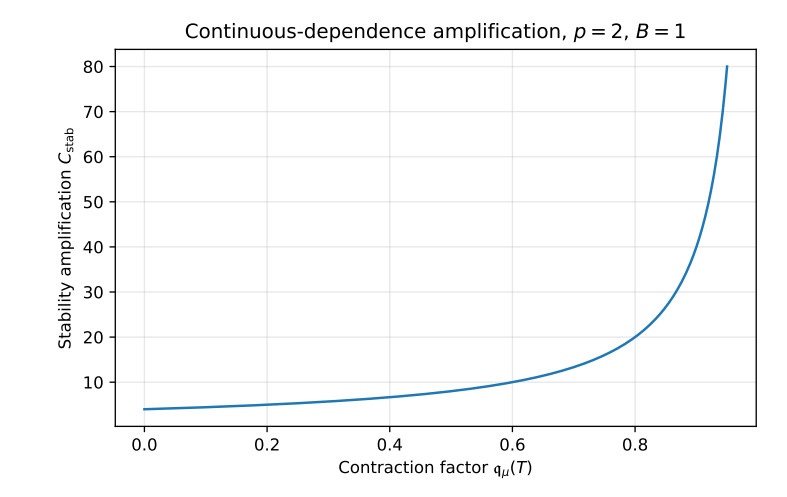
Figure 1.
Illustrative continuous-dependence factor
$ C_{\mathrm{stab}}=4^{p-1}B/(1-\mathfrak{q}_\mu(T)) $ $ p=2 $ $ B=1 $ -
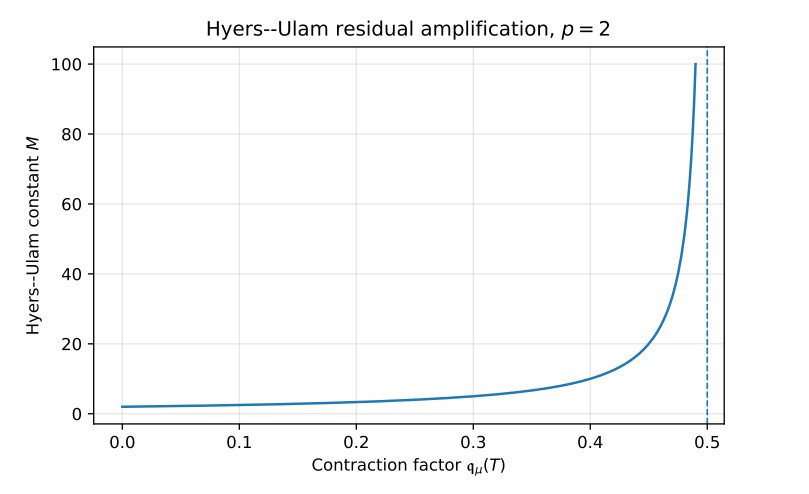
Figure 2.
Hyers–Ulam amplification constant
$ M=2^{p-1}/(1-2^{p-1}\mathfrak{q}_\mu(T)) $ $ p=2 $ $ \mathfrak{q}_\mu(T)=1/2 $ -
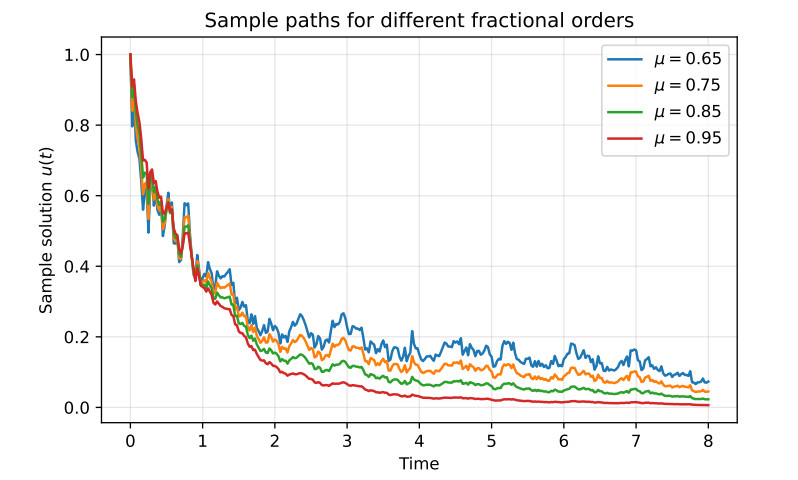
Figure 3.
Representative paths computed by the fractional finite-difference scheme for several values of
$ \mu $ -
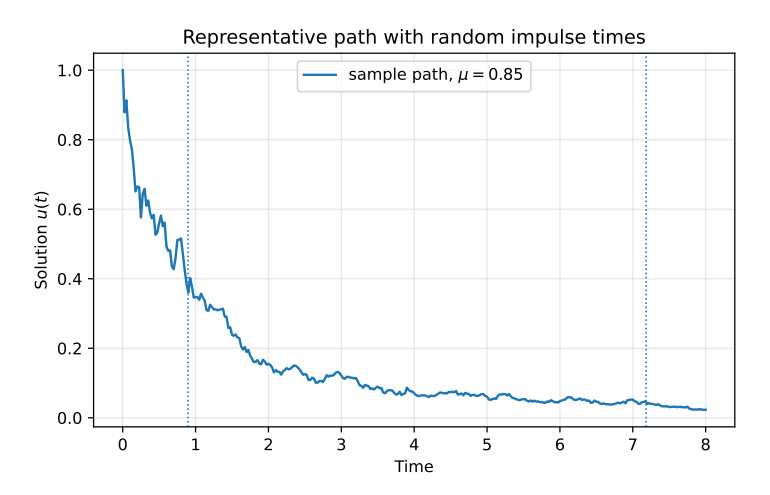
Figure 4.
Finite-difference trajectory for
$ \mu=0.85 $ -
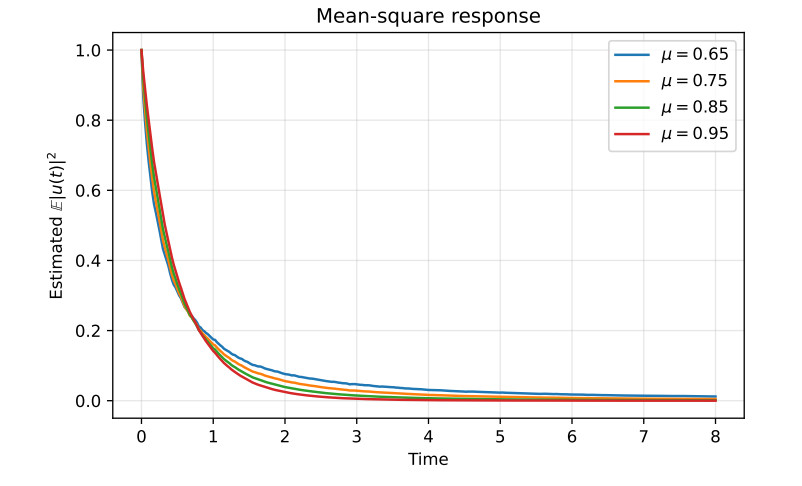
Figure 5.
Estimated second moment
$ \mathbb E|X(t)|^2 $ -
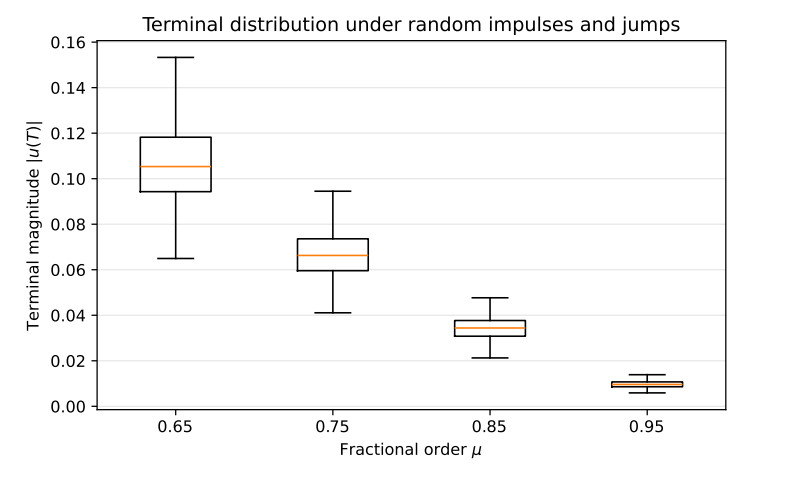
Figure 6.
Distribution of
$ |X(T)| $ -
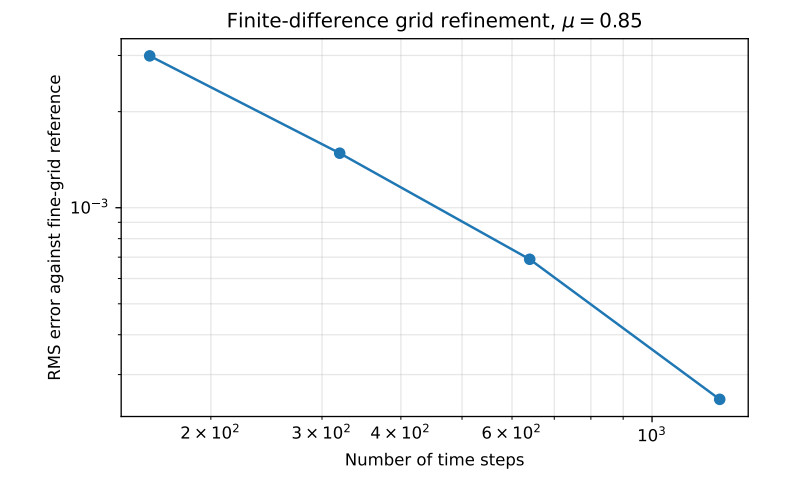
Figure 7.
Grid-refinement error of the finite-difference solution against a fine-grid reference for
$ \mu=0.85 $ -
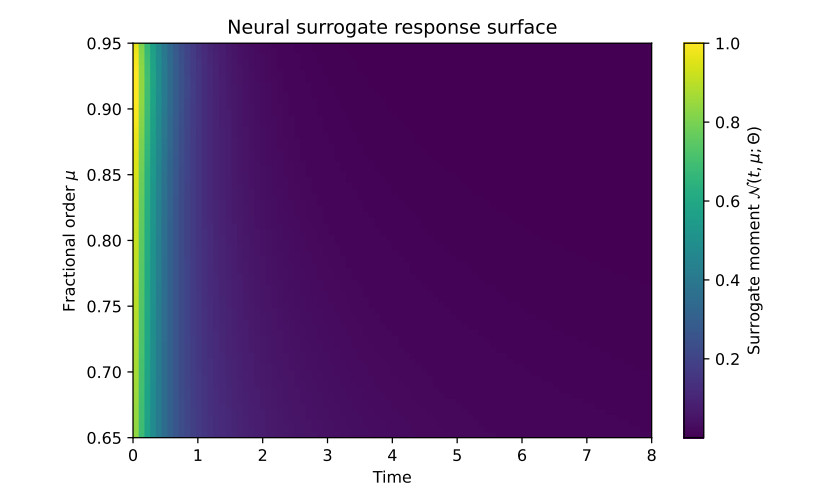
Figure 8.
Neural surrogate surface for
$ (t, \mu)\mapsto\mathbb E|X(t; \mu)|^2 $ -
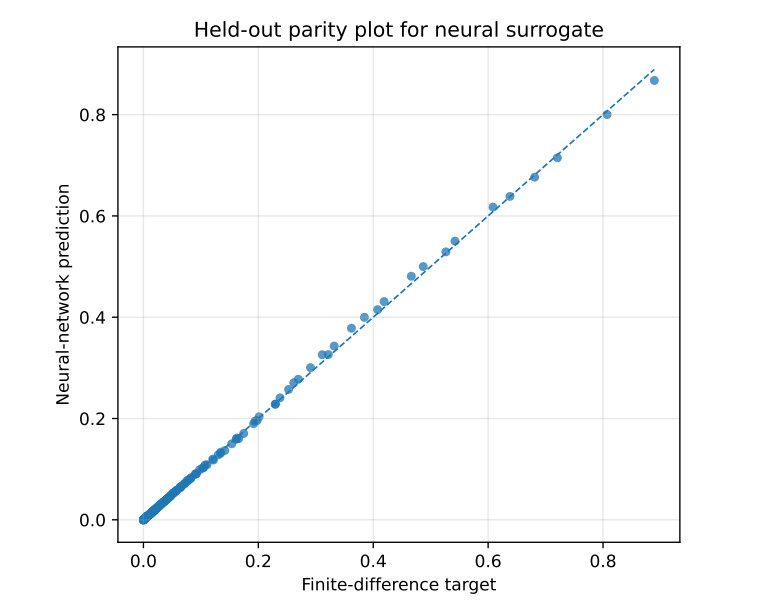
Figure 9.
Parity plot comparing held-out finite-difference targets with neural-network predictions. Points near the diagonal indicate accurate reproduction of the moment data.
-
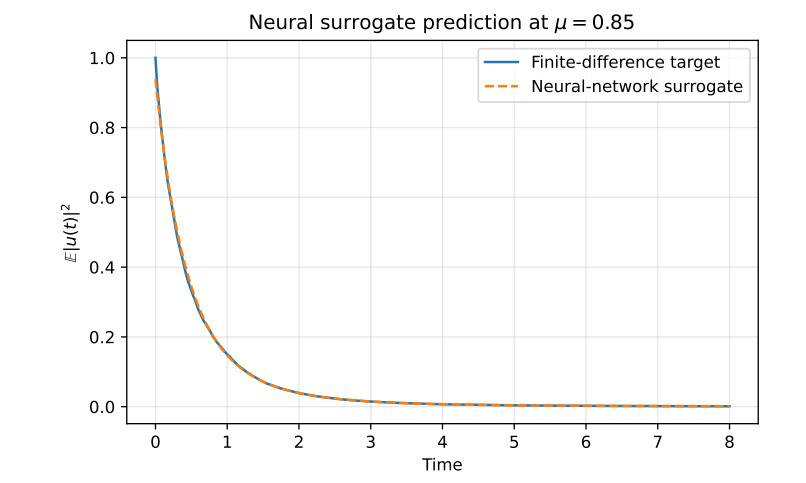
Figure 10.
Neural-network approximation of the finite-difference mean-square curve at
$ \mu=0.85 $ -
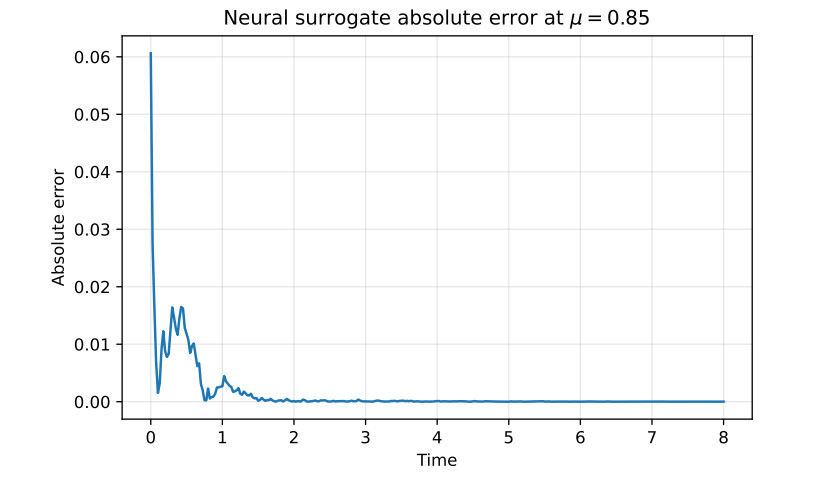
Figure 11.
Absolute prediction error of the neural surrogate for
$ \mu=0.85 $