

| Citation: |
Xuexin Li, Yanan Zhao, Tong Wu. DYNAMIC BEHAVIOR AND PARAMETER ESTIMATION OF A STOCHASTIC SIS DISEASE TRANSMISSION MODEL WITH LOGISTIC POPULATION INPUT AND DEGENERATE DIFFUSION TERM[J]. Journal of Applied Analysis & Computation, 2026, 16(6): 3071-3097. doi: 10.11948/20240033

|
DYNAMIC BEHAVIOR AND PARAMETER ESTIMATION OF A STOCHASTIC SIS DISEASE TRANSMISSION MODEL WITH LOGISTIC POPULATION INPUT AND DEGENERATE DIFFUSION TERM
-
Abstract
To account for population growth constrained by environmental capacity, we formulate a stochastic SIS model with logistic population input and standard incidence to describe disease transmission.Due to the degenerate structure of the stochastic differential equation, we employ the Lyapunov function method and Markov semigroup theory to establish a threshold theorem, including the extinction and ergodicity of the stochastic system.In addition, since the parameters in stochastic models are usually unknown in practice, we study parameter estimation for the proposed model under discrete observations by comparing least squares estimation, pseudo-maximum likelihood estimation (pseudo-MLE), and Bayesian posterior mean estimation. We further investigate how the observation step size, time horizon, and noise intensity affect the widths of confidence intervals and the accuracy of point estimates. Numerical simulations are provided to illustrate the theoretical results and to compare the performance of the three estimation methods.The results complement the dynamical analysis by providing a comparative study of parameter identification for this stochastic SIS model.
-

-
References
[1] M. A. Achterberg, B. Prasse and P. Van Mieghem, Analysis of continuous-time Markovian $\varepsilon$-SIS epidemics on networks, Phys. Rev. E, 2022, 105(5), 054305. $\varepsilon$-SIS epidemics on networks" target="_blank">Google Scholar
[2] R. Anderson and R. May, Infectious Diseases of Humans: Dynamics and Control, Oxford University Press, Oxford, 1991. [3] D. R. Bell, The Malliavin Calculus, Courier Corporation, New York, 2012. [4] J. P. N. Bishwal, Parameter Estimation in Stochastic Differential Equations, Springer, Berlin, 2007. [5] G. E. P. Box and G. C. Tiao, Bayesian Inference in Statistical Analysis, John Wiley & Sons, New York, 2011. [6] F. Brauer, Mathematical approaches to problems in resource management and epidemiology, Proceedings of a Conference Held at Ithaca, 1987, 109–123. [7] J. Cao and L. Hu, Asymptotic properties of a pseudo-MLE for CIR model, in: Proc. 2010 Int. Conf. ⅡGSS-CPS, Nanjing, China, 2010, 28–31. [8] L. Q. Gao and H. W. Hethcote, Disease transmission models with density-dependent demographics, J. Math. Biol., 1992, 30(7), 717–731. [9] A. Gray, D. Greenhalgh, L. Hu, et al., A stochastic differential equation SIS epidemic model, SIAM J. Appl. Math., 2011, 71(3), 876–902. doi: 10.1137/10081856X [10] S. He, S. Tang, Y. Cai, et al., A stochastic epidemic model coupled with seasonal air pollution: Analysis and data fitting, Stoch. Environ. Res. Risk Assess., 2020, 34(12), 2245–2257. doi: 10.1007/s00477-020-01856-3 [11] S. He and Z. Xiang, Dynamics of stochastic SIQS model based on nonlinear incidence: Disease extinction and stationary distribution under degenerate diffusion, Electron. Res. Arch., 2025, 33(7), 4259–4283. doi: 10.3934/era.2025193 [12] S. M. Iacus, Simulation and Inference for Stochastic Differential Equations: With R Examples, Springer, New York, 2008. [13] M. C. M. de Jong, O. Diekmann, et al., How does transmission of infection depend on population size?, Epidemic Models: Their Structure and Relation to Data, 1995, 84–94. [14] R. Khasminskii, Stochastic Stability of Differential Equations, Sijthoff and Noordhoff, Alphen aan den Rijn, The Netherlands, 1980. [15] N. R. Kristensen, H. Madsen and S. B. Jørgensen, Parameter estimation in stochastic grey-box models, Automatica, 2004, 40(2), 225–237. doi: 10.1016/j.automatica.2003.10.001 [16] S. Li and S. Guo, Permanence and extinction of a stochastic SIS epidemic model with three independent Brownian motions, Discrete Contin. Dyn. Syst. B, 2021, 26(5), 2693–2719. doi: 10.3934/dcdsb.2020201 [17] Q. Liu, D. Jiang, T. Hayat, et al., Threshold dynamics of a stochastic SIS epidemic model with nonlinear incidence rate, Phys. A, 2019, 526, 120946. doi: 10.1016/j.physa.2019.04.182 [18] Q. Liu, D. Jiang, T. Hayat, et al., A stochastic SIRS epidemic model with logistic growth and general nonlinear incidence rate, Phys. A, 2020, 551, 124152. doi: 10.1016/j.physa.2020.124152 [19] X. Mao, Stochastic Differential Equations and Applications, Elsevier, Horwood Publishing, 2007. [20] X. Mao and C. Yuan, Stochastic Differential Equations with Markovian Switching, Imperial College Press, London, 2006. [21] H. Nemoto and Y. Shimizu, Statistical inference for discretely sampled stochastic functional differential equations with small noise, Stat. Inference Stoch. Process., 2024, 27(2), 427–456. doi: 10.1007/s11203-023-09299-7 [22] J. Pan, A. Gray, D. Greenhalgh, et al., Parameter estimation for the stochastic SIS epidemic model, Stat. Inference Stoch. Process., 2014, 17(1), 75–98. doi: 10.1007/s11203-014-9091-8 [23] K. Pichór and R. Rudnicki, Stability of Markov semigroups and applications to parabolic systems, J. Math. Anal. Appl., 1997, 215(1), 56–74. doi: 10.1006/jmaa.1997.5609 [24] J. O. Rawlings, S. G. Pantula and D. A. Dickey, Applied Regression Analysis: A Research Tool, Springer, New York, 1998. [25] R. Rudnicki, Long-time behaviour of a stochastic prey-predator model, Stochastic Process. Appl., 2003, 108(1), 93–107. doi: 10.1016/S0304-4149(03)00090-5 [26] R. Rudnicki and K. Pichór, Influence of stochastic perturbation on prey-predator systems, Math. Biosci., 2007, 206(1), 108–119. doi: 10.1016/j.mbs.2006.03.006 [27] R. Rudnicki, K. Pichór and M. Tyran-Kamińska, Markov semigroups and their applications, Springer, Berlin, 2002, 215–238. [28] J. Timmer, Parameter estimation in nonlinear stochastic differential equations, Chaos Solitons Fractals, 2000, 11(15), 2571–2578. doi: 10.1016/S0960-0779(00)00015-1 [29] H. Wang, G. Zhang, T. Chen, et al., Threshold analysis of a stochastic SIRS epidemic model with logistic birth and nonlinear incidence, Mathematics, 2023, 11(7), 1737. doi: 10.3390/math11071737 [30] L. Wang, C. Gao, R. Rifhat, et al., Stationary distribution and bifurcation analysis for a stochastic SIS model with nonlinear incidence and degenerate diffusion, Chaos Solitons Fractals, 2024, 182, 114872. [31] Z. Xu and L. Wang, Stationary distribution and extinction of a stochastic SEI epidemic model with logistic growth and nonlinear perturbation, AIMS Math., 2025, 10(12), 28488–28513. doi: 10.3934/math.20251254 [32] Z. Xu, L. Wang and D. Jiang, The threshold of a stochastic SIR epidemic model with logistic growth, J. Appl. Anal. Comput., 2026, 16(3), 1187–1206. [33] T. Xue, X. Fan and Z. Chang, Dynamics of a stochastic SIRS epidemic model with standard incidence and vaccination, Math. Biosci. Eng., 2022, 19(10), 10618–10636. [34] A. Zellner, Applications of Bayesian analysis in econometrics, J. R. Stat. Soc. Ser. D Stat., 1983, 32(1), 23–34. [35] X. Zhang, Z. Zhang, J. Tong, et al., Ergodicity of stochastic smoking model and parameter estimation, Adv. Differ. Equ., 2016, 2016(1), 1–20. [36] Y. Zhao, D. Jiang, X. Mao, et al., The threshold of a stochastic SIRS epidemic model in a population with varying size, Discrete Contin. Dyn. Syst. B, 2015, 20(4), 1277–1295. [37] C. Zhou and Z. Li, Parameter estimation of stochastic SEIR epidemic model using particle MCMC, Chaos, 2025, 35(5), 053139. -
-
Figures(4) / Tables(7)

Export File
Citation
Xuexin Li, Yanan Zhao, Tong Wu. DYNAMIC BEHAVIOR AND PARAMETER ESTIMATION OF A STOCHASTIC SIS DISEASE TRANSMISSION MODEL WITH LOGISTIC POPULATION INPUT AND DEGENERATE DIFFUSION TERM[J]. Journal of Applied Analysis & Computation, 2026, 16(6): 3071-3097. doi: 10.11948/20240033
Format
Content
 DownLoad:
-
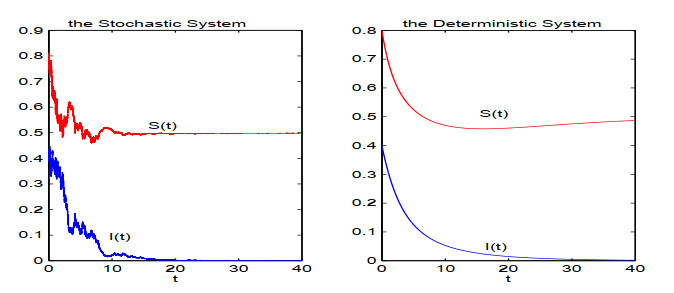
Figure 1.
Numerical simulations of the paths
$S(t)$ $I(t)$ $\Delta t=0.001$ $(S(0), I(0))=(0.8, \; 0.4)^T$ -
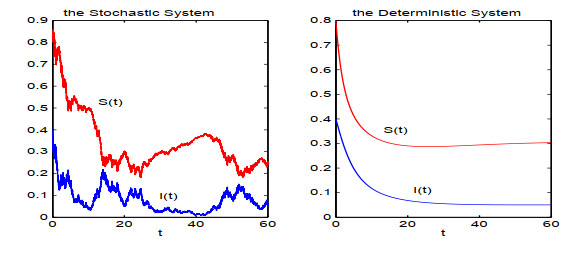
Figure 2.
Numerical simulations of the paths
$ S(t) $ $ I(t) $ $ \Delta t=0.001 $ $ (S(0), I(0))=(0.8, \; 0.4)^T $ -
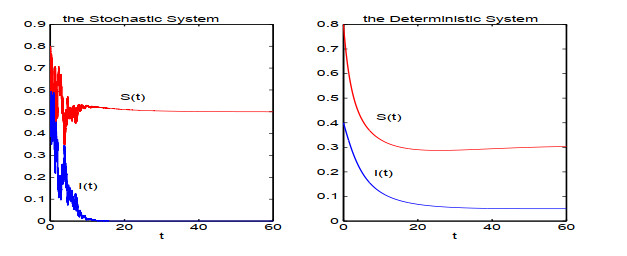
Figure 3.
Numerical simulations of the paths
$ S(t) $ $ I(t) $ $ \Delta t=0.001 $ $ (S(0), I(0))=(0.8, \; 0.4)^T $ $ \sigma=0.9 $ $ R_0 > 1 $ -
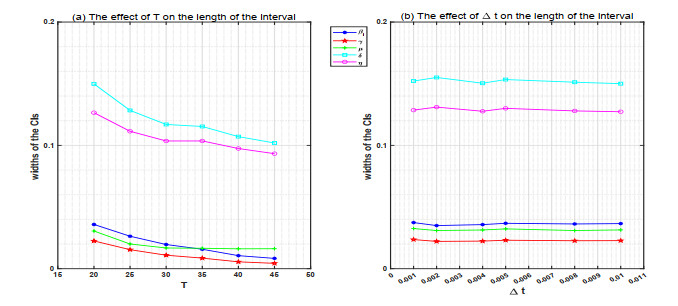
Figure 4.
The parameter values in Example 3.3 generate samples for parameter estimation, a shows the parameters 95% confidence region length change over time length
$ T $ $ \Delta t $