

| Citation: |
Changtong Li, Lifeng Wang, Xiaozhou Feng, Yuntao Liu. ANALYSIS OF AN IMPULSIVE TUMOR-CHEMOTHERAPY MODEL WITH MICHAELIS-MENTEN NONLINEAR DRUG DEGRADATION[J]. Journal of Applied Analysis & Computation, 2026, 16(6): 3046-3070. doi: 10.11948/20260019

|
ANALYSIS OF AN IMPULSIVE TUMOR-CHEMOTHERAPY MODEL WITH MICHAELIS-MENTEN NONLINEAR DRUG DEGRADATION
-
Abstract
While chemotherapeutic drugs can rapidly debulk tumor populations, they also induce irreversible harm to healthy tissues. Therefore, precise control of both dosage and timing of administration is critical. In this study, we establish a class of tumor–chemotherapy models incorporating a nonlinear drug elimination rate, characterized by a Michaelis–Menten function. For the tumor-extinction subsystem, we employ blue principal branch of the Lambert $W$ function to derive an analytical solution for the chemotherapy dose by solving the Michaelis-Menten equation, and construct an equivalent difference equation to establish the global stability of the fixed point. By combining the differential equation comparison theorem with Floquet multiplier analysis, we obtain explicit conditions for the local and global asymptotic stability of the tumor-free periodic solution and the permanence of the system. Additionally, using the bifurcation theorem, we establish explicit conditions for the existence of a stable positive periodic solution under the mechanism of system permanence. Numerical simulations further show that changes in the impulsive chemotherapy dose can drive a transition in the system dynamics, causing the tumor cells to evolve from a persistent state to an extinction state, thereby highlighting the decisive role of dose intensity in repeated chemotherapy. Moreover, small perturbations in the initial state can switch the long-term dynamics between tumor extinction and permanence, revealing bistability induced by the interaction between fixed-dose pulsed administration and nonlinear pharmacokinetics. Overall, this work provides a rigorous mathematical framework for analyzing dose–time effects in chemotherapy and offers valuable guidance for the design of clinical treatment regimens.
-
Keywords:
- Chemotherapeutic drug /
- Michaelis-Menten function /
- Lambert W function /
- stability /
- permanence /
- bifurcation
-

-
References
[1] I. Bashkirtseva, L. Ryashko and J. M. Seoane, Chaotic transitions in a tumor-immune model under chemotherapy treatment, Communications in Nonlinear Science and Numerical Simulation, 2024, 132, 107946. doi: 10.1016/j.cnsns.2024.107946 [2] S. L. Beal, Computation of the explicit solution to the Michaelis–Menten equation, Journal of Pharmacokinetics and Biopharmaceutics, 1983, 11, 641–657. doi: 10.1007/BF01059062 [3] D. Belkić, The Euler T and Lambert W functions in mechanistic radiobiological models with chemical kinetics for repair of irradiated cells, Journal of Mathematical Chemistry, 2018, 56, 2133–2193. doi: 10.1007/s10910-018-0932-3 [4] Y. L. Chen, M. C. Chang and W. F. Cheng, Metronomic chemotherapy and immunotherapy in cancer treatment, Cancer Letters, 2017, 400, 282–292. doi: 10.1016/j.canlet.2017.01.040 [5] Y. S. Cho and H. S. Lim, Comparison of various estimation methods for the parameters of Michaelis–Menten equation based on in vitro elimination kinetic simulation data, Translational and Clinical Pharmacology, 2018, 26(1), 39–47. doi: 10.12793/tcp.2018.26.1.39 [6] P. Das, S. Das and R. K. Upadhyay, Optimal treatment strategies for delayed cancer-immune system with multiple therapeutic approach, Chaos, Solitons & Fractals, 2020, 136, 109806. [7] D. A. Drexler and L. Kovács, Optimization of impulsive discrete-time tumor chemotherapy, 2019 First International Conference on Societal Automation (SA), 2019, 1–7. [8] M. Farhan, Z. Ling and Waseem, A novel intelligent framework for assessing within-host transmission dynamics of Chikungunya virus using an unsupervised stochastic neural network approach, Computational Biology and Chemistry, 2025, 117, 108380. doi: 10.1016/j.compbiolchem.2025.108380 [9] M. Goličnik, Explicit reformulations of the Lambert W-omega function for calculations of the solutions to one-compartment pharmacokinetic models with Michaelis–Menten elimination kinetics, European Journal of Drug Metabolism and Pharmacokinetics, 2011, 36, 121–127. doi: 10.1007/s13318-011-0040-2 [10] J. J. Jiao, Z. Z. Liu and L. M. Li, Threshold dynamics of a stage-structured single population model with non-transient and transient impulsive effects, Applied Mathematics Letters, 2019, 97, 88–92. doi: 10.1016/j.aml.2019.05.024 [11] V. A. Kuznetsov, I. A. Makalkin and M. A. Taylor, Nonlinear dynamics of immunogenic tumors: Parameter estimation and global bifurcation analysis, Bulletin of Mathematical Biology, 1994, 56(2), 295–321. doi: 10.1007/BF02460644 [12] A. Lakmeche and O. Arino, Bifurcation of non trivial periodic solutions of impulsive differential equations arising chemotherapeutic treatment, Nonlinear Analysis: Theory, Methods & Applications, 2000, 7, 265–287. [13] W. M. Lau, A. W. White and S. J. Gallagher, Scope and limitations of the co-drug approach to topical drug delivery, Current Pharmaceutical Design, 2008, 14(8), 794–802. doi: 10.2174/138161208784007653 [14] C. T. Li, X. Z. Feng and Y. Z. Wang, Complex dynamics of Beddington–DeAngelis-type predator–prey model with nonlinear impulsive control, Complexity, 2020, 2020, 8829235. [15] C. T. Li, Y. T. Liu, and Y. Z. Wang, Dynamic modeling of the glucose–insulin system with inhibitors impulsive control, Mathematical Methods in the Applied Sciences, 2024, 47(15), 18745–18760. [16] S. Li, M. Ullah and S. Ullah, A novel stochastic neural network framework for modeling and simulation of within-host Chikungunya virus transmission with latency, Knowledge-Based Systems, 2025, 329, 114412. doi: 10.1016/j.knosys.2025.114412 [17] S. G. Liliopoulos, G. S. Stavrakakis and K. S. Dimas, Linear and non-linear optimal control methods to determine the best chemotherapy schedule for most effectively inhibiting tumor growth, Biomedicines, 2025, 13(2), 13020315. [18] B. Liu, Y. J. Zhang and L. S. Chen, The dynamical behaviors of a Lotka–Volterra predator–prey model concerning integrated pest management, Nonlinear Analysis: Real World Applications, 2005, 6(2), 227–243. doi: 10.1016/j.nonrwa.2004.08.001 [19] Y. Liu, Y. H. Ma and C. H. Yang, Modeling the nonmonotonic immune response in a tumor–immune system interaction, Symmetry, 2024, 16(6), 676. doi: 10.3390/sym16060676 [20] L. Y. Pang, L. Shen and Z. Zhao. Mathematical modelling and analysis of the tumor treatment regimens with pulsed immunotherapy and chemotherapy, Computational and Mathematical Methods in Medicine, 2016, 2016, 6260474. [21] L. Pierik, P. McDonald and A. R. A. Anderson, Second-order effects of chemotherapy pharmacodynamics and pharmacokinetics on tumor regression and cachexia, Bulletin of Mathematical Biology, 2024, 86, 72. doi: 10.1007/s11538-024-01290-4 [22] L. G. de Pillis, W. Gu and A. E. Radunskaya, Mixed immunotherapy and chemotherapy of tumors: Modeling, applications and biological interpretations, Journal of Theoretical Biology, 2006, 238(4), 841–862. doi: 10.1016/j.jtbi.2005.06.037 [23] S. A. Saganuwan, Application of modified Michaelis–Menten equations for determination of enzyme inducing and inhibiting drugs, BMC Pharmacology and Toxicology, 2021, 22, 57. doi: 10.1186/s40360-021-00521-x [24] G. Song, G. Z. Liang and T. H. Tian, Mathematical modeling and analysis of tumor chemotherapy, Symmetry, 2022, 14(4), 704. doi: 10.3390/sym14040704 [25] H. Sung, J. Ferlay and R. L. Siegel, Global cancer statistics 2020: GLOBOCAN estimates of incidence and mortality worldwide for 36 cancers in 185 countries, CA A Cancer Journal for Clinicians, 2021, 71(3), 209–249. doi: 10.3322/caac.21660 [26] X. W. Tan, S. Y. Tang and X. Z. Chen, A stochastic differential equation model for pest management, Advances in Difference Equations, 2017, 2017, 197. doi: 10.1186/s13662-017-1251-x [27] B. Tang, Y. N. Xiao and J. H. Wu, A piecewise model of virus-immune system with two thresholds, Mathematical Biosciences, 2016, 278, 63–76. doi: 10.1016/j.mbs.2016.06.003 [28] S. Y. Tang, S. Li and B. Tang, Hormetic and synergistic effects of cancer treatments revealed by modelling combinations of radio- or chemotherapy with immunotherapy, BMC Cancer, 2023, 23, 1040. doi: 10.1186/s12885-023-11542-6 [29] S. Y. Tang and Y. N. Xiao, One-compartment model with Michaelis–Menten elimination kinetics and therapeutic window: An analytical approach, Journal of Pharmacokinetics and Pharmacodynamics, 2007, 34, 807–827. doi: 10.1007/s10928-007-9070-4 [30] Z. Veitch, O. F. Khan and D. Tilley, Impact of cumulative chemotherapy dose on survival with adjuvant FEC-D chemotherapy for breast cancer, Journal of the National Comprehensive Cancer Network, 2019, 17(8), 957–967. doi: 10.6004/jnccn.2019.7286 [31] Y. Wang, L. Y. Yang and L. Mao, SGLT2 inhibition restrains thyroid cancer growth via G1/S phase transition arrest and apoptosis mediated by DNA damage response signaling pathways, Cancer Cell International, 2022, 22, 74. doi: 10.1186/s12935-022-02496-z [32] Y. Z. Wang, Samreen and S. Ullah, Numerical assessment of multiple vaccinations to mitigate the transmission of COVID-19 via a new epidemiological modeling approach, Results in Physics, 2023, 52, 106889. doi: 10.1016/j.rinp.2023.106889 [33] J. J. Wu and D. J. Waxman, Immunogenic chemotherapy: Dose and schedule dependence and combination with immunotherapy, Cancer Letters, 2018, 419, 210–221. doi: 10.1016/j.canlet.2018.01.050 [34] D. D. Yan, M. Q. He and S. Y. Tang, Incorporating drug adherence stochasticity into pharmacokinetics and pharmacodynamics to understand the HIV transmission dynamics through a multiscale system, SIAM Journal on Applied Mathematics, 2025, 85, 2566–2590. doi: 10.1137/24M1720196 [35] M. Yosef and S. Bunimovich-Mendrazitsky, Mathematical model of MMC chemotherapy for non-invasive bladder cancer treatment, Frontiers in Oncology, 2024, 14, 1352065. doi: 10.3389/fonc.2024.1352065 [36] L. F. Zhang, H. B. Xie and Y. Q. Wang, Pharmacodynamic parameters of pharmacokinetic/pharmacodynamic (PK/PD) integration models, Frontiers in Veterinary Science, 2022, 9, 860472. doi: 10.3389/fvets.2022.860472 [37] Q. Zhao, L. Y. Pang and Q. Y. Li, Analysis of a hybrid impulsive tumor-immune model with immunotherapy and chemotherapy, Chaos, Solitons & Fractals, 2021, 144, 110617. [38] Z. Zhao, X. Q. Zhang and L. S. Chen, The effect of pulsed harvesting policy on the inshore–offshore fishery model with the impulsive diffusion, Nonlinear Dynamics, 2011, 63, 537–545. doi: 10.1007/s11071-009-9527-7 -
-
Figures(6)

Export File
Citation
Changtong Li, Lifeng Wang, Xiaozhou Feng, Yuntao Liu. ANALYSIS OF AN IMPULSIVE TUMOR-CHEMOTHERAPY MODEL WITH MICHAELIS-MENTEN NONLINEAR DRUG DEGRADATION[J]. Journal of Applied Analysis & Computation, 2026, 16(6): 3046-3070. doi: 10.11948/20260019
Format
Content
 DownLoad:
-
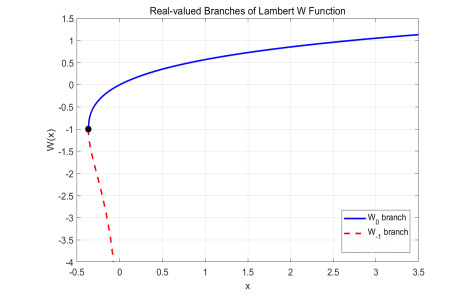
Figure 1.
The
$\text{Lambert } W$ $ W(x) $ $W_{0}: [\exp\{-1\}, \infty]\to[-1, \infty]$ $W_{-1}: [\exp\{-1\}, \infty]\to[\infty, -1]$ -
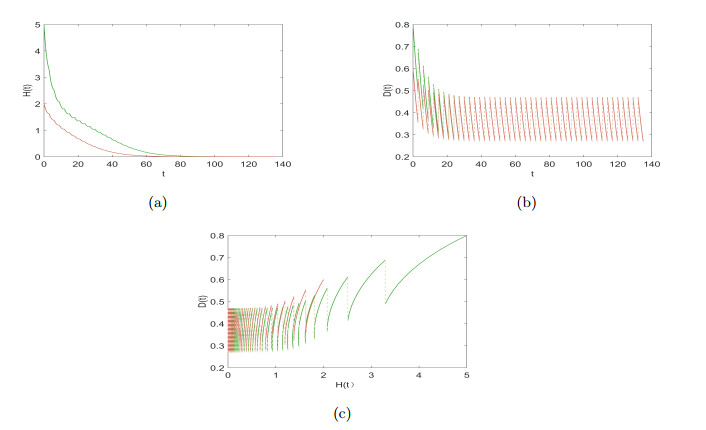
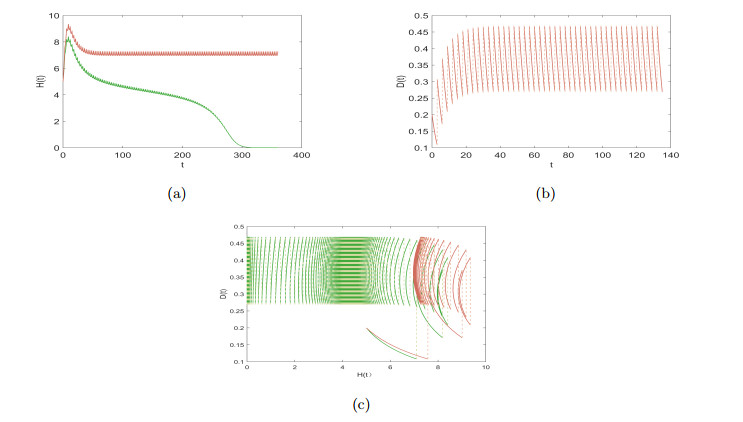
Figure 2.
Periodic solutions for tumor eradication under different initial conditions: (a) Time series of tumor cell concentration
$ H(t) $ $ (H_0, D_0)=(5, 0.8) $ $ (H_0, D_0)=(2, 0.6) $ $ D(t) $ $ H(t) $ $ D(t) $ $ r=0.72 $ $ \alpha=0.6 $ $ \eta=0.05 $ $ \omega=0.2 $ $ k=0.6 $ $ \beta=0.4 $ $ \tilde{\sigma}=0.2 $ $ K=1.8 $ $ \tau=3 $ -
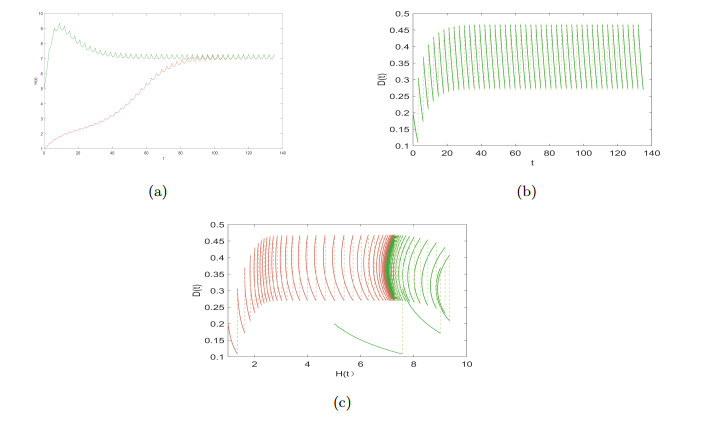
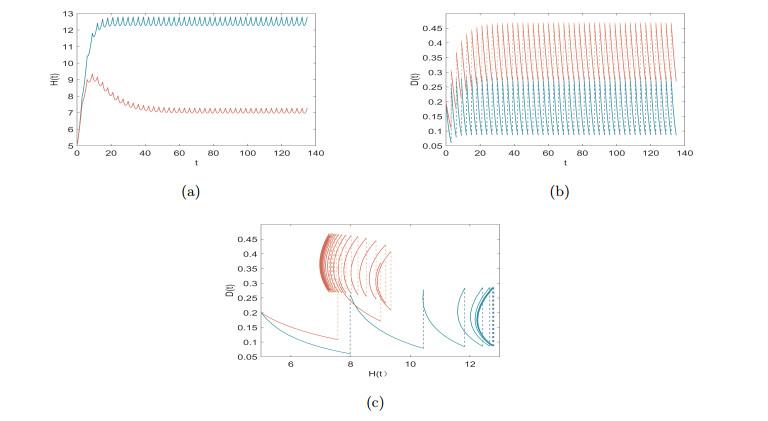
Figure 3.
Periodic solutions for tumor eradication under different initial conditions: (a) Time series of tumor cell concentration
$ H(t) $ $ (H_0, D_0)=(5, 0.8) $ $ (H_0, D_0)=(2, 0.6) $ $ D(t) $ $ H(t) $ $ D(t) $ $ r=0.72 $ $ \alpha=0.6 $ $ \eta=0.05 $ $ \omega=0.2 $ $ k=0.6 $ $ \beta=0.4 $ $ \tilde{\sigma}=0.2 $ $ K=1.8 $ $ \tau=3 $ -
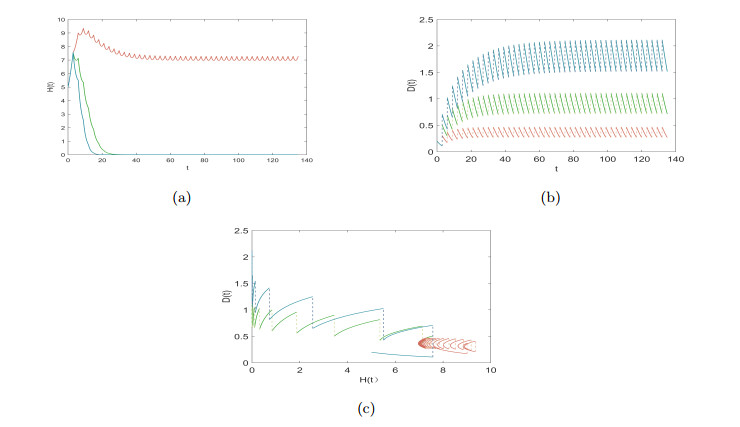
Figure 4.
Dynamics under different injection doses. (a) Time series of tumor cell concentration
$H(t)$ $\tilde{\sigma}=0.2$ $\tilde{\sigma}=0.4$ $\tilde{\sigma}=0.6$ $D(t)$ $H(t)$ $D(t)$ $(H_0, D_0)=(2, 0.4)$ -
Figure 5.
Sensitivity to parameter
$r$ $H(t)$ $r=0.72$ $r=0.685$ $D(t)$ $r$ $H(t)$ $D(t)$ $r$ $(H_0, D_0)=(5, 0.2)$ -
Figure 6.
Comparison of linear and nonlinear drug elimination rates. (a) Time series of tumor cell concentration
$H(t)$ $D'(t)=-\beta D(t)$ $D(t)$ $H(t)$ $D(t)$ $(H_0, D_0)=(5, 0.2)$