

| Citation: |
Yaxin Zhou, Daqing Jiang. COMPARISON OF RESEARCH METHODS FOR DISEASE MODELS WITH TWO DIFFERENT RANDOM PERTURBATIONS UNDER THE INFLUENCE OF SANITATION AND AWARENESS[J]. Journal of Applied Analysis & Computation, 2026, 16(3): 1325-1354. doi: 10.11948/20240043

|
COMPARISON OF RESEARCH METHODS FOR DISEASE MODELS WITH TWO DIFFERENT RANDOM PERTURBATIONS UNDER THE INFLUENCE OF SANITATION AND AWARENESS
-
Abstract
Environmental hygiene and public awareness play a key role in controlling the spread of infectious diseases, and they are also very effective health intervention measures for the public. This paper studies the dynamical behaviors of a nonlinear mathematical model with health and publicity which controlled by investment budget. We compared and analyzed the research methods of two disease models generated under white noise and Ornstein-Uhlenbeck process perturbations. At first, we discuss the local stability of the endemic equilibrium by Lyapunov function method which avoids the tedious calculation process when studying the local stability of the positive solution of the models with dimensions greater than three. And then we conduct research on random models under the influence of white noise, we study the existence and uniqueness of positive solution. We get a critical value $ R^* $ which corresponding to the control reproduction number $ R_1 $ of the ordinary differential equation when we discuss the stationary distribution of the stochastic system. In addition, constructing a Lyapunov function is a method to obtain some sufficient conditions for the extinction of the disease. Finally, the numerical simulations illustrate our above theoretical results and several parameters have a significant impact on the model are pointed out. Specifically, we present the dynamic properties of the same model under Ornstein-Uhlenbeck process perturbations in the Appendix.
-

-
References
[1] K. B. Blyuss and Y. N. Kyrychko, Stability and bifurcations in an epidemic model with varying immunity period, B. Math. Biol., 2010, 72, 490–505. doi: 10.1007/s11538-009-9458-y [2] N. T. Dieu. Asymptotic properties of a stochastic SIR epidemic model with Beddington-DeAngelis incidence rate, J. Dyn. Diff. Equ., 2018, 30, 93–106. doi: 10.1007/s10884-016-9532-8 [3] N. H. Du and G. Yin. Conditions for permanence and ergodicity of certain stochastic predatoršCprey models, J. Appl. Pro., 2016, 53, 187–202. doi: 10.1017/jpr.2015.18 [4] B. Dubey, P. Dubey and U. S. Dubey, Role of media and treatment on an SIR model, Nonlinear Anal. Model. Control., 2015, 21, 185–200. [5] S. Funk, E. Gilad, C. Watkins and V. A. A. Jansen, The spread of awareness and its impact on epidemic outbreaks, Proc. Natl. Acad. Sci. USA, 2009, 106, 6872–6877. doi: 10.1073/pnas.0810762106 [6] T. C. Gard, Introduction to Stochastic Differential Equations, Marcel Dekker INC, New York, 1988. [7] D. J. Higham, An algorithmic introduction to numerical simulations of stochastic differential equations, SIAM Rev., 2001, 43, 525–546. doi: 10.1137/S0036144500378302 [8] C. M. Huang, S. Q. Gan and D. S. Wang, Delay-dependent stability analysis of numerical methods for stochastic delay differential equations, J. Comput. Appl. Math., 2012, 236, 3514–3527. doi: 10.1016/j.cam.2012.03.003 [9] C. Y. Ji, D. Q. Jiang and N. Z. Shi, Analysis of a predator-prey model with modified Leslie-Gower and Holling-type Ⅱ schemes with stochastic perturbation, J. Math. Anal. Appl., 2009, 359, 482–498. doi: 10.1016/j.jmaa.2009.05.039 [10] D. Q. Jiang, N. Z. Shi and X. Y. Li, Global stability and stochastic permanence of a non-autonomous logistic equation with random perturbation, J. Math. Anal. Appl., 2008, 340, 588–597. doi: 10.1016/j.jmaa.2007.08.014 [11] R. Z. Khasminskii, Stochastic Stability of Differential Equations, Springer, Heidelberg Publishing, 1980. [12] A. Kumar, P. K. Srivastava and Y. Takeuchi, Modeling the role of information and limited optimal treatment on disease prevalence, J. Theor. Biol., 2017, 414, 103–119. doi: 10.1016/j.jtbi.2016.11.016 [13] D. S. Li, The stationary distribution and ergodicity of a stochastic generalized logistic system, Statist. Probab. Lett., 2013, 83, 580–583. doi: 10.1016/j.spl.2012.11.006 [14] Y. G. Lin and D. Q. Jiang, Threshold behavior in a stochastic SIS epidemic model with standard incidence, J. Dyn. Differ. Equ., 2014, 26, 1079–1094. doi: 10.1007/s10884-014-9408-8 [15] M. Liu and K. Wang, Staionary distribution, ergodicity and extinction of a stochastic generalized logistic system, Appl. Math. Lett., 2012, 25, 1980–1985. doi: 10.1016/j.aml.2012.03.015 [16] Q. Liu, D. Q. Jiang and N. Z. Shi, Threshold behavior in a stochastic SIQR epidemic model with standard incidence and regime switching, Appl. Math. Comput., 2018, 316, 310–325. [17] X. Liu, Z. W. Yang and Y. M. Zeng, Long-time numerical properties analysis of a diffusive SIS epidemic model under a linear external source, Int. J. Comput. Math., 2023, 100, 1737–1756. doi: 10.1080/00207160.2023.2214242 [18] X. J. Lu, S. K. Wang, S. Q. Liu and J. Li, An SEI infection model incorporating media impact, Math. Biosci. Eng., 2017, 14, 1317–1335. doi: 10.3934/mbe.2017068 [19] X. R. Mao, G. Marion and E. Renshaw, Environmental brownian noise suppresses explosions in population dynamics, Stoch. Proc. Appl., 2002, 97, 95–110. doi: 10.1016/S0304-4149(01)00126-0 [20] S. P. Meyn and R. L. Tweedie. Stability of Markovian processes Ⅲ: Foster-Lyapunov criteria for continuous-time processes, Adv. Appl. Pro., 1993, 25, 518–548. doi: 10.2307/1427522 [21] A. K. Misra, R. K. Rai and Y. Takeuchi, Modeling the control of infectious diseases: Effects of TV and social media advertisements, Math. Biosci. Eng., 2018, 15, 1315–1343. doi: 10.3934/mbe.2018061 [22] R. K. Rai, A. K. Misra and Y. Takeuchi, Modeling the impact of sanitation and awareness on the spread of infectious diseases, Math. Biosci. Eng., 2019, 16, 667–700. doi: 10.3934/mbe.2019032 [23] S. G. Ruan, Delay differential equations in single species dynamics, in: O. Arino, et al. (Eds.), Delay Differential Equations and Applications, Springer, 2006, 477–517. [24] J. La Salle and S. Lefschetz. Stability by Liapunovs Direct Method with Applications, New York, Academic Press, 1961. [25] Z. F. Shi, D. Q. Jiang, N. Z. Shi, T. Hayat and A. Alsaedi, Analysis of a multi-group alcoholism model with public health education under regime switching, J. Appl. Anal. Comput., 2021, 11, 2279–2302. [26] G. Strang, Linear Algebra and its Applications, Thomson Learning INC, London, 1988. [27] WHO: World Health Organisation Media Centre, Sanitation Fact Sheet. http://www.who.int/mediacentre/factsheets/fs392/en/ .[28] World Health Organization and UNICEF, Progress on Drinking Water and Sanitation: WHO/UNICEF Joint Monitoring Programme. http://www.who.int/water-sanitation-health/publications/2014/jmp-report/en/ .[29] X. M. Wu and S. L. Yuan, Dynamics behavior of a stochastic predator-prey model with stage structure for predator and Lévy jumps, Journal of Nonlinear Modeling and Analysis, 2023, 5, 394–414. [30] Y. N. Xiao, S. Y. Tang and J. H. Wu, Media impact switching surface during an infectious disease outbreak, Scientifc Reports. [31] Q. S. Yang, D. Q. Jiang, N. Z. Shi and C. Y. Ji, The ergodicity and extinction of stochastically perturbed SIR and SEIR epidemic models with saturated incidence, J. Math. Anal. Appl., 2012, 388, 248–271. doi: 10.1016/j.jmaa.2011.11.072 [32] S. Y. Yang, X. Liu and M. Zhang, Threshold stability of an improved IMEX numerical method based on conservation law for a nonlinear advection-diffusion Lotka-Volterra model, Math. Comput. Simulat., 2023, 213, 127–144. doi: 10.1016/j.matcom.2023.06.009 [33] S. Q. Zhang, X. Z. Meng, T. Feng and T. H. Zhang, Dynamics analysis and numerical simulations of a stochastic non-autonomous predator-prey system with impulsive effects, Nonlinear Anal. Hybrid. Syst., 2017, 26, 19–37. doi: 10.1016/j.nahs.2017.04.003 [34] Y. X. Zhou and D. Q. Jiang, Estimation of the dynamics of Coronavirus infection by stochastic infectious disease biological system, Math. Method. Appl. Sci., 2025. DOI: 10.1002/mma.70252. [35] Y. X. Zhou and D. Q. Jiang, Dynamical behavior of a stochastic SIQR epidemic model with Ornstein-Uhlenbeck process and standard incidence rate after dimensionality reduction, Commun. Nonlinear. Sci., 2023, 116, 106878. doi: 10.1016/j.cnsns.2022.106878 [36] Y. X. Zhou and D. Q. Jiang, Dynamic behavior of infectious diseases influenced by TV and social media advertisement, Chaos Soliton. Fract., 2023, 168, 113127. doi: 10.1016/j.chaos.2023.113127 [37] Y. X. Zhou, W. J. Zuo, D. Q. Jiang and M. Y. Song, Stationary distribution and extinction of a stochastic model of syphilis transmission in an MSM population with telegraph noises, J. Appl. Math. Comput., 2021, 66, 645–672. doi: 10.1007/s12190-020-01453-1 [38] C. Zhu and G. Yin, Asymptotic properties of hybrid diffusion systems, SIAM J. Control. Optim., 2007, 46, 1155–1179. doi: 10.1137/060649343 [39] W. J. Zuo and D. Q. Jiang, Periodic solutions for a stochastic non-autonomous Holling-Tanner predator-prey system with impulses, Nonlinear Anal. Hybrid. Syst., 2016, 22, 191–201. doi: 10.1016/j.nahs.2016.03.004 [40] W. J. Zuo and Y. X. Zhou, Density function and stationary distribution of a stochastic SIR model with distributed delay, Appl. Math. Lett., 2022, 129, 107931. doi: 10.1016/j.aml.2022.107931 -
-
Figures(6) / Tables(1)

Export File
Citation
Yaxin Zhou, Daqing Jiang. COMPARISON OF RESEARCH METHODS FOR DISEASE MODELS WITH TWO DIFFERENT RANDOM PERTURBATIONS UNDER THE INFLUENCE OF SANITATION AND AWARENESS[J]. Journal of Applied Analysis & Computation, 2026, 16(3): 1325-1354. doi: 10.11948/20240043
Format
Content
 DownLoad:
-
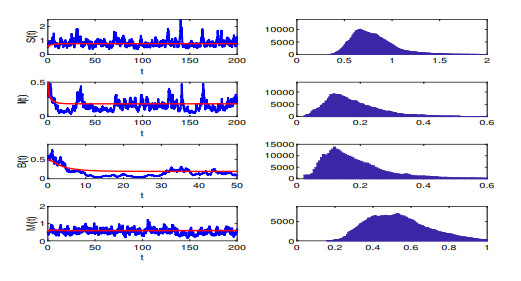
Figure 1.
The stationary distribution of system (2.3) with initial value
$ (S(0), I(0), B(0), M(0))=(0.5, 0.5, 0.5, 0.5) $ -
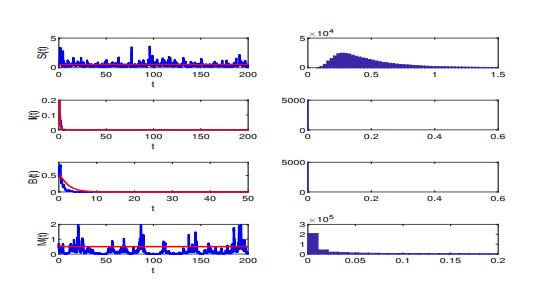
Figure 2.
The extinction of system (2.3) with initial value
$ (S(0), I(0), B(0), M(0))=(0.5, 0.5, 0.5, 0.5) $ -
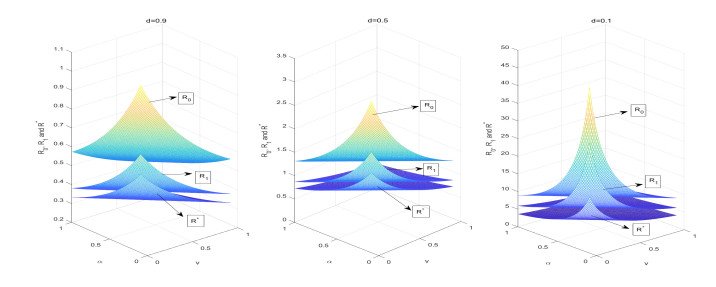
Figure 3.
The trend of
$ R_{0}, \; R_{1}\; \text{and}\; R^{*} $ $ v\; \text{and}\; \alpha $ $ d=0.9, \; d=0.5\; \text{and}\; d=0.1 $ -
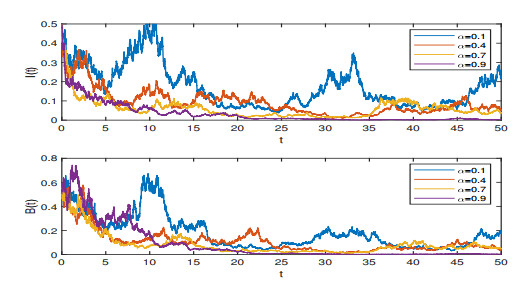
Figure 4.
The influence of system (2.3) under the different
$ \alpha $ $ I(t)\; \text{and}\; B(t) $ $ \alpha=0.1, \; \alpha=0.4, \; \alpha=0.7, \; \alpha=0.9, $ -
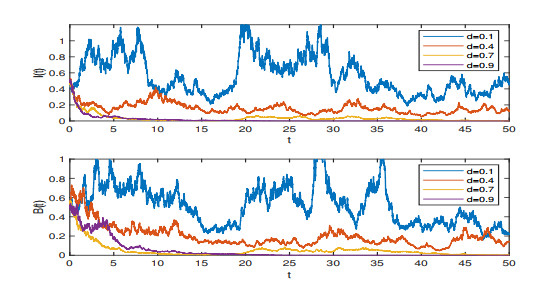
Figure 5.
The influence of system (2.3) under the different
$ d $ $ I(t)\; \text{and}\; B(t) $ $ d=0.1, \; d=0.4, \; d=0.7, \; d=0.9, $ -
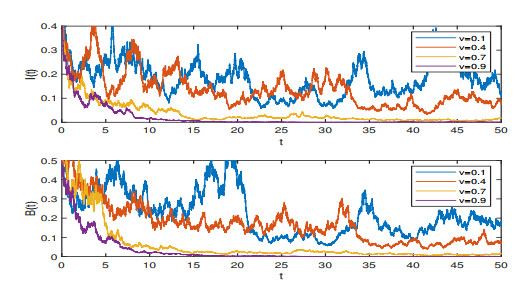
Figure 6.
The influence of system (2.3) under the different
$ v $ $ I(t)\; \text{and}\; B(t) $ $ v=0.1, \; v=0.4, \; v=0.7, \; v=0.9, $