

| Citation: |
Yuting Huang, Fengde Chen, Zhong Li, Lijuan Chen. GLOBAL DYNAMICS OF TWO-SPECIES AMENSALISM SYSTEM WITH SATURATED FEAR AND ALLEE EFFECTS[J]. Journal of Applied Analysis & Computation, 2026, 16(2): 665-704. doi: 10.11948/20250047

|
GLOBAL DYNAMICS OF TWO-SPECIES AMENSALISM SYSTEM WITH SATURATED FEAR AND ALLEE EFFECTS
-
Abstract
This paper proposes and investigates a two-species amensalism system incorporating a Holling-Ⅱ functional response, which integrates both the saturated fear effect and the Allee effect on the first species. We first establish sufficient conditions for the existence and stability of equilibrium points, analyzing saddle-node, transcritical and pitchfork bifurcations while conducting comprehensive global dynamics analysis. Subsequently, stochastic perturbations are introduced to construct a random system, where we observe noise-induced state transitions and estimate the critical noise threshold for such transitions. Finally, numerical simulations are performed to validate the feasibility of the theoretical results. The study shows that excessively high fear does not necessarily lead to the extinction of the first species. Specifically, when the saturation fear parameter exceeds a certain threshold, the first species persists even under extreme fear conditions; however, when below this threshold, high fear levels still lead to extinction, though weak Allee effects significantly slow this process.
-
Keywords:
- Amensalism model /
- saturated fear effect /
- Allee effect /
- bifurcation /
- global dynamics
-

-
References
[1] S. Akimoto, Coexistence and weak amensalism of congeneric gall‐forming aphids on the Japanese elm, Population Ecology, 1995, 37(1), 81-89. doi: 10.1007/BF02515763 [2] A. R. S. Abd Alhadi and R. K. Naji, The contribution of amensalism and parasitism in the three-species ecological system's dynamic, Communications in Mathematical Biology and Neuroscience, 2024, 2024, 33-45. [3] I. Bashkirtseva and L. Ryashko, Sensitivity analysis of stochastic attractors and noise-induced transitions for population model with Allee effect, Chaos: An Interdisciplinary Journal of Nonlinear Science, 2011, 21, 047514. doi: 10.1063/1.3647316 [4] B. Chen, Dynamic behaviors of a non-selective harvesting Lotka–Volterra amensalism model incorporating partial closure for the populations, Advances in Difference Equations, 2018, 2018(1), 1-14. doi: 10.1186/s13662-017-1452-3 [5] F. Chen, W. He and R. Han, On discrete amensalism model of Lotka–Volterra, Journal of Beihua University, 2015, 16, 141-144. [6] F. Chen, M. Zhang and R. Han, Existence of positive periodic solution of a discrete Lotka-Volterra amensalism model, Journal of ShengYang University (Natural Science), 2015, 27(3), 251-254. [7] Y. Chong, Y. Hou, S. Chen and F. Chen, The influence of fear effect to the dynamic behaviors of Lotka-Volterra ammensalism model, Engineering Letters, 2024, 32(6), 1233-1242. [8] A. Dhooge, W. Govaerts and Y. A. Kuznetsov, MATCONT: A MATLAB package for numerical bifurcation analysis of ODEs, ACM Transactions on Mathematical Software (TOMS), 2003, 29(2), 141-164. doi: 10.1145/779359.779362 [9] Y. Dong, D. Wu, C. Shen and L. Ye, Influence of fear effect and predator-taxis sensitivity on dynamical behavior of a predator–prey model, Zeitschrift für Aangewandte Mathematik und Physik, 2022, 73(1), 1-17. [10] X. Guan and F. Chen, Dynamical analysis of a two species amensalism model with Beddington–DeAngelis functional response and Allee effect on the second species, Nonlinear Analysis: Real World Applications, 2019, 48, 71-93. doi: 10.1016/j.nonrwa.2019.01.002 [11] X. Guan, Y. Liu and X. Xie, Stability analysis of a Lotka-Volterra type predator-prey system with Allee effect on the predator species, Communications in Mathematical Biology and Neuroscience, 2018, 2018(1), 9-23. [12] X. Guo, L. Ding, Y. Hui and X. Song, Dynamics of an amensalism system with strong Allee effect and nonlinear growth rate in deterministic and fluctuating environment, Nonlinear Dynamics, 2024, 112(23), 21389-21408. doi: 10.1007/s11071-024-10158-0 [13] M. E. Hibbing, C. Fuqua, M. R. Parsek and S. B. Peterson, Bacterial competition: Surviving and thriving in the microbial jungle, Nature Reviews Microbiology, 2010, 8(1), 15-25. doi: 10.1038/nrmicro2259 [14] Y. Kang and O. Udiani, Dynamics of a single species evolutionary model with Allee effects, Journal of Mathematical Analysis and Applications, 2014, 418(1), 492-515. doi: 10.1016/j.jmaa.2014.03.083 [15] R. Khasminskii, Stochastic Stability of Differential Equations (Vol. 66), Springer Science & Business Media, 2011. [16] C. Lei, Dynamic behaviors of a stage structure amensalism system with a cover for the first species, Advances in Difference Equations, 2018, 2018, 1-23. doi: 10.1186/s13662-017-1452-3 [17] Q. Li, F. Chen, L. Chen and Z. Li, Dynamical analysis of a discrete amensalism system with the Beddington-DeAngelis functional response and fear effect, Journal of Applied Analysis & Computation, 2025, 15(4), 2089-2123. [18] Q. Lin and X. Zhou, On the existence of positive periodic solution of a amensalism model with Holling-Ⅱ functional response, Communications in Mathematical Biology and Neuroscience, 2017, 2017, 3. DOI: 10.28919/cmbn/2809. [19] H. Liu, H. Yu, C. Dai, Z. Ma, Q. Wang and M. Zhao, Dynamical analysis of an aquatic amensalism model with non-selective harvesting and Allee effect, Mathematical Biosciences and Engineering, 2021, 18(6), 8857-8882. doi: 10.3934/mbe.2021437 [20] Y. Liu, L. Zhao, X. Huang and H. Deng, Stability and bifurcation analysis of two-species amensalism model with Michaelis–Menten type harvesting and a cover for the first species, Advances in Difference Equations, 2018, 2018, 1-19. doi: 10.1186/s13662-017-1452-3 [21] D. Luo and Q. Wang, Global dynamics of a Holling-Ⅱ amensalism system with nonlinear growth rate and Allee effect on the first species, International Journal of Bifurcation and Chaos, 2021, 31(03), 2150050. doi: 10.1142/S0218127421500504 [22] D. Luo and Q. Wang, Global dynamics of a Beddington–DeAngelis amensalism system with weak Allee effect on the first species, Applied Mathematics and Computation, 2021, 408, 126368. doi: 10.1016/j.amc.2021.126368 [23] A. U. Mallik, Allelopathy and competition in coniferous forests, Environmental Forest Science, 1998, 54, 309-315. [24] L. Perko, Differential Equations and Dynamical Systems, Springer-Verlag, NY, 2001. [25] J. C. Polking, Ordinary Differential Equations Using MATLAB, Pearson Education India, 2009. [26] S. Schreiber, Allee effects, extinctions, and chaotic transients in simple population models, Theoretical Population Biology, 2003, 64(2), 201-209. doi: 10.1016/S0040-5809(03)00072-8 [27] M. K. Singh, Dynamical study and optimal harvesting of a two-species amensalism model incorporating nonlinear harvesting, Applications & Applied Mathematics, 2023, 18(1), 19. [28] G. Sun, Qualitative analysis on two populations amensalism model, Journal of Jiamusi University, 2003, 21(3), 283-286. [29] J. P. Tripathi, S. S. Meghwani, M. Thakur and S. Abbas, A modified Leslie–Gower predator-prey interaction model and parameter identifiability, Communications in Nonlinear Science and Numerical Simulation, 2018, 54, 331-346. doi: 10.1016/j.cnsns.2017.06.005 [30] S. Wang, Z. Wang, C. Xu and G. Jiao, Sensitivity analysis and stationary probability distributions of a stochastic two-prey one-predator model, Applied Mathematics Letters, 2021, 116, 106996. doi: 10.1016/j.aml.2020.106996 [31] S. Wang, Z. Xie, R. Zhong and Y. Wu, Stochastic analysis of a predator–prey model with modified Leslie–Gower and Holling type Ⅱ schemes, Nonlinear Dynamics, 2020, 101, 1245-1262. doi: 10.1007/s11071-020-05803-3 [32] Z. Wei, Y. Xia and T. Zhang, Stability and bifurcation analysis of an amensalism model with weak Allee effect, Qualitative Theory of Dynamical Systems, 2020, 19, 1-15. doi: 10.1007/s12346-019-00337-5 [33] R. Wu, Dynamic behaviors of a nonlinear amensalism model, Advances in Difference Equations, 2018, 2018, 187. DOI: 10.1186/s13662-018-1624-9. [34] R. Wu, A two species amensalism model with non-monotonic functional response, Communications in Mathematical Biology and Neuroscience, 2016, 2016, 19. [35] R. Wu, L. Li and Q. Lin, A Holling type commensal symbiosis model involving Allee effect, Communications in Mathematical Biology and Neuroscience, 2018. DOI: 10.3934/cmb.2018.6.1. [36] R. Wu, L. Zhao and Q. Lin, Stability analysis of a two species amensalism model with Holling-Ⅱ functional response and a cover for the first species, Journal of Nonlinear Functional Analysis, 2016, 46, 1-15. [37] X. Xi, J. N. Griffin and S. Sun, Grasshoppers amensalistically suppress caterpillar performance and enhance plant biomass in an alpine meadow, Oikos, 2013, 122(7), 1049-1057. doi: 10.1111/j.1600-0706.2012.00126.x [38] X. Xie, F. Chen and M. He, Dynamic behaviors of two species amensalism model with a cover for the first species, Journal of Mathematics and Computer Science, 2016, 16(2), 395-401. [39] W. Yin, Z. Li, F. Chen and M. He, Modeling allee effect in the leslie-gower predator–prey system incorporating a prey refuge, International Journal of Bifurcation and Chaos, 2022, 32(06), 2250086. doi: 10.1142/S0218127422500869 [40] J. Zhang, Bifurcated periodic solutions in an amensalism system with strong generic delay kernel, Mathematical Methods in the Applied Sciences, 2013, 36(1), 113-124. doi: 10.1002/mma.2575 [41] Z. Zhang, Stability and bifurcation analysis for an amensalism system with delays, Mathematica Numerica Sinica, 2008, 30(2), 213-224. [42] Z. Zhang, T. Ding, W. Huang and Z. Dong, Qualitative Theory of Differential Equations, Science Press, Beijing, 1997. [43] M. Zhao and Y. Du, Stability and bifurcation analysis of an amensalism system with Allee effect, Advances in Difference Equations, 2020, 2020, 1-13. doi: 10.1186/s13662-019-2438-0 [44] M. Zhao, Y. Ma and Y. Du, Global dynamics of an amensalism system with Michaelis-Menten type harvesting, Electronic Research Archive, 2023, 31(2), 549-574. doi: 10.3934/era.2023027 [45] Q. Zhou and F. Chen, Dynamical analysis of a discrete amensalism system with the Beddington–DeAngelis functional response and Allee effect for the unaffected species, Qualitative Theory of Dynamical Systems, 2023, 22(1), 16. doi: 10.1007/s12346-022-00716-5 [46] Q. Zhu, F. Chen, Z. Li and L. Chen, Global dynamics of two-species amensalism model with Beddington–DeAngelis functional response and fear effect, International Journal of Bifurcation and Chaos, 2024, 34(06), 245007. -
-
Figures(24) / Tables(2)
Export File
Citation
Yuting Huang, Fengde Chen, Zhong Li, Lijuan Chen. GLOBAL DYNAMICS OF TWO-SPECIES AMENSALISM SYSTEM WITH SATURATED FEAR AND ALLEE EFFECTS[J]. Journal of Applied Analysis & Computation, 2026, 16(2): 665-704. doi: 10.11948/20250047
Format
Content
 DownLoad:
-
Figure 1.
(a)
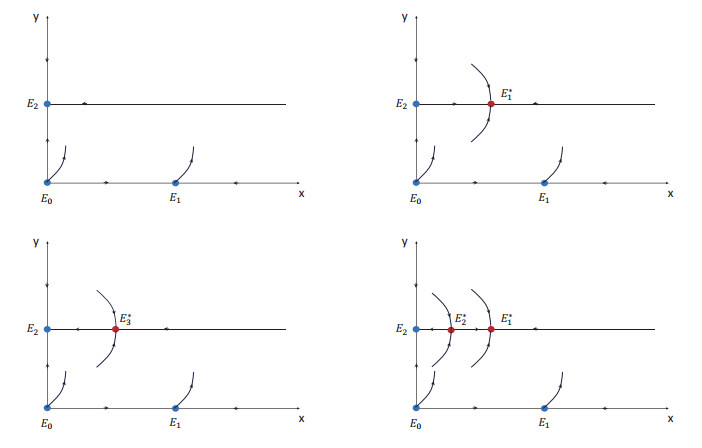
$ 0<c<c^{**} $ $ E_2 $ $ c>c^{**} $ $ E_2 $ $ c=c^{**} $ $ \eta\neq \eta^* $ $ E_2 $ $ c=c^{**} $ $ \eta= \eta^* $ $ E_2 $ -
Figure 2.
(a)
$ 0<c\leq c^{**} $ $ E_1^* $ $ c^{**}<c<c^* $ $ \eta>\eta^* $ $ E_1^* $ $ E_2^* $ $ c=c^{*} $ $ \eta>\eta^* $ $ E_3^* $ -
Figure 3.
The qualitative properties of the equilibria for
$ G_1,\ G_2,\ G_3 $ $ G_4 $ -
Figure 4.
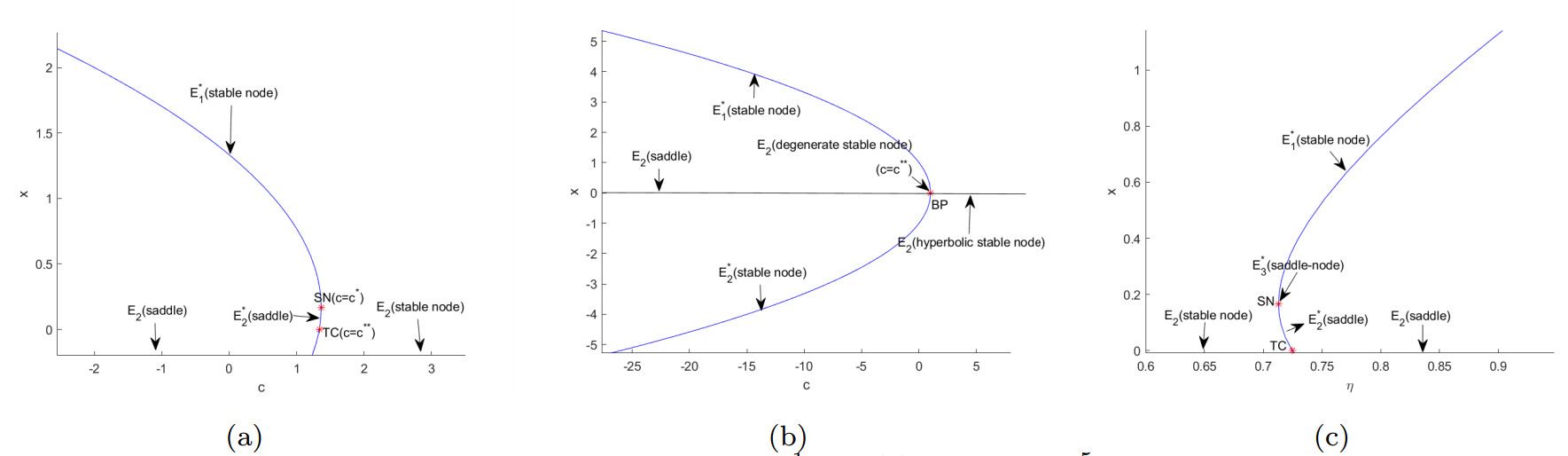
System (1.7) experiences a transcritical bifurcation at
$ E_2 $ -
Figure 5.
In (a)-(c), system (1.7) experiences a pitchfork bifurcation at
$ E_2 $ $ E_3^* $ -
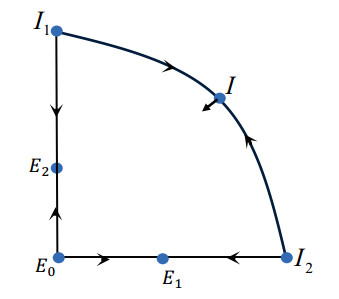
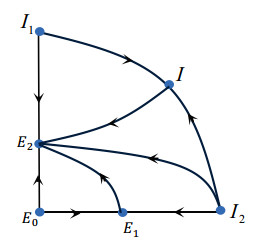
Figure 6.
The dynamics of system (1.7) near infinity.
-
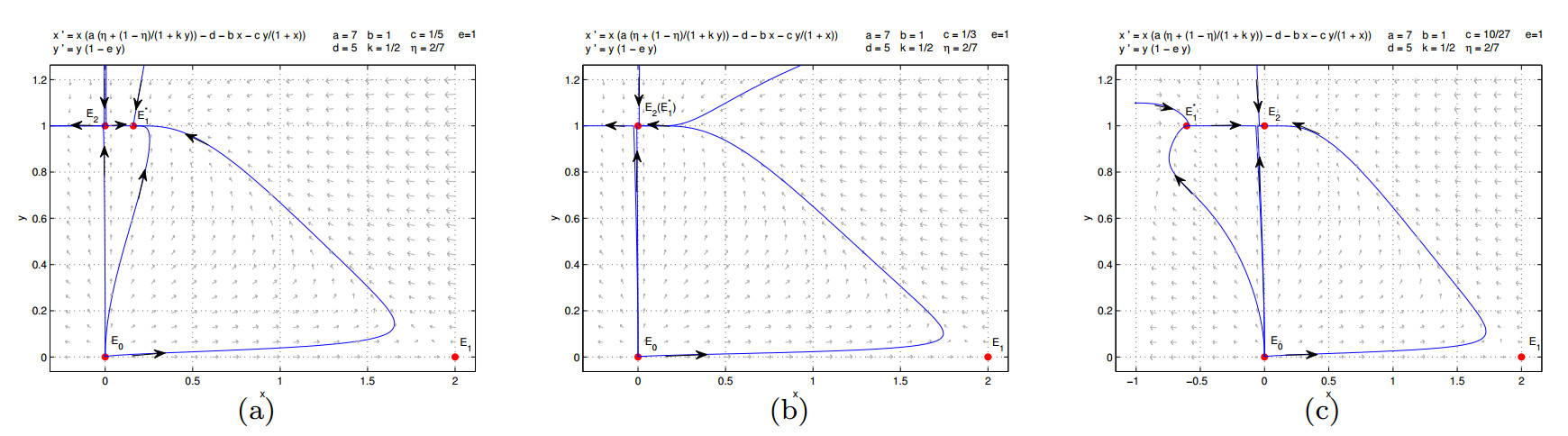
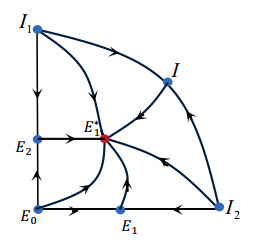
Figure 7.
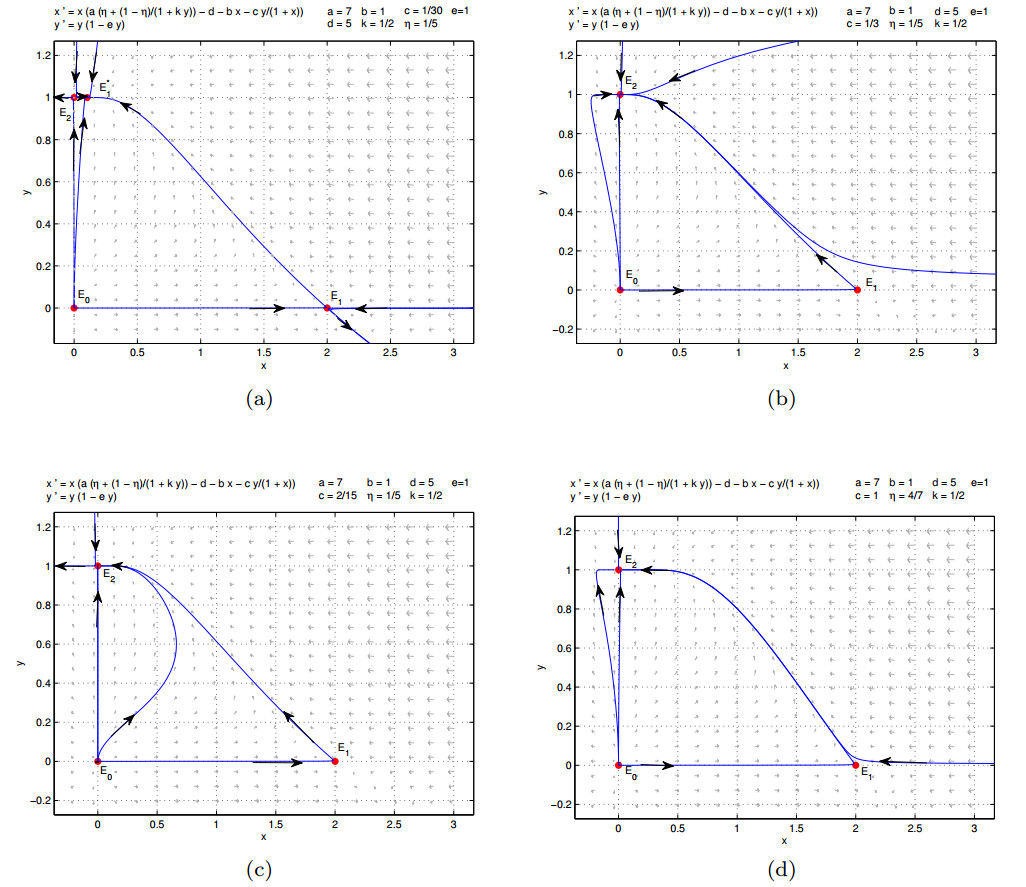
Global phase portraits of the system (1.7) in G1.
-
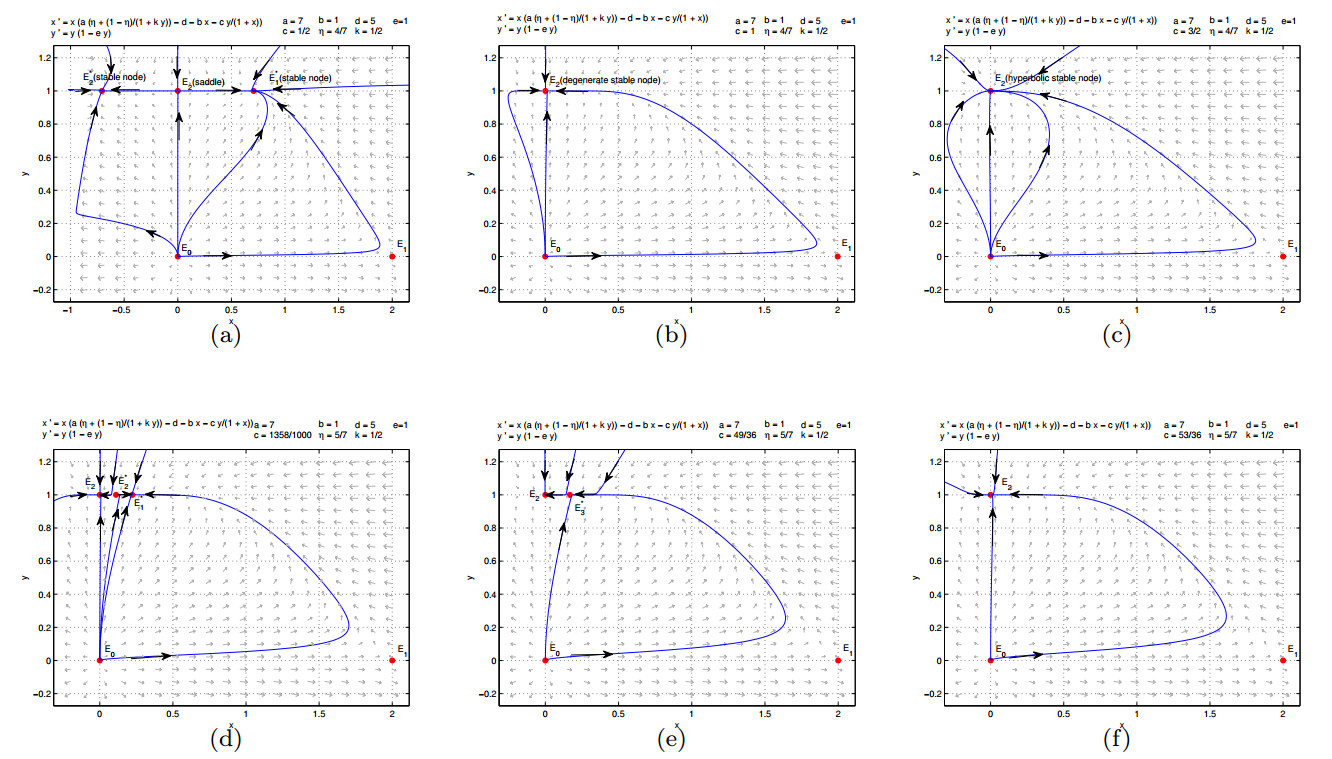
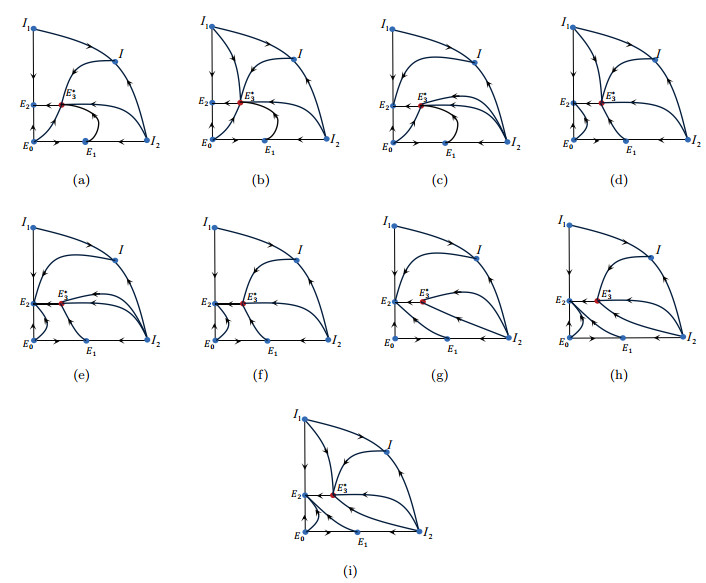
Figure 8.
Global phase portraits of the system (1.7) in G2.
-
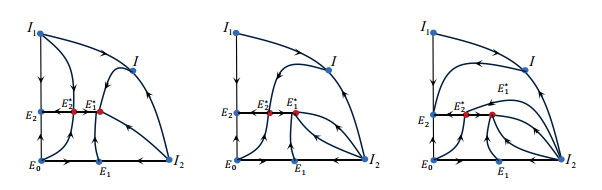
Figure 9.
Global phase portraits of the system (1.7) in
$ G_3 $ -
Figure 10.
Global phase portraits of the system (1.7) in G4.
-
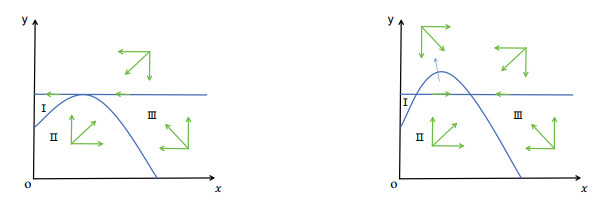
Figure 11.
The horizontal isocline
$ \frac{d x}{d t}=0 $ $ \frac{d y}{d t}=0 $ -
Figure 12.
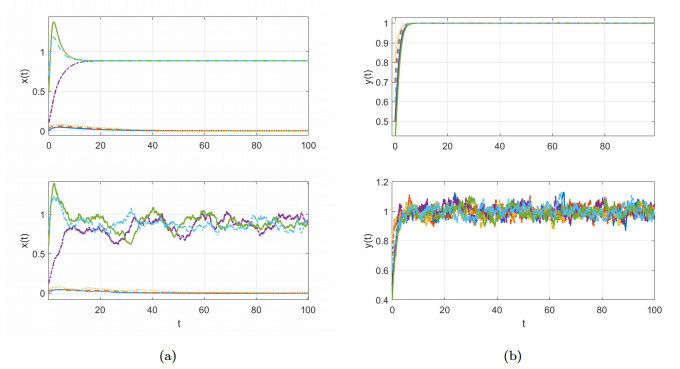
Taking the intial values as (0.01, 0.5), (0.03, 0.7), (0.05, 0.7), (0.2, 0.5), (0.5, 0.4), (0.8, 0.6)), plot the time series of populations x and y for the deterministic system (1.7) and the stochastic system (3.1) with σ = 0.05.
-
Figure 13.
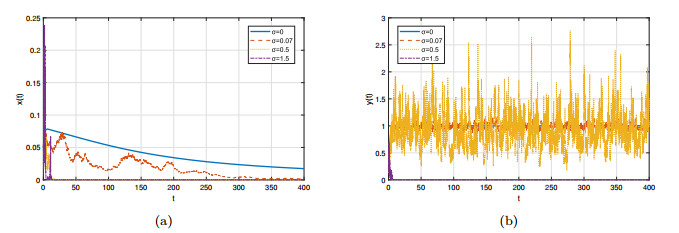
Take the initial value as (0.05, 0.7). When σ = 0.07, 0.5, 1.5, plot the time series of the two populations in the stochastic system (3.1).
-
Figure 14.
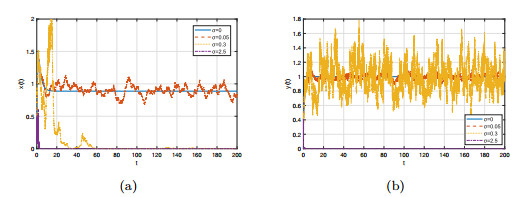
Take the initial value as (0.5, 0.4). When σ = 0.05, 0.3, 2.5, plot the time series of the two populations in the stochastic system (3.1).
-
Figure 15.
Fix parameters
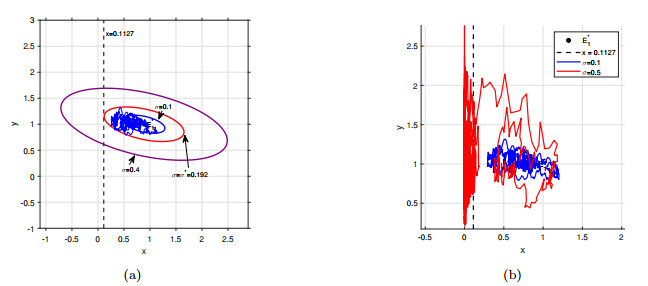
$ (a,b,c,d,e,k,\eta)=(4,1,\frac{21}{10},1,1,1,\frac{1}{2}) $ $ \sigma=0.1 $ $ E_1^* $ $ \sigma=0.1,\ 0.192 $ $ 0.4 $ $ \sigma=0.1,\ 0.5 $ -
Figure 16.
Fix parameters
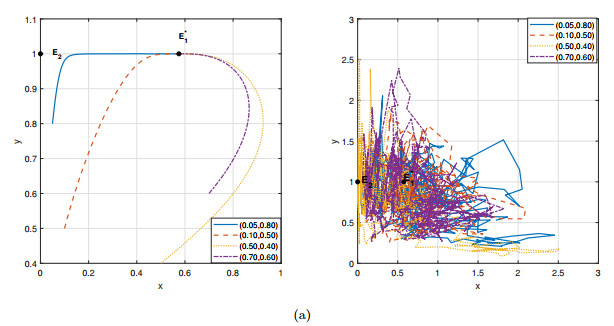
$ (a,b,c,d,e,k,\eta)=(7,1,\frac{43}{36},5,1,\frac{1}{2},\frac{5}{7}) $ $ (0.05,0.8),(0.1,0.5),(0.5,0.4),(0.7,0.6)) $ $ \sigma=0.5 $ -
Figure 17.
Fix parameters
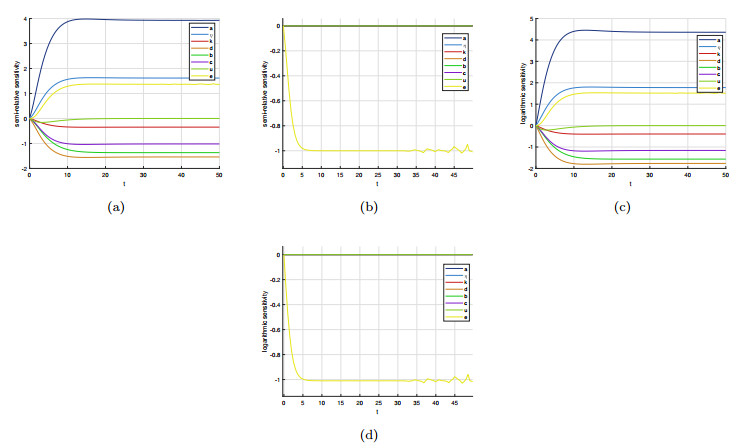
$ (a,b,c,d,e,k,\eta,u)=(3,1,1.25,1,1,1,0.7,1) $ -
Figure 18.
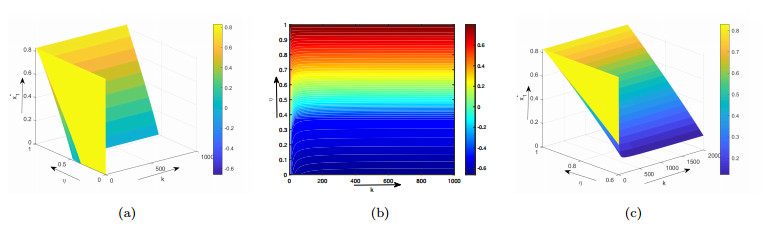
(a) Fix parameters (a, b, c, d, e, u) = (3, 1, 1.25, 1, 1, 1), (a) 3D plot of (k, η, x1*): The effects of fear level k and saturation parameter η on x1*, (b) contour plot corresponding to Figure (a), (c) 3D plot of (k, η, x1*) with k ∈ (0, 2000) and η ∈ (0.6, 1).
-
Figure 19.
In (a), both species coexist when
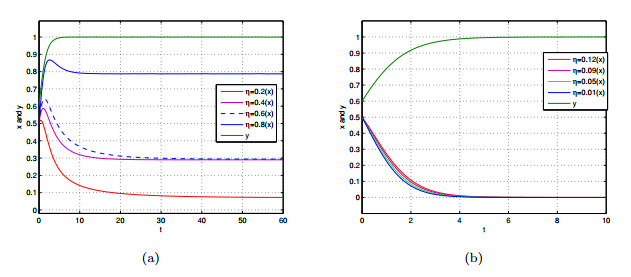
$ \eta>\eta^{**} $ $ \eta<\eta^{**} $ -
Figure 20.
In (a), both species cohabit when
$ \eta>\eta^* $ $ \eta<\eta^* $ -
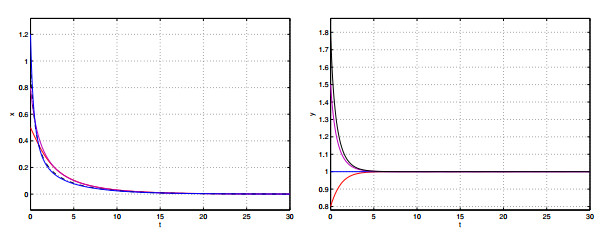
Figure 21.
Taking the initial values as
$ (0.5,0.8),\ (0.8,1.0),\ (1.0,1.5) $ $ (1.2,1.8) $ -
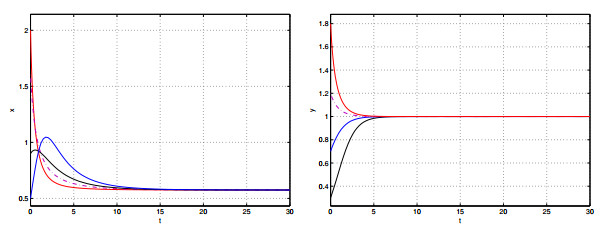
Figure 22.
Taking the initial values as
$ (2,1.8),\ (1.6,1.2),\ (0.9,0.7) $ $ (0.5,0.3) $ -
Figure 23.
Parameters:
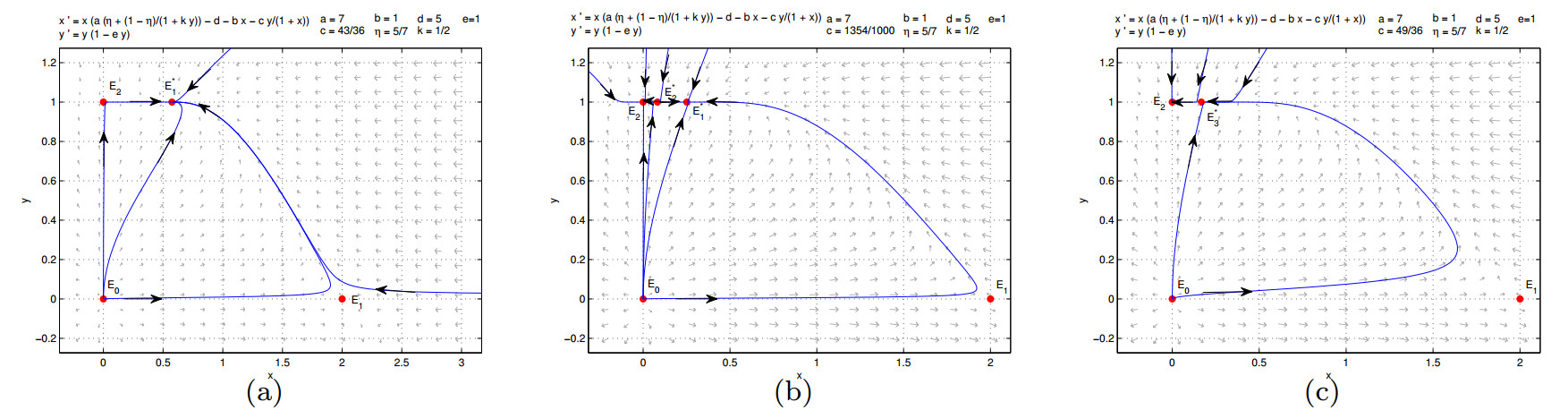
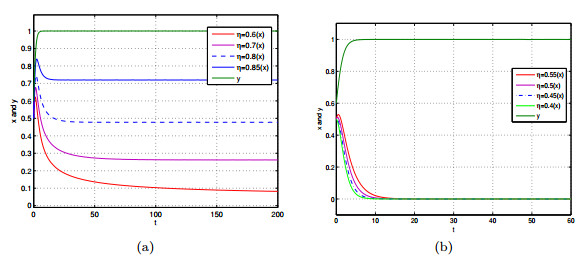
$ a=7,\ b=e=1,\ d=5,\ k=\frac{1}{2}. $ $ \eta=\frac{5}{7} $ $ c=c^*=\frac{49}{36} $ $ c=c^{**}=\frac{4}{3} $ $ \eta=\frac{4}{7} $ $ c=c^{**}=1 $ $ c = 1.358 $ -
Figure 24.
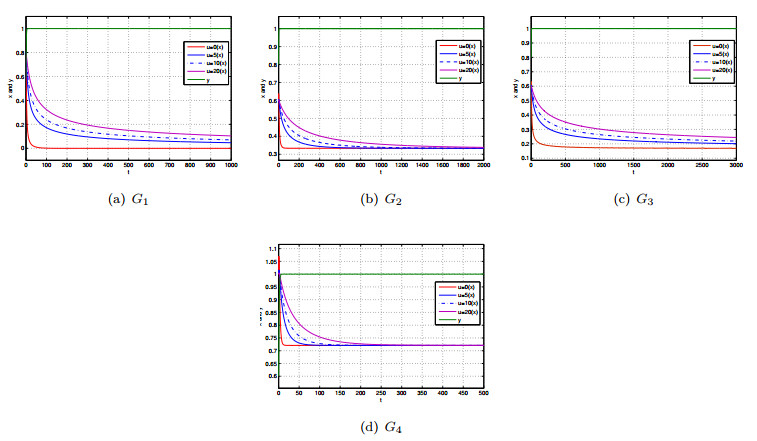
The impact of weak Allee effect on the first species in
$ G_i(i = 1, 2, 3, 4) $