

| Citation: |
Jingyi Zhao, Zongbin Yin, Yongchang Wei, Jinhai Guo. STOCHASTIC ANALYSIS OF A GENERAL HOLLING TYPE PREDATOR-PREY MODEL WITH REGIME-SWITCHING AND HABITAT COMPLEXITY[J]. Journal of Applied Analysis & Computation, 2026, 16(2): 636-664. doi: 10.11948/20250131

|
STOCHASTIC ANALYSIS OF A GENERAL HOLLING TYPE PREDATOR-PREY MODEL WITH REGIME-SWITCHING AND HABITAT COMPLEXITY
-
Abstract
This paper examines a generic predator-prey model of the Holling type that takes into account habitat complexity and Markovian chains. We first establish the existence and uniqueness of a global positive solution through rigorous stochastic analysis. Subsequently, we derive sharp threshold conditions governing population persistence and extinction, revealing that while moderate environmental noise may enhance species survival, excessive stochasticity inevitably leads to population collapse. Furthermore, we prove the existence of a unique stationary distribution by constructing appropriate Lyapunov functionals. Finally, the results of the numerical simulations are presented in order to illustrate the experimental findings.
-

-
References
[1] M. Aziz-Alaoui and M. Okiye, Boundedness and global stability for a predator-prey model with modified Leslie-Gower and Holling-type Ⅱ schemes, Appl. Math. Lett., 2003, 16, 1069–1075. doi: 10.1016/S0893-9659(03)90096-6 [2] J. Bao and J. Shao, Permanence and extinction of regime-switching predator-prey models, SIAM J. Math. Anal., 2016, 48, 725–739. doi: 10.1137/15M1024512 [3] M. Belabbas, A. Ouahab and F. Souna, Rich dynamics in a stochastic predator-prey model with protection zone for the prey and multiplicative noise applied on both species, Nonlinear Dyn., 2021, 106, 2761–2780. doi: 10.1007/s11071-021-06903-4 [4] S. Bell, E. McCoy and H. Mushinsky, Habitat Structure: The Physical Arrangement of Objects in Space, Springer Science & Business Media, 2012. [5] N. Beroual and T. Sari, A predator-prey system with Holling-type functional response, Proc. Amer. Math. Soc., 2020, 148, 5127–5140. doi: 10.1090/proc/15166 [6] J. Clark, Stability of predation ecosystem models, Ecology, 1976, 57, 1321–1325. doi: 10.2307/1935058 [7] J. Dawes and M. Souza, A derivation of Holling's type Ⅰ, Ⅱ and Ⅲ functional responses in predator-prey systems, J. Theor. Biol., 2013, 327, 11–22. doi: 10.1016/j.jtbi.2013.02.017 [8] S. Debnath, P. Majumdar, S. Sarkar and U. Ghosh, Global dynamics of a prey-predator model with Holling type Ⅲ functional response in the presence of harvesting, J. Biol. Syst., 2022, 30, 225–260. doi: 10.1142/S0218339022500073 [9] H. Freedman and P. Moson, Persistence definitions and their connections, Proc. Amer. Math. Soc., 1990, 109, 1025–1033. doi: 10.1090/S0002-9939-1990-1012928-6 [10] S. Gakkhar and R. Naji, On a food web consisting of a specialist and a generalist predator, J. Biol. Syst., 2003, 11, 365–376. doi: 10.1142/S0218339003000956 [11] J. Grabowski, Habitat complexity disrupts predator-prey interactions but not the trophic cascade on oyster reefs, Ecology, 2004, 85, 995–1004. doi: 10.1890/03-0067 [12] J. Hainzl, Stability and Hopf bifurcation in a predator-prey system with several parameters, SIAM J. Appl. Math., 1988, 48, 170–190. doi: 10.1137/0148008 [13] A. Hastings and T. Powell, Chaos in three-species food chain, Ecology, 1991, 72, 896–903. doi: 10.2307/1940591 [14] D. Higham, An algorithmic introduction to numerical simulation of stochastic differential equations, SIAM Rev., 2001, 43, 525–546. doi: 10.1137/S0036144500378302 [15] C. Holling, The components of predation as revealed by a study of small-mammal predation of the european pine sawfly, Canadian Entomologist., 1959, 91, 293–320. doi: 10.4039/Ent91293-5 [16] D. Jana and N. Bairagi, Habitat complexity, dispersal and metapopulations: Macroscopic study of a predator-prey system, Ecol. Complex., 2014, 17, 131–139. doi: 10.1016/j.ecocom.2013.11.006 [17] X. Jiang, L. Zu, D. Jiang and D. O'Regan, Analysis of a stochastic Holling type Ⅱ predator-prey model under regime switching, Bull. Malays. Math. Sci. Soc., 2020, 43, 2171–2197. doi: 10.1007/s40840-019-00798-6 [18] R. Khasminskii, C. Zhu and G. Yin, Stability of regime-switching diffusions, Stoch. Process Appl., 2007, 117, 1037–1051. doi: 10.1016/j.spa.2006.12.001 [19] S. Lassau and D. Hochuli, Effects of habitat complexity on ant assemblages, Ecography, 2004, 27, 157–164. doi: 10.1111/j.0906-7590.2004.03675.x [20] G. Li and Q. Yang, Dynamics of a stochastic Holling Ⅱ predator-prey model with Lévy jumps and habitat complexity, Int. J. Biomath., 2021, 14, 2150077. doi: 10.1142/S1793524521500777 [21] X. Li, A. Gray, D. Jiang and X. Mao, Sufficient and necessary conditions of stochastic permanence and extinction for stochastic logistic populations under regime switching, J. Math. Anal. Appl., 2011, 376, 11–28. doi: 10.1016/j.jmaa.2010.10.053 [22] X. Li and X. Mao, Population dynamical behavior of non-autonomous Lotka-Volterra competitive system with random perturbation, Discrete Contin. Dyn. Syst., 2009, 24, 523–593. doi: 10.3934/dcds.2009.24.523 [23] R. Lipster, A strong law of large numbers for local martingales, Stochastic, 1980, 3, 217–228. doi: 10.1080/17442508008833146 [24] M. Liu, X. He and J. Yu, Dynamics of a stochastic regime-switching predator-prey model with harvesting and distributed delays, Nonlinear Anal. Hybri., 2018, 28, 87–104. doi: 10.1016/j.nahs.2017.10.004 [25] M. Liu and K. Wang, Persistence and extinction of a stochastic single-specie model under regime switching in a polluted environment, J. Theor. Biol., 2010, 264, 934–944. doi: 10.1016/j.jtbi.2010.03.008 [26] M. Liu and K. Wang, Survival analysis of a stochastic cooperation system in a polluted environment, J. Biol. Syst., 2011, 19, 183–204. doi: 10.1142/S0218339011003877 [27] Q. Liu and D. Jiang, Stationary distribution and extinction of a stochastic one-prey two-predator model with Holling type Ⅱ functional response, Stoch. Anal. Appl., 2019, 37, 321–345. doi: 10.1080/07362994.2019.1566005 [28] Q. Liu, D. Jiang, T. Hayat and A. Alsaedi, Stationary distribution and extinction of a stochastic predator-prey model with herd behavior, J. Franklin Inst., 2018, 355, 8177–8193. doi: 10.1016/j.jfranklin.2018.09.013 [29] A. Lotka, Elements of physical biology, Williams and Wilkins Company, Baltimore. MD, 1925, 20, 452. [30] J. Lv and K. Wang, Asymptotic properties of a stochastic predator-prey system with Holling Ⅱ functional response, Commun. Nonlinear Sci. Numer. Simul., 2011, 16, 4037–4048. doi: 10.1016/j.cnsns.2011.01.015 [31] Z. Ma and S. Wang, A delay-induced predator-prey model with Holling type functional response and habitat complexity, Nonlinear Dyn., 2018, 93, 1519–1544. doi: 10.1007/s11071-018-4274-2 [32] X. Mao and C. Yuan, Stochastic Differential Equations with Markovian Switching, London, UK, Imperial College Press, 2006. [33] H. Molla, M. Sabiar Rahman and S. Sarwardi, Dynamics of a predator-prey model with Holling type Ⅱ functional response incorporating a prey refuge depending on both the species, Int. J. Nonlin. Sci. Numer. Simul., 2019, 20, 89–104. doi: 10.1515/ijnsns-2017-0224 [34] P. Pal, P. Mandal and K. Lahiri, A delayed ratio-dependent predator-prey model of interacting populations with Holling type Ⅲ functional response, Nonlinear Dyn., 2014, 76, 201–220. doi: 10.1007/s11071-013-1121-3 [35] H. Qi, X. Meng, T. Hayat and A. Hobiny, Stationary distribution of a stochastic predator-prey model with hunting cooperation, Appl. Math. Lett., 2022, 124, 107662. doi: 10.1016/j.aml.2021.107662 [36] M. Rosenzweig and R. MacArthur, Graphical representation and stability conditions of predator-prey interactions, Am. Nat., 1963, 97, 209–223. doi: 10.1086/282272 [37] S. Sengupta, P. Das and D. Mukjerjee, Stochastic non-autonomous Holling type-Ⅲ prey-predator model with predator's Intra-Specific competition, Discrete Contin. Dyn. Syst. B, 2018, 23, 3275–3296. doi: 10.3934/dcdsb.2018244 [38] A. Settati and A. Lahrouz, Stationary distribution of stochastic population systems under regime switching, Appl. Math. Comput., 2014, 244, 235–243. [39] F. Souna, M. Belabbas and Y. Menacer, Complex pattern formations induced by the presence of cross-diffusion in a generalized predator-prey model incorporating the Holling type functional response and generalization of habitat complexity effect, Math. Comput. Simul., 2023, 204, 597–618. doi: 10.1016/j.matcom.2022.09.004 [40] F. Souna, S. Djilali and F. Charif, Mathematical analysis of a diffusive predator-prey model with herd behavior and prey escaping, Math. Model. Nat. Pheno., 2020, 15, 23. doi: 10.1051/mmnp/2019044 [41] F. Souna and A. Lakmeche, Spatiotemporal patterns in a diffusive predator-prey system with Leslie-Gower term and social behavior for the prey, Math. Method. Appl. Sci., 2021, 44, 13920–13944. doi: 10.1002/mma.7666 [42] F. Souna, A. Lakmeche and S. Djilali, Spatiotemporal patterns in a diffusive predator-prey model with protection zone and predator harvesting, Chaos Solitons Fractals, 2020, 140, 110180. doi: 10.1016/j.chaos.2020.110180 [43] F. Souna, P. Tiwari, M. Belabbas and Y. Menacer, A predator-prey system with prey social behavior and generalized Holling Ⅲ functional response: Role of predator-taxis on spatial patterns, Math. Method. Appl. Sci., 2023, 46, 13991–14006. doi: 10.1002/mma.9300 [44] P. Srinivasu and I. Gayitri, Influence of prey reserve capacity on predator-prey dynamics, Ecol. Model., 2005, 181, 191–202. doi: 10.1016/j.ecolmodel.2004.06.031 [45] B. Tian, L. Yang and S. Zhong, Global stability of a stochastic predator-prey model with Allee effect, Int. J. Biomath., 2015, 8, 1550044. doi: 10.1142/S1793524515500448 [46] V. Volterra, Variazioni e fluttuazioni del numero d-individui in specie animali conviventi, Mem. Acad. Lincei. Roma., 1926, 2, 31–113. [47] Z. Wang, M. Deng and M. Liu, Stationary distribution of a stochastic ratio-dependent predator-prey system with regime-switching, Chaos Solitons Fractals, 2021, 142, 110462. doi: 10.1016/j.chaos.2020.110462 [48] R. Xu, M. Chaplain and F. Davidson, Periodic solutions for a predator-prey model with Holling-type functional response and time delays, Appl. Math. Comput., 2005, 161, 637–654. [49] D. Xu, M. Liu and X. Xu, Analysis of a stochastic predator-prey system with modified Leslie-Gower and Holling-type Ⅳ schemes, Phy. A, 2020, 537, 122761. doi: 10.1016/j.physa.2019.122761 [50] X. Yu, S. Yuan and T. Zhang, Persistence and ergodicity of a stochastic single species model with Allee effect under regime switching, Commun. Nonlinear Sci. Numer. Simul., 2018, 59, 359–374. doi: 10.1016/j.cnsns.2017.11.028 [51] J. Zhan and Y. Wei, Dynamical behavior of a stochastic non-autonomous distributed delay heroin epidemic model with regime-switching, Chaos Solitons Fractals, 2024, 184, 115024. doi: 10.1016/j.chaos.2024.115024 [52] J. Zhan and Y. Wei, Long time behavior for a stochastic heroin epidemic model under regime switching, Math. Method. Appl. Sci., 2025, 48, 11735–11749. doi: 10.1002/mma.10990 [53] X. Zhang, Y. Li and D. Jiang, Dynamics of a stochastic Holling type Ⅱ predator-prey model with hyperbolic mortality, Nonlinear Dyn., 2017, 87, 2011–2020. doi: 10.1007/s11071-016-3172-8 [54] C. Zhu and G. Yin, Asymptotic properties of hybrid diffusion systems, SIAM J. Control Optim., 2007, 46, 1155–1179. doi: 10.1137/060649343 -
-

Figures(4) / Tables(6)
Export File
Citation
Jingyi Zhao, Zongbin Yin, Yongchang Wei, Jinhai Guo. STOCHASTIC ANALYSIS OF A GENERAL HOLLING TYPE PREDATOR-PREY MODEL WITH REGIME-SWITCHING AND HABITAT COMPLEXITY[J]. Journal of Applied Analysis & Computation, 2026, 16(2): 636-664. doi: 10.11948/20250131
Format
Content
 DownLoad:

-
Figure 1.
(a) The movement of the Markov chain
$ \gamma(t) $ $ y(t) $ $ y(t) $ $ y(t) $ -
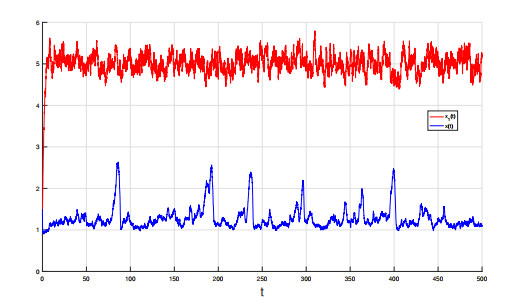
Figure 2.
The simulation of the prey
$ x(t) $ $ x_1(t) $ -
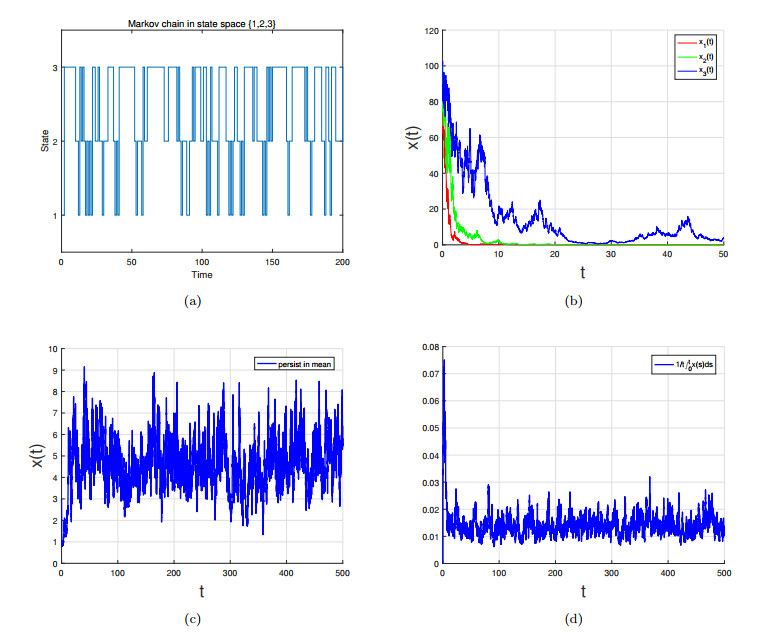
Figure 3.
(a) The movement of the Markov chain
$ \gamma(t) $ $ x(t) $ $ x(t) $ $ x(t) $ -
Figure 4.
(a) The movement of the Markov chain
$ \gamma(t) $ $ x(t) $ $ x(t) $ $ x(t) $ $ x(t) $ $ x(t) $ $ y(t) $ $ y(t) $