

| Citation: |
Fengqing Li, Zhengge Huang, Jingjing Cui, Xiuwen Zheng. DIAGONAL AND NEW MODIFIED GRADIENT-BASED ITERATIVE ALGORITHMS FOR SYLVESTER TENSOR EQUATIONS[J]. Journal of Applied Analysis & Computation, 2026, 16(2): 579-635. doi: 10.11948/20240566

|
DIAGONAL AND NEW MODIFIED GRADIENT-BASED ITERATIVE ALGORITHMS FOR SYLVESTER TENSOR EQUATIONS
-
Abstract
The main objective of this work is to construct some new gradient-based iterative (GI)-like algorithms for solving the (coupled) Sylvester tensor equations. In this paper, we first derive the optimal parameter and the corresponding optimal convergence factor of the GI algorithm (Math. Probl. Eng. 819479 (2013) 1-7) in terms of matricization of a tensor and straightening operator. In order to reduce the computation cost of each iteration of the GI algorithm, enlightened by the idea of the Jacobi method, we replace the system matrices in the GI algorithm by their diagonal parts, and design the diagonal GI (DGI) algorithm for the Sylvester tensor equations. And we derive the sufficient convergence condition, quasi-optimal parameter and quasi-optimal convergence factor of the DGI algorithm. Furthermore, we apply a new update strategy to the GI algorithm and develop the new modified GI (NMGI) algorithm for the Sylvester tensor equations. The proposed NMGI algorithm is different from the MGI one (Math. Probl. Eng. 819479 (2013) 1-7), and can make more full use of the latest computed results and has faster convergence rate than the MGI one for many cases. Also, by utilizing the properties of the tensor norm and techniques of inequalities, we prove that the proposed NMGI algorithm is convergent under proper restrictions. Lastly, some numerical examples are given to validate the efficiencies and advantages of the proposed algorithms for the (coupled) Sylvester tensor equations.
-

-
References
[1] Z. -Z. Bai, On Hermitian and skew-Hermitian splitting iteration methods for continuous Sylvester equations, Journal of Computational Mathematics, 2011, 185-198. [2] U. Baur and P. Benner, Cross-Gramian based model reduction for data-sparse systems, Electronic Transactions on Numerical Analysis, 2008, 31, 256-270. [3] F. P. A. Beik, M. Najafi-Kalyani and L. Reichel, Iterative Tikhonov regularization of tensor equations based on the Arnoldi process and some of its generalizations, Applied Numerical Mathematics, 2020, 151, 425-447. doi: 10.1016/j.apnum.2020.01.011 [4] F. P. A. Beik and F. S. Movahed and S. Ahmadi-Asl, On the Krylov subspace methods based on tensor format for positive definite Sylvester tensor equations, Numerical Linear Algebra with Applications, 2016, 23, 444-466. doi: 10.1002/nla.2033 [5] D. Calvetti and L. Reichel, Application of ADI iterative methods to the restoration of noisy images, SIAM Journal on Matrix Analysis and Applications, 1996, 17, 165-186. doi: 10.1137/S0895479894273687 [6] Z. Chen and L. -Z. Lu, A gradient based iterative solutions for Sylvester tensor equations, Mathematical Problems in Engineering, 2013, 2013, 819479. [7] D. -L. Chu and V. Mehrmann, CDisturbance decoupling for descriptor systems by state feedback, SIAM Journal on Control and Optimization, 2000, 38, 1830-1858. doi: 10.1137/S0363012900331891 [8] M. Dehghan and M. Hajarian, An iterative method for solving the generalized coupled Sylvester matrix equations over generalized bisymmetric matrices, Applied Mathematical Modelling, 2010, 34, 639-654. doi: 10.1016/j.apm.2009.06.018 [9] F. Ding and T. -W. Chen, Iterative least-squares solutions of coupled Sylvester matrix equations, Systems & Control Letters, 2005, 54, 95-107. [10] F. Ding and T. -W. Chen, Hierarchical identification of lifted state-space models for general dual-rate systems, IEEE Transactions on Circuits and Systems Ⅰ: Regular Papers, 2005, 52, 1179-1187. doi: 10.1109/TCSI.2005.849144 [11] F. Ding and T. -W. Chen, On iterative solutions of general coupled matrix equations, SIAM Journal on Control and Optimizatio, 2006, 44, 2269-2284. doi: 10.1137/S0363012904441350 [12] F. Ding and T. -W. Chen, Hierarchical least squares identification methods for multivariable systems, IEEE Transactions on Automatic control, 2005, 50, 397-402. doi: 10.1109/TAC.2005.843856 [13] F. Ding and T. -W. Chen, Gradient based iterative algorithms for solving a class of matrix equations, IEEE Transactions on Automatic Control, 2005, 50, 1216-1221. doi: 10.1109/TAC.2005.852558 [14] F. Ding, P. -X. Liu and J. Ding, Iterative solutions of the generalized Sylvester matrix equations by using the hierarchical identification principle, Applied Mathematics and Computation, 2008, 197, 41-50. doi: 10.1016/j.amc.2007.07.040 [15] G. H. Gloub and C. F. Van Loan, Matrix Computations, Johns Hopkins Universtiy Press, 3rd edtion, 1996. [16] G. H. Golub, S. Nash and C. V. Loan, A Hessenberg-Schur method for the problem $ AX+ XB= C$, IEEE Transactions on Automatic Control, 1979, 24, 909-913. doi: 10.1109/TAC.1979.1102170 [17] J. Heinen, A technique for solving the extended discrete Lyapunov matrix equation, IEEE Transactions on Automatic Control, 1972, 17, 156-157. doi: 10.1109/TAC.1972.1099898 [18] Z. -G. Huang and J. -J. Cui, Modified and accelerated relaxed gradient based iterative algorithms for the complex conjugate and transpose matrix equations, Numerical Algorithms, 2024, 97, 1955-2009. doi: 10.1007/s11075-024-01775-2 [19] A. Kaabi, A. Kerayechian and F. Toutounian, A new version of successive approximations method for solving Sylvester matrix equations, Applied Mathematics and Computation, 2007, 186, 638-645. doi: 10.1016/j.amc.2006.08.007 [20] A. Kaabi, F. Toutounian and A. Kerayechian, Preconditioned Galerkin and minimal residual methods for solving Sylvester equations, Applied Mathematics and Computation, 2006, 181, 1208-1214. doi: 10.1016/j.amc.2006.02.021 [21] Y. -F. Ke, Finite iterative algorithm for the complex generalized Sylvester tensor equations, Journal of Applied Analysis and Computation, 2020, 10, 972-985. doi: 10.11948/20190178 [22] T. G. Kolda, Multilinear Operators for Higher-Order Decompositions, Tech. rep., Sandia National Laboratories, Albuquerque, NM, and Livermore, CA, 2006. [23] T. G. Kolda and B. W. Bader, Tensor decompositions and applications, SIAM Review, 2009, 51, 455-500. doi: 10.1137/07070111X [24] B. -W. Li, S. Tian and Y. -S. Sun, Schur-decomposition for 3D matrix equations and its application in solving radiative discrete ordinates equations discretized by Chebyshev collocation spectral method, Journal of Computational Physics, 2010, 229, 1198-1212. doi: 10.1016/j.jcp.2009.10.025 [25] C. -X. Li and S. -L. Wu, The SHSS preconditioner for saddle point problems, Journal of Applied Analysis and Computation, 2023, 13, 3221-3230. doi: 10.11948/20220552 [26] H. -K. Li and R. -R. Li, A note on the inversion of Sylvester matrices in control systems, Mathematical Problems in Engineering, 2011, 2011, 609863. [27] J. -H. Li, F. Ding and G. -W. Yang, Maximum likelihood least squares identification method for input nonlinear finite impulse response moving average systems, Mathematical and Computer Modelling, 2012, 55, 442-450. [28] T. Li, Q. -W. Wang and X. -F. Zhang, Gradient based iterative methods for solving symmetric tensor equations, Numerical Linear Algebra with Applications, 2022, 29, e2414. [29] Y. -Q. Lin, Implicitly restarted global FOM and GMRES for nonsymmetric matrix equations and Sylvester equations, Applied Mathematics and Computation, 2005, 167, 1004-1025. [30] F. Saberi-Movahed, A. Tajaddini, M. Heyouni and L. Elbouyahyaoui, Some iterative approaches for Sylvester tensor equations, Part Ⅰ: A tensor format of truncated Loose Simpler GMRES, Applied Numerical Mathematics, 2022, 172, 428-445. [31] H. S. Najafi and A. Refahi Sheikhani, Refinement methods for state estimation via Sylvester-Observer equation, Advances in Numerical Analysis, 2011, 2011, 184314. [32] Q. Niu, X. Wang and L. -Z. Lu, A relaxed gradient based algorithm for solving Sylvester equations, Asian Journal of Control, 2011, 13, 461-464. [33] L. -Q. Qi, H. -B. Chen and Y. -N. Chen, Tensor eigenvalues and their applications, Springer, 2018, 39. [34] D. C. Sorensen and Y. -K. Zhou, Direct methods for matrix Sylvester and Lyapunov equations, Journal of Applied Mathematics, 2023, 2023, 277-303. [35] Q. -W. Wang, X. -J. Xu and X. -F. Duan, Least squares solution of the quaternion Sylvester tensor equation, Linear and Multilinear Algebra, 2021, 69, 104-130. [36] W. Wang, F. Ding and J. -Y. Dai, Maximum likelihood least squares identification for systems with autoregressive moving average noise, Applied Mathematical Modelling, 2012, 36, 1842-1853. [37] W. -L. Wang and C. -Q. Song, Iterative algorithms for discrete-time periodic Sylvester matrix equations and its application in antilinear periodic system, Applied Numerical Mathematics, 2021, 168, 251-273. [38] W. -L. Wang, C. -Q. Song and W. -L. Wang, A new BCR method for coupled operator equations with submatrix constraint, Journal of Applied Analysis and Computation, 2024, 14, 2002-2036. doi: 10.11948/20230106 [39] Y. -N. Wu and M. -L. Zeng, On ADMM-based methods for solving the nearness symmetric solution of the system of matrix equations, Journal of Applied Analysis and Computation, 2021, 11, 227-241. doi: 10.11948/20190282 [40] Y. -J. Xie and C. -F. Ma, The accelerated gradient based iterative algorithm for solving a class of generalized Sylvester-transpose matrix equation, Applied Mathematics and Computation, 2016, 273, 1257-1269. [41] T. -X. Yan and C. -F. Ma, An iterative algorithm for solving a class of generalized coupled Sylvester-transpose matrix equations over bisymmetric or skew-anti-symmetric matrices, Journal of Applied Analysis and Computation, 2020, 10, 1282-1310. doi: 10.11948/20190184 [42] H. -M. Zhang, Tensor Analysis: Spectral Theory and Special Tensors, SIAM, 2017. [43] X. -F. Zhang and Q. -W. Wang, On RGI algorithm for solving Sylvester tensor equations, Taiwanese Journal of Mathematics, 2022, 26, 501-519. [44] B. Zhou, J. Lam and G. -R. Duan, Gradient-based maximal convergence rate iterative method for solving linear matrix equations, International Journal of Computer Mathematics, 2010, 87, 515-527. [45] D. -M. Zhou, G. -L. Chena and Q. -Y. Cai, On modified HSS iteration methods for continuous Sylvester equations, Applied Mathematics and Computation, 2015, 263, 84-93. -
-
Figures(6) / Tables(9)

Export File
Citation
Fengqing Li, Zhengge Huang, Jingjing Cui, Xiuwen Zheng. DIAGONAL AND NEW MODIFIED GRADIENT-BASED ITERATIVE ALGORITHMS FOR SYLVESTER TENSOR EQUATIONS[J]. Journal of Applied Analysis & Computation, 2026, 16(2): 579-635. doi: 10.11948/20240566
Format
Content
 DownLoad:

-
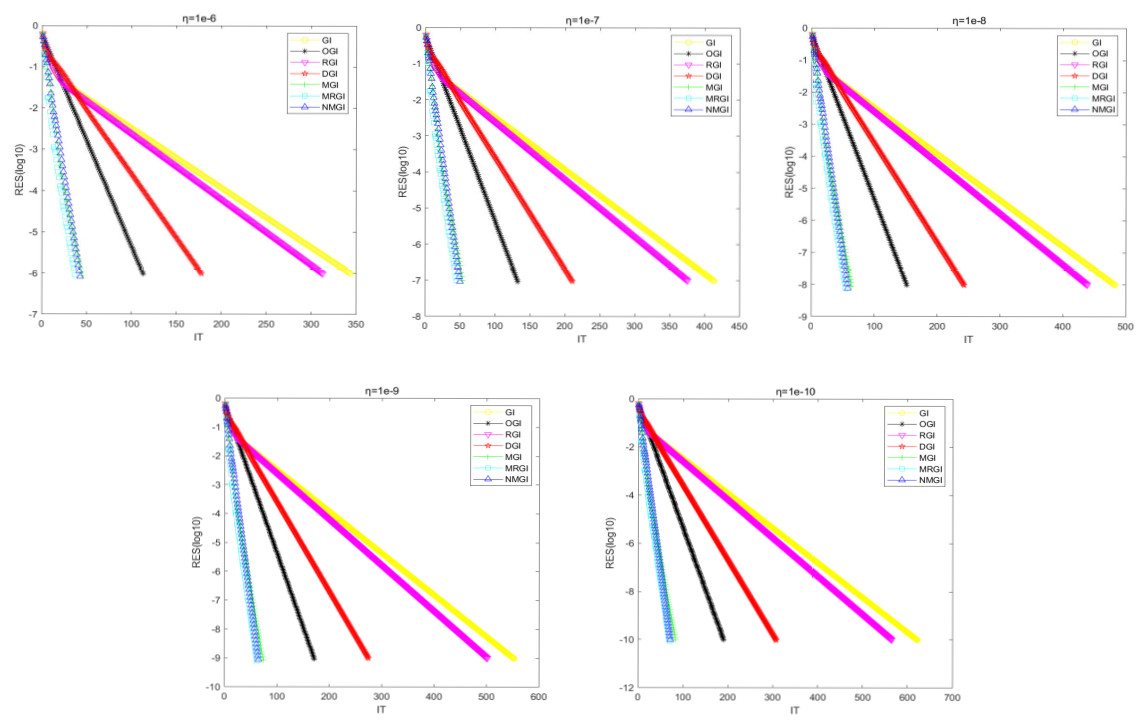
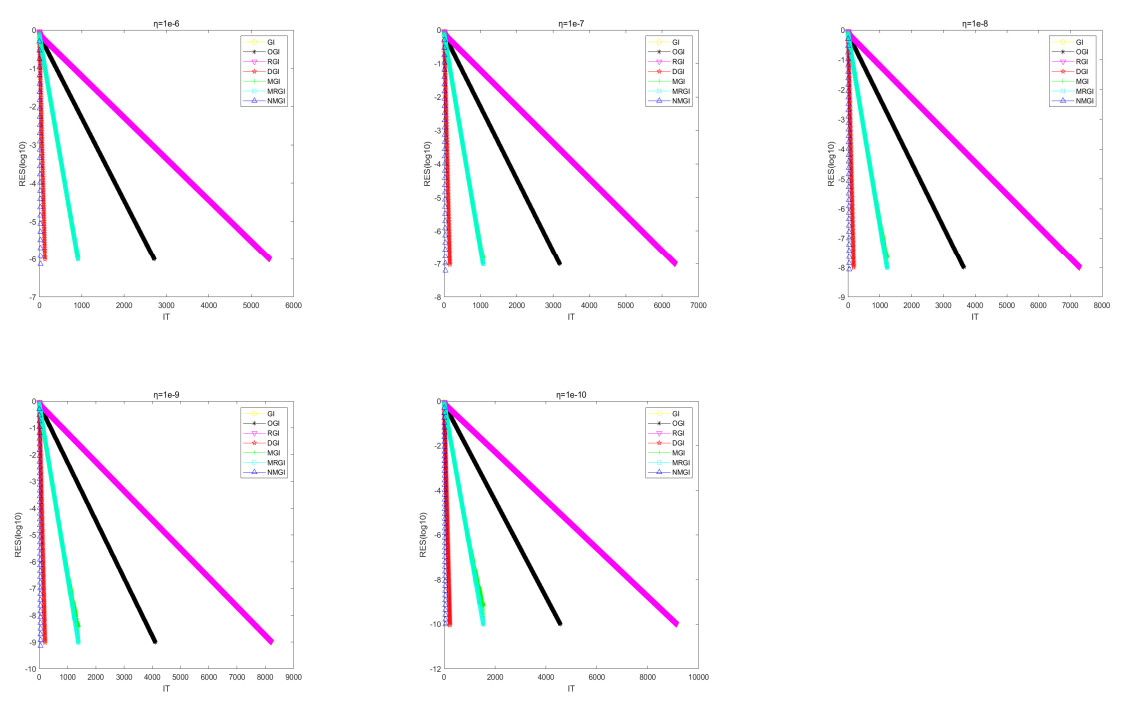
Figure 1.
RES(log10) curves of seven algorithms for Example 6.1 with five values of
$ \eta $ -
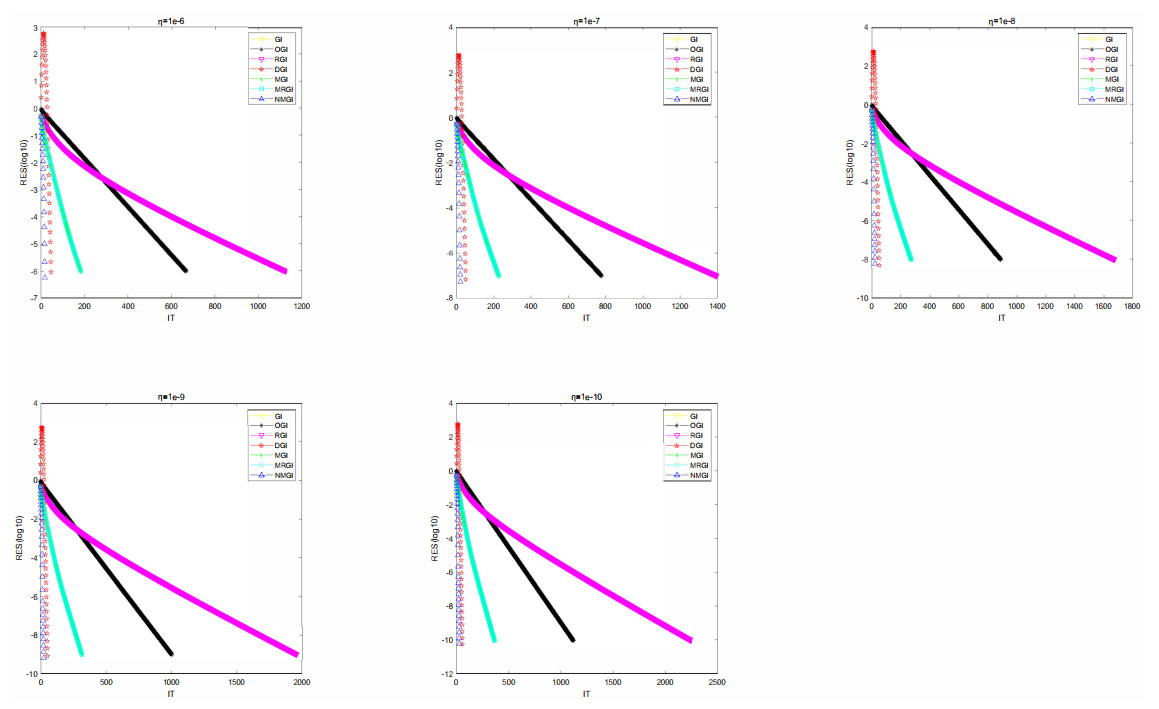
Figure 2.
RES(log10) curves of seven algorithms for Example 6.2 with five values of
$ \eta $ $ \rho=2 $ -
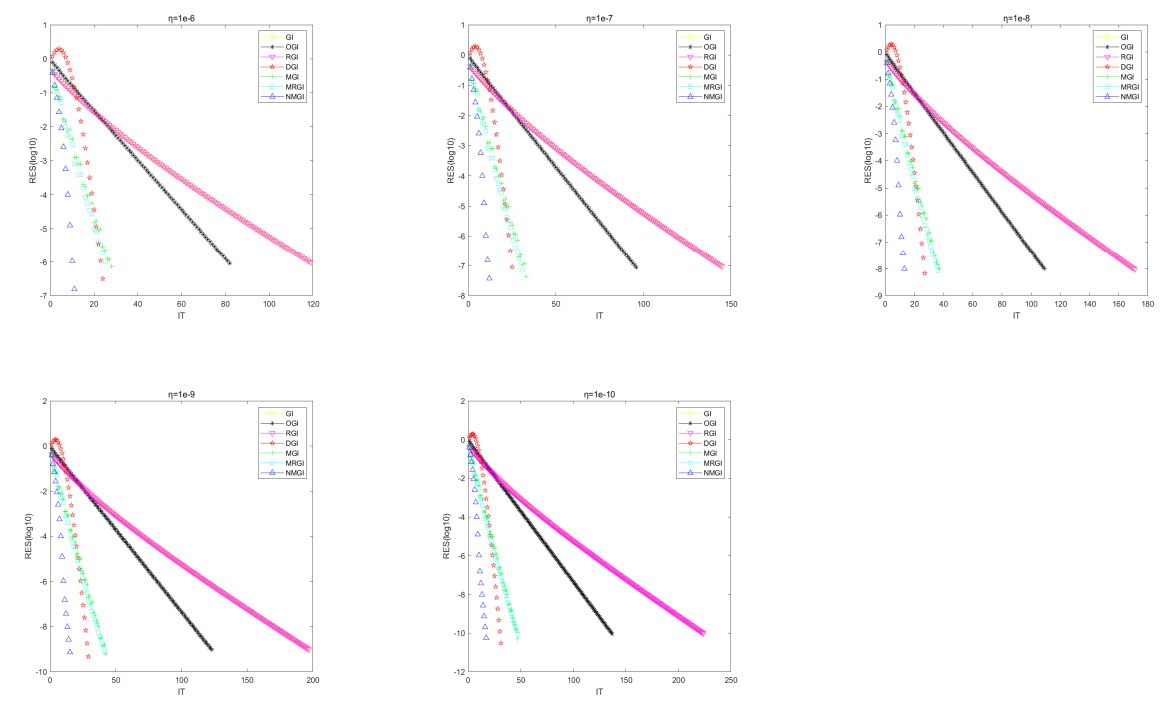
Figure 3.
RES(log10) curves of seven algorithms for Example 6.2 with five values of
$ \eta $ $ \rho=3 $ -
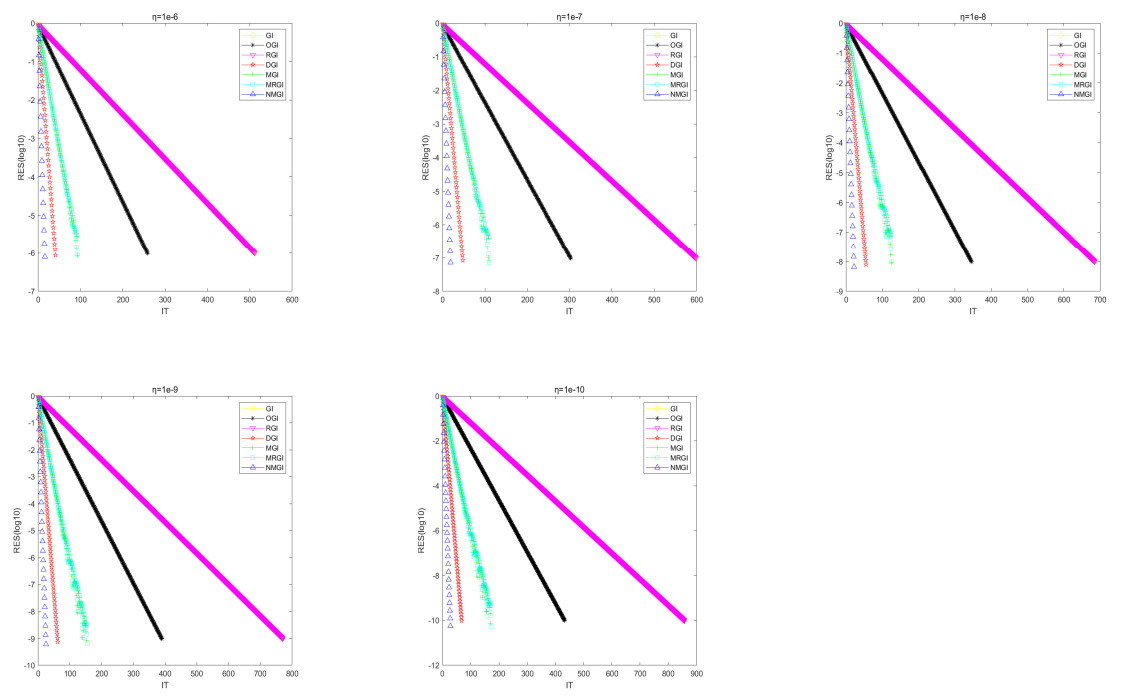
Figure 4.
RES(log10) curves of seven algorithms for Example 6.2 with five values of
$ \eta $ $ \rho=5 $ -
Figure 5.
RES(log10) curves of seven algorithms for Example 6.3 with five values of
$ \eta $ $ n=3 $ -
Figure 6.
RES(log10) curves of seven algorithms for Example 6.3 with five values of
$ \eta $ $ n=6 $