

| Citation: |
Qianqian Su, Zhiqiang Zhang, Fengde Chen. DYNAMICS OF A DISCRETE COMMENSALISM MODEL WITH NON-SELECTIVE HARVESTING: DEPENDENCE ON THE HARVESTABLE PROPORTION M[J]. Journal of Applied Analysis & Computation, 2027, 17(1): 105-118. doi: 10.11948/20250070

|
DYNAMICS OF A DISCRETE COMMENSALISM MODEL WITH NON-SELECTIVE HARVESTING: DEPENDENCE ON THE HARVESTABLE PROPORTION M
-
Abstract
This paper proposes and studies a discrete commensalism model with non-selective harvesting and partial population closure. By applying difference inequality theory and standard computational techniques, sufficient conditions are derived for the permanence and extinction of the system, respectively. Furthermore, by constructing a suitable Lyapunov function, sufficient conditions for the global attractivity of the system are obtained. Finally, numerical simulations are provided to illustrate the validity of the theoretical results. The results reveal that increasing the closure fraction promotes species persistence, while excessive harvesting may lead to extinction.
-
Keywords:
- Commensalism /
- harvesting /
- permanence /
- extinction /
- global attractivity
-

-
References
[1] K. Chakraborty, S. Das and T. K. Kar, On non-selective harvesting of a multispecies fishery incorporating partial closure for the populations, Appl. Math. Comput., 2013, 221, 581–597. [2] F. D. Chen, Permanence and global attractivity of a discrete multi-species Lotka–Volterra competition predator-prey systems, Appl. Math. Comput., 2006, 182(1), 3–12. [3] F. D. Chen, Permanence for the discrete mutualism model with time delays, Math. Comput. Model., 2008, 47(3–4), 431–435. [4] J. L. Chen, Y. M. Chen, Z. L. Zhu and F. D. Chen, Dynamical behaviors of a discrete-time prey-predator model with harvesting effect on the predator, J. Appl. Anal. Comput., 2024, 14(1), 283–297. [5] Q. Y. Cui, C. J. Xu, W. Ou, Y. C. Pang, Z. X. Liu, P. L. Li and L. Y. Yao, Bifurcation behavior and hybrid controller design of a 2D Lotka–Volterra commensal symbiosis system accompanying delay, Mathematics, 2023, 11(23), 4808. doi: 10.3390/math11234808 [6] H. Deng and X. Y. Huang, The influence of partial closure for the populations to a harvesting Lotka-Volterra commensalism model, Commun. Math. Biol. Neruosci., 2018, 2018, 10. [7] B. B. Du, C. J. Wu, G. Zhang and X. L. Zhou, Dynamical behaviors of a discrete two-dimensional competitive system exactly driven by the large centre, J. Appl. Anal. Comput., 2024, 14(5), 2822–2844. [8] M. J. Gao, L. J. Chen and F. D. Chen, Dynamical analysis of a discrete two-patch model with the Allee effect and nonlinear dispersal, Math. Biosci. Eng., 2024, 21(4), 5499–5520. doi: 10.3934/mbe.2024242 [9] P. Gupta, I. Jena and A. Priyadarshi, Complex dynamics of a tri-trophic food web model under commensalism, refuse and competition, J. Sci. Res., 2023, 67(3), 57–67. [10] Q. Q. Li, F. D. Chen, L. J. Chen and Z. Li, Dynamical analysis of a discrete amensalism system with Michaelis–Menten type harvesting for the second species, Qual. Theory Dyn. Syst., 2024, 23, 279. doi: 10.1007/s12346-024-01142-5 [11] S. Lin, Q. Zhou and R. Wu, Positive periodic solution of a discrete commensal symbiosis model with Beddington-DeAngelis functional response, J. Math. Comput. Sci., 2023, 28(4), 363–372. [12] C. Mondal, D. Kesh and D. Mukherjee, Dynamical behavior of a discrete-time predator–prey system incorporating prey refuge and fear effect, Chinese J. Phys., 2024, 91, 1004–1026. doi: 10.1016/j.cjph.2024.07.002 [13] Y. L. Ou, H. F. Ren, G. Zhang and Q. R. Wang, A note on a class of discrete large-and sub-centre systems, J. Appl. Anal. Comput., 2026, 16(5), 2771–2778. [14] R. R. Patra and S. Maitra, Dynamics of stability, bifurcation and control for a commensal symbiosis model, Int. J. Dynam. Control, 2024, 12(7), 2369–2384. doi: 10.1007/s40435-023-01367-3 [15] B. H. Prasad and N. C. P. Ramacharyulu, Discrete model of commensalism between two species, Int. J. Mod. Educ. Comput. Sci., 2012, 4(8), 40–46. doi: 10.5815/ijmecs.2012.08.06 [16] N. Puspitasari, W. M. Kusumawinahyu and T. Trisilowati, Dynamic analysis of the symbiotic model of commensalism and parasitism with harvesting in commensal populations, J. Teori Apl. Mat., 2021, 5(1), 193–204. [17] I. Seval, Stability and period-doubling bifurcation in a modified commensal symbiosis model with Allee effect, Erzincan Univ. J. Sci. Technol., 2022, 15(1), 310–324. [18] G. C. Sun and H. Sun, Analysis on symbiosis model of two populations, J. Weinan Norm. Univ., 2013, 28(9), 6–8. [19] B. F. Xie, N. Zhang and C. Liu, Dynamical analysis of a commensalism system incorporating Beddington-DeAngelis functional response and Allee effect, Eng. Lett., 2023, 31(3), 1208–1214. [20] B. F. Xie, Z. C. Zhang and N. Zhang, Dynamic analysis of a fractional order three-dimensional predator-prey system with competitive and fear effects, Nonlinear Dyn., 2025, 113(13), 26949–26979. [21] C. F. Xie, H. Zhang and R. C. Hwang, Discrete dynamic system modeling for simulated moving bed processes, Mathematics, 2024, 12(10), 1520. doi: 10.3390/math12101520 [22] J. H. Zhang and X. Y. Chen, Dynamic behaviors of a discrete commensal symbiosis model with Holling type functional response, IAENG Int. J. Appl. Math., 2023, 53(1), 33. [23] J. Zhang, W. Deng and S. X. Wang, The projection neural network method and the Euler method for solving the SDLCP, J. Appl. Anal. Comput., 2026, 16(5), 2392–2414. [24] K. H. Zhao, Global asymptotic stability for a classical controlled nonlinear periodic commensalism AG-ecosystem with distributed lags on time scales, Filomat, 2023, 37(29), 9899–9911. doi: 10.2298/FIL2329899Z [25] Q. M. Zhou and F. D. Chen, Dynamical analysis of a discrete amensalism system with the Beddington-DeAngelis functional response and Allee effect for the unaffected species, Qual. Theory Dyn. Syst., 2023, 22(1), 16. doi: 10.1007/s12346-022-00716-5 -
-
Figures(6)
Export File
Citation
Qianqian Su, Zhiqiang Zhang, Fengde Chen. DYNAMICS OF A DISCRETE COMMENSALISM MODEL WITH NON-SELECTIVE HARVESTING: DEPENDENCE ON THE HARVESTABLE PROPORTION M[J]. Journal of Applied Analysis & Computation, 2027, 17(1): 105-118. doi: 10.11948/20250070
Format
Content
 DownLoad:
-
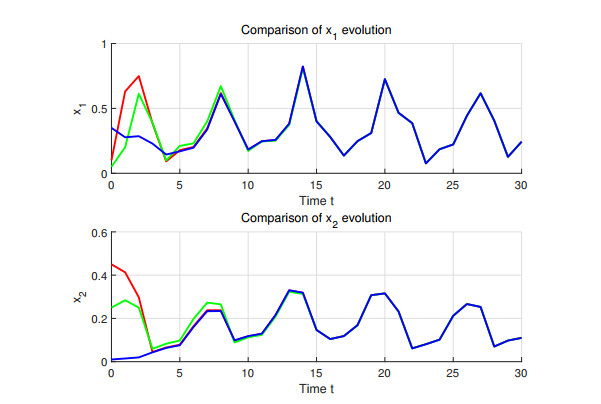
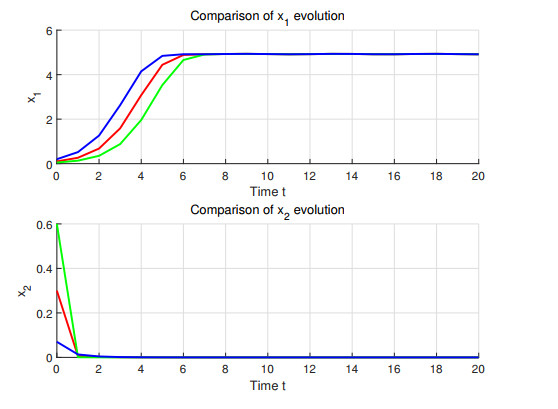
Figure 1.
Dynamic behaviors of system (1.3) with initial conditions
$ (x_1(0), x_2(0))^T=(0.1, 0.45)^T, (0.05, 0.25)^T, $ $ (0.35, 0.01)^T $ -
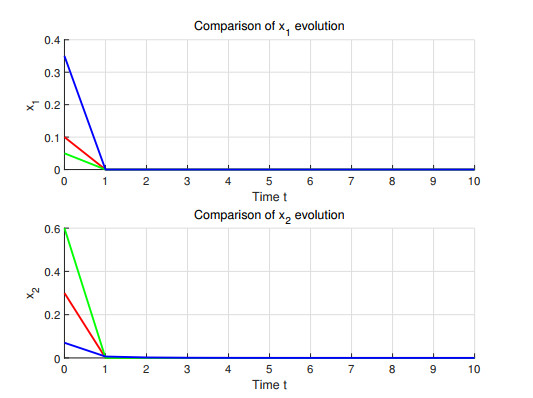
Figure 2.
Dynamic behaviors of system (1.3) with initial conditions
$ (x_1(0), x_2(0))^T=(0.1, 0.3)^T, (0.05, 0.6)^T, $ $ (0.35, 0.07)^T $ -
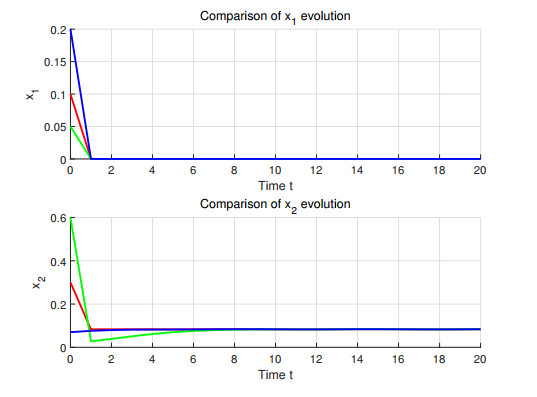
Figure 3.
Dynamic behaviors of system (1.3) with initial conditions
$ (x_1(0), x_2(0))^T=(0.1, 0.3)^T, (0.05, 0.6)^T, $ $ (0.2, 0.07)^T $ -
Figure 4.
Dynamic behaviors of system (1.3) with initial conditions
$ (x_1(0), x_2(0))^T=(0.1, 0.3)^T, (0.05, 0.6)^T, $ $ (0.2, 0.07)^T $ -
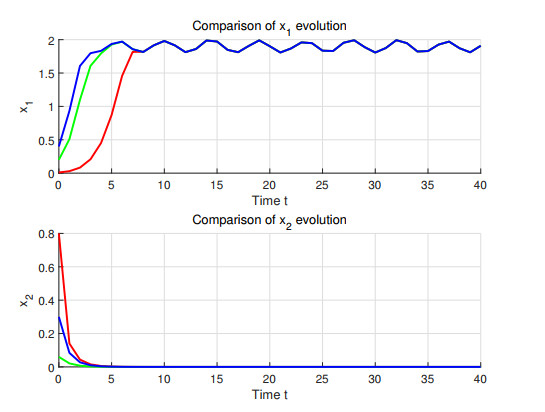
Figure 5.
Dynamic behaviors of system (1.3) with initial conditions
$ (x_1(0), x_2(0))^T=(0.01, 0.8)^T, (0.2, 0.06)^T, $ $ (0.4, 0.3)^T $ -
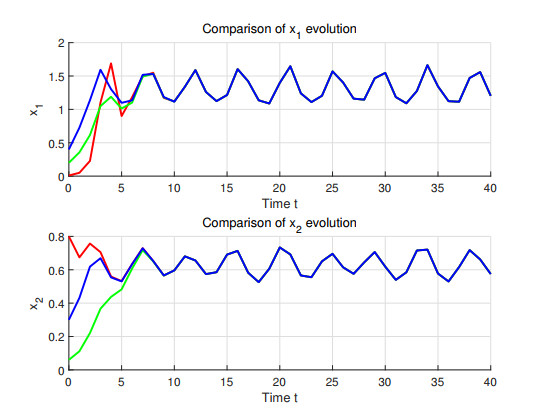
Figure 6.
Dynamic behaviors of system (1.3) with initial conditions
$ (x_1(0), x_2(0))^T=(0.01, 0.8)^T, (0.2, 0.06)^T, $ $ (0.4, 0.3)^T $