

| Citation: |
Yanting Li, Huantian Xie, Juan Zhang, Jianwei Zhou. A CONCISE TRAINING SCHEME OF RBF NEURAL NETWORKS WITH FIXED CENTER POINTS FOR PARTIAL DIFFERENTIAL EQUATIONS WITH DIRICHLET BOUNDARY CONDITIONS[J]. Journal of Applied Analysis & Computation, 2026, 16(4): 1805-1821. doi: 10.11948/20250078

|
A CONCISE TRAINING SCHEME OF RBF NEURAL NETWORKS WITH FIXED CENTER POINTS FOR PARTIAL DIFFERENTIAL EQUATIONS WITH DIRICHLET BOUNDARY CONDITIONS
-
Abstract
A concise numerical scheme based on radial basis function neural networks is proposed for solving second order partial differential equations with Dirichlet boundary conditions. By employing fixed center points across the geometric region, our approach reduces the memory requirements. And the shape parameters are obtained by machine learning, which overcomes the shortcomings of artificially selection about parameters. Specially, the corresponding numerical schemes are calculated by nonlinear least squares problems, avoiding directly solving linear algebraic equations. The proposed training scheme of RBF neural networks, which bases on Gaussian and multiquadric radial basis functions, significantly achieves high-accuracy approximations and improves the computational efficiency compared to existing meshless methods. In comparison with Kansa's method and the radial basis function neural networks method proposed in [22], numerical experiments demonstrate that our approximation schemes perform well in various domains. Through comprehensive numerical experiments comparing Kansa's method and radial basis function neural networks, our proposed approximation schemes also exhibit better performance across multiple geometric domains, such as unit square, peanut-shaped and five-petaled domains.
-

-
References
[1] M. Abbaszadeh, A. R. Salec and A. H. Taghreed, A radial basis function (RBF)-finite difference method for solving improved Boussinesq model with error estimation and description of solitary waves, Numerical Methods for Partial Differential Equations, 2024, 40, e23077. doi: 10.1002/num.23077 [2] O. Akbilgic, H. Bozdogan and M. E. Balaban, A novel hybrid RBF neural networks model as a forecaster, Statistics and Computing, 2014, 24, 365–375. doi: 10.1007/s11222-013-9375-7 [3] M. M. Alqezweeni, R. A. Glumskov, V. I. Gorbachenko, et al., Solving partial differential equations on radial basis functions networks and on fully connected deep neural networks, Proceedings of the International Conference on Intelligent Vision and Computing, 2022, 15, 240–249. [4] M. M. Alqezweeni, V. I. Gorbachenko, M. V. Zhukov, et al., Efficient solving of boundary value problems using radial basis function networks learned by trust region method, International Journal of Mathematics and Mathematical Sciences, 2018, 1, 9457578. [5] A. S. Bandeira, K. Scheinberg and L. N. Vicente, Convergence of trust-region methods based on probabilistic models, SIAM Journal on Optimization, 2014, 24(3), 1238–1264. doi: 10.1137/130915984 [6] C. S. Chen, A. Karageorghis and F. F. Dou, A novel RBF collocation method using fictitious centres, Applied Mathematics Letters, 2020, 101, 106069. doi: 10.1016/j.aml.2019.106069 [7] W. Chen and Z. J. Fu, Recent Advances in Radial Basis Function Collocation Methods, Springer, 2013. [8] M. Dehghan and A. Shokri, A numerical method for two-dimensional Schrödinger equation using collocation and radial basis functions, Computers & Mathematics with Applications, 2007, 54, 136–146. [9] F. F. Dou and Y. C. Hon, Fundamental kernel-based method for backward space-time fractional diffusion problem, Computers & Mathematics with Applications, 2016, 71, 356–367. [10] L. N. Elisov, V. I. Gorbachenko and M. V. Zhukov, Learning radial basis function networks with the trust region method for boundary problems, Automation and Remote Control, 2018, 79, 1621–1629. doi: 10.1134/S0005117918090072 [11] G. Fairweather and A. Karageorghis, The method of fundamental solutions for elliptic boundary value problems, Advances in Computational Mathematics, 1998, 9, 69–95. doi: 10.1023/A:1018981221740 [12] M. Farhan, Z. Omar, F. M. Oudina, et al., Implementation of the one-step one-hybrid block method on the nonlinear equation of a circular sector oscillator, Computational Mathematics and Modeling, 2020, 31, 116–132. [13] J. T. Fei and H. F. Ding, Adaptive sliding mode control of dynamic system using RBF neural network, Nonlinear Dynamics, 2012, 70, 1563–1573. doi: 10.1007/s11071-012-0556-2 [14] G. Garmanjani, M. Esmaeilbeigi and R. Cavoretto, Adaptive residual refinement in an RBF finite difference scheme for 2D time-dependent problems, Computational & Applied Mathematics, 2024, 43, 39. [15] M. A. Golberg and C. S. Chen, The method of fundamental solutions for potential, Helmholtz and diffusion problems, in: M. A. Golberg (Ed.), Boundary integral methods: Numerical and mathematical aspects, WIT Press/Comput. Mech. Publ., Boston, MA, 1999, 1, 103–176. [16] V. I. Gorbachenko and M. V. Zhukov, Solving boundary value problems of mathematical physics using radial basis function networks, Computational Mathematics and Mathematical Physics, 2017, 57, 145–155. doi: 10.1134/S0965542517010079 [17] M. Haghi, M. Ilati and M. Dehghan, A radial basis function-Hermite finite difference (RBF-HFD) method for the cubic-quintic complex Ginzburg-Landau equation, Computational and Applied Mathematics, 2023, 42(3), 115. doi: 10.1007/s40314-023-02256-3 [18] M. A. Jankowska and A. Karageorghis, Variable shape parameter Kansa RBF method for the solution of nonlinear boundary value problems, Engineering Analysis with Boundary Elements, 2019, 103, 32–40. doi: 10.1016/j.enganabound.2019.02.005 [19] M. A. Jankowska, A. Karageorghis and C. S. Chen, Kansa-RBF algorithms for elliptic BVPs in annular domains with mixed boundary conditions, Mathematics and Computers in Simulation, 2023, 206, 77–104. doi: 10.1016/j.matcom.2022.11.006 [20] M. A. Jankowska, A. Karageorghis and C. S. Chen, Training RBF neural networks for solving nonlinear and inverse boundary value problems, Computers & Mathematics with Applications, 2024, 165, 205–216. [21] E. J. Kansa, Multiquadrics-a scattered data approximation scheme with applications to computational fluid dynamics. II. Solutions to parabolic, hyperbolic and elliptic partial differential equations, Computers & Mathematics with Applications, 1990, 19, 147–161. [22] A. Karageorghis and C. S. Chen, Training RBF neural networks for the solution of elliptic boundary value problems, Computers & Mathematics with Applications, 2022, 126, 196–211. [23] E. Lehto, V. Shankar and G. B. Wright, A radial basis function (RBF) compact finite difference (FD) scheme for reaction-diffusion equations on surfaces, Society of Industrial and Applied, 2017, 39(5), 2129–2151. [24] L. Ling, R. Opfer and R. Schaback, Results on meshless collocation techniques, Engineering Analysis with Boundary Elements, 2006, 30, 247–253. doi: 10.1016/j.enganabound.2005.08.008 [25] G. R. Liu, Mesh Free Methods: Moving Beyond the Finite Element Method, CRC Press, Boca Raton, 2002. [26] P. Priyanka, S. Arora and F. M. Oudina, et al., Superconvergence analysis of fully discrete Hermite splines to simulate wave behavior of Kuramoto-Shivashinsky equation, Wave Motion, 2023, 121, 103187. doi: 10.1016/j.wavemoti.2023.103187 [27] P. Priyanka, F. M. Oudina, S. Sahani, et al., Travelling wave solution of fourth order reaction diffusion equation using hybrid quintic Hermite splines collocation technique, Arabian Journal of Mathematics, 2024, 13, 341–367. doi: 10.1007/s40065-024-00459-y [28] S. A. Sarra and D. Sturgill, A random variable shape parameter strategy for radial basis function approximation methods, Engineering Analysis with Boundary Elements, 2009, 33, 1239–1245. doi: 10.1016/j.enganabound.2009.07.003 [29] C. Satyanarayana, M. K. Yadav and M. Nath, Multiquadric based RBF-HFD approximation formulas and convergence properties, Engineering Analysis with Boundary Elements, 2024, 160, 234–257. doi: 10.1016/j.enganabound.2023.12.032 [30] T. Tanbay and B. Ozgener, A comparison of the meshless RBF collocation method with finite element and boundary element methods in neutron diffusion calculations, Engineering Analysis with Boundary Elements, 2014, 46, 30–40. doi: 10.1016/j.enganabound.2014.05.005 -
-
Figures(11) / Tables(6)

Export File
Citation
Yanting Li, Huantian Xie, Juan Zhang, Jianwei Zhou. A CONCISE TRAINING SCHEME OF RBF NEURAL NETWORKS WITH FIXED CENTER POINTS FOR PARTIAL DIFFERENTIAL EQUATIONS WITH DIRICHLET BOUNDARY CONDITIONS[J]. Journal of Applied Analysis & Computation, 2026, 16(4): 1805-1821. doi: 10.11948/20250078
Format
Content
 DownLoad:
-
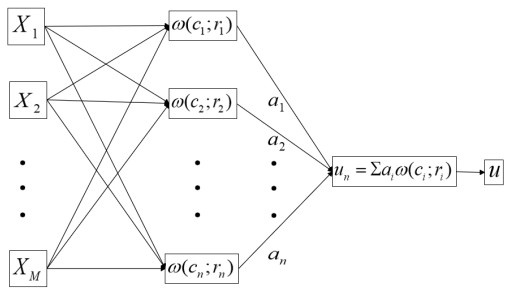
Figure 1.
Architecture of RBF neural networks.
-
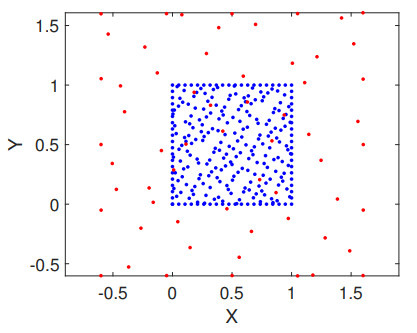
Figure 2.
Centers(red) and collocation points (blue) of square.
-
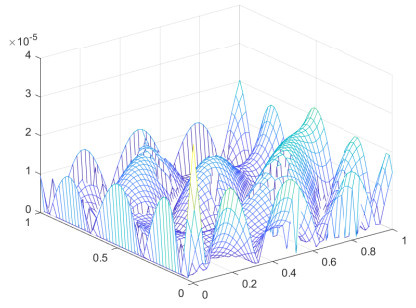
Figure 3.
Point-wise errors on the square with Nint = 16 and λ = 100.
-
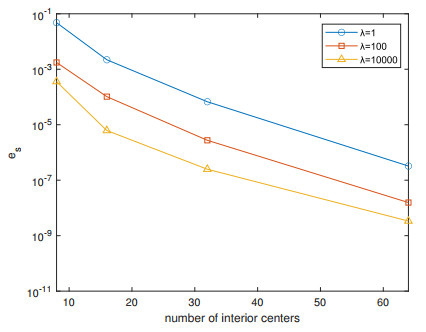
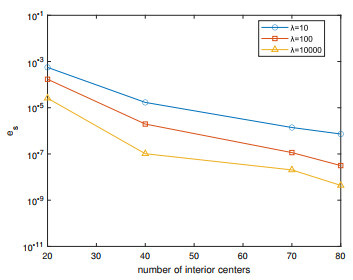
Figure 4.
Convergence curves on the square.
-
Figure 5.
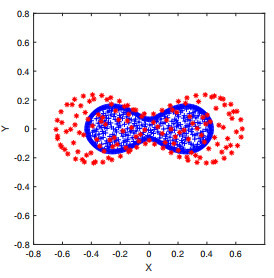
Centers(red) and collocation points (blue) of the peanut-shaped domain.
-
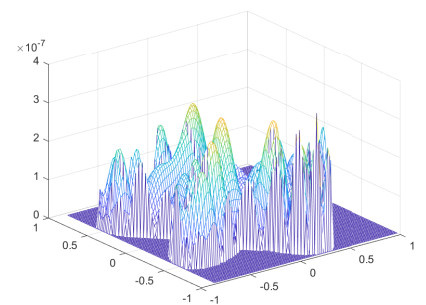
Figure 6.
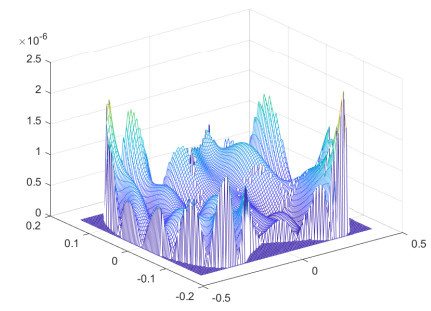
Point-wise errors on peanut-shaped domain with Nint = 20 and λ = 100.
-
Figure 7.
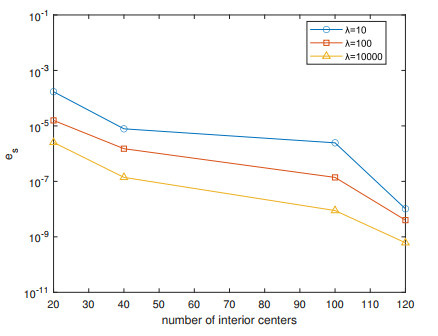
Convergence curves on peanut-shaped domain.
-
Figure 8.
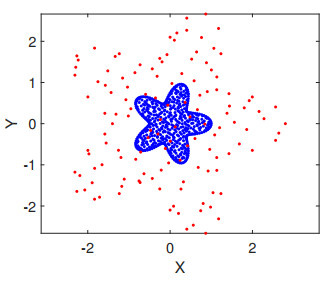
Centers(red) and collocation points (blue) of five-petaled region.
-
Figure 9.
Point-wise errors on five-petaled domain with
$ N_\text{int}=40 $ $ \lambda=100 $ -
Figure 10.
Convergence curves on five-petaled domain.
-
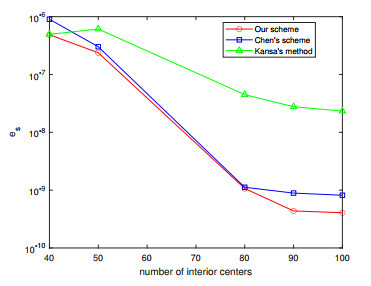
Figure 11.
Convergence curves of three schemes.