

| Citation: |
Ting-Jia Liu, Mengyao Li, Ruijuan Zhao, Shu-Xin Miao. A NOISE-TOLERANT AND FIXED-TIME ZEROING NEURAL NETWORK MODEL FOR SOLVING MULTI-LINEAR $ \mathcal{M} $-TENSOR EQUATIONS[J]. Journal of Applied Analysis & Computation, 2027, 17(1): 524-539. doi: 10.11948/20250257

|
A NOISE-TOLERANT AND FIXED-TIME ZEROING NEURAL NETWORK MODEL FOR SOLVING MULTI-LINEAR $ \mathcal{M} $-TENSOR EQUATIONS
-
Abstract
Zeroing neural network (ZNN) models are effective methods for solving multi-linear systems. To improve the performance of ZNN models, a new ZNN model is proposed for solving multi-linear systems with $ \mathcal{M} $-tensor in this paper. The proposed ZNN model incorporates with a nonlinear activation function. Convergence and robustness of the proposed ZNN model are analyzed. Theoretical results reveal that the proposed ZNN model converges within a fixed time and tolerates different types of noise. Numerical experiments illustrate that the proposed ZNN model is more powerful than some existing ZNN models for solving multi-linear systems with $ \mathcal{M} $-tensor.
-
Keywords:
- Multi-linear system /
- ZNN model /
- fixed-time convergence /
- noise-tolerant
-

-
References
[1] M.-Y. Deng, W. Ding and X.-P. Guo, Modified splitting methods for solving non-homogenous multi-linear equations with $ \mathcal{M} $-tensors, Pacific Journal of Optimization, An International Journal, 2022, 18(1), 91–117. [2] W. Ding, L. Qi and Y. Wei, $ \mathcal{M} $-tensors and nonsingular $ \mathcal{M} $-tensors, Linear Algebra and its Applications, 2013, 439(10), 3264–3278. doi: 10.1016/j.laa.2013.08.038 CrossRef $ \mathcal{M} $-tensors and nonsingular
$ \mathcal{M} $ [3] W. Ding and Y. Wei, Solving multi-linear systems with $ \mathcal{M} $-tensors, Journal of Scientific Computing, 2016, 68(2), 689–715. doi: 10.1007/s10915-015-0156-7 CrossRef $ \mathcal{M} $-tensors" target="_blank">Google Scholar
[4] H. Duan, X. Xiao, J. Long and Y. Liu, Tensor alternating least squares grey model and its application to short-term traffic flows, Applied Soft Computing, 2020, 89, 106145. doi: 10.1016/j.asoc.2020.106145 [5] C. Han, B. Zheng and J. Xu, A modified noise-tolerant ZNN model for solving time-varying Sylvester equation with its application to robot manipulator, Journal of the Franklin Institute, 2023, 360(12), 8633–8650. doi: 10.1016/j.jfranklin.2023.06.045 [6] L. Han, A homotopy method for solving multilinear systems with $ \mathcal{M} $-tensors, Applied Mathematics Letters, 2017, 69, 49–54. doi: 10.1016/j.aml.2017.01.019 CrossRef $ \mathcal{M} $-tensors" target="_blank">Google Scholar
[7] H. He, C. Ling, L. Qi and G. Zhou, A globally and quadratically convergent algorithm for solving multilinear systems with $ \mathcal{M} $-tensors, Journal of Scientific Computing, 2018, 76, 1718–1741. doi: 10.1007/s10915-018-0689-7 CrossRef $ \mathcal{M} $-tensors" target="_blank">Google Scholar
[8] S. Hu, Z.-H. Huang, C. Ling and L. Qi, On determinants and eigenvalue theory of tensors, Journal of Symbolic Computation, 2013, 50, 508–531. doi: 10.1016/j.jsc.2012.10.001 [9] H. Huang, D. Fu, J. Zhang, X. Xiao, G. Wang and S. Liao, Modified Newton integration neural algorithm for solving the multi-linear $ \mathcal{M} $-tensor equation, Applied Soft Computing, 2020, 96, 106674. doi: 10.1016/j.asoc.2020.106674 CrossRef $ \mathcal{M} $-tensor equation" target="_blank">Google Scholar
[10] J. Jin, J. Zhu, L. Zhao and L. Chen, A fixed-time convergent and noise-tolerant zeroing neural network for online solution of time-varying matrix inversion, Applied Soft Computing, 2022, 130, 109691. doi: 10.1016/j.asoc.2022.109691 [11] H. K. Khalil, Nonlinear Systems, Upper Saddle River, NJ, USA: Prentice-Hall, 1996. [12] D.-H. Li, H.-B. Guan and X.-Z. Wang, Finding a nonnegative solution to an $ \mathcal{M} $-tensor equation, Pacific Journal of Optimization, An International Journal, 2020, 16, 419–440. $ \mathcal{M} $-tensor equation" target="_blank">Google Scholar
[13] D.-H. Li, S. Xie and H.-R. Xu, Splitting methods for tensor equations, Numerical Linear Algebra with Applications, 2017, 24(5), e2102. doi: 10.1002/nla.2102 [14] W. Li, D.-D. Liu and S.-W. Vong, Comparison results for splitting iterations for solving multi-linear systems, Applied Numerical Mathematics, 2018, 134, 105–121. doi: 10.1016/j.apnum.2018.07.009 [15] X. Li and M. K. Ng, Solving sparse non-negative tensor equations: Algorithms and applications, Frontiers of Mathematics in China, 2015, 10(3), 649–680. doi: 10.1007/s11464-014-0377-3 [16] D. Liu, W. Li and S.-W. Vong, The tensor splitting with application to solve multi-linear systems, Journal of Computational and Applied Mathematics, 2018, 330, 75–94. doi: 10.1016/j.cam.2017.08.009 [17] M. Liu, H. Wu and M. Shang, A noise-suppressing discrete-time neural dynamics model for solving time-dependent multi-linear $ \mathcal{M} $-tensor equation, Neurocomputing, 2023, 520, 240–249. doi: 10.1016/j.neucom.2022.11.071 CrossRef $ \mathcal{M} $-tensor equation" target="_blank">Google Scholar
[18] Z. Luo, L. Qi and N. Xiu, The sparsest solutions to $\mathcal{Z} $-tensor complementarity problems, Optimization Letters, 2017, 11(3), 471–482. doi: 10.1007/s11590-016-1013-9 CrossRef $\mathcal{Z} $-tensor complementarity problems" target="_blank">Google Scholar
[19] C.-Q. Lv and C.-F. Ma, A Levenberg-Marquardt method for solving semi-symmetric tensor equations, Journal of Computational and Applied Mathematics, 2018, 332, 13–25. doi: 10.1016/j.cam.2017.10.005 [20] M. Najafi Kalyani, M. Nobakht Kooshkghazi and L. Reichel, Block iterative methods for solving multi-linear systems, Numerical Algorithms, 2025, 100, 803–829. doi: 10.1007/s11075-025-02077-x [21] M. Nobakht-Kooshkghazi and M. Najafi-Kalyani, Improving the Gauss-Seidel iterative method for solving multi-linear systems with $ \mathcal{M} $-tensors, Japan Journal of Industrial and Applied Mathematics, 2024, 41, 1061–1077. doi: 10.1007/s13160-023-00637-z CrossRef $ \mathcal{M} $-tensors" target="_blank">Google Scholar
[22] A. Polyakov, Nonlinear feedback design for fixed-time stabilization of linear control systems, IEEE Transactions on Automatic Control, 2012, 57(8), 2106–2110. doi: 10.1109/TAC.2011.2179869 [23] L. Qi, Eigenvalues of a real supersymmetric tensor, Journal of Symbolic Computation, 2005, 40(6), 1302–1324. doi: 10.1016/j.jsc.2005.05.007 [24] S. Wang, L. Jin, X. Du and P. S. Stanimirovi, Accelerated convergent zeroing neurodynamics models for solving multi-linear systems with $ \mathcal{M} $-tensors, Neurocomputing, 2021, 458, 271–283. doi: 10.1016/j.neucom.2021.06.005 CrossRef $ \mathcal{M} $-tensors" target="_blank">Google Scholar
[25] X. Wang, M. Che and Y. Wei, Neural network approach for solving nonsingular multi-linear tensor systems, Journal of Computational and Applied Mathematics, 2020, 368, 112569. doi: 10.1016/j.cam.2019.112569 [26] X. Wang, M. Che and Y. Wei, Neural networks based approach solving multi-linear systems with $ \mathcal{M} $-tensors, Neurocomputing, 2019, 351, 33–42. doi: 10.1016/j.neucom.2019.03.025 CrossRef $ \mathcal{M} $-tensors" target="_blank">Google Scholar
[27] X. Wang, C. Mo, S. Qiao and Y. Wei, Predefined-time convergent neural networks for solving the time-varying nonsingular multi-linear tensor equations, Neurocomputing, 2022, 472, 68–84. doi: 10.1016/j.neucom.2021.11.108 [28] H. Wu, S. Wang, X. Du and M. Liu, Discrete-time recurrent neural network for solving multi-linear $ \mathcal{M} $-tensor equation, Advances in Intelligent Systems and Computing, 2022, 1409, 131–143. $ \mathcal{M} $-tensor equation" target="_blank">Google Scholar
[29] L. Xiao and B. Liao, A convergence-accelerated Zhang neural network and its solution application to Lyapunov equation, Neurocomputing, 2016, 193, 213–218. doi: 10.1016/j.neucom.2016.02.021 [30] K. Xie and S.-X. Miao, A new preconditioner for Gauss-Seidel method for solving multi-linear systems, Japan Journal of Industrial and Applied Mathematics, 2023, 41, 1159–1173. [31] Z.-J. Xie, X. Jin and Y. Wei, Tensor methods for solving symmetric $\mathcal{M}$-tensor systems, Journal of Scientific Computing, 2018, 74, 412–425. doi: 10.1007/s10915-017-0444-5 [32] D.-X. Yan, C.-Q. Li, J.-Y. Wu, et al., A novel error-based adaptive feedback zeroing neural network for solving time-varying quadratic programming problems, Mathematics, 2024, 12(13), 2090. doi: 10.3390/math12132090 [33] H. Zhang and L. Wan, Zeroing neural network methods for solving the Yang-Baxter-like matrix equation, Neurocomputing, 2020, 383, 409–418. doi: 10.1016/j.neucom.2019.11.101 [34] Y. Zhang, D. Jiang and J. Wang, A recurrent neural network for solving Sylvester equation with time-varying coefficients, IEEE Transactions on Neural Networks, 2002, 13(5), 1053–1063. doi: 10.1109/TNN.2002.1031938 -
-
Figures(6)
Export File
Citation
Ting-Jia Liu, Mengyao Li, Ruijuan Zhao, Shu-Xin Miao. A NOISE-TOLERANT AND FIXED-TIME ZEROING NEURAL NETWORK MODEL FOR SOLVING MULTI-LINEAR $ \mathcal{M} $-TENSOR EQUATIONS[J]. Journal of Applied Analysis & Computation, 2027, 17(1): 524-539. doi: 10.11948/20250257
Format
Content
 DownLoad:
-
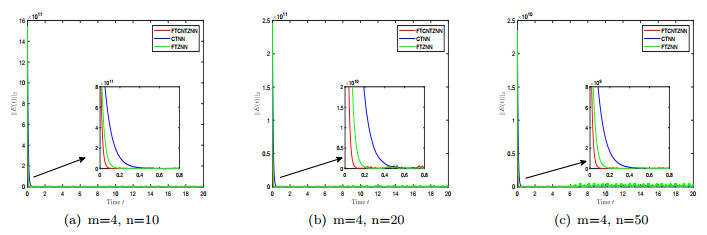
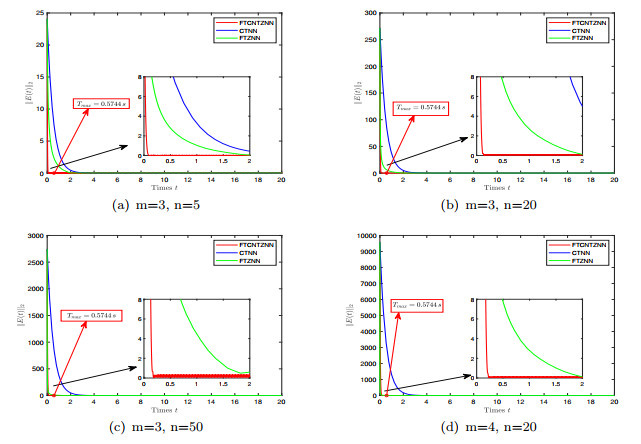
Figure 1.
The comparison of the FTCNTZNN and CTNN, FTZNN for solving Example 5.1.
-
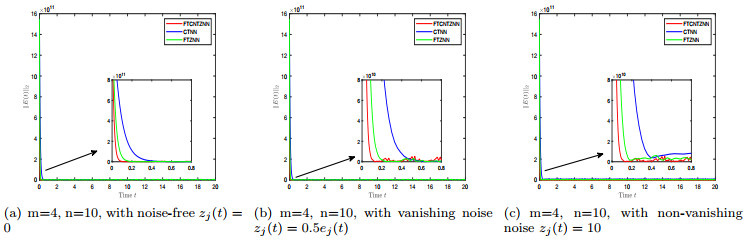
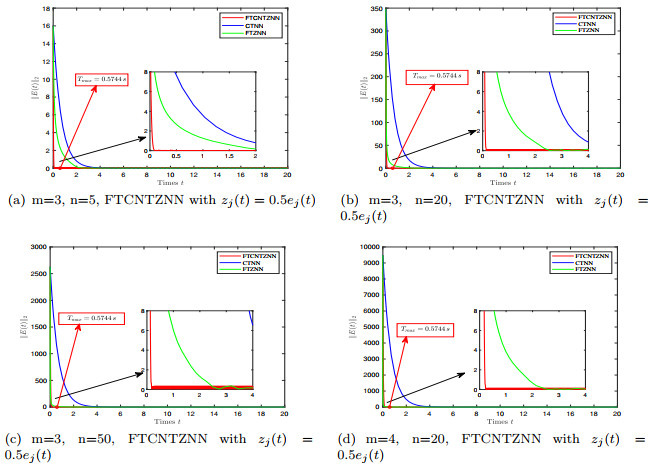
Figure 2.
The comparison of the FTCNTZNN and CTNN, FTZNN with different noise for solving Example 5.1.
-
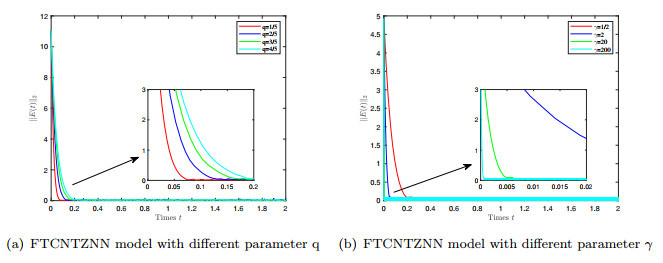
Figure 3.
m=3, n=5 FTCNTZNN model with different parameters under Case 2.
-
Figure 4.
The convergence rate of different models for solving Example 5.2.
-
Figure 5.
The dynamic bounded vanishing noise of different models for solving Example 5.2.
-
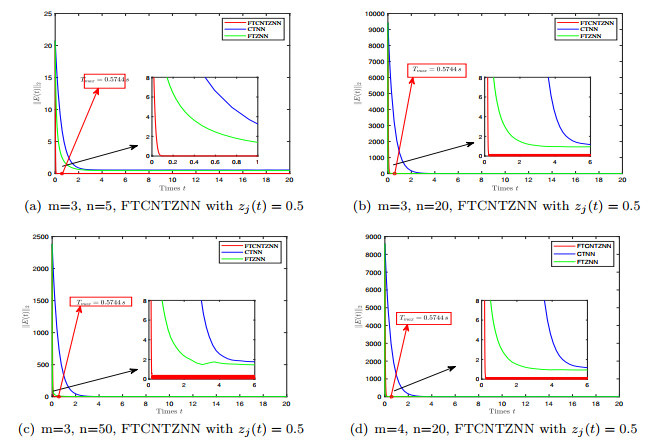
Figure 6.
The dynamic bounded non-vanishing noise of different models for solving Example 5.2.