

| Citation: |
Yunjie Yang, Jianping Shi, Hui Fang. NOVEL EXACT ANALYTICAL SOLUTIONS OF THE (3+1)-DIMENSIONAL POTENTIAL YU-TODA-SASA-FUKUYAMA EQUATION VIA LIE SYMMETRY ANALYSIS AND NEURAL NETWORK MODELS[J]. Journal of Applied Analysis & Computation, 2027, 17(1): 500-523. doi: 10.11948/20250287

|
NOVEL EXACT ANALYTICAL SOLUTIONS OF THE (3+1)-DIMENSIONAL POTENTIAL YU-TODA-SASA-FUKUYAMA EQUATION VIA LIE SYMMETRY ANALYSIS AND NEURAL NETWORK MODELS
-
Abstract
A novel method combining Lie symmetry analysis and neural network model is proposed for solving the (3+1)-dimensional potential-Yu-Toda-Sasa-Fukuyama (pYTSF) equation in this paper. This method has three processes: Firstly, the dimension of the given equation are reduced and two reduction equations are derived via Lie symmetry analysis; secondly, different test functions are constructed based on neural network models and various activation functions to yield solutions of the reduction equations; finally, a series of exact solutions of the original equation is achieved depending on the expression of group-invariant solutions and the transformation of variables. 12 novel exact analytical solutions of the (3+1)-dimensional pYTSF equation are obtained by the novel method. Furthermore, the dynamical characteristics of all solutions are illustrated by choosing appropriate parameters. The results validate the feasibility of this new method and show that the novel method may be applied in more nonlinear partial differential equations.
-

-
References
[1] M. J. Ablowitz and H. Segur, Solitons and the inverse scattering transform, Soc. Ind. Appl. Math., 1981. [2] O. D. Adeyemo, C. M. Khalique, Y. S. Gasimov and F. Villecco, Variational and non-variational approaches with Lie algebra of a generalized (3+1)-dimensional nonlinear potential Yu-Toda-Sasa-Fukuyama equation in engineering and physics, Alex. Eng. J., 2023, 63, 17–43. doi: 10.1016/j.aej.2022.07.024 [3] R. Archana and P. S. E. Jeevaraj, Deep learning models for digital image processing: A review, Artif. Intell. Rev., 2024, 57(1), 11. doi: 10.1007/s10462-023-10631-z [4] G. W. Bluman and Z. Z. Yang, A symmetry-based method for constructing nonlocally related partial differential equation systems, J. Math. Phys., 2013, 54(9), 806. [5] S. J. Chen, Y. H. Yin, W. X. Ma and X. Lü, Abundant exact solutions and interaction phenomena of the (2+1)-dimensional YTSF equation, Anal. Math. Phys., 2019, 9, 2329–2344. doi: 10.1007/s13324-019-00338-2 [6] S. Choubey and G. P. Karmakar, Artificial intelligence techniques and their application in oil and gas industry, Artif. Intell. Rev., 2021, 54(5), 3665–3683. doi: 10.1007/s10462-020-09935-1 [7] P. A. Clarkson and M. D. Kruskal, New similarity reductions of the Boussinesq equation, J. Math. Phys., 1989, 30(10), 2201–2213. doi: 10.1063/1.528613 [8] G. F. Deng, Y. T. Gao, J. J. Su and C. C. Ding, Multi-breather wave solutions for a generalized (3+1)-dimensional Yu-Toda-Sasa-Fukuyama equation in a two-layer liquid, Appl. Math. Lett., 2019, 98,177–183. doi: 10.1016/j.aml.2019.05.037 [9] T. Fang and Y. H. Wang, Lump-stripe interaction solutions to the potential Yu-Toda-Sasa-Fukuyama equation, Anal. Math. Phys., 2019, 9, 1481–1495. doi: 10.1007/s13324-018-0255-3 [10] Y. Y. Feng and S. Bilige, Multiple rogue wave solutions of (2+1)-dimensional YTSF equation via Hirota bilinear method, Waves Random Complex Media, 2024, 34(1), 94–110. doi: 10.1080/17455030.2021.1900625 [11] R. T. Forestano, K. T. Matchev, K. Matcheva, A. Roman, E. B. Unlu and S. Verner, Discovering sparse representations of Lie groups with machine learning, Phys. Lett. B, 2023,844, 138086. doi: 10.1016/j.physletb.2023.138086 [12] R. T. Forestano, K. T. Matchev, K. Matcheva, A. Roman, E. B. Unlu and S. Verner, Accelerated discovery of machine-learned symmetries: Deriving the exceptional Lie groups G2, F4 and E6, Phys. Lett. B, 2023,847, 138266. doi: 10.1016/j.physletb.2023.138266 [13] M. Foroutan, J. Manafian and A. Ranjbaran, Lump solution and its interaction to (3+1)-D potential-YTSF equation, Nonlinear Dyn., 2018, 92(4), 2077–2092. doi: 10.1007/s11071-018-4182-5 [14] H. Gao, L. N. Sun and J. X. Wang, PhyGeoNet: Physics-informed geometry-adaptive convolutional neural networks for solving parameterized steady-state PDEs on irregular domain, J. Comput. Phys., 2021,428, 110079. doi: 10.1016/j.jcp.2020.110079 [15] K. Hornik, M. Stinchcombe and H. White, Universal approximation of an unknown mapping and its derivatives using multilayer feedforward networks, Neural Netw., 1990, 3(5), 551–560. doi: 10.1016/0893-6080(90)90005-6 [16] Y. J. Hu, H. L. Chen and Z. D. Dai, New kink multi-soliton solutions for the (3+1)-dimensional potential-Yu-Toda-Sasa-Fukuyama equation, Appl. Math. Comput., 2014,234,548–556. [17] L. Huang, J. Manafian, G. Singh, K. S. Nisar and M. K. M. Nasution, New lump and interaction soliton, N-soliton solutions and the LSP for the (3+1)-D potential-YTSF-like equation, Results Phys., 2021, 29, 104713. doi: 10.1016/j.rinp.2021.104713 [18] N. H. Ibragimov and R. N. Ibragimov, Applications of Lie Group Analysis in Geophysical Fluid Dynamics, Higher Education Press, 2011. [19] O. A. Ilhan and J. Manafian, A study of the wave dynamics for the reaction-diffusion Brusselator system and RKL equation, Discrete. Dyn. Nat. Soc., 2025, 2025(1), 5188579. doi: 10.1155/ddns/5188579 [20] H. F. Ismael, İ. Okumuş, T. Aktürk, H. Bulut and M. S. Osman, Analyzing study for the 3D potential Yu-Toda-Sasa-Fukuyama equation in the two-layer liquid medium, J. Ocean Eng. Sci., 2024, 9(5), 454–460. doi: 10.1016/j.joes.2022.03.017 [21] D. J. Korteweg and G. de Vries, XLI. On the change of form of long waves advancing in a rectangular canal, and on a new type of long stationary waves, Lond. Edinb. Dubl. Phil. Mag., 1895, 39(240), 422–443. [22] S. Kumar, K. S. Nisar and M. Niwas, On the dynamics of exact solutions to a (3+1)-dimensional YTSF equation emerging in shallow sea waves: Lie symmetry analysis and generalized Kudryashov method, Results Phys., 2023, 48, 106432. doi: 10.1016/j.rinp.2023.106432 [23] D. Levi and R. Benguria, Bäcklund transformations and nonlinear differential difference equations, Proc. Natl. Acad. Sci., 1980, 77(9), 5025–5027. doi: 10.1073/pnas.77.9.5025 [24] W. T. Li and B. Li, Construction of degenerate lump solutions for (2+1)-dimensional Yu-Toda-Sasa-Fukuyama equation, Chaos, Solitons & Fractals, 2024,180, 114572. [25] Y. N. Li, J. Manafian, S. F. S. Takami, Z. M. Shatouri, F. A. Alenizi, A. H. Alawadi and A. Alsaalamy, Study of the modulational instability and miscellaneous soliton for metamaterials via three powerful schemes, J. Nonlinear Opt. Phys. & Mater., 2025, 34(3), 2350090. [26] Z. T. Li and Z. D. Dai, Exact periodic cross-kink wave solutions and breather type of two-solitary wave solutions for the (3+1)-dimensional potential-YTSF equation, Comput. Math. Appl., 2011, 61(8), 1939–1945. doi: 10.1016/j.camwa.2010.07.055 [27] S. K. Liu, Z. T. Fu, S. D. Liu and Q. Zhao, Jacobi elliptic function expansion method and periodic wave solutions of nonlinear wave equations, Phys. Lett. A, 2001,289(1–2), 69–74. [28] J. M. Luo, J. Manafian, A. Aghazadeh, O. A. Ilhan, B. Eslami, A. A. Fattah, K. H. Mahmoud and M. F. Aghdaei, Study of phase separation process in multi-component mixtures using analytical methods and decomposition variational iteration method for the fourth-order Cahn–Hilliard equation, Sci. Rep., 2025, 15(1), 38789. doi: 10.1038/s41598-025-22702-y [29] V. B. Matveev, Darboux transformation and explicit solutions of the kadomtcev-petviaschvily equation, depending on functional parameters, Lett. Math. Phys., 1979, 3(3), 213–216. doi: 10.1007/BF00405295 [30] E. Noether, Invariant variation problems, Transp. Theory Stat. Phys., 1971, 1(3), 186–207. doi: 10.1080/00411457108231446 [31] M. Raissi, P. Perdikaris and G. E. Karniadakis, Physics-informed neural networks: A deep learning framework for solving forward and inverse problems involving nonlinear partial differential equations, J. Comput. Phys., 2019,378,686–707. doi: 10.1016/j.jcp.2018.10.045 [32] A. S. Rashed, M. Inc and R. Saleh, Extensive novel waves evolution of three-dimensional Yu-Toda-Sasa-Fukuyama equation compatible with plasma and electromagnetic applications, Mod. Phys. Lett. B, 2023, 37(01), 2250195. doi: 10.1142/S0217984922501950 [33] D. Ray, J. Murgoitio-Esandi, A. Dasgupta and A. A. Oberai, Solution of physics-based inverse problems using conditional generative adversarial networks with full gradient penalty, Comput. Methods Appl. Mech. Eng., 2023,417, 116338. doi: 10.1016/j.cma.2023.116338 [34] S. T. R. Rizvi, K. Ali, U. Akram, S. O. Abbas, A. Bekir and A. R. Seadawy, Stability analysis and solitary wave solutions for Yu Toda Sasa Fukuyama equation, Nonlinear Dyn., 2025,113(3), 2611–2623. doi: 10.1007/s11071-024-10320-8 [35] F. Schwarz, Symmetries of differential equations: From Sophus Lie to computer algebra, SIAM Rev., 1988, 30(3), 450–481. doi: 10.1137/1030094 [36] R. Y. Shao, J. Manafian, O. A. İlhan, K. H. Mahmoud, B. A. Alreda and A. S. A. Alsubaie, Computational study of thin films made from the ferroelectric materials with Paul Painlevé approach and expansion and variational methods, Sci. Rep., 2024, 14(1), 29039. doi: 10.1038/s41598-024-80259-8 [37] J. Sirignano and K. Spiliopoulos, DGM: A deep learning algorithm for solving partial differential equations, J. Comput. Phys., 2018,375, 1339–1364. doi: 10.1016/j.jcp.2018.08.029 [38] S. R. Svirshchevskii, Lie-Bäcklund symmetries of linear ODEs and generalized separation of variables in nonlinear equations, Phys. Lett. A, 1995,199(5–6), 344–348. [39] M. L. Wang and X. Z. Li, Applications of F-expansion to periodic wave solutions for a new Hamiltonian amplitude equation, Chaos, Solitons & Fractals, 2005, 24(5), 1257–1268. [40] X. Y. Wu, Y. Q. Yuan and Z. Du, Resonant interactions between lumps/rogue waves and solitons for the (3+1)-dimensional Yu-Toda-Sasa-Fukuyama equation, Nonlinear Dyn., 2023,111(15), 14395–14408. doi: 10.1007/s11071-023-08438-2 [41] X. R. Xie and R. F. Zhang, Neural network-based symbolic calculation approach for solving the Korteweg-de Vries equation, Chaos, Solitons & Fractals, 2025,194, 116232. [42] Y. H. Xu, J. Manafian, O. A. Ilhan, A. Aghazadeh, A. A. Fattah, K. H. Mahmoud, R. A. Barhe and W. D. Kadhim, Conservation law, stability analysis, degenerate lump and traveling wave solutions for (2+1)-dimensional KP-BBM equation, Qual. Theor. Dyn. Syst., 2025, 24(6), 1–54. [43] Z. Y. Yan, New families of nontravelling wave solutions to a new (3+1)-dimensional potential-YTSF equation, Phys. Lett. A, 2003,318(1–2), 78–83. [44] S. J. Yu, K. Toda, N. Sasa and T. Fukuyama, N soliton solutions to the Bogoyavlenskii Schiff equation and a quest for the soliton solution in (3+1) dimensions, J. Phys. A: Math. Gen., 1998, 31(14), 3337. doi: 10.1088/0305-4470/31/14/018 [45] X. H. Yu and D. W. Zuo, Breather and soliton solutions of a generalized (3+1)-dimensional Yu-Toda-Sasa-Fukuyama equation, Phys. Fluids, 2024, 36(3), 037110. doi: 10.1063/5.0196716 [46] X. P. Zeng, Z. D. Dai and D. L. Li, New periodic soliton solutions for the (3+1)-dimensional potential-YTSF equation, Chaos, Solitons & Fractals, 2009, 42(2), 657–661. [47] R. F. Zhang and S. Bilige, Bilinear neural network method to obtain the exact analytical solutions of nonlinear partial differential equations and its application to p-gBKP equation, Nonlinear Dyn., 2019, 95, 3041–3048. doi: 10.1007/s11071-018-04739-z [48] R. F. Zhang and M. C. Li, Bilinear residual network method for solving the exactly explicit solutions of nonlinear evolution equations, Nonlinear Dyn., 2022,108(1), 521–531. doi: 10.1007/s11071-022-07207-x [49] R. F. Zhang, M. C. Li, J. Y. Gan, Q. Li and Z. Z. Lan, Novel trial functions and rogue waves of generalized breaking soliton equation via bilinear neural network method, Chaos, Solitons & Fractals, 2022,154, 111692. [50] T. X. Zhang, H. N. Xuan, D. F. Zhang and C. J. Wang, Non-travelling wave solutions to a (3+1)-dimensional potential-YTSF equation and a simplified model for reacting mixtures, Chaos, Solitons & Fractals, 2007, 34(3), 1006–1013. [51] X. Zhao, L. M. Wang, Y. F. Zhang, X. M. Han, M. Deveci and M. Parmar, A review of convolutional neural networks in computer vision, Artif. Intell. Rev., 2024, 57(4), 99. doi: 10.1007/s10462-024-10721-6 [52] Y. Zhao, B. Tian, H. Y. Tian, D. Y. Yang and Y. Shen, Gram-type, breather and hybrid solutions for the (3+1)-dimensional potential Yu-Toda-Sasa-Fukuyama equation in a two-layer liquid, Nonlinear Dyn., 2023,111(17), 16353–16365. doi: 10.1007/s11071-023-08579-4 [53] Z. L. Zhao and L. C. He, Multiple lump solutions of the (3+1)-dimensional potential Yu-Toda-Sasa-Fukuyama equation, Appl. Math. Lett., 2019, 95,114–121. doi: 10.1016/j.aml.2019.03.031 [54] R. Z. Zhdanov, Conditional Lie-Backlund symmetry and reduction of evolution equations, J. Phys. A: Math. Gen., 1995, 28(13), 3841. doi: 10.1088/0305-4470/28/13/027 -
-
Figures(14)

Export File
Citation
Yunjie Yang, Jianping Shi, Hui Fang. NOVEL EXACT ANALYTICAL SOLUTIONS OF THE (3+1)-DIMENSIONAL POTENTIAL YU-TODA-SASA-FUKUYAMA EQUATION VIA LIE SYMMETRY ANALYSIS AND NEURAL NETWORK MODELS[J]. Journal of Applied Analysis & Computation, 2027, 17(1): 500-523. doi: 10.11948/20250287
Format
Content
 DownLoad:
-
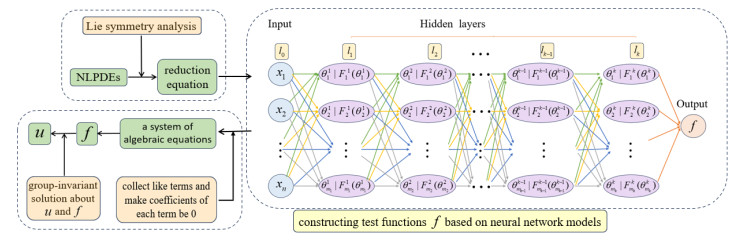
Figure 1.
The framework of Lie-symmetry neural network method.
-
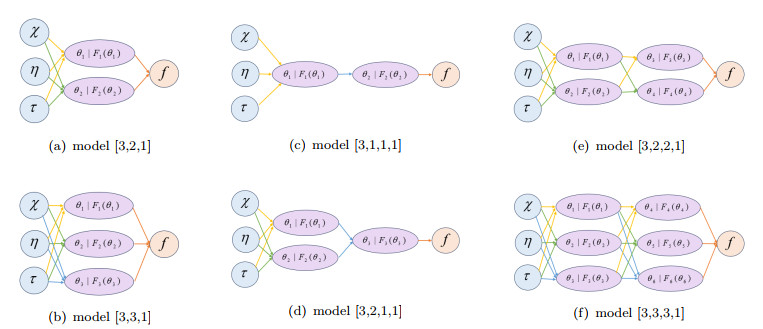
Figure 2.
Six neural network models.
-
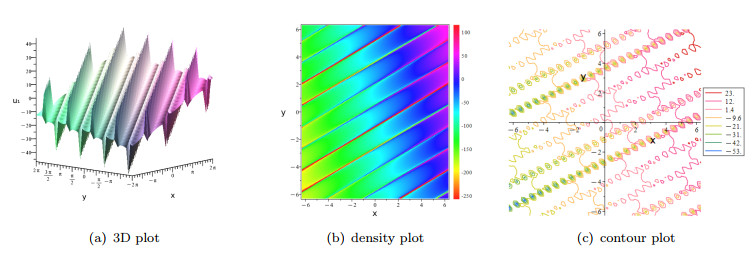
Figure 3.
The profiles of solution
$ u_{1} $ $ z=1, t=1, b_3=2, w_{1,f}=1, w_{2,f}=1, w_{\eta,1}=1, w_{\tau,1}=1, w_{\chi,2}=1, w_{\tau,2}=1 $ -
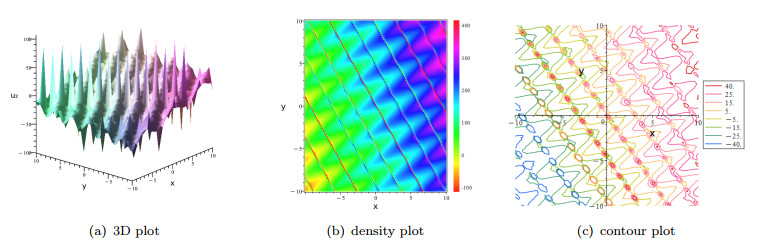
Figure 4.
The profiles of solution
$ u_{2} $ $ z=1, t=1, b_4=2, w_{1,f}=1, w_{2,f}=1, w_{3,f}=10, w_{\eta,1}=1, w_{\tau,1}=1, w_{\chi,2}=1, w_{\chi,3}=1, w_{\tau,3}=1 $ -
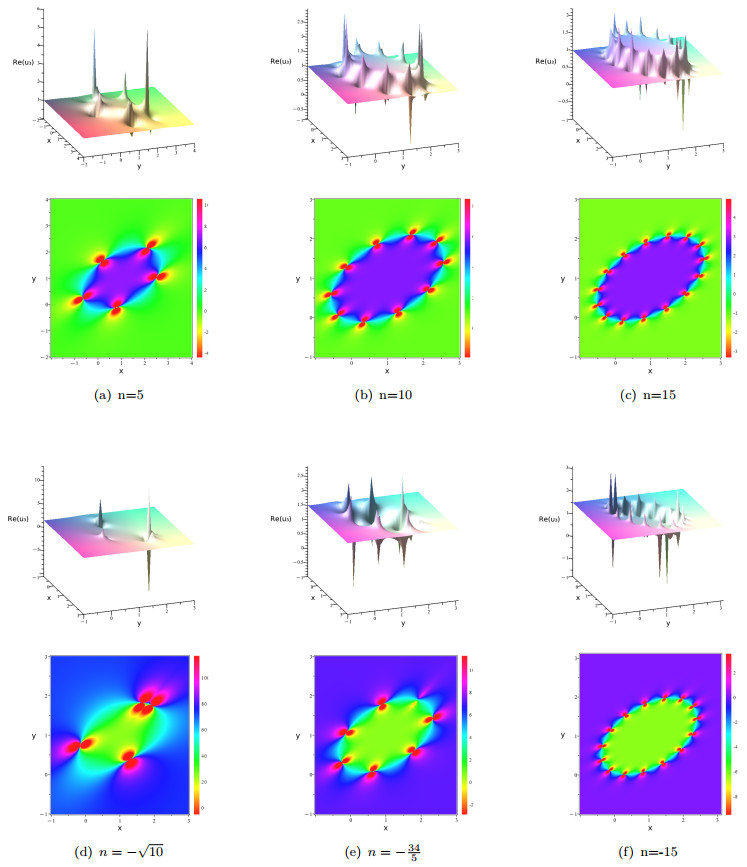
Figure 5.
The real part profiles of solution
$ u_3 $ $ n $ $ t=1, z=1, b_2=2, w_{2,f}=1, w_{1,2}=1, w_{\tau,1}=1 $ -
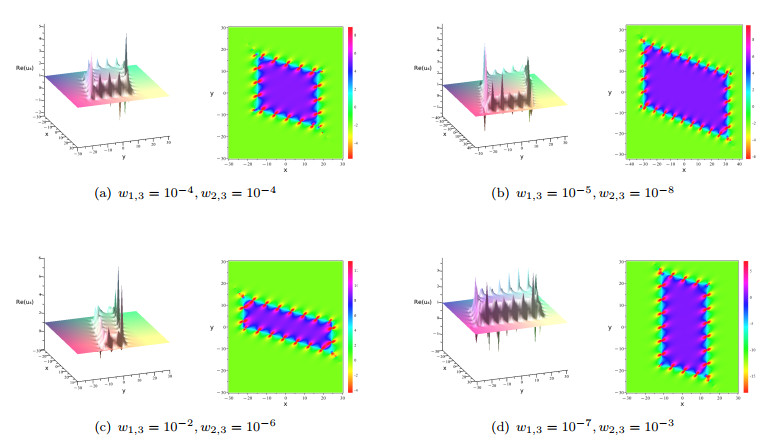
Figure 6.
The real part evolution plots of solution
$ u_4 $ $ w_{1,3} $ $ w_{2,3} $ $ z=1, t=1, b_3=1, w_{3,f}=1, w_{\tau,1}=1, w_{\eta,2}=1 $ -
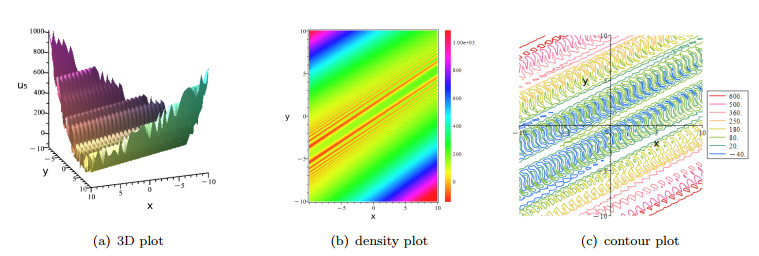
Figure 7.
The profiles of solution
$ u_{5} $ $ z=1, t=1, b_5=2, w_{3,f}=1, w_{4,f}=100, w_{1,3}=1, w_{2,3}=1, w_{2,4}=1, w_{\eta,1}=1, w_{\tau,1}=1, w_{\chi,2}=1, w_{\tau,2}=1 $ -
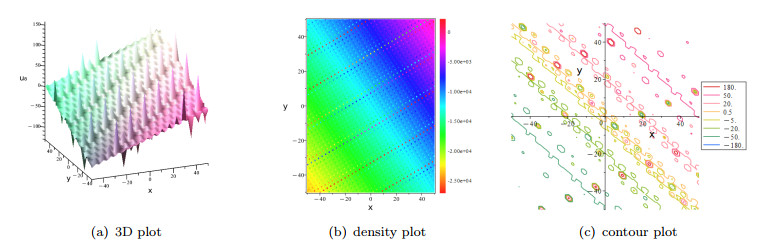
Figure 8.
The profiles of solution
$ u_{6} $ $ z=1, t=1, b_7=2, w_{4,f}=1, w_{5,f}=1, w_{6,f}=1, w_{\eta,1}=1, w_{\tau,1}=1, w_{\chi,3}=1, w_{\eta,2}=1 $ -
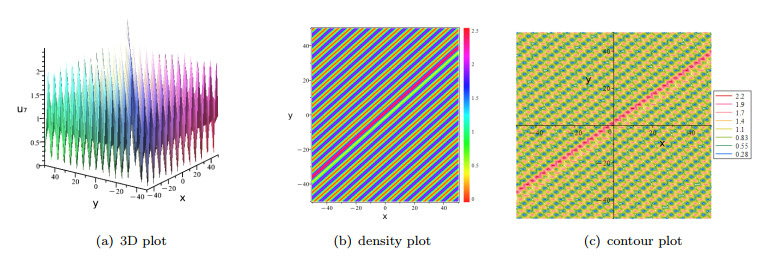
Figure 9.
The profiles of solution
$ u_{7} $ $ z=1, t=1, b_3=2, w_{1,f}=1, w_{2,f}=1, w_{\eta,1}=1, w_{\eta,2}=1 $ -
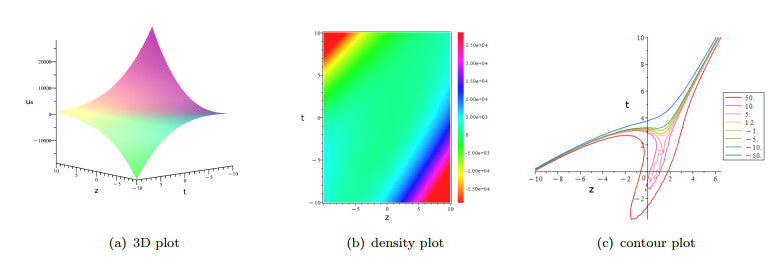
Figure 10.
The profiles of solution
$ u_{8} $ $ z=1, t=1, b_4=2, w_{1,f}=1, w_{2,f}=1, w_{3,f}=1, w_{\chi,1}=1, w_{\chi,2}=1, w_{\chi,3}=1, w_{\eta,1}=1, w_{\eta,3}=1 $ -
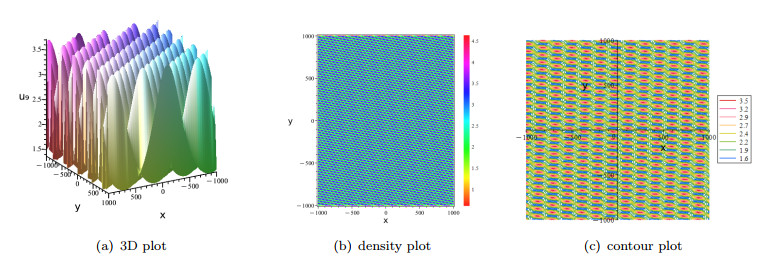
Figure 11.
The profiles of solution
$ u_{9} $ $ z=1, t=1, b_3=2, w_{2,f}=1, w_{1,2}=1, w_{\eta,1}=1 $ -
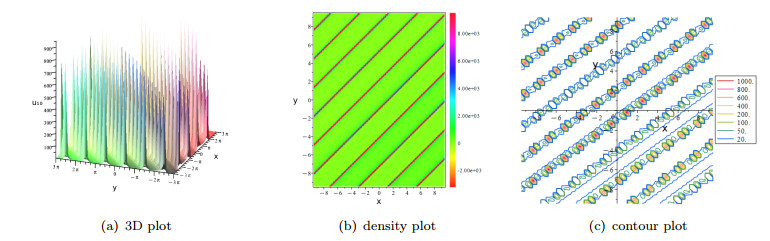
Figure 12.
The profiles of solution
$ u_{10} $ $ z=1, t=1, b_4=2, w_{3,f}=1, w_{1,3}=1, w_{2,3}=1, w_{\eta,1}=1, w_{\eta,2}=1 $ -
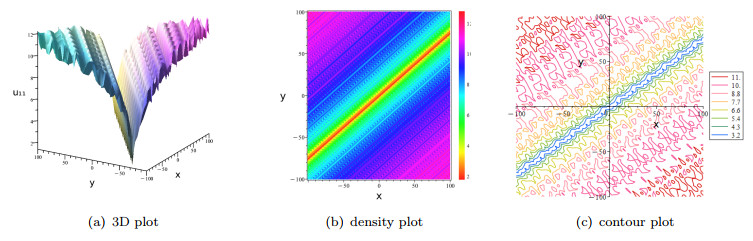
Figure 13.
The profiles of solution
$ u_{11} $ $ z=1, t=1, b_{3}=2, b_{5}=2, w_{3,f}=1, w_{4,f}=1, w_{1,3}=1, w_{2,3}=1, w_{2,4}=1, w_{\eta,1}=1, w_{\eta,2}=1 $ -
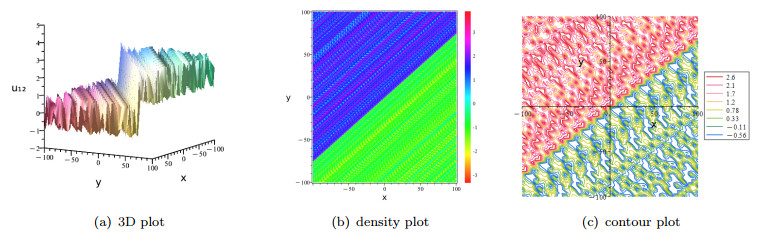
Figure 14.
The profiles of solution
$ u_{12} $ $ z=1, t=1, b_{7}=2 $