

| Citation: |
Muath Awadalla, Abulrahman A. Sharif. A CAPUTO FRACTIONAL LOTKA-VOLTERRA MODEL FOR COMPETITIVE OPINION DYNAMICS: STABILITY ANALYSIS AND DATA-DRIVEN VALIDATION[J]. Journal of Applied Analysis & Computation, 2027, 17(1): 473-499. doi: 10.11948/20260064

|
A CAPUTO FRACTIONAL LOTKA-VOLTERRA MODEL FOR COMPETITIVE OPINION DYNAMICS: STABILITY ANALYSIS AND DATA-DRIVEN VALIDATION
-
Abstract
Competitive opinion dynamics in socio-economic systems often exhibit memory and history-dependent interactions that cannot be adequately captured by classical integer-order models. In this paper, we propose a Caputo fractional-order Lotka-Volterra framework to describe the competition between two interacting opinions and provide a rigorous mathematical analysis of the resulting system. By reformulating the model in an equivalent Volterra integral form, we establish existence and uniqueness of solutions and conduct a local stability analysis based on the Jacobian matrix and the Matignon criterion.The analysis shows that the coexistence equilibrium is asymptotically stable for $0 <q <1$ and neutrally stable for the classical case $q=1$. The theoretical findings are supported by numerical simulations using a predictor-corrector Adams-Bashforth-Moulton scheme for Caputo fractional differential equations. Furthermore, an illustrative calibration based on normalized pseudo-temporal prevalence data and least-squares fitting demonstrates that the fractional model achieves a lower root-mean-square error compared to its classical counterpart, which is consistent with the memory-induced damping mechanism predicted by the stability analysis. In response to reviewer comments, we emphasize that the empirical component is purely illustrative: The data lack genuine timestamps, and no claim of statistical significance or predictive validation is made.
-

-
References
[1] K. I. A. Ahmed, et al., Analytical solutions for a class of variable-order fractional Liu system under time-dependent variable coefficients, Results in Physics, 2024, 56, 107311. DOI: 10.1016/j.rinp.2023.107311. [2] G. Albi, E. Calzola and G. Dimarco, A data-driven kinetic model for opinion dynamics with social network contacts, European Journal of Applied Mathematics, 2025, 36(2), 264–290. doi: 10.1017/S0956792524000068 [3] N. Almutairi, et al., A deterministic and stochastic fractional-order model for computer virus propagation with Caputo-Fabrizio derivative: Analysis, numerics, and dynamics, Computer Modeling in Engineering & Sciences, 2026, 146(3), 1. DOI: 10.32604/cmes.2026.076371. [4] N. Almutairi and S. Saber, Application of a time-fractal fractional derivative with a power-law kernel to the Burke-Shaw system based on Newton's interpolation polynomials, MethodsX, 2024, 12, 102510. DOI: 10.1016/j.mex.2023.102510. [5] M. Althubyani, et al., Epidemiological modeling of pneumococcal pneumonia: Insights from ABC fractal-fractional derivatives, Computer Modeling in Engineering & Sciences, 2025, 143(3), 3491. DOI: 10.32604/cmes.2025.061640. [6] K. Cao and Y. Chen, Fractional Order Crowd Dynamics: Cyber-Human System Modeling and Control, Vol. 4, Walter de Gruyter GmbH & Co. KG, 2018. [7] C. Castellano, S. Fortunato and V. Loreto, Statistical physics of social dynamics, Reviews of Modern Physics, 2009, 81(2), 591–646. doi: 10.1103/RevModPhys.81.591 [8] D. Centola, The spread of behavior in an online social network experiment, Science, 2010, 329(5996), 1194–1197. doi: 10.1126/science.1185231 [9] P. Clifford and A. Sudbury, A model for spatial conflict, Biometrika, 1973, 60(3), 581–588. doi: 10.1093/biomet/60.3.581 [10] A. K. S. Dalbon, E. N. D. Rao, K. S. Reddy and A. S. Ram, Challenges and sustainability of contiguous mining leases in India: Legal, environmental, and socio-economic perspectives from Goa, Karnataka, and Odisha states, Social Sciences & Humanities Open, 2026, 13, 102426. [11] K. Diethelm, N. J. Ford and A. D. Freed, A predictor-corrector approach for the numerical solution of fractional differential equations, Nonlinear Dynamics, 2002, 29(1), 3–22. [12] V. D. Djordjevic, J. Jarić, B. Fabry, J. J. Fredberg and D. Stamenović, Fractional derivatives embody essential features of cell rheological behavior, Annals of Biomedical Engineering, 2003, 31(6), 692–699. doi: 10.1114/1.1574026 [13] D. S. Evans and R. Schmalensee, Matchmakers: The New Economics of Multisided Platforms, Harvard Business Review Press, 2016. [14] S. Galam, Sociophysics: A Physicist's Modeling of Psycho-Political Phenomena, Springer US, 2011. [15] R. Garrappa, Numerical solution of fractional differential equations: A survey and a software tutorial, Mathematics, 2018, 6(2), 16. doi: 10.3390/math6020016 [16] S. He, H. Wang and K. Sun, Solutions and memory effect of fractional-order chaotic system: A review, Chinese Physics B, 2022, 31(6), 060501. doi: 10.1088/1674-1056/ac43ae [17] D. Helbing, Social Self-Organization: Agent-Based Simulations and Experiments to Study Emergent Social Behavior, Springer, 2012. [18] P. Holme and J. Saramäki, Temporal networks, Physics Reports, 2012, 519(3), 97–125. doi: 10.1016/j.physrep.2012.03.001 [19] L. Huang, D. F. Xie, L. Li and Z. He, A survey on data-driven modeling of human drivers' lane-changing decisions, arXiv preprint, 2025. arXiv: 2505.06680. [20] E. Ising, Beitrag zur Theorie des Ferromagnetismus, Zeitschrift für Physik, 1925, 31(1), 253–258. [21] H. Jafari, R. M. Ganji, N. S. Nkomo and Y. P. Lv, A numerical study of fractional order population dynamics model, Results in Physics, 2021, 27, 104456. doi: 10.1016/j.rinp.2021.104456 [22] G. Jin, H. Fan, Y. Wu, Y. Shi, Y. Fang, J. Zhang and Y. Liang, A Survey on Sociophysics-Guided Deep Learning for Social Dynamics: Taxonomy, Methods, and Outlook, Methods, and Outlook, 2026. [23] M. Kenney and J. Zysman, The rise of the platform economy, Issues in Science and Technology, 2016, 32(3), 61. [24] A. A. Kilbas, H. M. Srivastava and J. J. Trujillo, Theory and Applications of Fractional Differential Equations, Vol. 204, Elsevier, 2006. [25] S. A. Kiselev, A. A. Podberezkin, A. M. Borzenkov, A. V. Ostroukh and C. B. Pronin, Dynamic pricing in air cargo: Machine learning and genetic algorithm-based optimization, in 2025 Wave Electronics and its Application in Information and Telecommunication Systems (WECONF), IEEE, 2025, 1–5. [26] J. Lee, J. Kang, S. Son and H. M. Oh, Numerical weather data-driven sensor data generation for PV digital twins: A hybrid model approach, IEEE Access, 2025, 13, 5009–5022. doi: 10.1109/ACCESS.2025.3525659 [27] Y. Lin, J. Tang, J. Guo, S. Wu and Z. Li, Advancing AI-enabled techniques in energy system modeling: A review of data-driven, mechanism-driven, and hybrid modeling approaches, Energies, 2025, 18(4), 845. doi: 10.3390/en18040845 [28] A. J. Lotka, Elements of Physical Biology, Williams & Wilkins, 1925. [29] J. T. Machado, V. Kiryakova and F. Mainardi, Recent history of fractional calculus, Communications in Nonlinear Science and Numerical Simulation, 2011, 16(3), 1140–1153. doi: 10.1016/j.cnsns.2010.05.027 [30] C. Magazzino, T. Gattone and M. Madaleno, The impact of socio-economic factors on the ecological footprint in Turkey: A comprehensive analysis using machine learning approaches, Journal of Environmental Management, 2025, 387, 125861. doi: 10.1016/j.jenvman.2025.125861 [31] R. L. Magin, Fractional Calculus in Bioengineering, Begell House Publishers, 2006. [32] F. Mainardi, Fractional Calculus and Waves in Linear Viscoelasticity: An Introduction to Mathematical Models, World Scientific, 2022. [33] D. Matignon, Stability results for fractional differential equations with applications to control processing, in Proceedings of the IMACS Multiconference on Computational Engineering in Systems Applications (CESA'96), Lille, France, 1996, 963–968. [34] R. Metzler and J. Klafter, The random walk's guide to anomalous diffusion: A fractional dynamics approach, Physics Reports, 2000, 339(1), 1–77. [35] P. S. Meyer and J. H. Ausubel, Carrying capacity: A model with logistically varying limits, Technological Forecasting and Social Change, 1999, 61(3), 209–214. doi: 10.1016/S0040-1625(99)00022-0 [36] T. Modis, Technological forecasting at the stock market, Technological Forecasting and Social Change, 1999, 62(3), 173–202. doi: 10.1016/S0040-1625(99)00046-3 [37] J. Mou, X. Chen, W. Du and J. Han, Simulation research on the optimization of rural tourism system resilience based on a long short-term memory neural network—Taking well-known tourist villages in Heilongjiang Province as examples, Sustainability, 2025, 17(3), 1305. doi: 10.3390/su17031305 [38] B. I. A. Muttaqin and C. N. Rosyidi, Open pit mining profit maximization considering selling stage and waste rehabilitation cost, in AIP Conference Proceedings, AIP Publishing LLC, 2017, 1902(1), 020022. [39] K. Oldham and J. Spanier, The Fractional Calculus Theory and Applications of Differentiation and Integration to Arbitrary Order, Vol. 111, Elsevier, 1974. [40] K. M. Owolabi, J. F. Gómez-Aguilar and B. Karaagac, Modelling, analysis and simulations of some chaotic systems using derivative with Mittag-Leffler kernel, Chaos, Solitons & Fractals, 2019, 125, 54–63. [41] A. De Paola, L. Fortunati, E. Musiari, G. P. Anselmi, D. Curro, N. Andreadou and G. Fulli, Residential load forecast: An enhanced machine learning model with socio-economic data and synthetic features, Results in Engineering, 2026, 109184. [42] A. P. Parizad, E. Dehghani and M. A. M. A. Kermani, Data driven framework for ranking influential nodes in social networks using machine learning and neural networks, Social Network Analysis and Mining, 2026, 16(1), 13. [43] G. G. Parker, M. W. Van Alstyne and S. P. Choudary, Platform Revolution: How Networked Markets are Transforming the Economy and How to Make Them Work for You, WW Norton & Company, 2016. [44] I. Podlubny, Fractional Differential Equations: An Introduction to Fractional Derivatives, Fractional Differential Equations, to Methods of Their Solution and Some of Their Applications, Vol. 198, Elsevier, 1998. [45] G. Ren, Y. Yu, Z. Lu and W. Chen, A fractional order model for rumor spreading in mobile social networks from a stochastic process, in 2021 9th International Conference on Systems and Control (ICSC), IEEE, 2021, 312–318. [46] K. Sastry, D. E. Goldberg and G. Kendall, Genetic algorithms, in Search Methodologies: Introductory Tutorials in Optimization and Decision Support Techniques, Springer US, 2013, 93–117. [47] D. S. Seara, J. Colen, M. Fruchart, Y. Avni, D. G. Martin and V. Vitelli, Sociohydrodynamics: Data-driven modeling of social behavior, Proceedings of the National Academy of Sciences, 2025, 122(35), e2508692122. doi: 10.1073/pnas.2508692122 [48] A. Sirbu, V. Loreto, V. D. Servedio and F. Tria, Opinion dynamics: Models, extensions and external effects, in Participatory Sensing, Opinions and Collective Awareness, Springer International Publishing, 2016, 363–401. [49] E. Solouma, et al., On the stochastic simulation by optimal control and bifurcation analysis of the computer virus model in Caputo-type, Alexandria Engineering Journal, 2026, 144, 12–22. DOI: 10.1016/j.aej.2026.04.017. [50] V. E. Tarasov, Fractional nonlinear dynamics of learning with memory, Nonlinear Dynamics, 2020, 100(2), 1231–1242. doi: 10.1007/s11071-020-05602-w [51] V. Volterra, Variazioni e fluttuazioni del numero d'individui in specie animali conviventi, Società Anonima Tipografica "Leonardo da Vinci", 1926. [52] S. Wang, S. Bekiros, A. Yousefpour, S. He, O. Castillo and H. Jahanshahi, Synchronization of fractional time-delayed financial system using a novel type-2 fuzzy active control method, Chaos, Solitons & Fractals, 2020, 136, 109768. -
-
Figures(5) / Tables(1)
Export File
Citation
Muath Awadalla, Abulrahman A. Sharif. A CAPUTO FRACTIONAL LOTKA-VOLTERRA MODEL FOR COMPETITIVE OPINION DYNAMICS: STABILITY ANALYSIS AND DATA-DRIVEN VALIDATION[J]. Journal of Applied Analysis & Computation, 2027, 17(1): 473-499. doi: 10.11948/20260064
Format
Content
 DownLoad:
-
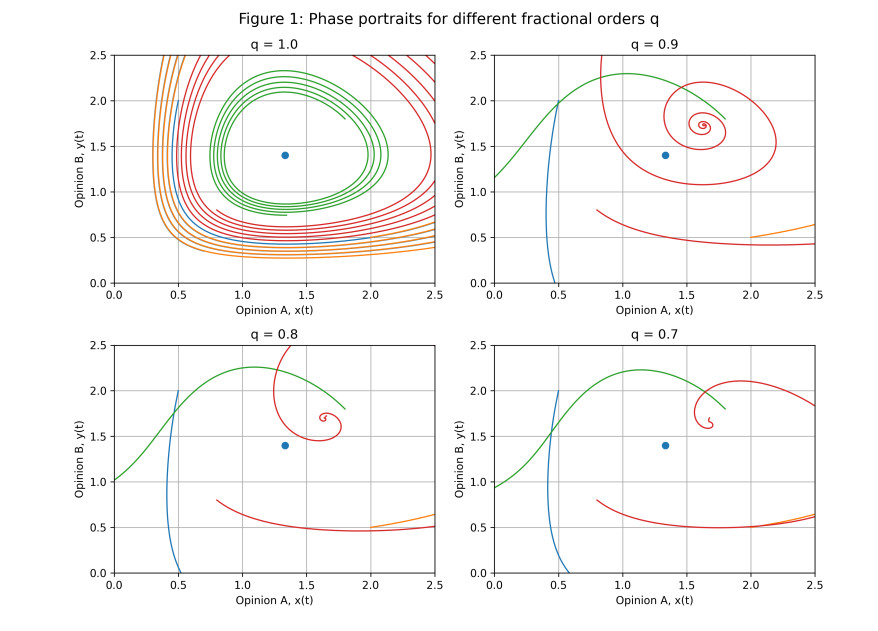
Figure 1.
Phase portraits of the fractional-order Lotka–Volterra opinion dynamics model for different values of
$q$ $E^{*}$ $q=1$ $E^{*}$ $q=0.9$ $q=0.8$ $q=0.7$ $E^{*}$ $0 < q < 1$ $a=0.7$ $b=0.5$ $c=0.6$ $d=0.8$ $E^{*}\approx(1.333, 1.4)$ $(0.5, 2.0)$ $(2.0, 0.5)$ $(1.8, 1.8)$ $(0.8, 0.8)$ -
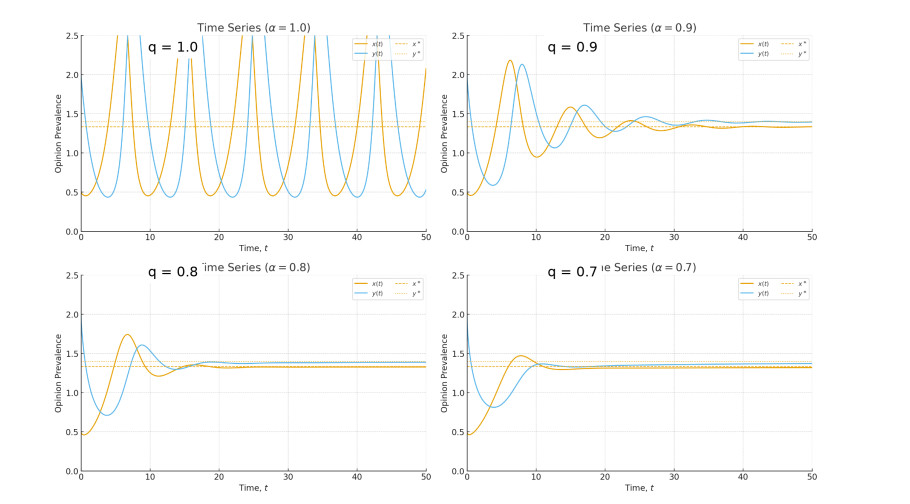
Figure 2.
Time-series plots of the opinion prevalences
$x(t)$ $y(t)$ $(x_0, y_0)=(0.5, 2.0)$ $q=1$ $q=0.9$ $q=0.8$ $q=0.7$ $x^{*}\approx1.333$ $y^{*}\approx1.4$ $a=0.7$ $b=0.5$ $c=0.6$ $d=0.8$ -
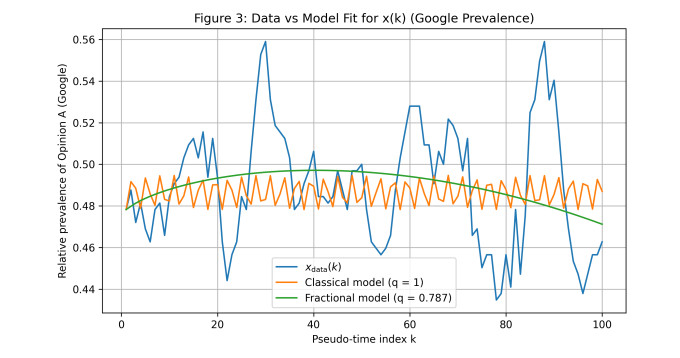
Figure 3.
Normalized Google prevalence: Comparison between the pseudo-temporal sequence and model trajectories. Under the adopted aggregation procedure, the fractional model
$(q\approx0.787)$ $(q=1)$ -
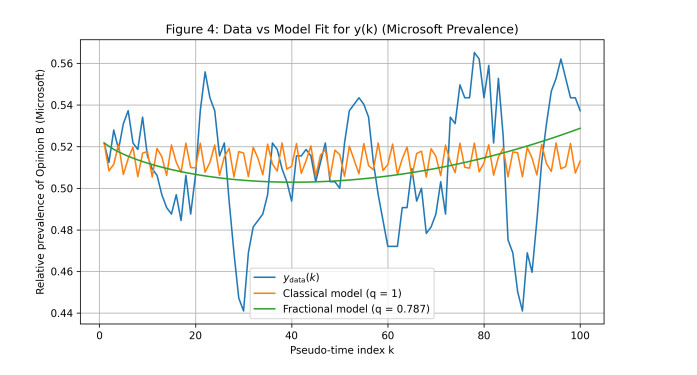
Figure 4.
Normalized Microsoft prevalence: Comparison between the pseudo-temporal sequence and model trajectories. The fractional model
$(q\approx0.787)$ $(q=1)$ -
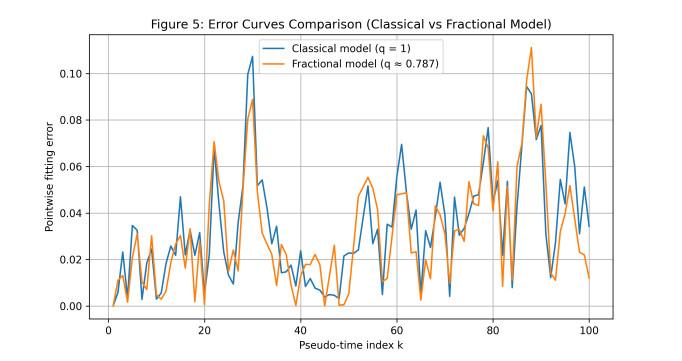
Figure 5.
Pointwise error curves
$e(k)$ $(q=1)$ $(q\approx0.787)$