

| Citation: |
Yuxin Zhang, Xiaoyue Guan, Zhengchao Li. TURING INSTABILITY OF PERIODIC SOLUTIONS IN THE FITZHUGH–NAGUMO MODEL WITH CROSS-DIFFUSION[J]. Journal of Applied Analysis & Computation, 2026, 16(4): 2097-2125. doi: 10.11948/20250271

|
TURING INSTABILITY OF PERIODIC SOLUTIONS IN THE FITZHUGH–NAGUMO MODEL WITH CROSS-DIFFUSION
-
Abstract
We investigate spatiotemporal pattern formation in a FitzHugh–Nagumo reaction-diffusion system with density-dependent cross-diffusion. In particular, we analyze how diffusion perturbs Hopf-bifurcating periodic orbits and derive conditions under which these oscillations lose stability via a Turing mechanism. Moreover, we obtain an explicit criterion, in terms of the diffusion coefficients, that predicts the onset of Turing instability for Hopf-bifurcating periodic solutions in the FitzHugh–Nagumo reaction-diffusion system with cross-diffusion. Numerical simulations validate the theoretical analysis and demonstrate the existence of spatiotemporal pattern formation.
-

-
References
[1] F. Berezovskaya, E. Camacho, S. Wirkus and G. Karev, “Traveling wave” solutions of FitzHugh model with cross-diffusion, Math. Biosci. Eng., 2008, 5(2), 239–260. doi: 10.3934/mbe.2008.5.239 [2] V. N. Biktashev and M. A. Tsyganov, Solitary waves in excitable systems with cross-diffusion, Proc. R. Soc. Lond. Ser. A Math. Phys Eng. Sci., 2005,461(2064), 3711–3730. [3] L. B. Bushard, Periodic solutions of perturbed autonomous systems, and locking-in, SIAM J. Appl. Math., 1972, 22(4), 519–528. doi: 10.1137/0122046 [4] X. Cao and W. Jiang, Interactions of Turing and Hopf bifurcations in an additional food provided diffusive predator–prey model, J. Appl. Anal. Comput., 2019, 9(4), 1277–1304. [5] V. Castets, E. Dulos, J. Boissonade and P. De Kepper, Experimental evidence of a sustained standing Turing-type nonequilibrium chemical pattern, Phys. Rev. Lett., 1990, 64(24), 2953–2956. doi: 10.1103/PhysRevLett.64.2953 [6] D. Cebrián-Lacasa, M. Leda, A. B. Goryachev and L. Gelens, Wave-driven phase wave patterns in a ring of FitzHugh–Nagumo oscillators, Phys. Rev. E, 2024,110(5), 054208. doi: 10.1103/PhysRevE.110.054208 [7] E. A. Coddington and N. Levinson, Theory of Ordinary Differential Equations, McGraw-Hill, New York, 1955. [8] M. C. Cross and P. C. Hohenberg, Pattern formation outside of equilibrium, Rev. Mod. Phys., 1993, 65(3), 851–1112. doi: 10.1103/RevModPhys.65.851 [9] R. FitzHugh, Impulses and physiological states in theoretical models of nerve membrane, Biophys. J., 1961, 1(6), 445–466. doi: 10.1016/S0006-3495(61)86902-6 [10] G. Gambino, M. C. Lombardo, R. Rizzo and M. Sammartino, Excitable FitzHugh–Nagumo model with cross-diffusion: Long-range activation instabilities, Ric. Mat., 2024, 73(Suppl 1), 115–135. [11] S. Gao, L. Chang, M. Perc and Z. Wang, Turing patterns in simplicial complexes, Phys. Rev. E, 2023,107(1), 014216. doi: 10.1103/PhysRevE.107.014216 [12] A. Gierer and H. Meinhardt, A theory of biological pattern formation, Kybernetik, 1972, 12(1), 30–39. doi: 10.1007/BF00289234 [13] K. P. Hadeler, U. an der Heiden and K. Schumacher, Generation of the nervous impulse and periodic oscillations, Biol. Cybernet., 1976, 23(4), 211–218. doi: 10.1007/BF00340337 [14] D. Nezhad Hajian, F. Parastesh, S. Jafari, M. Perc and E. Klemenčič, Medium inhomogeneities modulate emerging spiral waves, Chaos Soliton. Fract., 2024,179, 114413. doi: 10.1016/j.chaos.2023.114413 [15] D. Nezhad Hajian, F. Parastesh, K. Rajagopal, S. Jafari and M. Perc, When do chemical synapses modulate the formation of spiral waves?, Nonlinear Dyn., 2023,111(24), 22551–22565. doi: 10.1007/s11071-023-08994-7 [16] B. D. Hassard, N. D. Kazarinoff and Y.-H. Wan, Theory and Applications of Hopf Bifurcation, Cambridge University Press, Cambridge, 1981. [17] A. L. Hodgkin and A. F. Huxley, A quantitative description of membrane current and its application to conduction and excitation in nerve, J. Physiol., 1952,117(4), 500–544. doi: 10.1113/jphysiol.1952.sp004764 [18] D. Horstmann, From 1970 until present : The Keller-Segel model in chemotaxis and its consequences I, Jahresberichte DMV, 2003,105(3), 103–165. [19] I.-D. Hsü and N. D. Kazarinoff, An applicable Hopf bifurcation formula and instability of small periodic solutions of the Field–Noyes model, J. Math. Anal. Appl., 1976, 55(1), 61–89. doi: 10.1016/0022-247X(76)90278-X [20] E. M. Izhikevich, Dynamical Systems in Neuroscience: The Geometry of Excitability and Bursting, MIT Press, Cambridge, MA, 2007. [21] E. M. Izhikevich and R. FitzHugh, FitzHugh–Nagumo model, Scholarpedia, 2006, 1(9), 1349. doi: 10.4249/scholarpedia.1349 [22] C. K. R. T. Jones, Stability of the travelling wave solution of the FitzHugh–Nagumo system, Trans. Amer. Math. Soc., 1984,286(2), 431–469. doi: 10.1090/S0002-9947-1984-0760971-6 [23] E. F. Keller and L. A. Segel, Initiation of slime mold aggregation viewed as an instability, J. Theor. Biol., 1970, 26(3), 399–415. doi: 10.1016/0022-5193(70)90092-5 [24] E. F. Keller and L. A. Segel, Model for chemotaxis, J. Theor. Biol., 1971, 30(2), 225–234. doi: 10.1016/0022-5193(71)90050-6 [25] M. Krupa, B. Sandstede and P. Szmolyan, Fast and slow waves in the FitzHugh–Nagumo equation, J. Differ. Equ., 1997,133(1), 49–97. doi: 10.1006/jdeq.1996.3198 [26] M. Kuwamura and H. Izuhara, Diffusion-driven destabilization of spatially homogeneous limit cycles in reaction–diffusion systems, Chaos, 2017, 27(3), 033112. doi: 10.1063/1.4978924 [27] K. Maginu, Stability of spatially homogeneous periodic solutions of reaction-diffusion equations, J. Differ. Equ., 1979, 31(1), 130–138. doi: 10.1016/0022-0396(79)90156-6 [28] S. Majhi, S. Ghosh, P. K. Pal, S. Pal, T. K. Pal, D. Ghosh, J. Završnik and M. Perc, Patterns of neuronal synchrony in higher-order networks, Phys. Life Rev., 2025, 52,144–170. doi: 10.1016/j.plrev.2024.12.013 [29] C. E. Rubio-Mercedes and G. B. Verão, Numerical simulation of traveling waves in the FitzHugh–Nagumo system via equilibria of nonlocal equations, Comp. Appl. Math., 2025, 44(5), 218. doi: 10.1007/s40314-025-03182-2 [30] J. D. Murray, Mathematical Biology Ⅱ: Spatial Models and Biomedical Applications, 3rd ed., Springer, New York, 2003. [31] J. Nagumo, S. Arimoto and S. Yoshizawa, An active pulse transmission line simulating nerve axon, Proc. IRE, 1962, 50(10), 2061–2070. doi: 10.1109/JRPROC.1962.288235 [32] F. Parastesh, S. Jafari, H. Azarnoush, Z. Shahriari, Z. Wang, S. Boccaletti and M. Perc, Chimeras, Phys. Rep., 2021,898, 1–114. [33] M. R. Ricard and S. Mischler, Turing instabilities at Hopf bifurcation, J. Nonlinear Sci., 2009, 19(5), 467–496. doi: 10.1007/s00332-009-9041-6 [34] S. Ruan, Diffusion-driven instability in the Gierer–Meinhardt model of morphogenesis, Nat. Resour. Model., 1998, 11(2), 131–141. doi: 10.1111/j.1939-7445.1998.tb00304.x [35] G. She and F. Yi, Dynamics and bifurcations in a nondegenerate homogeneous diffusive SIR rabies model, SIAM J. Appl. Math., 2024, 84(2), 632–660. doi: 10.1137/23M159055X [36] G. She and F. Yi, Stability and bifurcation analysis of a reaction–diffusion SIRS epidemic model with the general saturated incidence rate, J. Nonlinear Sci., 2024, 34(6), 101. doi: 10.1007/s00332-024-10081-z [37] W. C. Troy, Bifurcation phenomena in FitzHugh's nerve conduction equations, J. Math. Anal. Appl., 1976, 54(3), 678–690. doi: 10.1016/0022-247X(76)90187-6 [38] A. M. Turing, The chemical basis of morphogenesis, Philos. Trans. R. Soc. Lond. B, 1952,237(641), 37–72. doi: 10.1098/rstb.1952.0012 [39] S. Wiggins, Introduction to Applied Nonlinear Dynamical Systems and Chaos, Springer, New York, 1990. [40] Y. Yang, Bifurcation and Turing instability of the solutions of the diffusive Lauffenburger–Kennedy bacterial infection model with phagocyte and bacterial chemotactic terms, Nonlinear Dyn., 2023,111(15), 14621–14638. doi: 10.1007/s11071-023-08606-4 [41] Y. Yang and X. Ju, Diffusion-driven instability of the periodic solutions for a diffusive system modeling mammalian hair growth, Nonlinear Dyn., 2023,111(6), 5799–5815. doi: 10.1007/s11071-022-08114-x [42] F. Yi, Turing instability of the periodic solutions for reaction–diffusion systems with cross-diffusion and the patch model with cross-diffusion-like coupling, J. Differ. Equ., 2021,281,379–410. doi: 10.1016/j.jde.2021.02.006 [43] F. Yi, J. Wei and J. Shi, Diffusion-driven instability and bifurcation in the Lengyel–Epstein system, Nonlinear Anal. Real World Appl., 2008, 9(3), 1038–1051. doi: 10.1016/j.nonrwa.2007.02.005 [44] E. P. Zemskov, I. R. Epstein and A. Muntean, Oscillatory pulses in FitzHugh–Nagumo type systems with cross-diffusion, Math. Med. Biol., 2011, 28(2), 217–226. doi: 10.1093/imammb/dqq012 [45] E. P. Zemskov and A. Yu. Loskutov, Oscillating travelling waves in excitable media, J. Exp. Theor. Phys., 2008,107(2), 344–349. doi: 10.1134/S1063776108080189 [46] E. P. Zemskov, M. A. Tsyganov and W. Horsthemke, Multifront regime of a piecewise-linear FitzHugh–Nagumo model with cross diffusion, Phys. Rev. E, 2019, 99(6), 062214. doi: 10.1103/PhysRevE.99.062214 -
-
Figures(8)

Export File
Citation
Yuxin Zhang, Xiaoyue Guan, Zhengchao Li. TURING INSTABILITY OF PERIODIC SOLUTIONS IN THE FITZHUGH–NAGUMO MODEL WITH CROSS-DIFFUSION[J]. Journal of Applied Analysis & Computation, 2026, 16(4): 2097-2125. doi: 10.11948/20250271
Format
Content
 DownLoad:
-
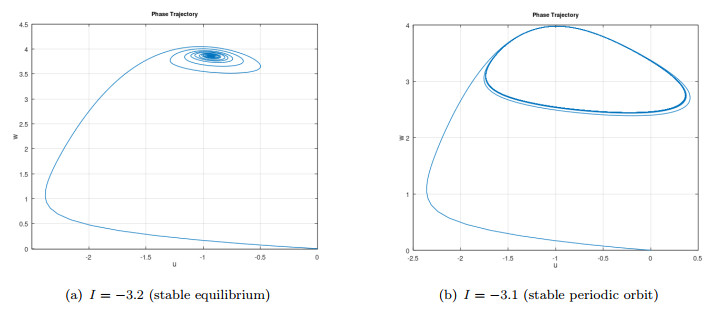
Figure 1.
Trajectories in the
$ (u,w) $ $ a=1 $ $ b=0.4 $ $ \rho=0.5 $ $ t\in[0,500] $ $ \Delta t=0.1 $ $ u(0)=w(0)=0 $ $ I=-3.2 $ $ I=-3.1 $ -
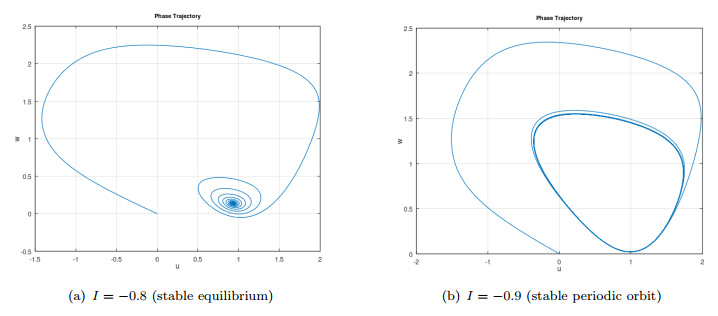
Figure 2.
Trajectories in the
$ (u,w) $ $ a=1 $ $ b=0.4 $ $ \rho=0.5 $ $ t\in[0,500] $ $ \Delta t=0.1 $ $ u(0)=w(0)=0 $ $ I=-0.8 $ $ I=-0.9 $ -
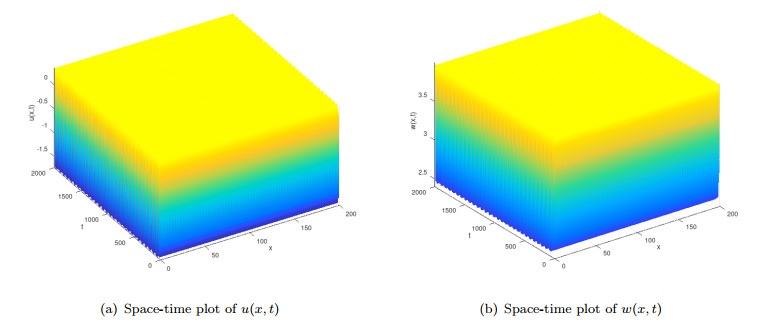
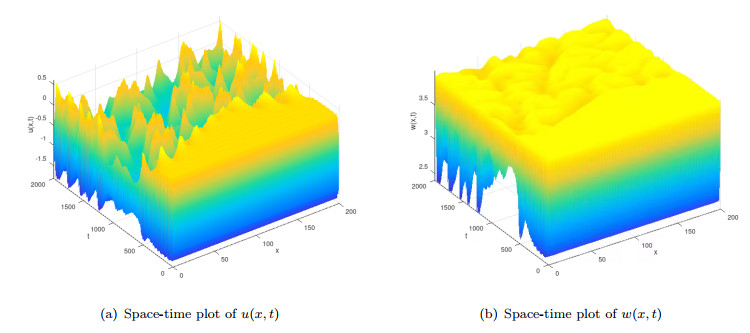
Figure 3.
Numerical solution of the FitzHugh–Nagumo system (1.3) on the one-dimensional domain
$ \Omega=(0,200) $ $ \partial_{\nu}u=\partial_{\nu}w=0 $ $ a=1 $ $ b=0.4 $ $ \rho=0.5 $ $ I=-3.1 $ $ (d_{11},d_{12},d_{21},d_{22})=(1,0,0,1) $ $ u(x,t) $ $ w(x,t) $ $ t\in[0,2000] $ $ \Delta x=0.5 $ $ \Delta t=1 $ $ u(x,0)=-0.9+0.1\sin(2x) $ $ w(x,0)=3+0.1\sin(2x) $ $ (u_{I_{1}},w_{I_{1}})\approx(-0.8944,3.7889) $ -
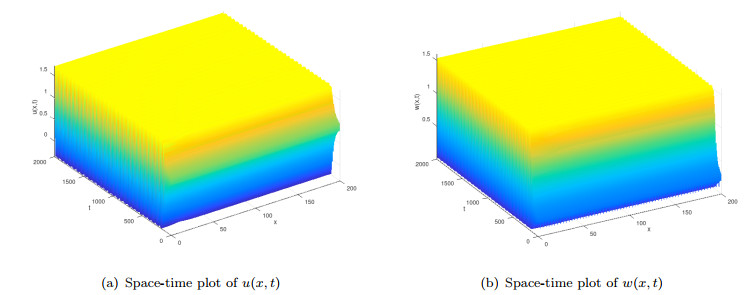
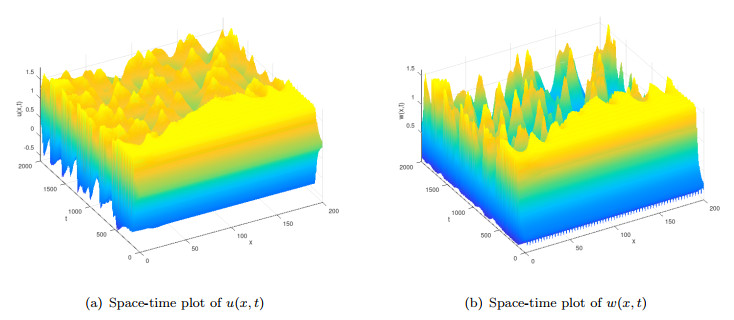
Figure 4.
Numerical solution of the FitzHugh–Nagumo system (1.3) on the one-dimensional domain
$ \Omega=(0,200) $ $ \partial_{\nu}u=\partial_{\nu}w=0 $ $ a=1 $ $ b=0.4 $ $ \rho=0.5 $ $ I=-0.9 $ $ (d_{11},d_{12},d_{21},d_{22})=(1,0,0,1) $ $ u(x,t) $ $ w(x,t) $ $ t\in[0,2000] $ $ \Delta x=0.5 $ $ \Delta t=1 $ $ u(x,0)=0.9+0.1\sin(2x) $ $ w(x,0)=0.2+0.1\sin(2x) $ $ (u_{I_{2}},w_{I_{2}})\approx(0.8944,0.2111) $ -
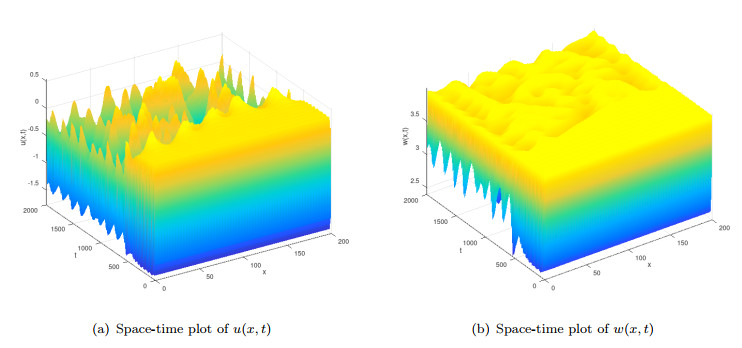
Figure 5.
Numerical solution of the FitzHugh–Nagumo system (1.3) on the one-dimensional domain
$ \Omega=(0,200) $ $ \partial_{\nu}u=\partial_{\nu}w=0 $ $ a=1 $ $ b=0.4 $ $ \rho=0.5 $ $ I=-3.1 $ $ (d_{11},d_{12},d_{21},d_{22})=(1,0,0,0.001) $ $ u(x,t) $ $ w(x,t) $ $ t\in[0,2000] $ $ \Delta x=0.5 $ $ \Delta t=1 $ $ u(x,0)=-0.9+0.1\sin(2x) $ $ w(x,0)=3+0.1\sin(2x) $ $ (u_{I_{1}},w_{I_{1}})\approx(-0.8944,3.7889) $ -
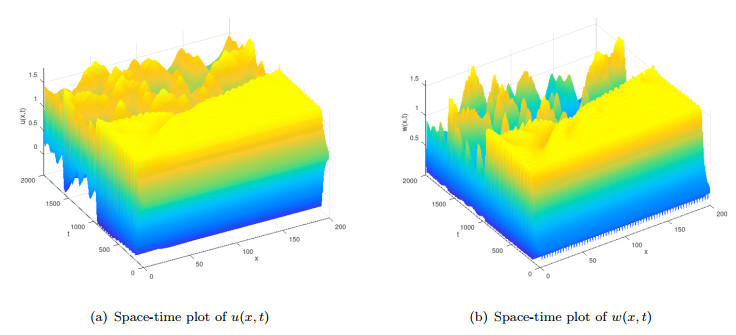
Figure 6.
Numerical solution of the FitzHugh–Nagumo system (1.3) on the one-dimensional domain
$ \Omega=(0,200) $ $ \partial_{\nu}u=\partial_{\nu}w=0 $ $ a=1 $ $ b=0.4 $ $ \rho=0.5 $ $ I=-0.9 $ $ (d_{11},d_{12},d_{21},d_{22})=(1,0,0,0.001) $ $ u(x,t) $ $ w(x,t) $ $ t\in[0,2000] $ $ \Delta x=0.5 $ $ \Delta t=1 $ $ u(x,0)=0.9+0.1\sin(2x) $ $ w(x,0)=0.2+0.1\sin(2x) $ $ (u_{I_{2}},w_{I_{2}})\approx(0.8944,0.2111) $ -
Figure 7.
Numerical solution of the cross-diffusion FitzHugh–Nagumo system (1.3) on the one-dimensional domain
$ \Omega=(0,200) $ $ \partial_{\nu}u=\partial_{\nu}w=0 $ $ a=1 $ $ b=0.4 $ $ \rho=0.5 $ $ I=-3.1 $ $ (d_{11},d_{12},d_{21},d_{22})=(1,-1,0.2,1) $ $ u(x,t) $ $ w(x,t) $ $ t\in[0,2000] $ $ \Delta x=0.5 $ $ \Delta t=1 $ $ u(x,0)=-0.9+0.1\sin(2x) $ $ w(x,0)=3+0.1\sin(2x) $ $ (u_{I_{1}},w_{I_{1}})\approx(-0.8944,3.7889) $ -
Figure 8.
Numerical solution of the cross-diffusion FitzHugh–Nagumo system (1.3) on the one-dimensional domain
$ \Omega=(0,200) $ $ \partial_{\nu}u=\partial_{\nu}w=0 $ $ a=1 $ $ b=0.4 $ $ \rho=0.5 $ $ I=-0.9 $ $ (d_{11},d_{12},d_{21},d_{22})=(1,0.1,2,1) $ $ u(x,t) $ $ w(x,t) $ $ t\in[0,2000] $ $ \Delta x=0.5 $ $ \Delta t=1 $ $ u(x,0)=0.9+0.1\sin(2x) $ $ w(x,0)=0.2+0.1\sin(2x) $ $ (u_{I_{2}},w_{I_{2}})\approx(0.8944,0.2111) $