

| Citation: |
Shuxiang Shao, Bo Du, Xiaoliang Li. STATIONARY DISTRIBUTION OF A STOCHASTIC ENTERPRISE CLUSTER MODEL WITH HIGH-ORDER PERTURBATION[J]. Journal of Applied Analysis & Computation, 2026, 16(5): 2351-2365. doi: 10.11948/20250362

|
STATIONARY DISTRIBUTION OF A STOCHASTIC ENTERPRISE CLUSTER MODEL WITH HIGH-ORDER PERTURBATION
-
Abstract
The survival and development of enterprise clusters are closely related to the sustainable development of the entire economy, so research on them has attracted much attention. In this article, we study the dynamic properties of a stochastic enterprise cluster model with high-order perturbation. First, we study stochastically ultimate boundedness of the system. Then, some sufficient condition for the existence of the stationary distribution in the system are obtained. We also discussed the destructiveness and permanence of the system. Finally, three numerical examples are applied to verify the obtained results.
-
Keywords:
- Cluster model /
- stationary distribution /
- stochastic /
- dynamics
-

-
References
[1] R. Has'minskii, Stochastic Stability of Differential Equations, Sijthoff Noordhoff, Alphen aan den Rijn, The Netherlands, 1980. [2] D. Higham, An algorithmic introduction to numerical simulation of stochastic differential equations, SIAM Rev., 2001, 43, 525–546. doi: 10.1137/S0036144500378302 [3] M. Liao, C. Xu and X. Tang, Dynamical behaviors for a competition and cooperation model of enterprises with two delays, Nonlinear Dyn., 2014, 75, 257–266. doi: 10.1007/s11071-013-1063-9 [4] P. Liu and Y. Li, Analysis of permanence and extinction of enterprise cluster based on ecology theory, Int. J. Comput. Math. Sci., 2011, 5, 154–159. [5] Q. Liu and D. Jiang, Stationary distribution and extinction of a stochastic SIR model with nonlinear perturbation, Applied Mathematics Letters, 2017, 73, 8–15. doi: 10.1016/j.aml.2017.04.021 [6] Q. Liu and D. Jiang, Periodic solution and stationary distribution of stochastic predator-prey models with higher-order perturbation, J. Nonlinear Sci., 2018, 28 423–442. doi: 10.1007/s00332-017-9413-2 [7] L. Lu, Y. Lian and C. Li, Dynamics for a discrete competition and cooperation model of two enterprises with multiple delays and feedback controls, Open Mathematics, 2017, 15, 218–232. doi: 10.1515/math-2017-0023 [8] X. Lv, X. Meng and X. Wang, Extinction and stationary distribution of an impulsive stochastic chemostat model with nonlinear perturbation, Chaos, Solitons and Fractals, 2018, 110, 273–279. doi: 10.1016/j.chaos.2018.03.038 [9] X. Mao, Stochastic Differential Equations and Applications, Horwood Publishing, Chichester, 1997. [10] X. Meng, L. Wang and T. Zhang, Global dynamics analysis of a nonlinear impulsive stochastic chemostat system in a polluted environment, J. Appl. Anal. Comput., 2016, 6, 865–875. [11] A. Muhammadhaji and Y. Maimaiti, On a competition and cooperation model of two enterprises with feedback controls and delays, Mathematics, 2023, 11, 4442. doi: 10.3390/math11214442 [12] C. Xu and P. Li, Almost periodic solutions for a competition and cooperation model of two enterprises with time-varying delays and feedback controls, J. Appl. Math. Comput., 2017, 53, 397–411. doi: 10.1007/s12190-015-0974-7 [13] C. Xu, M. Liao and P. Li, Bifurcation control of a fractional-order delayed competition and cooperation model of two enterprises, Sci. China Technol. Sci., 2019, 62, 2130–2143. doi: 10.1007/s11431-018-9376-2 [14] C. Xu, M. Liao, P. Li and S. Yuan, New insights on bifurcation in a fractional-order delayed competition and cooperation model of two enterprises, J. Appl. Anal. Comput., 2021, 11, 1240–1258. [15] C. Xu and Y. Saho, Existence and global attractivity of periodic solution for enterprise clusters based on ecology theory with impulse, J. Appl. Math. Comput., 2012, 39, 367–384. doi: 10.1007/s12190-011-0530-z [16] Y. Zhi, Z. Ding and Y. Li, Permanence and almost periodic solution for an enterprise cluster model based on ecology theory with feedback controls on time scales, Discrete Dynamics in Nature and Society, 2013, 2013, 639138. -
-
Figures(4)
Export File
Citation
Shuxiang Shao, Bo Du, Xiaoliang Li. STATIONARY DISTRIBUTION OF A STOCHASTIC ENTERPRISE CLUSTER MODEL WITH HIGH-ORDER PERTURBATION[J]. Journal of Applied Analysis & Computation, 2026, 16(5): 2351-2365. doi: 10.11948/20250362
Format
Content
 DownLoad:
-
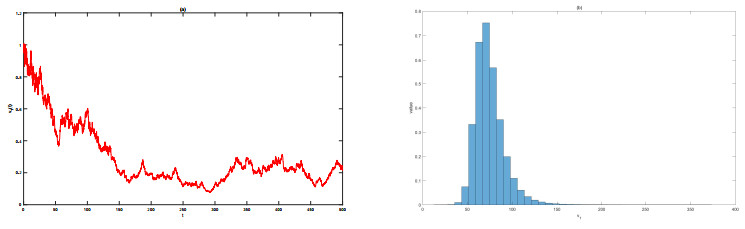
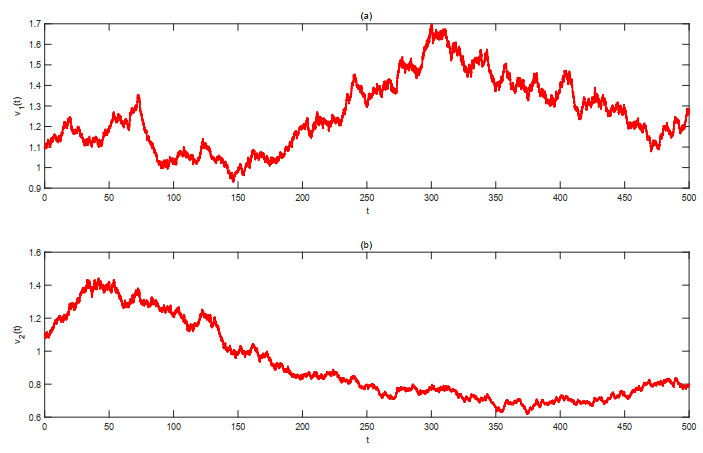
Figure 1.
Figure 1(a) is the stochastic path of
$ v_1 $ $ v_1 $ -
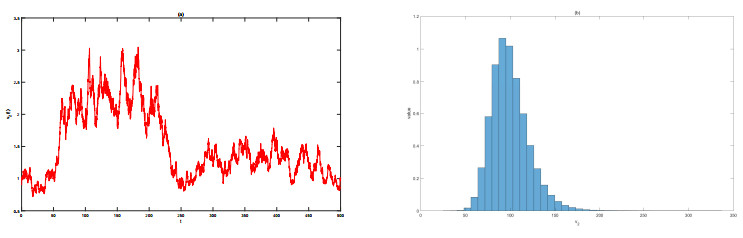
Figure 2.
Figure 2(a) is the stochastic path of
$ v_2 $ $ v_2 $ -
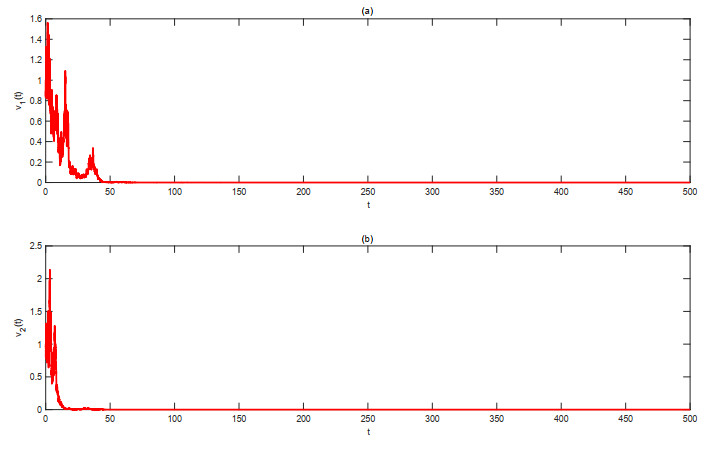
Figure 3.
The solution of system (1.2) is extinct by using parameters of Example 6.2
-
Figure 4.
The solution of system (1.2) is permanent by using parameters of Example 6.3