

| Citation: |
Yiwei Wang, Lijun Zhang. THE INFLUENCE OF SMALL PERMANENT CHARGES AND PARTIAL BOUNDARY CONDITIONS ON INDIVIDUAL FLUXES VIA POISSON-NERNST-PLANCK SYSTEMS[J]. Journal of Applied Analysis & Computation, 2026, 16(4): 2218-2237. doi: 10.11948/20250367

|
THE INFLUENCE OF SMALL PERMANENT CHARGES AND PARTIAL BOUNDARY CONDITIONS ON INDIVIDUAL FLUXES VIA POISSON-NERNST-PLANCK SYSTEMS
-
Abstract
We investigate ionic flow through membrane channels within a one-dimensional Poisson-Nernst-Planck framework, considering two oppositely charged ion species and incorporating a small but non-zero permanent charge. Building upon prior analysis in [50], which was confined to cases with higher left-side concentrations, we relax this constraint to examine a broader and more physiologically relevant range of boundary conditions. Crucially, instead of considering the product of zeroth- and first-order terms in the flux expansion, we focus on the first-order term itself, which directly captures the leading effects of channel geometry and permanent charge. Under partial electroneutral boundary conditions, our analysis results demonstrate that the permanent charge plays a regulatory role: It can either enhance or suppress both ion fluxes simultaneously, or exert opposing effects by increasing anion flux while decreasing cation flux - an outcome that depends on the electric potential applied at the boundary. We further identify and compare several critical electric potentials, providing new insights into the transport mechanisms operative across different potential intervals. Numerical simulations on selected cases yield results in excellent agreement with the theory, confirming and supporting our analytical conclusions.
-
Keywords:
- PNP systems /
- permanent charges /
- individual fluxes /
- partial boundary conditions
-

-
References
[1] N. Abaid, R. S. Eisenberg and W. Liu, Asymptotic expansions of Ⅰ-Ⅴ relations via a Poisson-Nernst-Planck system, SIAM J. Appl. Dyn. Syst., 2008, 7, 1507–1526. doi: 10.1137/070691322 [2] R. Aitbayev, P. W. Bates, H. Lu, L. Zhang and M. Zhang, Mathematical studies of Poisson-Nernst-Planck systems: Dynamics of ionic flows without electroneutrality conditions, J. Comput. Appl. Math., 2019, 362, 510–527. doi: 10.1016/j.cam.2018.10.037 [3] V. Barcilon, Ion flow through narrow membrane channels: Part Ⅰ, SIAM J. Appl. Math., 1992, 52, 1391–1404. doi: 10.1137/0152080 [4] V. Barcilon, D. -P. Chen and R. S. Eisenberg, Ion flow through narrow membrane channels: Part Ⅱ, SIAM J. Appl. Math., 1992, 52, 1405–1425. doi: 10.1137/0152081 [5] V. Barcilon, D. -P. Chen, R. S. Eisenberg and J. W. Jerome, Qualitative properties of steady-state Poisson-Nernst-Planck systems: Perturbation and simulation study, SIAM J. Appl. Math., 1997, 57, 631–648. doi: 10.1137/S0036139995312149 [6] P. W. Bates, J. Chen and M. Zhang, Dynamics of ionic flows via Poisson-Nernst-Planck systems with local hard-sphere potentials: Competition between cations, Math. Biosci. Eng., 2020, 17, 3736–3766. doi: 10.3934/mbe.2020210 [7] P. W. Bates, Y. Jia, G. Lin, H. Lu and M. Zhang, Individual flux study via steady-state Poisson-Nernst-Planck systems: Effects from boundary conditions, SIAM J. Appl. Dyn. Syst., 2017, 16, 410–430. doi: 10.1137/16M1071523 [8] P. W. Bates, Z. Wen and M. Zhang, Small permanent charge effects on individual fluxes via Poisson-Nernst-Planck models with multiple cations, J. Nonlinear Sci., 2021, 33, 1–62. [9] D. Boda, D. Busath, B. Eisenberg, D. Henderson and W. Nonner, Monte Carlo simulations of ion selectivity in a biological Na+ channel: Charge-space competition, Phys. Chem. Chem. Phys., 2002, 4, 5154–5160. doi: 10.1039/B203686J [10] D. -P. Chen and R. S. Eisenberg, Charges, currents and potentials in ionic channels of one conformation, Biophys. J., 1993, 64, 1405–1421. doi: 10.1016/S0006-3495(93)81507-8 [11] J. Chen, Y. Wang, L. Zhang and M. Zhang, Mathematical analysis of Poisson-Nernst-Planck models with permanent charges and boundary layers: Studies on individual fluxes, Nonlinearity, 2021, 34, 3879–3906. doi: 10.1088/1361-6544/abf33a [12] B. Eisenberg, Ion channels as devices, J. Comput. Electro., 2003, 2, 245–249. doi: 10.1023/B:JCEL.0000011432.03832.22 [13] B. Eisenberg, Proteins, channels, and crowded ions, Biophysical Chemistry, 2003, 100, 507–517. [14] B. Eisenberg and W. Liu, Poisson-Nernst-Planck systems for ion channels with permanent charges, SIAM J. Math. Anal., 2007, 38, 1932-1966. doi: 10.1137/060657480 [15] B. Eisenberg, W. Liu and H. Xu, Reversal charge and reversal potential: Case studies via classical Poisson-Nernst-Planck models, Nonlinearity, 2015, 28, 103–128. doi: 10.1088/0951-7715/28/1/103 [16] R. S. Eisenberg, Channels as enzymes, J. Memb. Biol., 1990, 115, 1–12. [17] R. S. Eisenberg, Atomic biology, electrostatics and ionic channels, in New Developments and Theoretical Studies of Proteins, R. Elber, Editor, World Scientific, Philadelphia, 1996, 269–357. [18] D. Gillespie, A Singular Perturbation Analysis of the Poisson-Nernst-Planck System: Applications to Ionic Channels, Ph. D Dissertation, Rush University at Chicago, 1999. [19] D. Gillespie and R. S. Eisenberg, Modified Donnan potentials for ion transport through biological ion channels, Phys. Rev. E, 2001, 63, 061902. doi: 10.1103/PhysRevE.63.061902 [20] D. Gillespie, W. Nonner and R. S. Eisenberg, Coupling Poisson-Nernst-Planck and density functional theory to calculate ion flux, J. Phys. Condens. Matter, 2002, 14, 12129–12145. doi: 10.1088/0953-8984/14/46/317 [21] D. Gillespie, W. Nonner and R. S. Eisenberg, Density functional theory of charged, hard-sphere fluids, Phys. Rev. E, 2003, 68, 0313503. [22] D. Gillespie, L. Xu, Y. Wang and G. Meissner, (De)constructing the Ryanodine receptor: Modeling ion permeation and selectivity of the Calcium release channel, J. Phys. Chem. B, 2005, 109, 15598–15610. doi: 10.1021/jp052471j [23] A. L. Hodgkin and R. D. Keynes, The potassium permeability of a giant nerve fibre, J. Physiol., 1955, 128, 61–88. [24] U. Hollerbach, D. -P. Chen and R. S. Eisenberg, Two- and three-dimensional Poisson-Nernst-Planck simulations of current flow through Gramicidian-A, J. Comput. Sci., 2002, 16, 373–409. [25] J. Huang, S. Li and Z. Yao, Local well-posedness to the free boundary problem of incompressible Euler-Poisson-Nernst-Planck system, J. Differ. Equations, 2025, 429, 157–203. doi: 10.1016/j.jde.2025.02.035 [26] Y. Hyon, B. Eisenberg and C. Liu, A mathematical model for the hard sphere repulsion in ionic solutions, Commun. Math. Sci., 2010, 9, 459–475. [27] Y. Hyon, J. Fonseca, B. Eisenberg and C. Liu, Energy variational approach to study charge inversion (layering) near charged walls, Discrete Contin. Dyn. Syst. Ser. B, 2012, 17, 2725–2743. doi: 10.3934/dcdsb.2012.17.2725 [28] Y. Hyon, C. Liu and B. Eisenberg, PNP equations with steric effects: A model of ion flow through channels, J. Phys. Chem. B, 2012, 116, 11422–11441. doi: 10.1021/jp305273n [29] S. Ji, B. Eisenberg and W. Liu, Flux ratios and channel structures, J. Dyn. Differ. Equ., 2019, 31, 1141–1183. doi: 10.1007/s10884-017-9607-1 [30] S. Ji and W. Liu, Poisson-Nernst-Planck systems for ion flow with density functional theory for hard-sphere potential: Ⅰ-Ⅴ relations and critical potentials. Part Ⅰ: Analysis, J. Dyn. Differ. Equ., 2012, 24, 955–983. doi: 10.1007/s10884-012-9277-y [31] S. Ji, W. Liu and M. Zhang, Effects of (small) permanent charges and channel geometry on ionic flows via classical Poisson-Nernst-Planck models, SIAM J. Appl. Math., 2015, 75, 114–135. doi: 10.1137/140992527 [32] Y. Jia, W. Liu and M. Zhang, Qualitative properties of ionic flows via Poisson-Nernst-Planck systems with Bikerman's local hard-sphere potential: Ion size effects, Discrete Contin. Dyn. Syst. Ser. B, 2016, 21, 1775–1802. doi: 10.3934/dcdsb.2016022 [33] G. Lin, W. Liu, Y. Yi and M. Zhang, Poisson-Nernst-Planck systems for ion flow with density functional theory for local hard-sphere potential, SIAM J. Appl. Dyn. Syst., 2013, 12, 1613–1648. doi: 10.1137/120904056 [34] W. Liu, Geometric singular perturbation approach to steady-state Poisson-Nernst-Planck systems, SIAM J. Appl. Math., 2005, 65, 754–766. doi: 10.1137/S0036139903420931 [35] W. Liu, One-dimensional steady-state Poisson-Nernst-Planck systems for ion channels with multiple ion species, J. Differ. Equations, 2009, 246, 428–451. doi: 10.1016/j.jde.2008.09.010 [36] W. Liu, X. Tu and M. Zhang, Poisson-Nernst-Planck systems for ion flow with density functional theory for hard-sphere potential: Ⅰ-Ⅴ relations and critical potentials. Part Ⅱ: Numerics, J. Dyn. Differ. Equ., 2012, 24, 985–1004. doi: 10.1007/s10884-012-9278-x [37] W. Liu and B. Wang, Poisson-Nernst-Planck systems for narrow tubular-like membrane channels, J. Dyn. Differ. Equ., 2010, 22, 413–437. doi: 10.1007/s10884-010-9186-x [38] W. Liu and H. Xu, A complete analysis of a classical Poisson-Nernst-Planck model for ionic flow, J. Differ. Equations, 2015, 258, 1192–1228. doi: 10.1016/j.jde.2014.10.015 [39] H. Lu, J. Li, J. Shackelford, J. Vorenberg and M. Zhang, Ion size effects on individual fluxes via Poisson-Nernst-Planck systems with Bikerman's local hard-sphere potential: Analysis without electroneutrality boundary conditions, Discrete Contin. Dyn. Syst. Ser. B, 2018, 23, 1623–1643. doi: 10.3934/dcdsb.2018064 [40] M. Lv and B. Lu, A flux-based moving mesh method applied to solving the Poisson-Nernst-Planck equations, J. Comput. Phys., 2024, 513. [41] H. Mofidi, F. Hadadifard and M. Zhang, Analysis of flux-ratio bifurcation in ionic flows via classical Poisson-Nernst-Planck models, Stud. Appl. Math., 2025, 115, 2. [42] W. Nooner and R. S. Eisenberg, Ion permeation and glutamate residues linked by Poisson-Nernst-Planck theory in L-type Calcium channels, Biophys. J., 1998, 75, 1287–1305. doi: 10.1016/S0006-3495(98)74048-2 [43] J. -K. Park and J. W. Jerome, Qualitative properties of steady-state Poisson-Nernst-Planck systems: Mathematical study, SIAM J. Appl. Math., 1997, 57, 609–630. doi: 10.1137/S0036139995279809 [44] Z. Schuss, B. Nadler and R. S. Eisenberg, Derivation of Poisson and Nernst-Planck equations in a bath and channel from a molecular model, Phys. Rev. E, 2001, 64, 1–14. [45] A. Singer, D. Gillespie, J. Norbury and R. S. Eisenberg, Singular perturbation analysis of the steady-state Poisson-Nernst-Planck system: Applications to ion channels, European J. Appl. Math., 2008, 19, 541–560. doi: 10.1017/S0956792508007596 [46] A. Singer and J. Norbury, A Poisson-Nernst-Planck model for biological ion channels–an asymptotic analysis in a three-dimensional narrow funnel, SIAM J. Appl. Math., 2009, 70, 949–968. doi: 10.1137/070687037 [47] N. Sun and W. Liu, Flux ratios for effects of permanent charges on ionic flows with three ion species: New phenomena from a case study, J. Dyn. Differ. Equ., 2024, 36, 27–62. doi: 10.1007/s10884-021-10118-x [48] N. Sun and W. Liu, Flux ratios for effects of permanent charges on ionic flows with three ion species: A universality (Ⅲ), J. Differ. Equations, 2025, 421, 264–290. doi: 10.1016/j.jde.2024.12.003 [49] X. -S. Wang, D. He, J. Wylie and H. Huang, Singular perturbation solutions of steady-state Poisson-Nernst-Planck systems, Phys. Rev. E, 2014, 89, 022722. doi: 10.1103/PhysRevE.89.022722 [50] Y. Wang, L. Zhang and M. Zhang, Studies on individual fluxes via Poisson-Nernst-Planck models with small permanent charges and partial electroneutrality conditions, J. Appl. Anal. Comput., 2022, 12, 87–105. [51] Z. Wen, P. Bates and M. Zhang, Effects on Ⅰ-Ⅴ relations from small permanent charge and channel geometry via classical Poisson-Nernst-Planck equations with multiple cations, Nonlinearity, 2021, 34, 4464–4502. doi: 10.1088/1361-6544/abfae8 [52] Z. Wen, L. Zhang and M. Zhang, Dynamics of classical Poisson-Nernst-Planck systems with multiple cations and boundary layers, J. Dyn. Differ. Equ., 2021, 33, 211–234. doi: 10.1007/s10884-020-09861-4 [53] M. Zhang, Asymptotic expansions and numerical simulations of Ⅰ-Ⅴ relations via a steady-state Poisson-Nernst-Planck system, Rocky MT. J. Math., 2015, 45, 1681–1708. [54] M. Zhang, Boundary layer effects on ionic flows via classical Poisson-Nernst-Planck systems, Comput. Math. Biophys., 2018, 6, 14–27. doi: 10.1515/cmb-2018-0002 -
-
Figures(3)

Export File
Citation
Yiwei Wang, Lijun Zhang. THE INFLUENCE OF SMALL PERMANENT CHARGES AND PARTIAL BOUNDARY CONDITIONS ON INDIVIDUAL FLUXES VIA POISSON-NERNST-PLANCK SYSTEMS[J]. Journal of Applied Analysis & Computation, 2026, 16(4): 2218-2237. doi: 10.11948/20250367
Format
Content
 DownLoad:
-
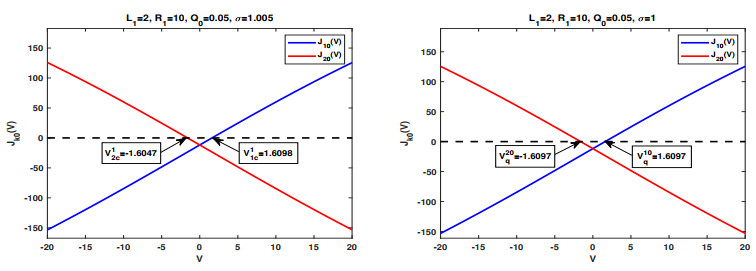
Figure 1.
Numerical identifications of
$ V_{kc}^1 $ $ V_q^{k0} $ $ k=1, 2 $ $ J_{k0}(V) $ -
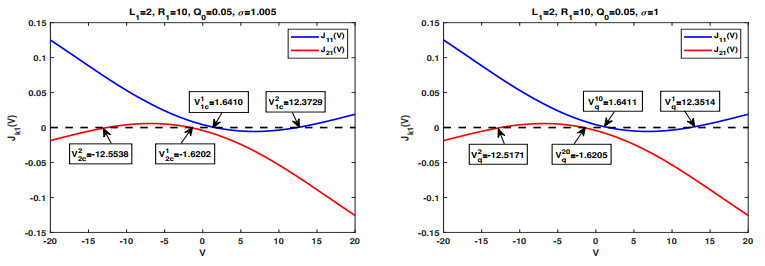
Figure 2.
Identification of critical potentials
$ V_{kc}^1, V_{kc}^2 $ $ V_q^{k0}, V_q^k $ $ k=1, 2 $ -
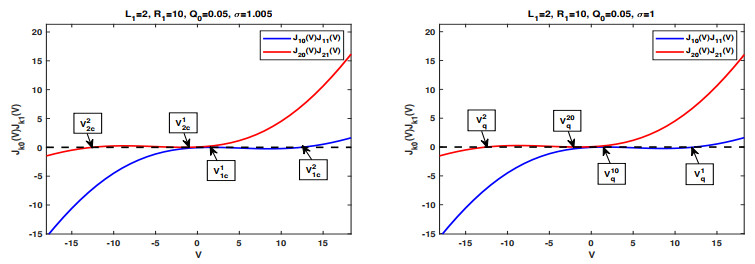
Figure 3.
Numerical simulations to
$ J_{k0}(V)J_{k1}(V) $