

| Citation: |
Mona Bin-Asfour, Emad Solouma, Mehmet Yavuz, Faisal Muteb K. Almalki, Ali Sarrah, Sayed Saber. A TWO-STEP ADAMS–BASHFORTH SCHEME FOR THE FRACTIONAL-ORDER GLUCOSE–INSULIN MODEL: STABILITY AND CONVERGENCE[J]. Journal of Applied Analysis & Computation, 2027, 17(2): 817-833. doi: 10.11948/20260005

|
A TWO-STEP ADAMS–BASHFORTH SCHEME FOR THE FRACTIONAL-ORDER GLUCOSE–INSULIN MODEL: STABILITY AND CONVERGENCE
-
Abstract
The regulation of blood glucose and insulin in the human body is a highly nonlinear physiological process influenced by hereditary memory, feedback mechanisms, and intrinsic delays. Classical integer-order models often fail to capture these memory-dependent and nonlocal effects. In this study, we introduce a novel fractional-order glucose–insulin regulatory model formulated with the Caputo–Fabrizio (CF) derivative, which employs a nonsingular exponential kernel to describe fading memory effects more realistically. The model accounts for essential physiological parameters and incorporates the interplay between blood glucose concentration, insulin secretion, and an auxiliary control variable representing insulin action or resistance. We establish the well-posedness of the proposed CF-based system by proving existence and uniqueness of solutions via fixed-point theory under Lipschitz continuity and boundedness conditions on the nonlinear operators. To approximate the solution, we design a two-step Adams–Bashforth scheme tailored to the CF operator and provide a rigorous analysis of its convergence and stability. Numerical simulations confirm the accuracy and robustness of the method, demonstrating its ability to reproduce physiologically consistent glucose–insulin trajectories that outperform classical integer-order models. The results highlight the effectiveness of Caputo–Fabrizio fractional calculus in capturing hereditary and fading-memory effects in glucose–insulin dynamics, offering a robust mathematical framework for parameter estimation, optimal control, and personalized strategies in diabetes management.
-

-
References
[1] B. Ahmad, J. Ali and A. Atangana, Numerical analysis of fractional glucose-insulin model with Atangana-Baleanu derivative, Appl. Math. Model., 2022, 100, 422–438. [2] K. I. A. Ahmed, H. D. S. Adam, N. Almutairi and S. Saber, Analytical solutions for a class of variable-order fractional Liu system under time-dependent variable coefficients, Results in Physics, 2024, 56, 107311. doi: 10.1016/j.rinp.2023.107311 [3] K. I. A. Ahmed, H. D. S. Adam, M. Y. Youssif and S. Saber, Different strategies for diabetes by mathematical modeling: Applications of fractal–fractional derivatives in the sense of Atangana–Baleanu, Results in Physics, 2023, 52, 106892. doi: 10.1016/j.rinp.2023.106892 [4] K. I. A. Ahmed, H. D. S. Adam, M. Y. Youssif and S. Saber, Different strategies for diabetes by mathematical modeling: Modified minimal model, Alexandria Engineering Journal, 2023, 80, 74–87. doi: 10.1016/j.aej.2023.07.050 [5] M. Alhazmi, A. F. Aljohani, N. E. Taha, S. Abdel-Khalek, M. Bayram and S. Saber, Application of a fractal fractional operator to nonlinear glucose–insulin systems: Adomian decomposition solutions, Computers in Biology and Medicine, 2025, 196(A), 110453. [6] M. Alhazmi and S. Saber, Glucose-insulin regulatory system: Chaos control and stability analysis via Atangana–Baleanu fractal-fractional derivatives, Alexandria Engineering Journal, 2025, 122, 77–90. doi: 10.1016/j.aej.2025.02.066 [7] F. M. K. Almalki, E. Solouma, M. Yavuz, S. Saber and A. Sarrah, Analytical and numerical study of bifurcations and reaction-diffusion patterns in a predator-prey model with Holling-Ⅲ response and variable carrying capacity, Ain Shams Engineering Journal, 2026, 17(6), 104131. doi: 10.1016/j.asej.2026.104131 [8] N. Almutairi, M. Messaoudi, F. M. K. Almalki and S. Saber, A deterministic and stochastic fractional-order model for computer virus propagation with Caputo-Fabrizio derivative: Analysis, numerics, and dynamics, Computer Modeling in Engineering & Sciences, 2026, 146(3), 29. [9] N. Almutairi and S. Saber, Application of a time-fractal fractional derivative with a power-law kernel to the Burke-Shaw system based on Newton’s interpolation polynomials, MethodsX, 2024, 12, 102510. doi: 10.1016/j.mex.2023.102510 [10] M. Althubyani, N. E. Taha, K. O. Taha, R. A. Alharb and S. Saber, Epidemiological modeling of pneumococcal pneumonia: Insights from ABC fractal-fractional derivatives, Computer Modeling in Engineering & Sciences, 2025, 143(3), 3491–3521. [11] A. Atangana and K. M. Owolabi, New numerical method for solving fractional differential equations, Math. Model. Nat. Phenom., 2018, 13, 1–17. [12] R. N. Bergman, Y. Z. Ider, C. R. Bowden and C. Cobelli, Quantitative estimation of insulin sensitivity, Am. J. Physiol., 1979, 236, E667–E677. [13] M. Caputo, Linear models of dissipation whose Q is almost frequency independent–II, Geophys. J. R. Astron. Soc., 1967, 13, 529–539. doi: 10.1111/j.1365-246X.1967.tb02303.x [14] M. Caputo and M. Fabrizio, A new definition of fractional derivative without singular kernel, Prog. Fract. Differ. Appl., 2015, 1, 73–85. [15] M. Caputo and M. Fabrizio, On the notion of fractional derivative and applications to the hysteresis phenomena, Meccanica, 2017, 52(13), 3043–3052. doi: 10.1007/s11012-017-0652-y [16] A. De Gaetano and O. Arino, Mathematical modelling of the intravenous glucose tolerance test, J. Math. Biol., 2000, 40, 136–168. doi: 10.1007/s002850050007 [17] J. K. Hunter and B. Nachtergaele, Applied Analysis, World Scientific, Singapore, 2001. [18] B. K. Jha, H. Vora and T. P. Singh, The effect of amyloid beta, membrane, and ER pathways on the fractional behavior of neuronal calcium, Bulletin of Biomathematics, 2024, 2(2), 198–217. [19] M. Jornet and J. J. Nieto, Properties of a new generalized Caputo-Fabrizio fractional derivative, J. Appl. Anal. Comput., 2024, 14, 3520–3538. [20] H. Joshi and M. Yavuz, Chaotic dynamics of a cancer model with singular and non-singular kernel, Discrete and Continuous Dynamical Systems-S, 2025, 18(5), 1416–1439. doi: 10.3934/dcdss.2025016 [21] H. Joshi and M. Yavuz, A novel fractional-order model and analysis of cancer-immune system interaction in an avascular environment with an efficient control mechanism, J. Comput. Appl. Math., 2026, 473, 116888. doi: 10.1016/j.cam.2025.116888 [22] A. A. Kilbas, H. M. Srivastava and J. J. Trujillo, Theory and Applications of Fractional Differential Equations, Elsevier, 2006. [23] E. Kreyszig, Introductory Functional Analysis with Applications, Wiley, New York, 1978. [24] J. Li, E. Kuang and E. T. H. Wang, Analysis of IVGTT glucose-insulin minimal model, Math. Biosci., 2001, 172, 33–64. doi: 10.1016/S0025-5564(01)00060-8 [25] J. Losada and J. J. Nieto, Properties of a new fractional derivative without singular kernel, Prog. Fract. Differ. Appl., 2015, 1(2), 87–92. [26] R. L. Magin, Fractional calculus models of complex dynamics in biological tissues, Comput. Math. Appl., 2010, 59, 1586–1593. doi: 10.1016/j.camwa.2009.08.039 [27] F. Mainardi, Fractional Calculus and Waves in Linear Viscoelasticity, Imperial College Press, London, 2010. [28] M. Onitsuka and I. I. EL-Fassi, Generalized Caputo-Fabrizio fractional differential equation, J. Appl. Anal. Comput., 2024, 14(2), 964–975. [29] P. Palumbo, S. Panunzi and F. De Gaetano, Qualitative behavior of a family of delay-differential models of the glucose–insulin system, J. Math. Biol., 2007, 55, 1–22. [30] I. Podlubny, Fractional Differential Equations, Academic Press, San Diego, 1999. [31] I. Podlubny, Fractional differential equations, Academic Press, New York, 1999. [32] S. Saber and A. A. Alahmari, Existence, stability, and control of glucose-insulin dynamics via Caputo-Fabrizio fractal-fractional operators, MethodsX, 2026, 16, 103757. doi: 10.1016/j.mex.2025.103757 [33] E. Solouma, M. Alsulami, H. M. Baskonus, A. F. Aljohani and S. Saber, On the stochastic simulation by optimal control and bifurcation analysis of the computer virus model in Caputo-type, Alexandria Engineering Journal, 2026, 144, 12–22. doi: 10.1016/j.aej.2026.04.017 [34] M. Toufik and A. Atangana, New numerical approximation with non-local and non-singular kernel, Eur. Phys. J. Plus, 2017, 132, 444. doi: 10.1140/epjp/i2017-11717-0 [35] L. Xue, Q. Sun, D. O’Regan and J. Xu, Existence of nontrivial solutions for an integral boundary value problem involving the Caputo-Fabrizio-type fractional derivative, Journal of Applied Analysis & Computation, 2025, 15(3), 1786–1802. -
-
Figures(5) / Tables(1)

Export File
Citation
Mona Bin-Asfour, Emad Solouma, Mehmet Yavuz, Faisal Muteb K. Almalki, Ali Sarrah, Sayed Saber. A TWO-STEP ADAMS–BASHFORTH SCHEME FOR THE FRACTIONAL-ORDER GLUCOSE–INSULIN MODEL: STABILITY AND CONVERGENCE[J]. Journal of Applied Analysis & Computation, 2027, 17(2): 817-833. doi: 10.11948/20260005
Format
Content
 DownLoad:
-
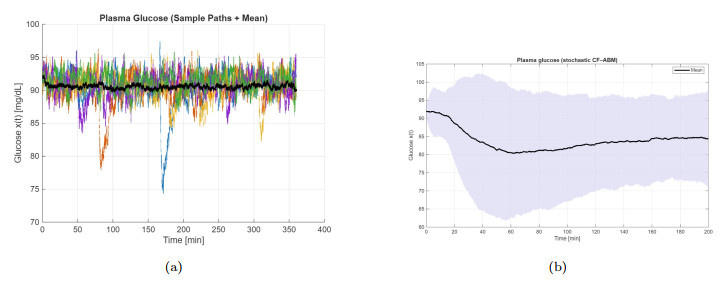
Figure 1.
Stochastic CF simulation under mild noise
$ \sigma_i=0.1 $ -
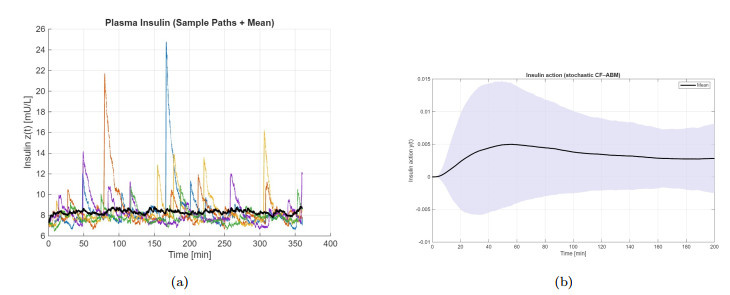
Figure 2.
Influence of moderate stochastic intensity
$ \sigma_i=0.3 $ -
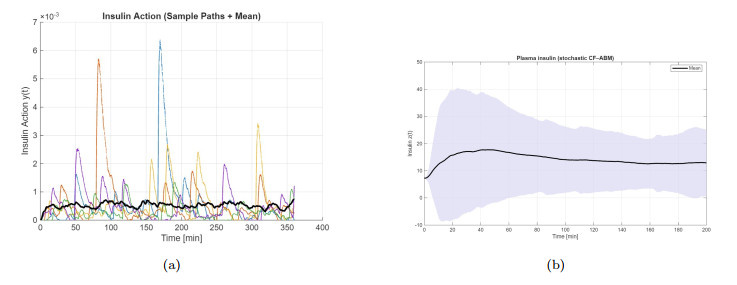
Figure 3.
Emergence of intermittent oscillations for
$ \sigma_i=0.6 $ -
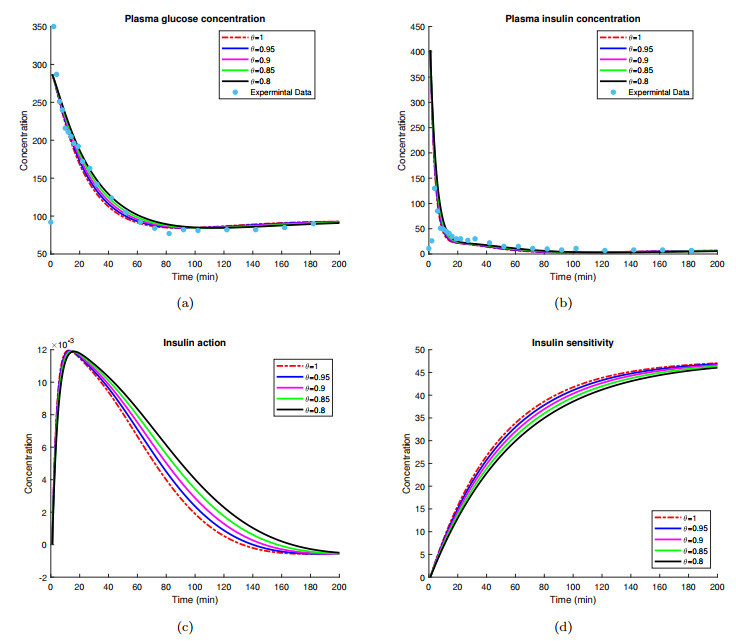
Figure 4.
Time evolution of the state variables (a) plasma glucose
$ x(t) $ $ z(t) $ $ y(t) $ $ u(t) $ $ \varepsilon = 1,\,0.98,\,0.95,\,0.9 $ -
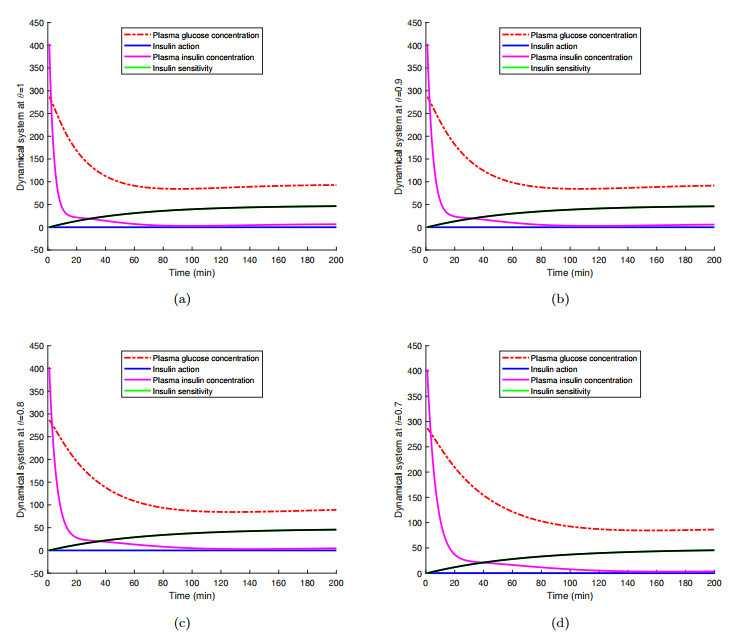
Figure 5.
Global dynamical behavior of model (1.2) for fractional orders (a)
$ \varepsilon=1.0 $ $ \varepsilon=0.95 $ $ \varepsilon=0.9 $ $ \varepsilon=0.85 $