

| Citation: |
Miao Peng, Rui Zhu, Zhengdi Zhang. BIFURCATION ANALYSIS OF A DELAYED PREDATOR-PREY MODEL WITH GLOBAL WARMING, WIND FLOW, HUNTING COOPERATION AND FEAR EFFECT[J]. Journal of Applied Analysis & Computation, 2026, 16(6): 3201-3231. doi: 10.11948/20260032

|
BIFURCATION ANALYSIS OF A DELAYED PREDATOR-PREY MODEL WITH GLOBAL WARMING, WIND FLOW, HUNTING COOPERATION AND FEAR EFFECT
-
Abstract
The impacts of abiotic factors on species are of great research significance. With the intensification of global warming, the interactions among species have become increasing complex. Meanwhile, species activities can exacerbate global warming, which in turn exerts multifaceted influences on the environmental carrying capacity of species, the predation processes, etc. Wind flow is an omnipresent component of the natural environment, and existing studies have indicated that wind speed exerts a notable influence on the predation efficiency of predators for their prey. Although abiotic factors are ubiquitous in nature, studies investigating their impacts on species interactions remain relatively scarce. In this paper, we propose a delayed predator-prey model that incorporates global warming and wind flow, as well as other factors including hunting cooperation and fear effect. First, we discuss the non-delayed model and prove the positivity and boundedness of the solutions. Then, the analysis of the related characteristic equations enables us to examine the existence and local stability of four equilibria. We also discuss the existence of bifurcations near different equilibria. For the model with time delay, the local stability of the positive equilibrium and the existence of Hopf bifurcation are addressed in our discussion. Furthermore, we analyze the direction of Hopf bifurcation and the stability of the periodic solutions by the center manifold theorem and normal form method. Finally, some numerical simulations are given to support our findings.
-
Keywords:
- Predator-prey model /
- stability analysis /
- Hopf bifurcation /
- numerical simulation
-

-
References
[1] R. Arditi and L. R. Ginzburg, Coupling in predator-prey dynamics: Ratio-dependence, J. Theor. Biol., 1989, 139(3), 311–326. doi: 10.1016/S0022-5193(89)80211-5 [2] D. Barman, V. Kumar, J. Roy and S. Alam, Modeling wind effect and herd behavior in a predator-prey system with spatiotemporal dynamics, Eur. Phys. J. Plus, 2022, 137(8), 950. doi: 10.1140/epjp/s13360-022-03133-4 [3] M. Cherry and B. Barton, Effects of wind on predator-prey interactions, Food. Webs., 2017, 13, 92–97. doi: 10.1016/j.fooweb.2017.02.005 [4] W. Cresswell, Predation in bird populations, J. Ornithol., 2011, 152(Suppl 1), 251–263. [5] Y. Enatsu, J. Roy and M. Banerjee, Hunting cooperation in a prey-predator model with maturation delay, J. Biol. Dyn., 2024, 18(1), 2332279. doi: 10.1080/17513758.2024.2332279 [6] R. K. Goodrich, A Riesz representation theorem, P. Am. Math. Soc., 1970, 24(3), 629–636. doi: 10.1090/S0002-9939-1970-0415386-2 [7] B. D. Hassard, N. D. Kazarinoff and Y. H. Wan, Theory and Applications of Hopf Bifurcation, Cambridge University Press, Cambridge, 1981. [8] A. R. Hayes and N. J. Huntly, Effects of wind on the behavior and call transmission of pikas (Ochotona princeps), J. Mammal., 2005, 86(5), 974–981. doi: 10.1644/1545-1542(2005)86[974:EOWOTB]2.0.CO;2 [9] C. S. Holling, The functional response of predators to prey density and its role in mimicry and population regulation, Mem. Entomol. Soc. Can., 1965, 97(S45), 5–60. doi: 10.4039/entm9745fv [10] K. B. Howell, Ordinary Differential Equations, an Introduction to the Fundamentals, CRC Press, Boca Raton, 2019. [11] D. Jana and R. Gopal, Complex dynamics generated by negative and positive feedback delays of a prey-predator system with prey refuge: Hopf bifurcation to chaos, Int. J. Dyn. Control., 2017, 5(4), 1020–1034. doi: 10.1007/s40435-016-0267-5 [12] S. Jawad, S. Roy, A. A. Thirthar and P. K. Tiwari, Deterministic and stochastic risks assessment of excessive CO$_2$ emission on forest biomass under weak allee effect, J. Appl. Math. Comput., 2025, 71(6), 9129–9156. doi: 10.1007/s12190-025-02640-8 CrossRef $_2$ emission on forest biomass under weak allee effect" target="_blank">Google Scholar
[13] S. Jawad, A. A. Thirthar and K. S. Nisar, The impact of climate change on flowering plants-bees-Vespa orientalis model, Results Control Optim., 2025, 20, 100583. doi: 10.1016/j.rico.2025.100583 [14] E. Klimczuk, L. Halupka, B. Czyż, M. Borowiec, J. J. Nowakowski and H. Sztwiertnia, Factors driving variation in biparental incubation behaviour in the reed warbler Acrocephalus scirpaceus, Ardea., 2015, 103(1), 51–59. doi: 10.5253/arde.v103i1.a5 [15] A. Kumar and B. Dubey, Modeling the effect of fear in a prey-predator system with prey refuge and gestation delay, Int. J. Bifurcation and Chaos, 2019, 29(14), 1950195. doi: 10.1142/S0218127419501955 [16] Y. H. Law and A. Sediqi, Sticky substance on eggs improves predation success and substrate adhesion in newly hatched Zelus renardii (Hemiptera: Reduviidae) instars, Ann. Entomol. Soc. Am., 2010, 103(5), 771–774. doi: 10.1603/AN09143 [17] Z. Liang and X. Meng, Stability and Hopf bifurcation of a multiple delayed predator-prey system with fear effect, prey refuge and Crowley-Martin function, Chaos Soliton. Fract., 2023, 175, 1139555. [18] Y. Liu and Y. Yang, Dynamics and bifurcation analysis of a delay non-smooth Filippov Leslie-Gower prey-predator model, Nonlin. Dyn., 2023, 111(19), 18541–18557. doi: 10.1007/s11071-023-08789-w [19] A. J. Lotka, Elements of Physical Biology, Williams and Wilkins, Baltimore, 1925. [20] I. M. D. Maclean and R. J. Wilson, Recent ecological responses to climate change support predictions of high extinction risk, Proc. Natl. Acad. Sci. U. S. A., 2011, 108(30), 12337–12342. doi: 10.1073/pnas.1017352108 [21] G. Mandal, L. N. Guin and S. Chakravarty, Complex patterns in a reaction-diffusion system with fear and anti-predator responses, Int. J. Bifurcation and Chaos, 2024, 34(12), 2450154. doi: 10.1142/S0218127424501542 [22] X. Y. Meng, H. F. Huo, X. B. Zhang and H. Xiang, Stability and Hopf bifurcation in a three-species system with feedback delays, Nonlin. Dyn., 2011, 64(4), 349–364. doi: 10.1007/s11071-010-9866-4 [23] S. Pal, A. Gupta, A. K. Misra and B. Dubey, Chaotic dynamics of a stage-structured prey-predator system with hunting cooperation and fear in presence of two discrete delays, J. Biol. Syst., 2023, 31(02), 611–642. doi: 10.1142/S0218339023500213 [24] S. Pal, N. Pal, S. Samanta and J. Chattopadhyay, Effect of hunting cooperation and fear in a predator-prey model, Ecol. Complex., 2019, 39, 100770. doi: 10.1016/j.ecocom.2019.100770 [25] K. Parida, B. P. Sarangi and S. Chand, Impact of fear and anti-predator behavior on stability and chaos in multi-delayed predator-prey system, J. Appl. Math. Comput., 2025, 71(6), 8851–8886. doi: 10.1007/s12190-025-02597-8 [26] B. Paul, G. C. Sikdar and U. Ghosh, Effect of fear and non-linear predator harvesting on a predator-prey system in presence of environmental variability, Math. Comput. Simul., 2025, 227, 442–460. doi: 10.1016/j.matcom.2024.08.021 [27] M. Peng, R. Lin, L. Huang and Z. D. Zhang, Bifurcation analysis of a delayed predator-prey model with square root response functions, J. Math., 2024, 2024(1), 8120170. doi: 10.1155/2024/8120170 [28] M. Peng and Z. D. Zhang, Bifurcation analysis and control of a delayed stage-structured predator-prey model with ratio-dependent Holling type Ⅲ functional response, J. Vib. Control., 2020, 26(13–14), 1232–1245. doi: 10.1177/1077546319892144 [29] M. Peng, Z. D. Zhang, X. D. Wang and X. Y. Liu, Hopf bifurcation analysis for a delayed predator-prey system with a prey refuge and selective harvesting, J. Appl. Anal. Comput., 2018, 8(3), 982–997. [30] L. Perko, Differential Equations and Dynamical Systems, Springer-Verlag, New York, 1991. [31] S. Roy, D. S. AL-Jaf, A. A. Thirthar and P. K. Tiwari, The impact of human shields in autonomous and non-autonomous prey-predator models with modified Cosner functional response, Math. Comput. Simul., 2025, 242, 54–73. https://doi.org/10.1016/j.matcom.2025.11.016. doi: 10.1016/j.matcom.2025.11.016 [32] S. Ruan and J. Wei, On the zeros of transcendental functions with applications to stability of delay differential equations with two delays, Dyn. Contin. Discrete Impuls. Syst. Ser. A Math. Anal., 2003, 10, 863–874. [33] Z. C. Shang and Y. H. Qiao, Multiple bifurcations in a predator-prey system of modified Holling and Leslie type with double Allee effect and nonlinear harvesting, Math. Comput. Simul., 2023, 205, 745–764. doi: 10.1016/j.matcom.2022.10.028 [34] Z. H. Shen, Y. C. Xu, C. Y. Gai and J. J. Wei, Anti-predator behavior: A mechanism to lose localized patterns for diffusive ratio-dependent predator-prey systems, Chaos Soliton. Fract., 2026, 202, 117459. doi: 10.1016/j.chaos.2025.117459 [35] Y. L. Song and J. J. Wei, Bifurcation analysis for Chen's system with delayed feedback and its application to control of Chaos, Chaos Soliton. Fract., 2004, 22(1), 75–91. doi: 10.1016/j.chaos.2003.12.075 [36] T. O. Svennungsen, Ø. H. Holen and O. Leimar, Inducible defenses: Continuous reaction norms or threshold traits?, Amer. Nat., 2011, 178(3), 397–410. doi: 10.1086/661250 [37] A. A. Thirthar, S. Jawad and M. A. Abbasi, The modified predator-prey model response to the effects of global warming, wind flow, fear, and hunting cooperation, Int. J. Dyn. Control., 2025, 13, 3. https://doi.org/10.1007/s40435-024-01504-6. doi: 10.1007/s40435-024-01504-6 [38] A. A. Thirthar, M. Jumaah, S. Jawad, B. Kumar and M. A. Alomair, A mathematical analysis of wind-driven bottom-up interactions in a plant-ungulate-wolf ecosystem, Mathematics, 2026, 14(3), 418. doi: 10.3390/math14030418 [39] A. A. Thirthar, B. Kumar and S. K. Verma, Effects of predator cooperation in hunting and prey fear in a generalist predator-prey model that includes global warming phenomena, Eur. Phys. J. Plus., 2024, 139(12), 1099. doi: 10.1140/epjp/s13360-024-05880-y [40] A. A. Thirthar, S. K. Nazmul, B. Mondal, M. A. Alqudah and T. Abdeljawad, Utilizing memory effects to enhance resilience in disease-driven prey-predator systems under the influence of global warming, J. Appl. Math. Comput., 2023, 69(6), 4617–4643. doi: 10.1007/s12190-023-01936-x [41] A. A. Thirthar, P. Panja, A. Khan, M. A. Alqudah and T. Abdeljawad, An ecosystem model with memory effect considering global warming phenomena and an exponential fear function, Fractals-Complex Geom. Patterns Scaling Nat. Soc., 2023, 31(10), 2340162. [42] A. A. Thirthar, B. A. Sharba, S. J. Majeed, P. Panja and T. Abdeljawad, The dynamics of prey–predator model with global warming on carrying capacity and wind flow on predation, Nonlinear Engineering, 2026, 15(1), 20250182. [43] J. Turner, F. Vollrath and T. Hesselberg, Wind speed affects prey-catching behaviour in an orb web spider, Sci. Nat., 2011, 98(12), 1063–1067. doi: 10.1007/s00114-011-0854-4 [44] A. K. Umrao and P. K. Srivastava, Bifurcation analysis of a predator-prey model with Allee effect and fear effect in prey and hunting cooperation in predator, Differ. Equ. Dyn. Syst., 2025, 33(4), 1123–1149. [45] V. Volterra, Variations and fluctuations of the number of individuals in animal species living together, ICES J. Mar. Sci., 1928, 3(1), 3–51. [46] Y. Xia, X. H. Huang, F. D. Chen and L. J. Chen, Stability and bifurcation of a predator-prey system with multiple anti-predator behaviors, J. Biol. Syst., 2024, 32(02), 889–919. [47] L. Zheng and Y. H. Peng, Stability analysis of a diffusive ratio-dependent predator-prey model with nonlocal perception, J. Nonlinear Model. Anal., 2026, 8(1), 131–144. [48] J. Zhou, Bifurcation analysis of a diffusive predator-prey model with ratio-dependent Holling type Ⅲ functional response, Nonlin. Dyn., 2015, 81(3), 1535–1552. -
-
Figures(11) / Tables(2)
Export File
Citation
Miao Peng, Rui Zhu, Zhengdi Zhang. BIFURCATION ANALYSIS OF A DELAYED PREDATOR-PREY MODEL WITH GLOBAL WARMING, WIND FLOW, HUNTING COOPERATION AND FEAR EFFECT[J]. Journal of Applied Analysis & Computation, 2026, 16(6): 3201-3231. doi: 10.11948/20260032
Format
Content
 DownLoad:
-
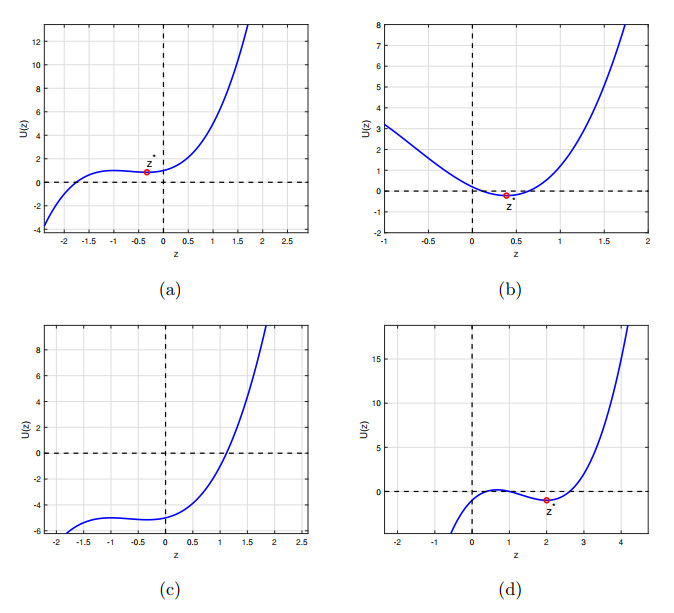
Figure 1.
Analysis of the number of solutions to Eq. (3.5) where the blue curve represents the function
$U(z)$ $z^*$ $(H_2)$ $(H_3)$ $(H_4)$ $(H_4)$ -
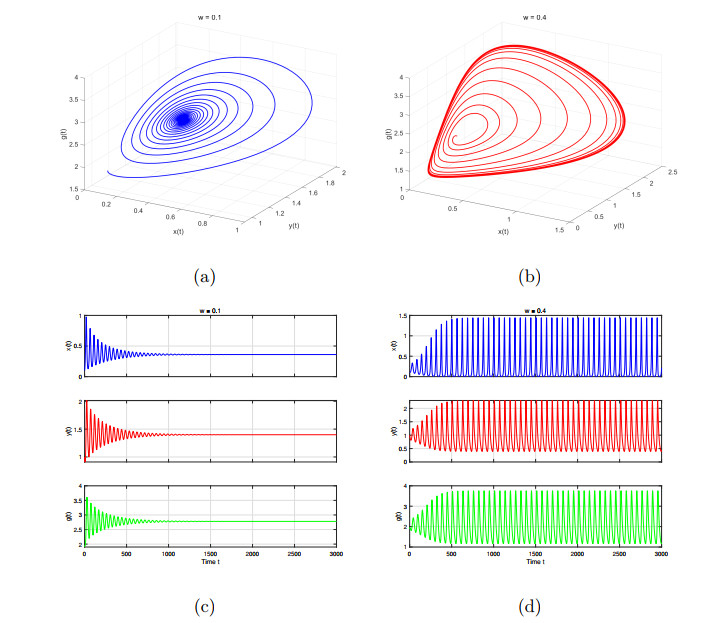
Figure 2.
Phase portraits and time-series plots for different values of
$w$ -
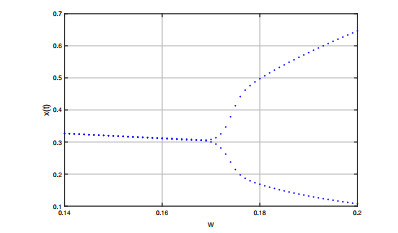
Figure 3.
Bifurcation diagram of system (2.1) with respect to
$w$ -
Figure 4.
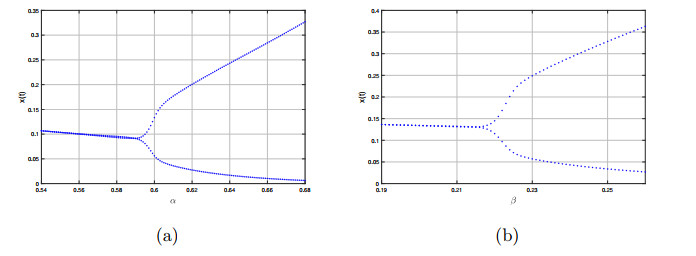
Bifurcation diagrams of system (2.1). (a) Hopf bifurcation diagram in the
$\alpha-x$ $\beta-x$ -
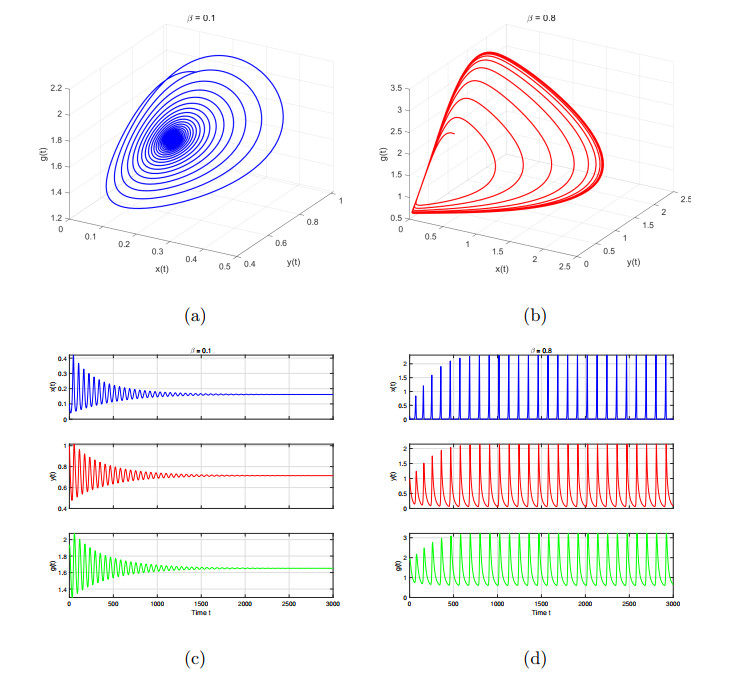
Figure 5.
Phase portraits and time-series plots for different values of
$\beta$ -
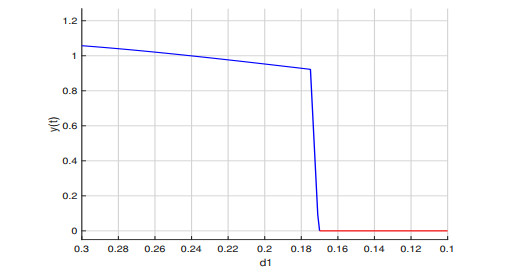
Figure 6.
The transcritical bifurcation diagram of system (2.1) for bifurcation parameter
$d_1$ -
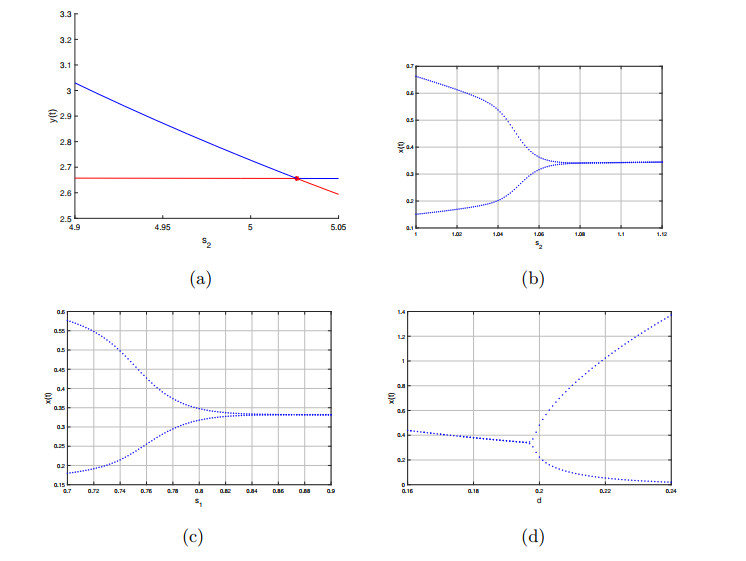
Figure 7.
Bifurcation diagrams of system (2.1). (a) Transcritical bifurcation diagram in the
$s_2-y$ $s_2-x$ $s_1-x$ $d-x$ -
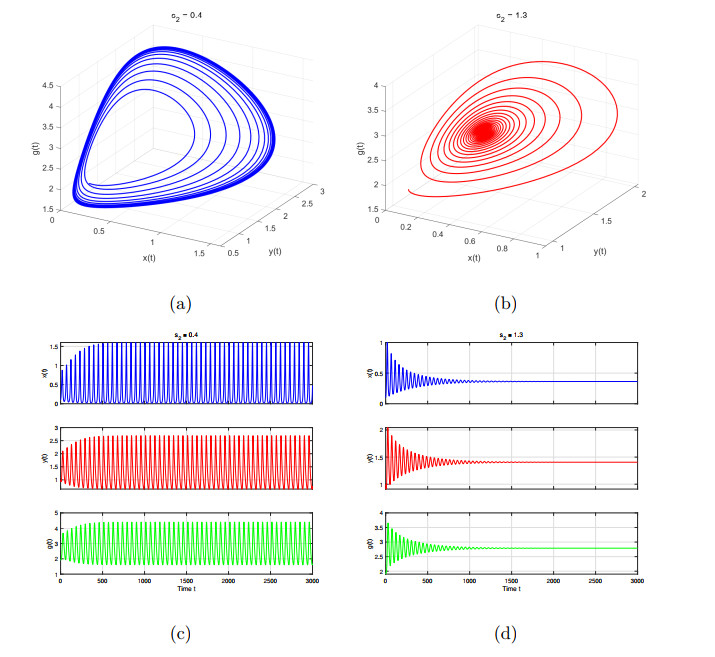
Figure 8.
Phase portraits and time-series plots for different values of
$s_2$ -
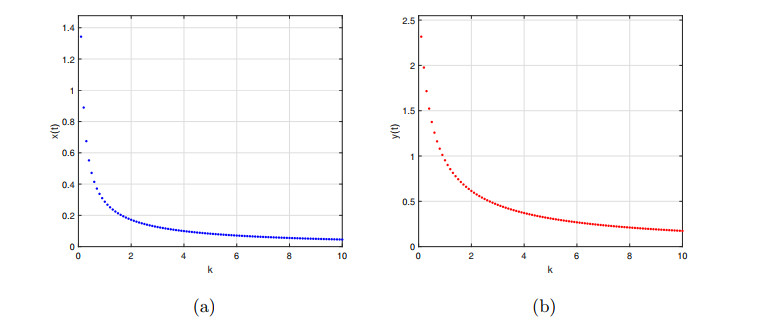
Figure 9.
The dependence of populations on
$k$ $x(t)$ $y(t)$ -
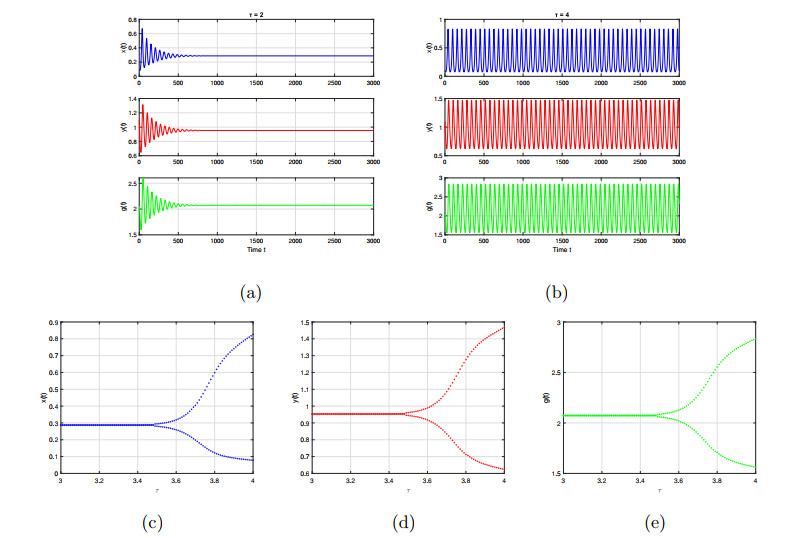
Figure 10.
Time-series plots and bifurcation diagrams with respect to fear response delay.
-
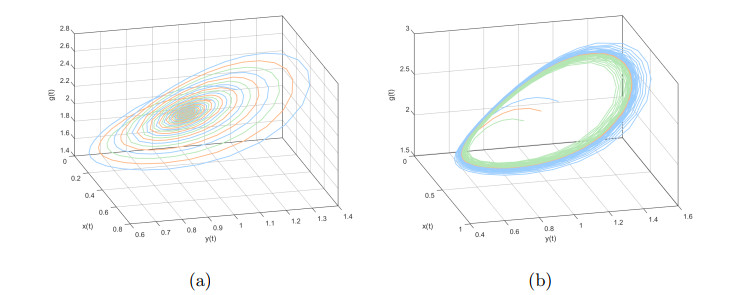
Figure 11.
Sensitivity of solutions of the system (1.2) regarding the initial conditions. Orange, blue, and green curves represent the initial conditions
$(0.1, 1.1, 2.0)$ $(0.1, 1.2, 2.1)$ $(0.1, 1.0, 1.9)$ $\tau=2$ $\tau =4$