

| Citation: |
Sijie Yu, Dapeng Gao, Shiqiang Feng, Qiang Chen. DYNAMIC ANALYSIS OF A FRACTIONAL-ORDER DRUG ADDICTION MODEL WITH GENERALIZED NONLINEAR INCIDENCE RATE[J]. Journal of Applied Analysis & Computation, 2027, 17(2): 1101-1135. doi: 10.11948/20260049

|
DYNAMIC ANALYSIS OF A FRACTIONAL-ORDER DRUG ADDICTION MODEL WITH GENERALIZED NONLINEAR INCIDENCE RATE
-
Abstract
This paper analyzes a fractional-order drug addiction model with a generalized incidence rate of the form $ f(P,A) $. The analysis begins by establishing the well-posedness of the model, verifying the existence, uniqueness, non-negativity, and boundedness of solutions. The basic reproduction number $ R_0 $ is derived, and two equilibrium points are identified: The drug-free equilibrium and the drug-persistent equilibrium. The local asymptotic stability of each equilibrium is investigated using the Routh-Hurwitz criterion, while global stability is established by constructing appropriate Lyapunov functionals and applying LaSalle’s invariance principle. Unlike classical integer-order models that assume memoryless dynamics, the incorporation of the Caputo fractional derivative effectively accounts for the 'memory effects' and historical dependence inherent in the neurological and behavioral progression of substance abuse. The main theoretical findings demonstrate that, under appropriate conditions, drug addiction will eventually die out when $ R_0 < 1 $, but will persist when $ R_0 > 1 $. Numerical simulations are conducted to validate the theoretical results, offering insights for intervention strategies and policy-making. In summary, the proposed framework provides a robust tool for understanding addiction dynamics and formulating public health policies to mitigate the impact of substance abuse in communities.
-

-
References
[1] B. A. Ahmad, J. S. Rossen and M. S. Sutton, Opioid-Involved Overdose Deaths in the United States, 2019, CDC, Atlanta, 2021. [2] A. Allahamou, E. Azroul, Z. Hammouch and A. L. Alaoui, Modeling and numerical investigation of a conformable co-infection model for describing hantavirus of the european moles, Math. Methods Appl. Sci., 2022, 45(5), 2736–2759. doi: 10.1002/mma.7950 [3] M. R. S. Ammi, M. Tahiri and D. F. M. Torres, Global stability of a caputo fractional SIRS model with general incidence rate, Math. Comput. Sci., 2021, 15(1), 91–105. doi: 10.1007/s11786-020-00467-z [4] R. M. Anderson and R. M. May, Infectious Diseases of Humans: Dynamics and Control, Oxford University Press, Oxford, 1991. [5] M. Boukhobza, A. Debbouche, L. Shangerganesh and D. F. Torres, Modeling the dynamics of the hepatitis B virus via a variable-order discrete system, Chaos Soliton Fract., 2024, 184, 114987. doi: 10.1016/j.chaos.2024.114987 [6] A. Boukhouima, K. Hattaf and N. Yousfi, Dynamics of a fractional order HIV infection model with specific functional response and cure rate, Int. J. Differ. Equ., 2017, 2017(1), 8372140. [7] V. Capasso and G. Serio, A generalization of the Kermack-McKendrick deterministic epidemic model, Math. Biosci., 1978, 42(1–2), 43–61. [8] J. Danane, Z. Hammouch, K. Allali, S. Rashid and J. Singh, A fractional-order model of coronavirus disease 2019 (COVID-19) with governmental action and individual reaction, Math. Methods Appl. Sci., 2023, 46(7), 8275–8288. doi: 10.1002/mma.7759 [9] K. Diethelm, The Analysis of Fractional Differential Equations: An Application-Oriented Exposition Using Differential Operators of Caputo Type, Springer, Berlin, 2010. [10] P. Van den Driessche and J. Watmough, Reproduction numbers and sub-threshold endemic equilibria for compartmental models of disease transmission, Math. Biosci., 2002, 180(1–2), 29–48. [11] M. Farman, R. Sarwar and A. Akgul, Modeling and analysis of sustainable approach for dynamics of infections in plant virus with fractal fractional operator, Chaos Soliton Fract., 2023, 170, 113373. doi: 10.1016/j.chaos.2023.113373 [12] P. Goswami, B. Pokhriyal and K. Kumar, On the solution of two-dimensional local fractional LWR model of fractal vehicular traffic flow, Math. Comput. Sci., 2025, 6(2), 43–63. [13] H. W. Hethcote, The mathematics of infectious diseases, SIAM Rev., 2000, 42(4), 599–653. doi: 10.1137/S0036144500371907 [14] M. Izadi, P. Veeresha and W. Adel, Mathematical and computational analysis of a fractional-order drug abuse model with nonlinear incidence and logistic growth, Math. Comput. Simul., 2026, 240, 451–472. doi: 10.1016/j.matcom.2025.07.032 [15] H. Joshi, M. Yavuz and N. Özdemir, Analysis of novel fractional order plastic waste model and its effects on air pollution with treatment mechanism, J. Appl. Anal. Comput., 2024, 14(6), 3078–3098. [16] M. Kamal, M. Ahmed and M. A. H. Sarkar, Optimal control strategies for mitigating drug addiction: A mathematical modeling approach, Results Control Optim., 2025, 19, 100580. doi: 10.1016/j.rico.2025.100580 [17] B. Khaminsou, C. Thaiprayoon, W. Sudsutad and S. A. Jose, Qualitative analysis of a proportional caputo fractional pantograph differential equation with mixed nonlocal conditions, Nonlinear Funct. Anal. Appl., 2021, 26(1), 197–223. [18] S. Kundu, N. Kumari, S. Kouachi and P. Kundu, Stability and bifurcation analysis of a heroin model with diffusion, delay and nonlinear incidence rate, Model. Earth Syst. Environ., 2022, 8(1), 1351–1362. doi: 10.1007/s40808-021-01164-x [19] A. Lahrouz, L. Omari, D. Kiouach and A. Belmaâti, Complete global stability for an SIRS epidemic model with generalized non-linear incidence and vaccination, Appl. Math. Comput., 2012, 218(11), 6519–6525. [20] C. Vargas-De-León, On the global stability of SIS, SIR and SIRS epidemic models with standard incidence, Chaos Soliton Fract., 2011, 44(12), 1106–1110. doi: 10.1016/j.chaos.2011.09.002 [21] H. L. Li, L. Zhang, C. Hu, Y. L. Jiang and Z. Teng, Dynamical analysis of a fractional-order predator-prey model incorporating a prey refuge, J. Appl. Math. Comput., 2017, 54, 435–449. doi: 10.1007/s12190-016-1017-8 [22] Z. Li, Z. Teng and H. Miao, Modeling and control for HIV/AIDS transmission in China based on data from 2004 to 2016, Comput. Math. Methods Med., 2017, 2017(1), 8935314. [23] N. Madani, Z. Hammouch and H. Jafari, Fractal-fractional modeling of drug addiction dynamics: Capturing memory-driven effects, Math. Methods Appl. Sci., 2026, 49(3), 2114–2128. doi: 10.1002/mma.70232 [24] S. Mangal, O. P. Misra and J. Dhar, Fractional-order deterministic epidemic model for the spread and control of HIV/AIDS with special reference to Mexico and India, Math. Comput. Simul., 2023, 210, 82–102. doi: 10.1016/j.matcom.2023.03.008 [25] D. Matignon, Stability results for fractional differential equations with applications to control processing, Comput. Eng. Syst. Appl., 1996, 2(1), 963–968. [26] F. Matonya, Mathematical Modeling on the Effects of Drug Abuse to the Societies, Ph. D. thesis, NM-AIST, 2022. [27] B. M. Mayosi, J. E. Lawn, A. Van Niekerk, D. Bradshaw, S. S. A. Karim and H. M. Coovadia, Health in South Africa: Changes and challenges since 2009, Lancet, 2012, 380(9858), 2029–2043. doi: 10.1016/S0140-6736(12)61814-5 [28] A. Mouaouine, A. Boukhouima, K. Hattaf and N. Yousfi, A fractional order SIR epidemic model with nonlinear incidence rate, Adv. Differ. Equ., 2018, 2018(1), 1–9. doi: 10.1186/s13662-017-1452-3 [29] M. Naim, F. Lahmidi, A. Namir and A. Kouidere, Dynamics of an fractional SEIR epidemic model with infectivity in latent period and general nonlinear incidence rate, Chaos Soliton Fract., 2021, 152, 111456. doi: 10.1016/j.chaos.2021.111456 [30] Z. M. Odibat and N. T. Shawagfeh, Generalized Taylor's formula, Appl. Math. Comput., 2007, 186, 286–293. [31] I. Podlubny, Fractional Differential Equations: An Introduction to Fractional Derivatives, Fractional Differential Equations, to Methods of their Solution and Some of their Applications, Academic Press, San Diego, 1998. [32] S. G. Samko, A. A. Kilbas and O. I. Marichev, Fractional Integrals and Derivatives: Theory and Applications, Gordon and Breach Science Publishers, Yverdon, 1993. [33] M. Shams, N. Kausar and B. Carpentieri, A class of high-order fractional parallel iterative methods for nonlinear engineering problems: Convergence, stability, and neural network-based acceleration, Chaos Soliton Fract., 2025, 199, 116646. doi: 10.1016/j.chaos.2025.116646 [34] C. Sun, Y. Lin and S. Tang, Global stability for an special SEIR epidemic model with nonlinear incidence rates, Chaos Soliton Fract., 2007, 33(1), 290–297. doi: 10.1016/j.chaos.2005.12.028 [35] H. Tang, M. Li, X. Yan, Z. Lu and Z. Jia, Modeling the dynamics of drug spreading in China, Int. J. Environ. Res. Public Health, 2021, 18(1), 288. doi: 10.3390/ijerph18010288 [36] P. Trucillo, R. Campardelli, M. Scognamiglio and E. Reverchon, Control of liposomes diameter at micrometric and nanometric level using a supercritical assisted technique, J. CO2 Util., 2019, 32, 119–127. doi: 10.1016/j.jcou.2019.04.014 [37] M. F. Uddin, M. G. Hafez, Z. Hammouch and D. Baleanu, Traveling wave with beta derivative spatial-temporal evolution for describing the nonlinear directional couplers with metamaterials via two distinct methods, Alex. Eng. J., 2021, 60(1), 1055–1065. doi: 10.1016/j.aej.2020.10.030 [38] R. K. Upadhyay and P. Singh, Modeling and control of computer virus attack on a targeted network, Physica A, 2020, 538, 122617. doi: 10.1016/j.physa.2019.122617 [39] L. Wang, Z. Liu and X. Zhang, Global dynamics for an age-structured epidemic model with media impact and incomplete vaccination, Nonlinear Anal. Real World Appl., 2016, 32, 136–158. doi: 10.1016/j.nonrwa.2016.04.009 [40] L. Wang, X. Zhang and Z. Liu, An SEIR epidemic model with relapse and general nonlinear incidence rate with application to media impact, Qual. Theory Dyn. Syst., 2018, 17(2), 309–329. doi: 10.1007/s12346-017-0231-6 [41] Y. Wei, J. Zhan and J. Guo, Asymptotic behaviors of a heroin epidemic model with nonlinear incidence rate influenced by stochastic perturbations, J. Appl. Anal. Comput., 2024, 14, 1060–1077. [42] K. Witkiewitz and K. E. Vowles, Alcohol and opioid use, co-use, and chronic pain in the context of the opioid epidemic: A critical review, Alcohol. Clin. Exp. Res., 2018, 42(3), 478–488. doi: 10.1111/acer.13594 [43] Z. Yaagoub and K. Allali, Fractional HBV infection model with both cell-to-cell and virus-to-cell transmissions and adaptive immunity, Chaos Soliton Fract., 2022, 165, 112855. doi: 10.1016/j.chaos.2022.112855 [44] Z. Yaagoub, J. Danane, Z. Hammouch and K. Allali, Mathematical analysis of a fractional order two strain SEIR epidemic model, Result. Nonlinear Anal., 2024, 7(1), 156–175. -
-
Figures(11) / Tables(5)

Export File
Citation
Sijie Yu, Dapeng Gao, Shiqiang Feng, Qiang Chen. DYNAMIC ANALYSIS OF A FRACTIONAL-ORDER DRUG ADDICTION MODEL WITH GENERALIZED NONLINEAR INCIDENCE RATE[J]. Journal of Applied Analysis & Computation, 2027, 17(2): 1101-1135. doi: 10.11948/20260049
Format
Content
 DownLoad:
-
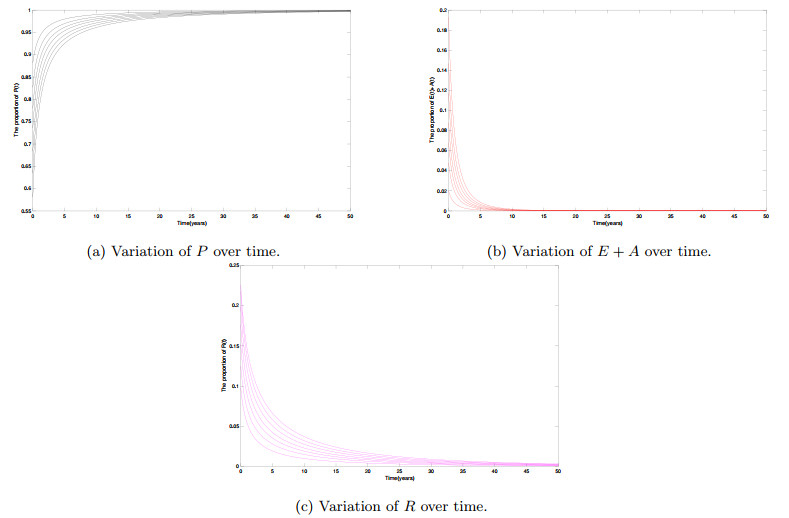
Figure 1.
Variation of the proportion of
$ P, E+A $ $ R_0 \approx 0.8569<1 $ -
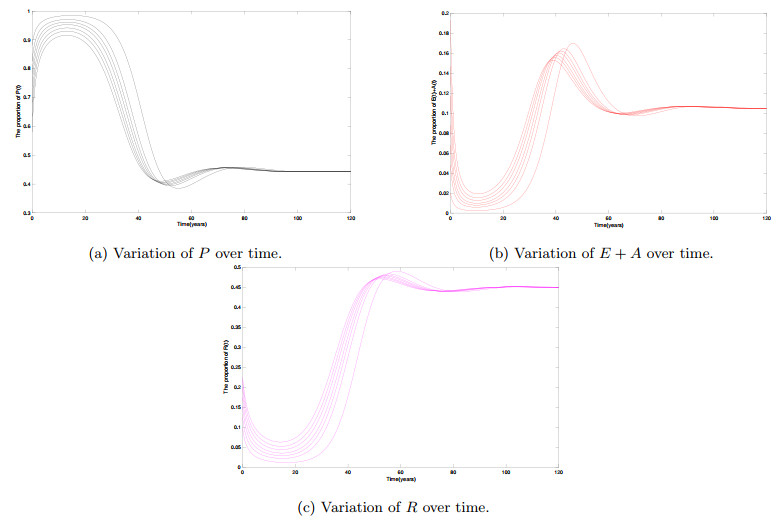
Figure 2.
Variation of the proportion of
$ P, E+A $ -
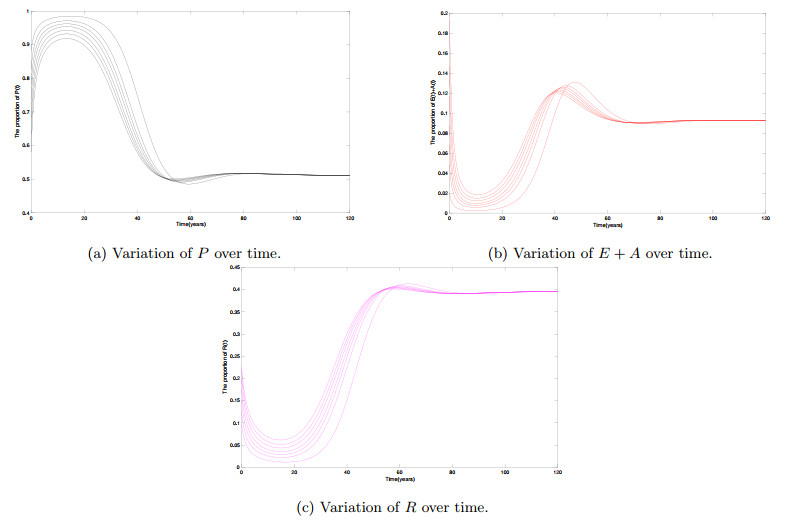
Figure 3.
Variation of the proportion of
$ P, E+A $ -
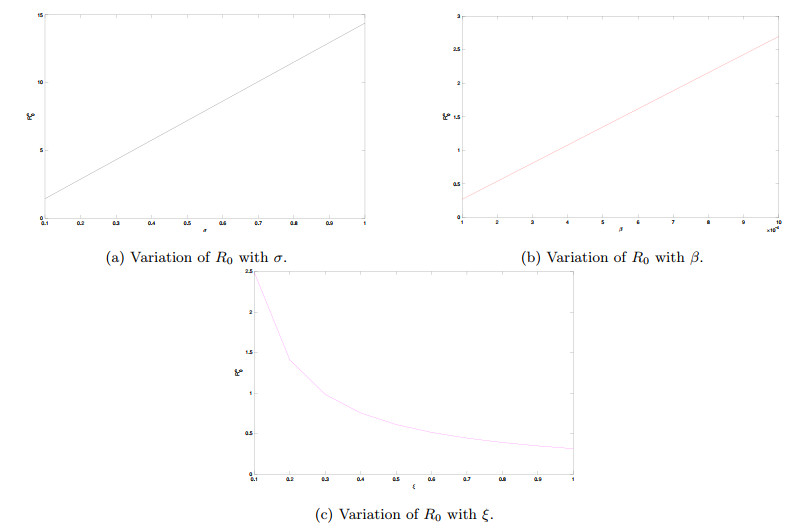
Figure 4.
The evolution of
$ R_0 $ $ \sigma $ $ \beta $ $ \xi $ -
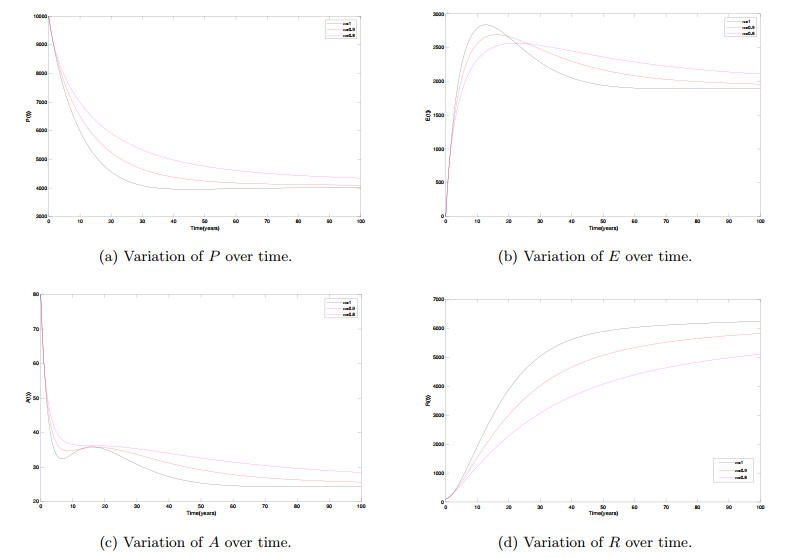
Figure 5.
Forecasting of the future drug addiction in the context of model (4.1) with
$ \alpha = 1, 0.9 $ -
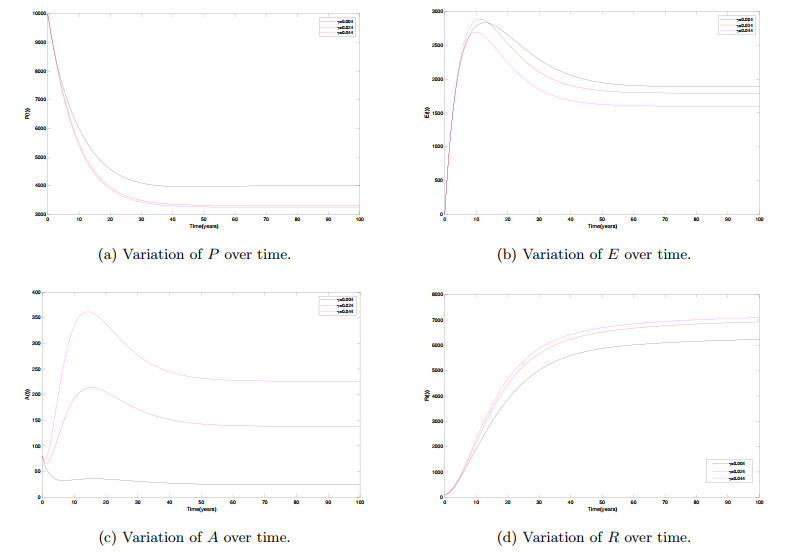
Figure 6.
Forecasting of the future drug addiction in the context of model (4.1) with
$ \gamma = 0.004, 0.024 $ -
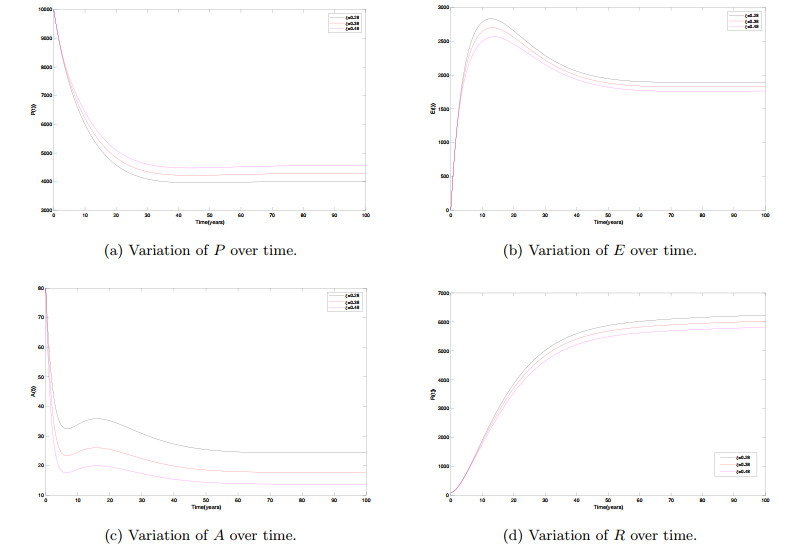
Figure 7.
Forecasting of the future drug addiction in the context of model (4.1) with
$ \xi = 0.28, 0.38 $ -
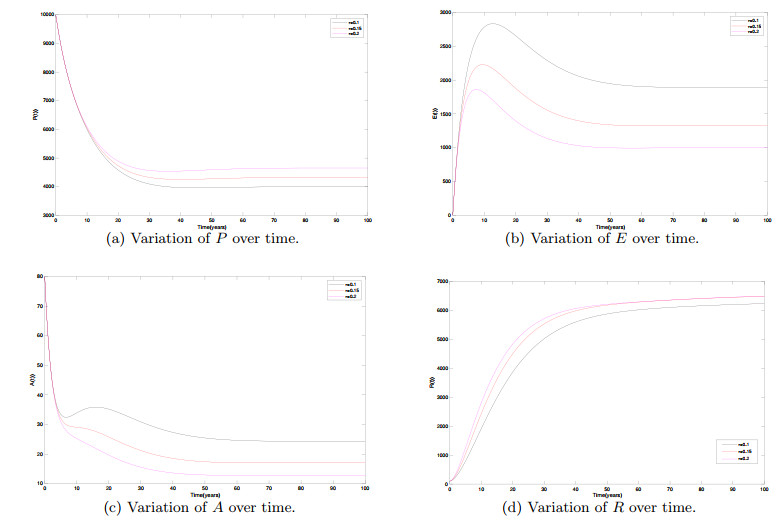
Figure 8.
Forecasting of the future drug addiction in the context of model (4.1) with
$ \tau = 0.1,0.15 $ -
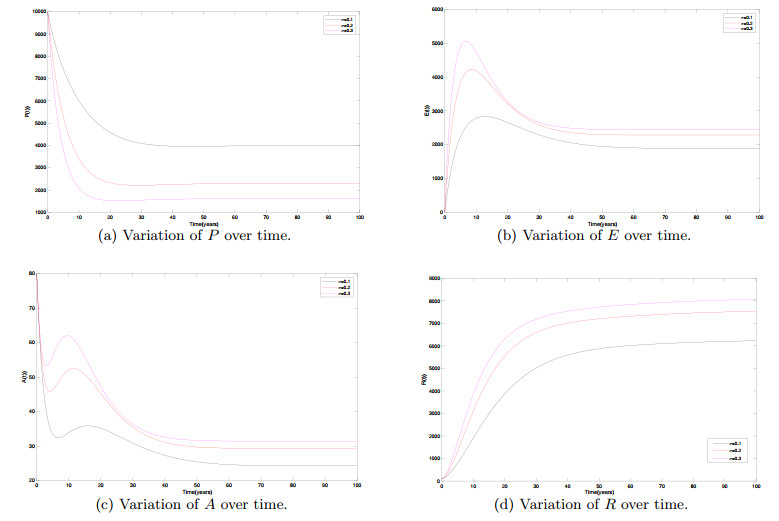
Figure 9.
Forecasting of the future drug addiction in the context of model (4.1) with
$ \sigma = 0.1,0.2 $ -
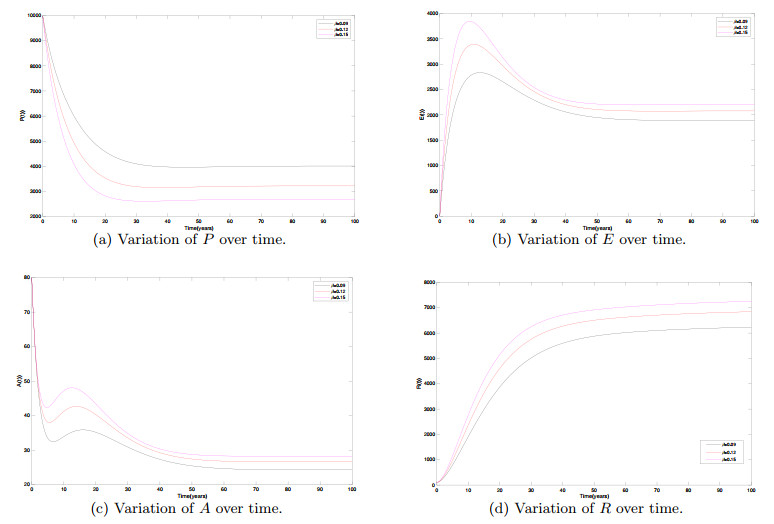
Figure 10.
Forecasting of the future drug addiction in the context of model (4.1) with
$ \beta = 0.09,0.12 $ -
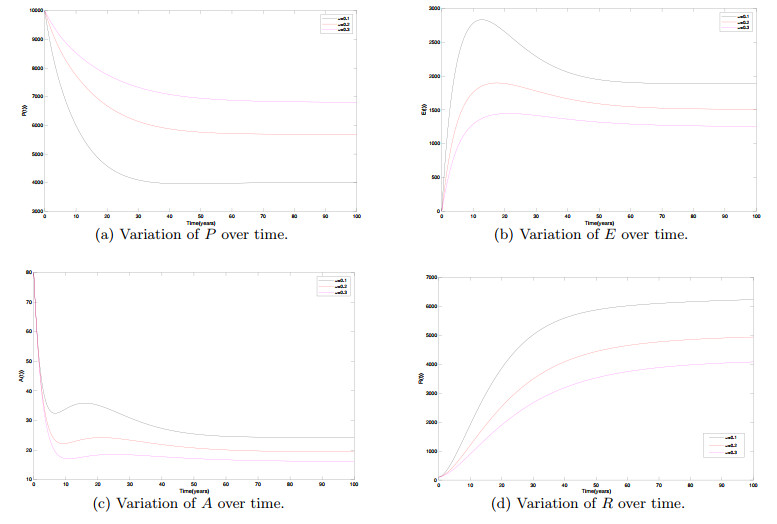
Figure 11.
Forecasting of the future drug addiction in the context of model (4.1) with
$ \omega = 0.1,0.2 $