

| Citation: |
Yuwei Xiao, Fumin Zhang, Xinyan Guo, Ruoshi Tang, Yang Liu, Yunzhu Zhou. OPTIMAL CONTROL AND COST-EFFECTIVENESS ANALYSIS OF AN INTEGRATED INTERVENTION MODEL INCORPORATING VECTOR PREFERENCE FOR MOSO BAMBOO SOOTY MOLD DISEASE[J]. Journal of Applied Analysis & Computation, 2027, 17(2): 1064-1100. doi: 10.11948/20260219

|
OPTIMAL CONTROL AND COST-EFFECTIVENESS ANALYSIS OF AN INTEGRATED INTERVENTION MODEL INCORPORATING VECTOR PREFERENCE FOR MOSO BAMBOO SOOTY MOLD DISEASE
-
Abstract
Understanding the transmission mechanisms of Moso bamboo sooty mold disease and the vector preference behavior of its vector insect (bamboo aphid) is of great significance for developing cost-effective integrated pest management strategies. This study constructs a compartmental model that incorporates vector preference to describe the transmission dynamics of the disease between bamboo plants and bamboo aphids. Through rigorous mathematical derivation, an explicit expression for the basic reproduction number $\mathcal{R}_0$ of the disease is obtained. Global sensitivity analysis identified the key parameters that most significantly influence the dynamics of disease transmission. Theoretical and numerical findings indicate: (ⅰ) When $\mathcal{R}_0 <1$, the disease-free equilibrium of model (2.1) is globally asymptotically stable (GAS); when $\mathcal{R}_0 > 1$, the system is uniformly persistent and possesses a unique positive equilibrium, which is GAS. (ⅱ) Under identical state variables and parameter values in this model, compared to the model ignoring vector preference $(\phi=1)$, the model incorporating vector preference $(\phi>1)$ overestimates the disease’s potential transmission capacity while simultaneously underestimating the actual infection scale. (ⅲ) Spraying insecticides and injecting nutrient solutions are long-term control measures that should be implemented throughout the entire disease management process. In contrast, using yellow adhesive traps to capture pests and removing bamboo plants exhibiting symptoms of sooty mold are short-term control strategies suitable for use during the early stages of an outbreak. Considering the cost-effectiveness of labor and materials, these measures can be discontinued in later stages. (ⅳ) According to the optimal control model for the disease and related numerical simulation results, the integrated control measure combining insecticide spraying with nutrient solution injection is found to be the most cost-effective among all strategies. This study provides a theoretical basis and decision-making support for the prevention and control of the disease.
-

-
References
[1] F. B. Agusto, Optimal isolation control strategies and cost-effectiveness analysis of a two-strain avian influenza model, Biosystems, 2013, 113(3), 155–164. doi: 10.1016/j.biosystems.2013.06.004 [2] F. B. Agusto and M. Khan, Optimal control strategies for dengue transmission in pakistan, Mathematical Biosciences, 2018, 305, 102–121. doi: 10.1016/j.mbs.2018.09.007 [3] Z. Ahmad, Y. Ding and A. Shahzad, Biotechnological Advances in Bamboo, Springer, 2021. [4] Z. Ahmad, J. A. Teixeira da Silva, A. Shahzad, et al., Biotechnological interventions in bamboo plants, Plant Cell, Tissue and Organ Culture (PCTOC), 2023, 153(3), 459–487. doi: 10.1007/s11240-023-02490-x [5] Z. Ahmad, A. Upadhyay, Y. Ding, et al., Bamboo: Origin, habitat, distributions and global prospective, in Biotechnological Advances in Bamboo: The "Green Gold" on the Earth, Springer, 2021, 1–31. [6] E. T. Akinlabi, K. Anane-Fenin and D. R. Akwada, Bamboo, The Multipurpose Plant, 2017, 268. [7] B. Anderson, J. Jackson and M. Sitharam, Descartes’ rule of signs revisited, The American Mathematical Monthly, 1998, 105(5), 447–451. doi: 10.1080/00029890.1998.12004907 [8] F. Al Basir, S. Adhurya, M. Banerjee, et al., Modelling the effect of incubation and latent periods on the dynamics of vector-borne plant viral diseases, Bulletin of Mathematical Biology, 2020, 82(7), 1–22. [9] F. Al Basir, Y. Kyrychko, K. Blyuss and S. Ray, Effects of vector maturation time on the dynamics of cassava mosaic disease, Bulletin of Mathematical Biology, 2021, 83(8), 87. doi: 10.1007/s11538-021-00921-4 [10] M. A. Coffelt and P. B. Schultz, Seasonal abundance and population dynamics of a bamboo aphid, takecallis arundinaria (homoptera: Aphididae), Journal of Entomological Science, 1990, 25(4), 526–534. doi: 10.18474/0749-8004-25.4.526 [11] N. J. Cunniffe, N. P. Taylor, F. M. Hamelin and M. J. Jeger, Epidemiological and ecological consequences of virus manipulation of host and vector in plant virus transmission, PLOS Computational Biology, 2021, 17(12), e1009759. doi: 10.1371/journal.pcbi.1009759 [12] O. Diekmann, J. A. P. Heesterbeek and J. A. J. Metz, On the definition and the computation of the basic reproduction ratio $R_0$ in models for infectious diseases in heterogeneous populations, Journal of Mathematical Biology, 1990, 28(4), 365–382. $R_0$ in models for infectious diseases in heterogeneous populations" target="_blank">Google Scholar
[13] T. F. Döring and S. M. Kirchner, A model for colour preference behaviour of spring migrant aphids, Philosophical Transactions of the Royal Society B: Biological Sciences, 2022, 377(1862). [14] P. Van den Driessche and J. Watmough, Reproduction numbers and sub-threshold endemic equilibria for compartmental models of disease transmission, Mathematical Biosciences, 2002, 180(1–2), 29–48. [15] S. Dutta, S. Gorain, J. Roy, et al., Bamboo for global sustainability: A systematic review of its environmental and ecological implications, climate action, and biodiversity contributions, Environmental Reviews, 2025, 33, 1–26. [16] W. H. Fleming and R. W. Rishel, Deterministic and Stochastic Optimal Control, Springer Science & Business Media, 2012. [17] F. M. Hamelin, F. M. Hilker and Y. Dumont, Spatial spread of infectious diseases with conditional vector preferences, Journal of Mathematical Biology, 2023, 87(2), 38. doi: 10.1007/s00285-023-01972-y [18] W. Han, S. Gao, R. Yuan, et al., Modeling HLB transmission and integrated control based on intercropping and vector preference, Advances in Continuous and Discrete Models, 2026, 2026(1), 61. doi: 10.1186/s13662-026-04095-y [19] A. Anzo Hernández, U. J. Giménez Mujica, C. A. Hernández Gracidas and J. J. Oliveros Oliveros, Optimizing control parameters for huanglongbing disease in citrus orchards using SAIR-SI compartmental model, epidemic final size, and genetic algorithms, Journal of Mathematical Biology, 2025, 90(1), 4. doi: 10.1007/s00285-024-02161-1 [20] Y. Hou and Y. Ding, Spatiotemporal dynamic analysis of delayed diffusive pine wilt disease model with nonlocal effect, SIAM Journal on Applied Mathematics, 2024, 84(4), 1312–1336. doi: 10.1137/23M1575305 [21] S. Lenhart and J. T. Workman, Optimal Control Applied to Biological Models, Chapman and Hall/CRC, 2007. [22] J. Li and Y. Ding, New mechanism for spatial heterogeneity pattern revealed by nonlocal competition and host-taxis in a 2D pine wilt disease model, Journal of Mathematical Biology, 2026, 92(1), 19. doi: 10.1007/s00285-025-02336-4 [23] W. Liese, Research on bamboo, Wood Science and Technology, 1987, 21(3), 189–209. doi: 10.1007/BF00351391 [24] D. L. Lukes, Differential Equations: Classical to Controlled, 162 of Mathematics in Science and Engineering, Academic Press, New York, 1982. [25] Y. Luo, S. Tang, F. Zhang, et al., Analysis of huanglongbing transmission model with vector preferences and heterogeneous environments, Advances in Continuous and Discrete Models, 2024, 2024(1), 56. doi: 10.1186/s13662-024-03854-z [26] S. Marino, I. B. Hogue, C. J. Ray and D. E. Kirschner, A methodology for performing global uncertainty and sensitivity analysis in systems biology, Journal of Theoretical Biology, 2008, 254(1), 178–196. doi: 10.1016/j.jtbi.2008.04.011 [27] X. Meng and Z. Li, The dynamics of plant disease models with continuous and impulsive cultural control strategies, Journal of Theoretical Biology, 2010, 266(1), 29–40. doi: 10.1016/j.jtbi.2010.05.033 [28] A. Mojeeb and J. Li, Analysis of a vector-bias malaria transmission model with application to mexico, sudan and democratic republic of the congo, Journal of Theoretical Biology, 2019, 464, 72–84. doi: 10.1016/j.jtbi.2018.12.033 [29] L. S. Pontryagin, Mathematical Theory of Optimal Processes, Routledge, 2018. [30] M. Ramakrishnan, K. Yrjälä, K. K. Vinod, et al., Genetics and genomics of moso bamboo (phyllostachys edulis): Current status, future challenges, and biotechnological opportunities toward a sustainable bamboo industry, Food and Energy Security, 2020, 9(4), e229. doi: 10.1002/fes3.229 [31] S. Ramanayake and K. Yakandawala, Incidence of flowering, death and phenology of development in the giant bamboo (dendrocalamus giganteus wall. ex munro), Annals of Botany, 1998, 82(6), 779–785. doi: 10.1006/anbo.1998.0754 [32] R. Caja Rivera and I. Barradas, Vector preference annihilates backward bifurcation and reduces endemicity, Bulletin of Mathematical Biology, 2019, 81(11), 4447–4469. doi: 10.1007/s11538-018-00561-1 [33] Z. Sang, Z. Qiu, Q. Kong and Y. Zou, Assessment of vector control and pharmaceutical treatment in reducing malaria burden: A sensitivity and optimal control analysis, Journal of Biological Systems, 2012, 20(01), 67–85. doi: 10.1142/S0218339011500331 [34] Z. Shuai and P. van den Driessche, Global stability of infectious disease models using lyapunov functions, SIAM Journal on Applied Mathematics, 2013, 73(4), 1513–1532. doi: 10.1137/120876642 [35] S. R. Singh, R. Singh, S. Kalia, et al., Limitations, progress and prospects of application of biotechnological tools in improvement of bamboo–a plant with extraordinary qualities, Physiology and Molecular Biology of Plants, 2013, 19(1), 21–41. doi: 10.1007/s12298-012-0147-1 [36] H. L. Smith, Monotone Dynamical Systems: An Introduction to the Theory of Competitive and Cooperative Systems, 41, American Mathematical Soc., 1995. [37] H. Sun, J. Wang, H. Li, et al., Advancements and challenges in bamboo breeding for sustainable development, Tree Physiology, 2023, 43(10), 1705–1717. doi: 10.1093/treephys/tpad086 [38] S. Tang, S. Gao, F. Zhang and Y. Liu, Role of vector resistance and grafting infection in huanglongbing control models, Infectious Disease Modelling, 2023, 8(2), 491–513. doi: 10.1016/j.idm.2023.04.006 [39] S. Tiwari, R. S. Mann, M. E. Rogers and L. L. Stelinski, Insecticide resistance in field populations of asian citrus psyllid in florida, Pest Management Science, 2011, 67(10), 1258–1268. doi: 10.1002/ps.2181 [40] P. A. Trillo, X. E. Bernal and R. J. Hall, Mixed-species assemblages and disease: The importance of differential vector and parasite attraction in transmission dynamics, Philosophical Transactions of the Royal Society B: Biological Sciences, 2023, 378(1878). [41] W. Wang, Q. Wu, N. Wang, et al., Advances in bamboo genomics: Growth and development, stress tolerance, and genetic engineering, Journal of Integrative Plant Biology, 2025, 67(7), 1725–1755. doi: 10.1111/jipb.13909 [42] X. Wang, M. Shen, Y. Xiao and L. Rong, Optimal control and cost-effectiveness analysis of a zika virus infection model with comprehensive interventions, Applied Mathematics and Computation, 2019, 359, 165–185. doi: 10.1016/j.amc.2019.04.026 [43] X. Wang and X.-Q. Zhao, A periodic vector-bias malaria model with incubation period, SIAM Journal on Applied Mathematics, 2017, 77(1), 181–201. doi: 10.1137/15M1046277 [44] D. Xu and X.-Q. Zhao, Dynamics in a periodic competitive model with stage structure, Journal of Mathematical Analysis and Applications, 2005, 311(2), 417–438. doi: 10.1016/j.jmaa.2005.02.062 [45] F. Zhang, Z. Qiu, T. Feng, et al., Modeling the importation and local transmission of huanglongbing disease: Bifurcation and sensitivity analysis, International Journal of Bifurcation and Chaos, 2022, 32(08), 2250117. doi: 10.1142/S0218127422501176 [46] F. Zhang, Z. Qiu, A. Huang and X. Zhao, Optimal control and cost-effectiveness analysis of a Huanglongbing model with comprehensive interventions, Applied Mathematical Modelling, 2021, 90, 719–741. doi: 10.1016/j.apm.2020.09.033 [47] F. Zhang, Z. Qiu, B. Zhong, et al., Modeling citrus huanglongbing transmission within an orchard and its optimal control, Mathematical Biosciences and Engineering, 2020, 17(3), 2048–2069. doi: 10.3934/mbe.2020109 [48] T. Zhao, Y. Xiao, et al., Non-smooth plant disease models with economic thresholds, Mathematical Biosciences, 2013, 241(1), 34–48. doi: 10.1016/j.mbs.2012.09.005 [49] W. Zhao, J. Li, T. Zhang, et al., Persistence and ergodicity of plant disease model with markov conversion and impulsive toxicant input, Communications in Nonlinear Science and Numerical Simulation, 2017, 48, 70–84. doi: 10.1016/j.cnsns.2016.12.020 [50] X.-Q. Zhao, Dynamical Systems in Population Biology, 16, Springer, 2003. -
-
Figures(15) / Tables(8)

Export File
Citation
Yuwei Xiao, Fumin Zhang, Xinyan Guo, Ruoshi Tang, Yang Liu, Yunzhu Zhou. OPTIMAL CONTROL AND COST-EFFECTIVENESS ANALYSIS OF AN INTEGRATED INTERVENTION MODEL INCORPORATING VECTOR PREFERENCE FOR MOSO BAMBOO SOOTY MOLD DISEASE[J]. Journal of Applied Analysis & Computation, 2027, 17(2): 1064-1100. doi: 10.11948/20260219
Format
Content
 DownLoad:
-
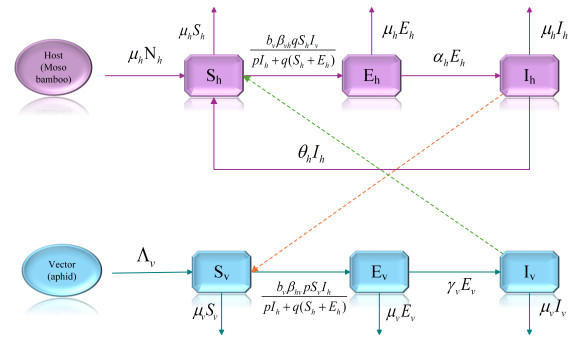
Figure 1.
A schematic of system (2.1) showing transitions between different classes for Moso bamboo and bamboo aphids.
-
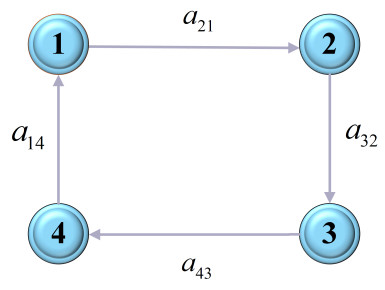
Figure 2.
The weighted digraph
$ (\mathcal{G},A) $ -
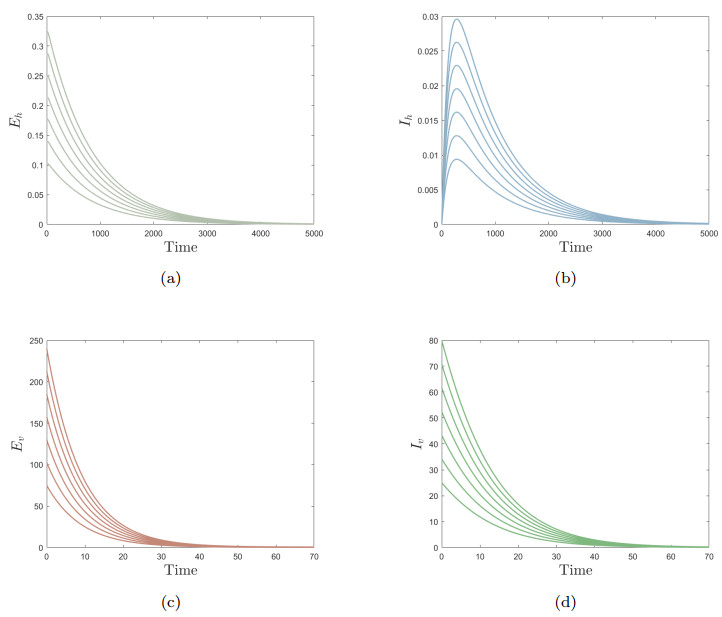
Figure 3.
The long-term behavior of
$ E_h(t) $ $ I_h(t) $ $ E_v(t) $ $ I_v(t) $ $ \mathcal{R}_0= 0.0079< 1 $ $E^0$ -
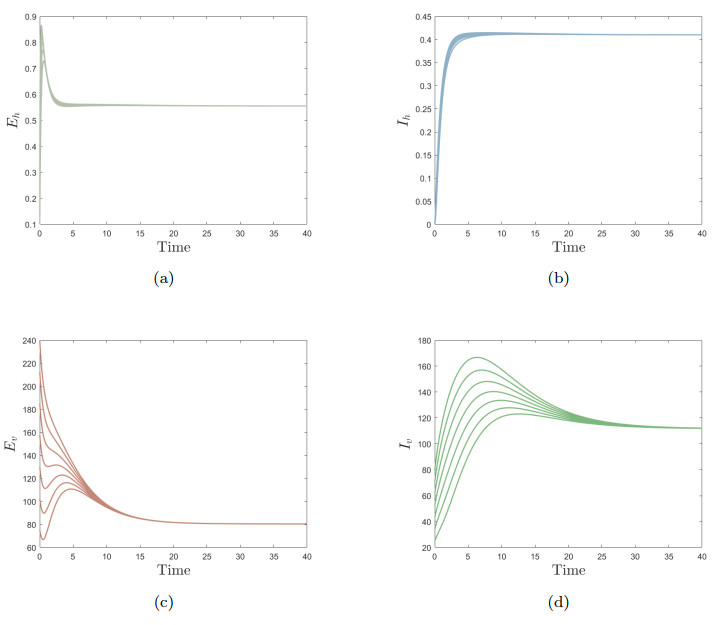
Figure 4.
The long-term behavior of
$ S_h(t) $ $ E_h(t) $ $ I_h(t) $ $ S_v(t) $ $ E_v(t) $ $ I_v(t) $ $ \mathcal{R}_0 = 1.3869 > 1 $ $ E^* $ -
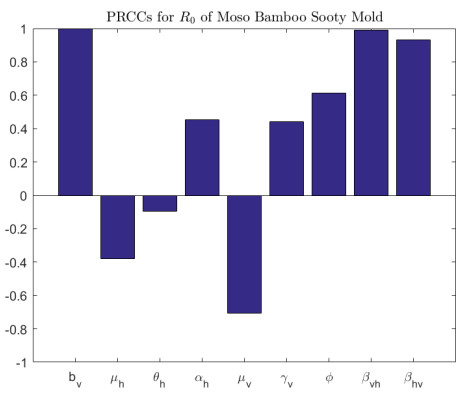
Figure 5.
Global sensitivity analysis of
$\mathcal{R}_0$ -
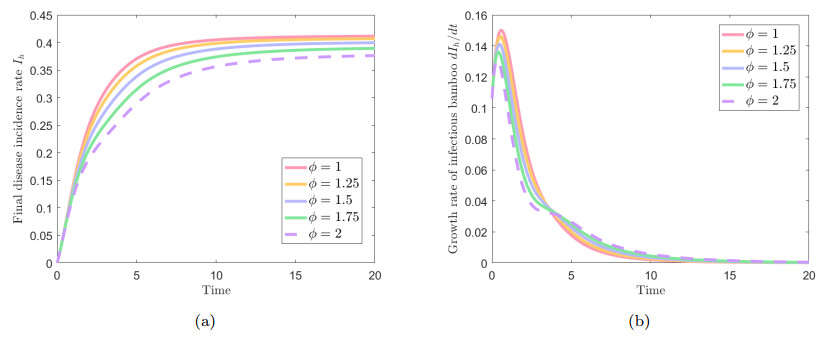
Figure 6.
Effect of vector preference
$\phi$ -
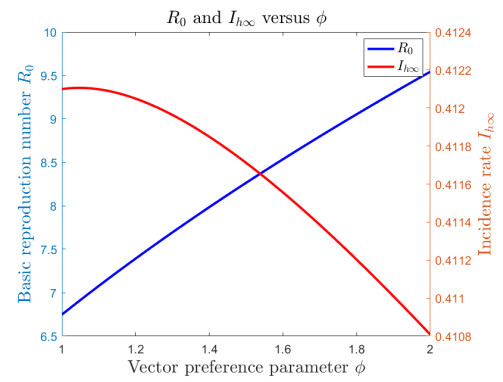
Figure 7.
Effect of
$\phi$ $\mathcal{R}_0$ $I_{h\infty}$ -
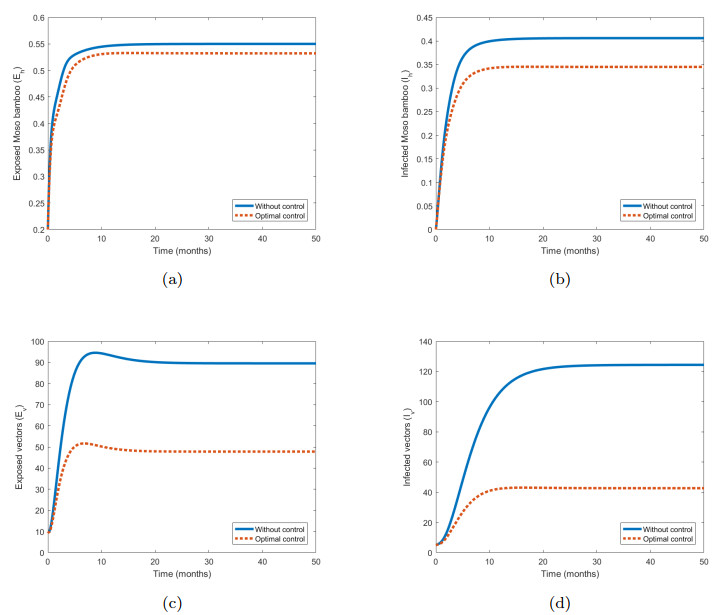
Figure 8.
Simulation results of the Moso bamboo sooty mold model (2.1) as a function of time without control and with optimal control for: (a) Total number of
$ E_h $ $ I_{h} $ $ E_v $ $ I_v $ $ \rho_1 = 0.5 $ $ \rho_2 = 0.5 $ $ \rho_3 = 0.6 $ $ \rho_4 = 0.5 $ $ T_f = 50 $ -
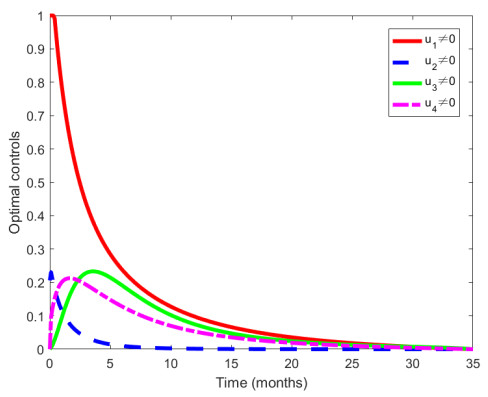
Figure 9.
The optimal controls of the Moso bamboo sooty mold model (2.1) for: (a) Insecticide treatment
$(u_1)$ $(u_2)$ $(u_3)$ $(u_4)$ $ \rho_1 = 0.5 $ $ \rho_2 = 0.5 $ $ \rho_3 = 0.6 $ $ \rho_4 = 0.5 $ $ T_f = 50 $ -
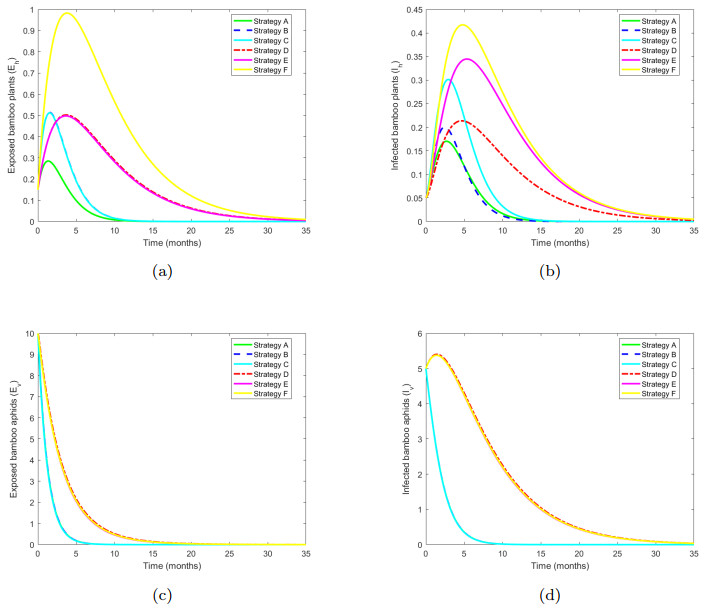
Figure 10.
Numerical simulation of the Moso bamboo sooty mold model (2.1) over time, employing plans A, B, C, D, E, and F for: (a) Total number of
$ E_h $ $ I_{h} $ $ E_v $ $ I_v $ -
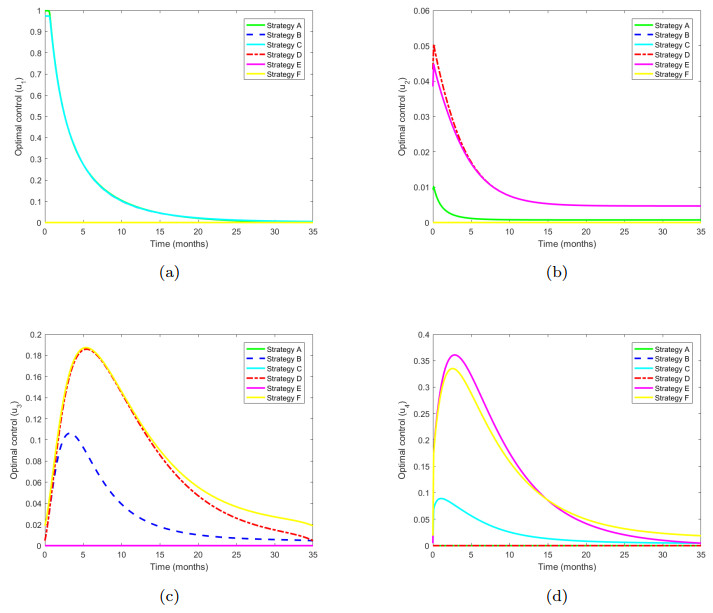
Figure 11.
The optimal control measures for the Moso bamboo sooty mold model (2.1) employing strategies A, B, C, D, E, and F for: (a) Pesticide application; (b) nutrient solution application; (c) removal of Moso bamboo with sooty mold symptoms; (d) yellow adhesive trap management.
-
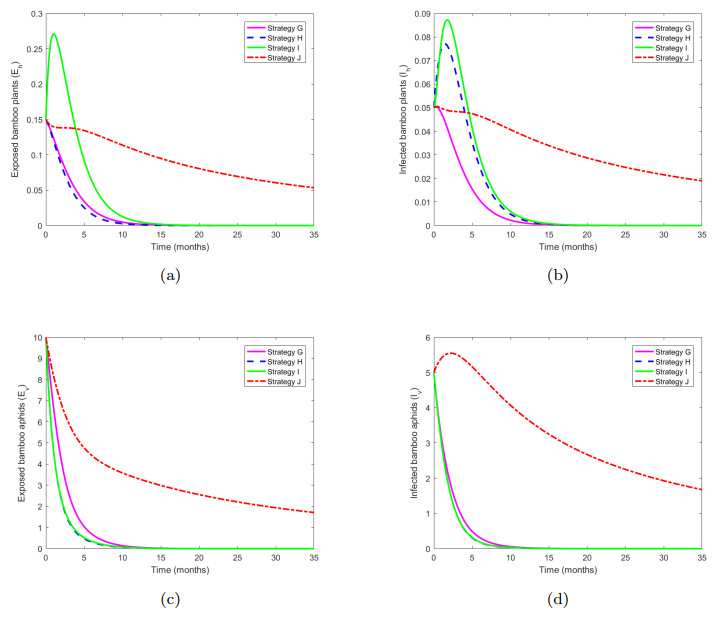
Figure 12.
Numerical simulation of the Moso bamboo sooty mold model (2.1) over time employing plans G, H, I, and J for: (a) Total number of
$ E_h $ $ I_{h} $ $ E_v $ $ I_v $ -
Figure 13.
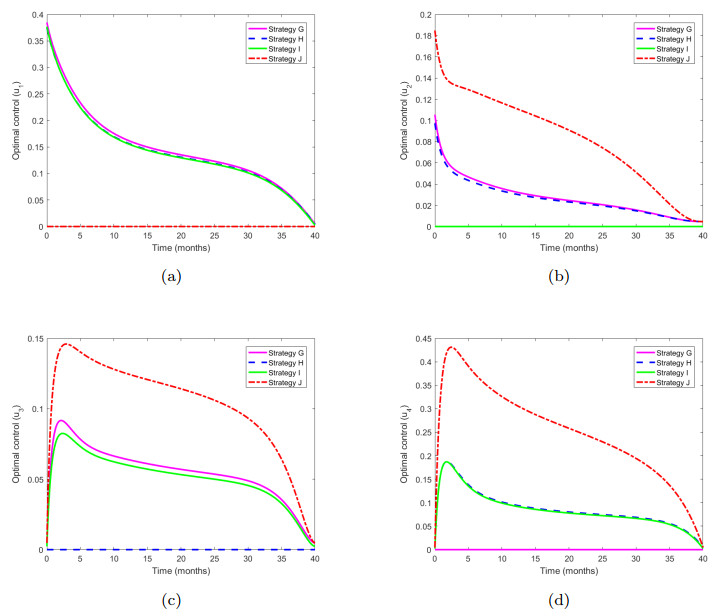
The optimal control measures for the Moso bamboo sooty mold model (2.1) employing plans G, H, I, and J for: (a) Pesticide application; (b) nutrient solution application; (c) removal of Moso bamboo with sooty mold symptoms; (d) yellow adhesive trap management.
-
Figure 14.
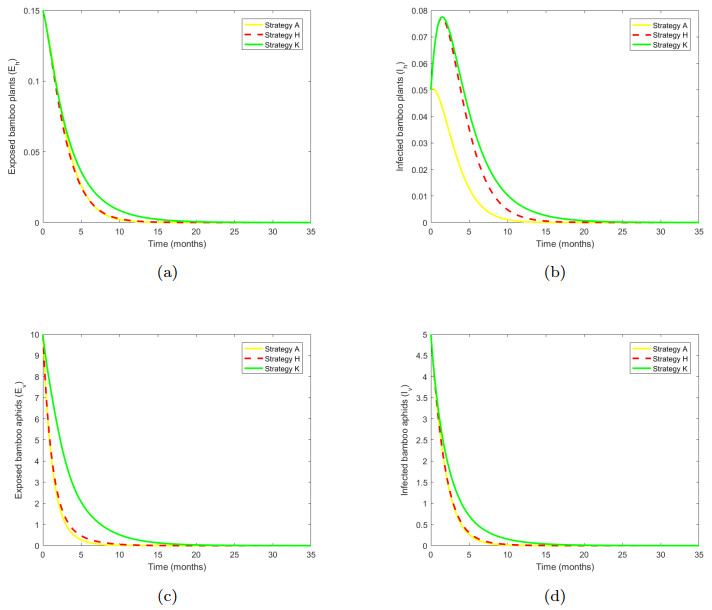
Numerical simulation of the Moso bamboo sooty mold model (2.1) over time, employing plans A, H, and K for: (a) Total number of
$ E_{h} $ $ I_{h} $ $ E_{v} $ $ I_v $ -
Figure 15.
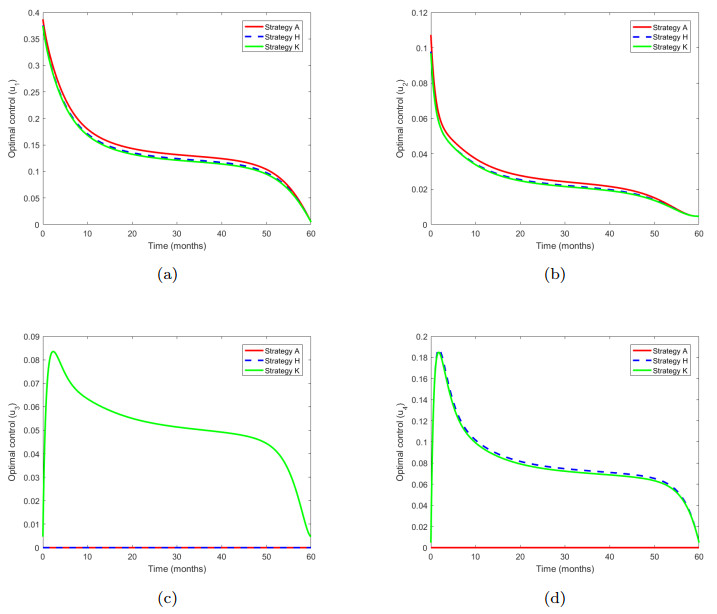
The optimal control measures for the Moso bamboo sooty mold model (2.1) employing plans A, H, and K for: (a) Pesticide application; (b) nutrient solution application; (c) removal of Moso bamboo with sooty mold symptoms; (d) yellow adhesive trap management.