

| Citation: |
Rabha W. Ibrahim, Dumitru Baleanu, Soheil Salahshour. DISCRETE-TIME SYNCHRONIZATION IN DELAYED QUANTUM-FRACTIONAL OSCILLATOR NETWORKS[J]. Journal of Applied Analysis & Computation, 2027, 17(3): 1898-1930. doi: 10.11948/20260141

|
DISCRETE-TIME SYNCHRONIZATION IN DELAYED QUANTUM-FRACTIONAL OSCILLATOR NETWORKS
-
Abstract
This study develops a finite-horizon analytical framework for discrete-time nonlinear oscillator networks with delay, based on the $(q,\tau)$-fractional nabla operator. The network dynamics are formulated as Volterra-type summation systems to represent the combined effects of fractional memory, quantum deformation, delayed interactions, graph coupling, and pinning control. Sufficient conditions are analytically derived for existence, uniqueness, continuous dependence on the prescribed initial history, invariance of the synchronization manifold, and bounded transverse disagreement. The resulting conditions explicitly incorporate the fractional order, deformation parameters, delay length, graph structure, coupling strength, and finite simulation horizon. Adaptive pinning is treated through a spectral condition involving the complete controlled network matrix, without assuming unbounded growth of the controller gains. Numerical experiments for three-node delayed networks with fixed and time-varying coupling are supported by convergence criteria, product-truncation error estimates, and recursion-residual checks. A three-regime comparison examines parameters within the analytically supported region, near its sufficient boundary, and outside the guaranteed region. The numerical results indicate smoother finite-horizon convergence behavior and decreasing synchronization disagreement for the tested parameter sets, while also demonstrating the conservative nature of the sufficient bounds. The conclusions are restricted to finite-horizon well-posedness, synchronization invariance, and disagreement control rather than an exact asymptotic synchronization threshold.
-

-
References
[1] M. Abisha, T. Sathinathan, D. Saraswathi and G. B. A. Xavier, Fundamental theorems in discrete fractional calculus using nabla operator, IAENG Int. J. Appl. Math., 2024, 54(10). [2] M. Z. Alqarni, M. Akel and M. Abdalla, Solutions to fractional q-kinetic equations involving quantum extensions of generalized hyper Mittag-Leffler functions, Fractal Fract., 2024, 8(1), Article 58. doi: 10.3390/fractalfract8010058 [3] H. Byeon, M. Abisha, V. R. Sherine, G. B. A. Xavier, S. Prema, V. Govindan, H. Ahmad, D. Piriadarshan and S. El-Morsy, Discrete version of fundamental theorems of fractional order integration for nabla operator, J. Math. Comput. Sci., 2024, 34(4), 381–393. doi: 10.22436/jmcs.034.04.05 [4] T. Ernst, A Comprehensive Treatment of q-Calculus, Springer, 2012. [5] X. Fang, S. Wang, L. Yan, C. Su and H. Dai, Finite/fixed-time synchronized stability of autonomous discrete-time dynamical systems, Nonlinear Dynam., 2024, 112(21), 19037–19054. doi: 10.1007/s11071-024-09997-8 [6] B. Gogoi, W. Singkai and S. Gogoi, Existence and uniqueness of solution of nonlinear fractional dynamic equation involving initial condition on time scales, in: Summability, Fixed Point Theory and Generalized Integrals with Applications, Chapman and Hall/CRC, 2025, 218–230. [7] N. S. Gopal and J. M. Jonnalagadda, Nabla fractional boundary value problem with a non-local boundary condition, TWMS J. Appl. Eng. Math., 2024. [8] A. Hasanov and H. Yuldashova, Mittag-Leffler type functions of three variables, Math. Methods Appl. Sci., 2025, 48(2), 1659–1675. doi: 10.1002/mma.10401 [9] A. Hioual, A. Ouannas, G. Grassi and T.-E. Oussaeif, Nonlinear nabla variable-order fractional discrete systems: Asymptotic stability and application to neural networks, J. Comput. Appl. Math., 2023, 423, Article 114939. doi: 10.1016/j.cam.2022.114939 [10] R. W. Ibrahim, Quantum-deformed growth geometry in the open unit disk, with applications in subordination, extremal functions, and phase transitions, Arab J. Math. Sci., 2026, 32(2), 237–253. [11] R. W. Ibrahim, Image edge detections based on fractional deformed harmonic univalent functions, Comput. Math. Model., 2026, 1–50. [12] R. W. Ibrahim and B. Dumitru, Theory, entropy analysis, and imaging applications, J. Appl. Anal. Comput., 2026, 16(5), 2639–2667. [13] F. H. Jackson, Ⅺ. On q-functions and a certain difference operator, Trans. Roy. Soc. Edinburgh, 1909, 46(2), 253–281. doi: 10.1017/S0080456800002751 [14] V. G. Kac and P. Cheung, Quantum Calculus, Universitext, Vol. 113, Springer, New York, 2002. [15] M. Kchaou, G. Narayanan, M. S. Ali, S. Sanober, G. Rajchakit and B. Priya, Finite-time Mittag-Leffler synchronization of delayed fractional-order discrete-time complex-valued genetic regulatory networks: Decomposition and direct approaches, Inform. Sci., 2024, 664, Article 120337. doi: 10.1016/j.ins.2024.120337 [16] A. M. S. Mahdy, Stability, existence, and uniqueness for solving fractional glioblastoma multiforme using a Caputo-Fabrizio derivative, Math. Methods Appl. Sci., 2025, 48(7), 7360–7377. doi: 10.1002/mma.9038 [17] J. Oboyi, M. P. Ineh, A. Maharaj, J. O. Achuobi and O. K. Narain, Practical stability of Caputo fractional dynamic equations on time scale, Adv. Fixed Point Theory, 2025, 15. [18] K. S. R. Priyanka and G. Nagamani, Non-fragile projective synchronization of delayed discrete-time neural networks via generalized weighted summation inequality, Appl. Math. Comput., 2024, 479, Article 128885. [19] K. S. R. Priyanka and G. Nagamani, Exponentially decaying memory recovery feedback controller design for quasi-synchronization of complex-valued discrete-time neural networks, Int. J. Adapt. Control Signal Process., 2025, 39(5), 1064–1078. doi: 10.1002/acs.3992 [20] A. Refice, M. Bensaid, M. S. Souid, S. Boulaaras, A. Amara and T. Radwan, Innovative approaches to initial and terminal value problems of fractional differential equations with two different derivative orders, Fixed Point Theory Algorithms Sci. Eng., 2025, 2025(1), Article 32. doi: 10.1186/s13663-025-00812-6 [21] S. Saber and S. M. Mirgani, Numerical analysis and stability of a fractional glucose insulin regulatory system using the Laplace residual power series method incorporating the Atangana–Baleanu derivative, Int. J. Model. Simul. Sci. Comput., 2025, 16(2). [22] S. Sabit, M. S. Souid, M. Benaouda, K. Sudarmozhi and J. K. K. Asamoah, Fixed point analysis for Cauchy-type variable-order fractional differential equations with finite delay, Int. J. Differ. Equ., 2026, 2026(1), Article 3615489. [23] D. Saraswathi, G. B. A. Xavier, M. Abisha and P. Aarthi, Novel discrete fundamental theorems of nabla operator, AIP Conf. Proc., 2025, 3306(1), Article 020009. [24] Y. Sheng, Z. Zeng and T. Huang, Finite-time synchronization of neural networks with infinite discrete time-varying delays and discontinuous activations, IEEE Trans. Neural Netw. Learn. Syst., 2021, 34(6), 3034–3043. [25] M. S. Souid, Z. Bouazza, M. Bensaid, K. Sudar Mozhi, M. Mokhtar and J. K. K. Asamoah, Analytical study of variable-order fractional differential equations with initial and terminal antiperiodic boundary conditions, J. Appl. Math., 2025, 2025(1), Article 8863599. doi: 10.1155/jama/8863599 [26] M. S. Souid, S. Guedim, S. Boulaaras, A. Benkerrouche, A. Amara, T. Radwan and R. Jan, New approaches to solving initial value problems of mixed differential equations, Filomat, 2026, 40(2), 649–659. doi: 10.2298/FIL2602649S [27] M. S. Souid, S. Sabit, Z. Bouazza and K. Sitthithakerngkiet, A study of Caputo fractional differential equations of variable order via Darbo's fixed point theorem and Kuratowski measure of noncompactness, AIMS Math., 2025, 10(7), 15410–15432. doi: 10.3934/math.2025691 [28] Y. Xue, K. Tu, C. Liu and X. Zhang, Non-fragile extended dissipative synchronization control for uncertain discrete-time neural networks with leakage and unbounded time-varying delays, Chaos Solitons Fractals, 2024, 185, Article 115072. doi: 10.1016/j.chaos.2024.115072 -
-
Figures(2) / Tables(9)
Export File
Citation
Rabha W. Ibrahim, Dumitru Baleanu, Soheil Salahshour. DISCRETE-TIME SYNCHRONIZATION IN DELAYED QUANTUM-FRACTIONAL OSCILLATOR NETWORKS[J]. Journal of Applied Analysis & Computation, 2027, 17(3): 1898-1930. doi: 10.11948/20260141
Format
Content
 DownLoad:
-
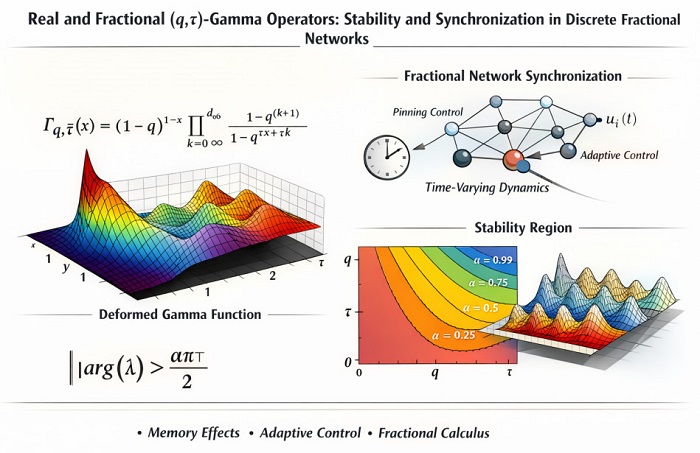
Figure 1.
The left panel shows the deformation of the Gamma function
$\Gamma_{q,\tau}(x)$ $(q,\tau)$ $\alpha$ -
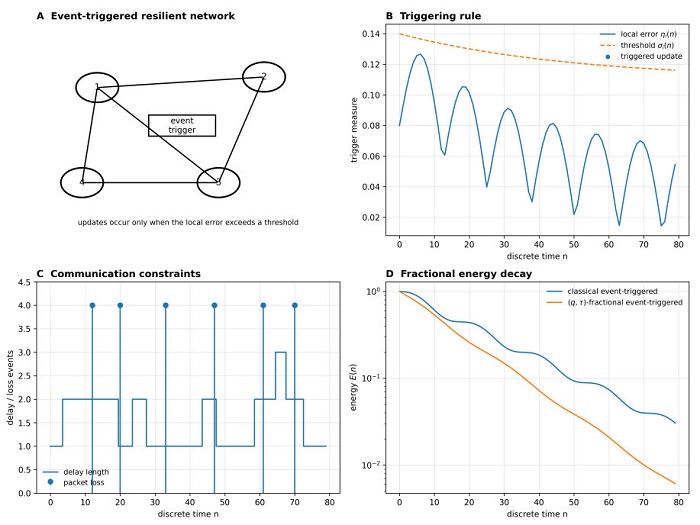
Figure 2.
Resilient event-triggered network under
$ (q,\tau) $ $ (q,\tau) $