

| Citation: |
Hailong Yuan, Yani Ma, Yanfei Dai. BIFURCATION AND SPATIOTEMPORAL PATTERNS IN A HOMOGENEOUS DIFFUSIVE GIERER-MEINHARDT SYSTEM[J]. Journal of Applied Analysis & Computation, 2026, 16(2): 860-894. doi: 10.11948/20230330

|
BIFURCATION AND SPATIOTEMPORAL PATTERNS IN A HOMOGENEOUS DIFFUSIVE GIERER-MEINHARDT SYSTEM
-
Abstract
This paper investigates an activator-inhibitor system with diffusion under homogeneous Neumann boundary conditions. Firstly, we consider the Hopf bifurcation at the positive equilibrium, and obtain the conditions for determining the bifurcation direction and stability of the bifurcating periodic solutions. Secondly, we demonstrate that the system undergoes a Turing-Hopf bifurcation with codimension-two. By calculating the normal form on the center manifold, we show that the system has the complex spatiotemporal dynamics near the Turing-Hopf bifurcation point. Moreover, the Turing instability of the positive equilibrium is discussed. By the bifurcation theory, we establish the local structure of the steady state bifurcations, and describe some conditions for determining the direction of bifurcations. Finally, some numerical simulations are carried out to explain and supplement the results of various bifurcation analyses.
-

-
References
[1] A. Benjamin, Bifurcation analysis and steady-state patterns in reaction-diffusion systems augmented with self- and cross-diffusion, Int. J. Bifurcat. Chaos, 2023, 33(9), 2350102. doi: 10.1142/S021812742350102X [2] S. Chen and J. Shi, Global attractivity of equilibrium in Gierer-Meinhardt system with activator production saturation and gene expression time delays, Nonlinear Anal.: Real World Appl., 2013, 14(4), 1871–1886. doi: 10.1016/j.nonrwa.2012.12.004 [3] S. Chen, J. Shi and J. Wei, Bifurcation analysis of the Gierer-Meinhardt system with a saturation in the activator production, Appl. Anal., 2014, 93(6), 1115–1134. doi: 10.1080/00036811.2013.817559 [4] M. Crandall and P. Rabinowitz, Bifurcation from simple eigenvalues, J. Funct. Anal., 1971, 8(2), 321–340. doi: 10.1016/0022-1236(71)90015-2 [5] X. Gao, Y. Cai, F. Rao, S. Fu and W. Wang, Positive steady states in an epidemic model with nonlinear incidence rate, Comput. Math. Appl., 2018,424–443. [6] A. H. Gierer and H. Meinhardt, A theory of biological pattern formation, Kybernetik, 1972, 12, 30–39. doi: 10.1007/BF00289234 [7] P. Gonpot, J. Collet and N. Sookia, Gierer-Meinhardt model: Bifurcation analysis and pattern formation, Trends Appl. Sci. Res., 2008, 3,115–128. doi: 10.3923/tasr.2008.115.128 [8] W. Jiang, Q. An and J. Shi, Formulation of the normal form of Turing-Hopf bifurcation in partial functional differential equations, J. Dyn. Differ. Equ., 2020,268(10), 6067–6102. doi: 10.1016/j.jde.2019.11.039 [9] W. Jiang, H. Wang and X. Cao, Turing instability and Turing-Hopf bifurcation in diffusive Schnakenberg systems with gene expression time delay, J. Dyn. Differ. Equ., 2019, 31(4), 2223–2247. doi: 10.1007/s10884-018-9702-y [10] J. Jin, J. Shi and J. Wei, Bifurcations of patterned solutions in the diffusive Lengyel-Epstein system of CIMA chemical reactions, Rocky. Mt. J. Math., 2013, 43(5), 1637–1674. [11] F. Karami, D. Meskine and K. Sadik, A new nonlocal model for the restoration of textured images, J. Appl. Anal. Comput., 2019, 9(6), 2070–2095. [12] Q. Li, L. Zhang and P. Zhou, Global bifurcation for a class of Lotka-Volterra competitive systems, Journal of Nonlinear Modeling and Analysis, 2023, 5(4), 720–739. [13] Y. Li, J. Wang and X. Hou, Stripe and spot patterns for the Gierer-Meinhardt model with saturated activator production, J. Math. Anal. Appl., 2017,449(2), 1863–1879. doi: 10.1016/j.jmaa.2017.01.019 [14] J. Liu, F. Yi and J. Wei, Multiple bifurcation analysis and spatiotemporal patterns in a 1-D Gierer-Meinhardt model of morphogenesis, Int. J. Bifurcat. Chaos, 2010, 20(4), 1007–1025. doi: 10.1142/S0218127410026289 [15] K. Morimoto, On positive solutions generated by semi-strong saturation effect for the Gierer-Meinhardt system, J. Math. Soc. Japan., 2013, 65(3), 887–929. [16] R. Moyles and J. Ward, Existence, stability, and dynamics of ring and near-ring solutions to the saturated Gierer-Meinhardt model in the semistrong regime, SIAM J. Appl. Dyn. Syst., 2017, 16(1), 597–639. doi: 10.1137/16M1060327 [17] J. Murray, Parameter space for turing instability in reaction diffusion mechanisms: A comparison of models, J. Theor. Biol., 1982, 98(1), 143–163. doi: 10.1016/0022-5193(82)90063-7 [18] P. A. Naik, J. Zu and M. Ghoreishi, Stability analysis and approximate solution of SIR epidemic model with Crowley-Martin type functional response and Holling type-Ⅱ treatment rate by using homotopy analysis method, J. Appl. Anal. Comput., 2020, 10(4), 1482–1515. [19] J. Shi, Persistence and bifurcation of degenerate solutions, J. Funct. Anal., 1999,169(2), 494–531. doi: 10.1006/jfan.1999.3483 [20] Y. Song, R. Yang and G. Sun, Pattern dynamics in a Gierer-Meinhardt model with a saturating term, Appl. Math. Model., 2017, 46,476–491. doi: 10.1016/j.apm.2017.01.081 [21] Y. Song and T. Zhang, Spatial pattern formations in diffusive predator-prey systems with non-homogeneous Dirichlet boundary conditions, J. Appl. Anal. Comput., 2020, 10(1), 165–177. [22] Y. Song, T. Zhang and Y. Peng, Turing-Hopf bifurcation in the reaction-diffusion equations and its applications, Commun. Nonlinear. Sci., 2016, 33(4), 229–258. [23] A. Suleiman, Stability analysis of the Gierer-Meinhardt system with activator degradation, Dutse. J. Pure. Appl. Sci., 2016, 2(1), 48–54. [24] A. Sun, R. Wu and M. Chen, Turing-Hopf bifurcation analysis in a diffusive Gierer-Meinhardt model, AIMS Math., 2021, 6(2), 1920–1942. doi: 10.3934/math.2021117 [25] J. Wang, X. Hou and Z. Jing, Stripe and spot patterns in a Gierer-Meinhardt activator-inhibitor model with different sources, Int. J. Bifurcat. Chaos, 2016, 25(8), 108–155. [26] J. Wei and M. Winter, On the Gierer-Meinhardt system with saturation, Commun. Contemp. Math., 2004, 6(2), 259–277. doi: 10.1142/S021919970400132X [27] R. Wu, Y. Zhou, Y. Shao and L. Chen, Bifurcation and turing patterns of reaction-diffusion activator-inhibitor model, Physica. A, 2017,482,597–610. doi: 10.1016/j.physa.2017.04.053 [28] X. Yan, Y. Ding and G. Zhang, Dynamics analysis in a Gierer-Meinhardt reaction-diffusion model with homogeneous Neumann boundary condition, Int. J. Bifurcat. Chaos., 2019, 9(29), 1930025. [29] R. Yang and Y. Song, Spatial resonance and Turing-Hopf bifurcations in the Gierer-Meinhardt model, Nonlinear Anal.: Real World Appl., 2016, 31,356–387. doi: 10.1016/j.nonrwa.2016.02.006 [30] M. Yari, Transitions and heteroclinic cycles in the general Gierer-Meinhardt equation and cardiovascular calcification model, Nonlinear. Anal-Theor., 2010, 73(5), 1160–1174. doi: 10.1016/j.na.2010.04.031 [31] F. Yi, J. Wei and J. Shi, Bifurcation and spatiotemporal patterns in a homogeneous diffusive predator-prey system, J. Dyn. Differ. Equ., 2009,246(5), 1944–1977. doi: 10.1016/j.jde.2008.10.024 [32] K. Zhao, Solvability, approximation and stability of periodic boundary value problem for a nonlinear Hadamard fractional differential equation with p-Laplacian, Axioms, 2023, 12(8), 733. doi: 10.3390/axioms12080733 [33] K. Zhao, Stability of a nonlinear fractional Langevin system with nonsingular exponential kernel and delay control, Discrete. Dyn. Nat. Soc., 2022, 9169185. [34] K. Zhao, Existence and UH-stability of integral boundary problem for a class of nonlinear higher-order Hadamard fractional Langevin equation via Mittag-Leffler functions, Filomat, 2023, 37(4), 1053–1063. doi: 10.2298/FIL2304053Z [35] K. Zhao, Stability of a nonlinear Langevin system of ML-type fractional derivative affected by time-varying delays and differential feedback control, Fractal. Fract., 2022, 6(12), 725. doi: 10.3390/fractalfract6120725 [36] K. Zhao, Probing the oscillatory behavior of internet game addiction via diffusion PDE model, Axioms, 2022, 11(11), 649. doi: 10.3390/axioms11110649 [37] K. Zhao, Global stability of a novel nonlinear diffusion online game addiction model with unsustainable control, AIMS Mathematics, 2022, 7(12), 20752–20766. doi: 10.3934/math.20221137 [38] K. Zhao, Attractor of a nonlinear hybrid reaction-diffusion model of neuroendocrine transdifferentiation of human prostate cancer cells with time-lags, AIMS Mathematics, 2023, 8(6), 14426–14448. doi: 10.3934/math.2023737 [39] K. Zhao, Generalized UH-stability of a nonlinear fractional coupling $(p_1, p_2)$-Laplacian system concerned with nonsingular Atangana-Baleanu fractional calculus, J. Inequal. Appl., 2023, 96. -
-
Figures(14)
Export File
Citation
Hailong Yuan, Yani Ma, Yanfei Dai. BIFURCATION AND SPATIOTEMPORAL PATTERNS IN A HOMOGENEOUS DIFFUSIVE GIERER-MEINHARDT SYSTEM[J]. Journal of Applied Analysis & Computation, 2026, 16(2): 860-894. doi: 10.11948/20230330
Format
Content
 DownLoad:
-
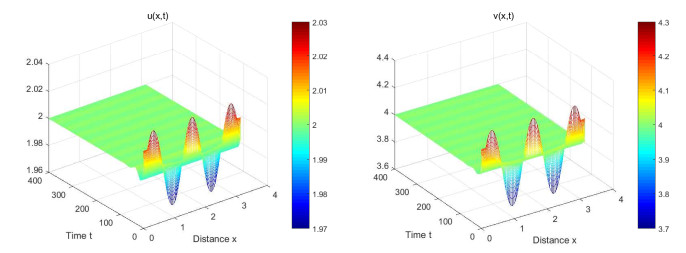
Figure 1.
Here
$ d=1.5 $ $ b=0.5<b_0^H=1 $ $ u_0(x)=2+0.5\cos(5x) $ $ v_0(x)=4+0.5\cos(5x) $ $ (2, 4) $ -
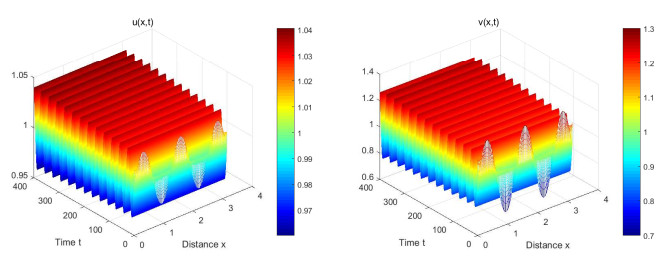
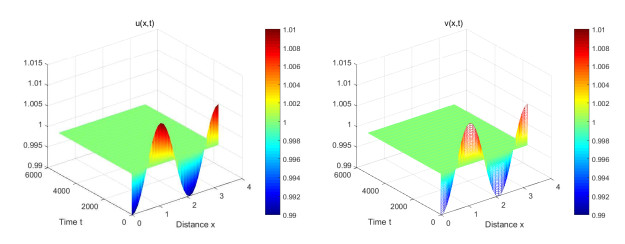
Figure 2.
Here
$ d=1.5 $ $ b=b_0^H=1 $ $ u_0(x)=1+5\sin(4x/5) $ $ v_0(x)=1+5\sin(4x/5) $ -
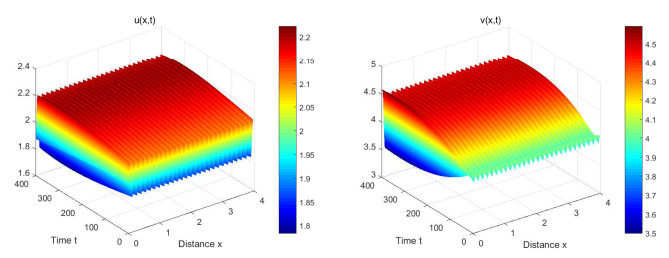
Figure 3.
Here
$ d=1.5 $ $ b=0.5<b_0^H=1 $ $ u_0(x)=2+5\sin(6x/5) $ $ v_0(x)=4+5\sin(6x/5) $ -
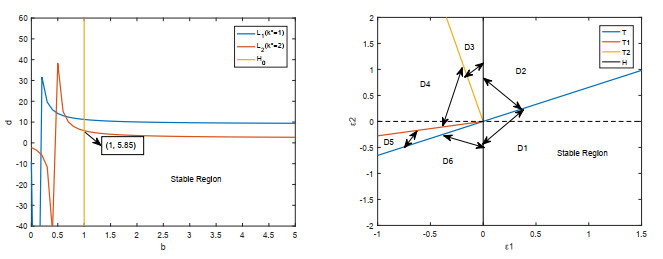
Figure 4.
Left: Turing-Hopf bifurcation point
$ (b^*, d_{k_*}^{*}) $ $ b $ $ d $ -
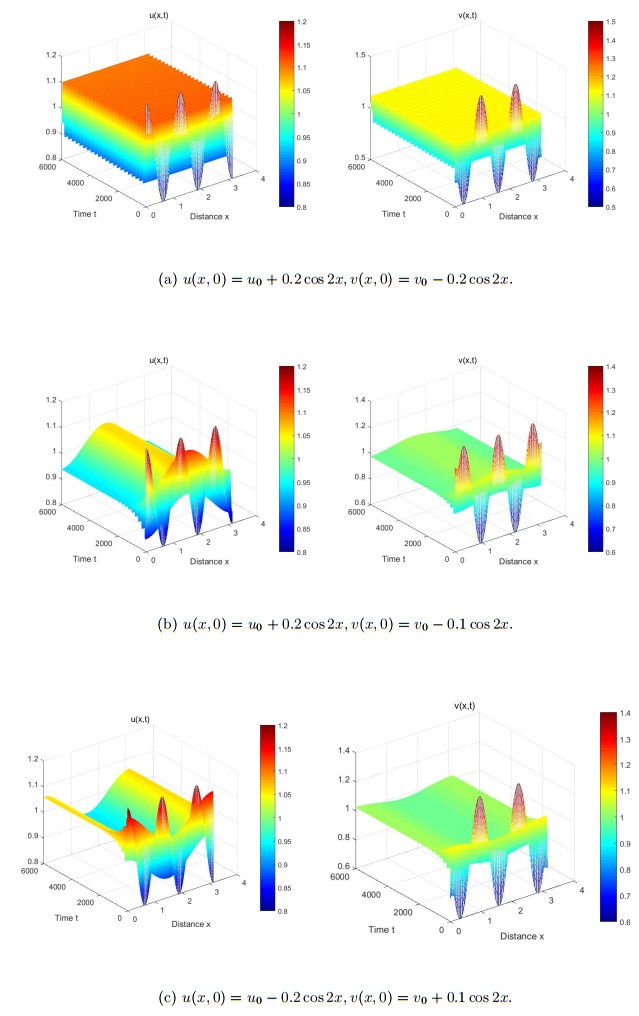
Figure 5.
$ (\varepsilon_1, \varepsilon_2)=(0.1, -0.1) $ $ u(x, 0)=u_0+2\cos5x, v(x,0)=v_0-2\cos5x $ $ E_0 $ -
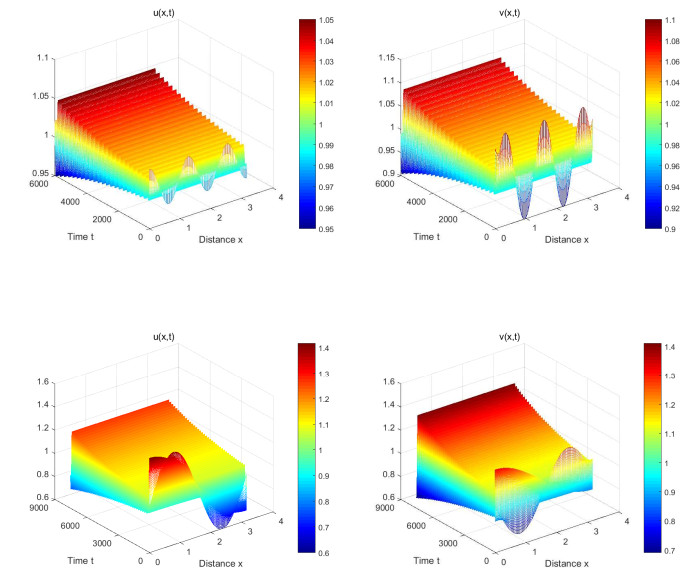
Figure 6.
$ (\varepsilon_1, \varepsilon_2)=(0.1, 0.07), E_0 $ $ E_1^{\pm} $ -
Figure 7.
When
$ (\varepsilon_1, \varepsilon_2)=(-0.1, 0.6) $ $ E_0 $ $ E_2 $ $ E_1^{\pm} $ -
Figure 8.
When
$ (\varepsilon_1, \varepsilon_2)=(-0.1, 0.02) $ $ E_0, E_3^{\pm} $ $ E_2, E_1^{\pm} $ -
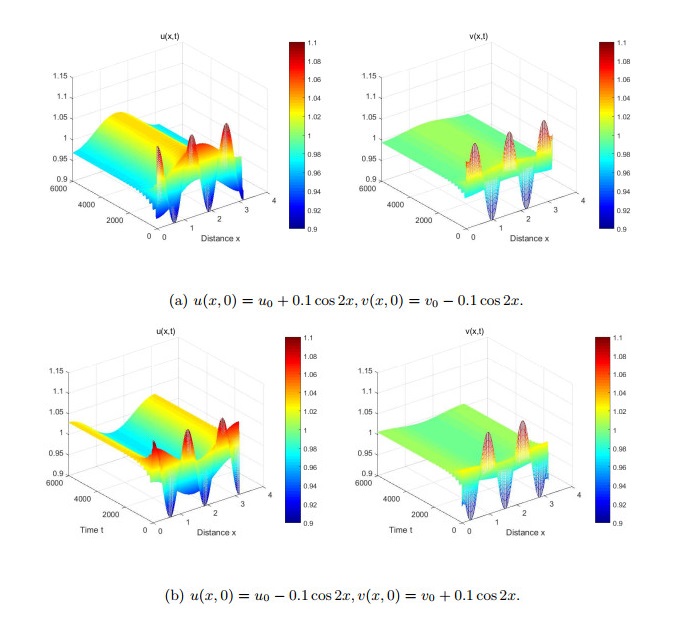
Figure 9.
When
$ (\varepsilon_1, \varepsilon_2)=(-0.1, -0.03) $ $ u(x, 0)=u_0+0.01\cos2x, v(x,0)=v_0-0.01\cos2x $ $ E_0, E_1^{\pm} $ $ E_2 $ -
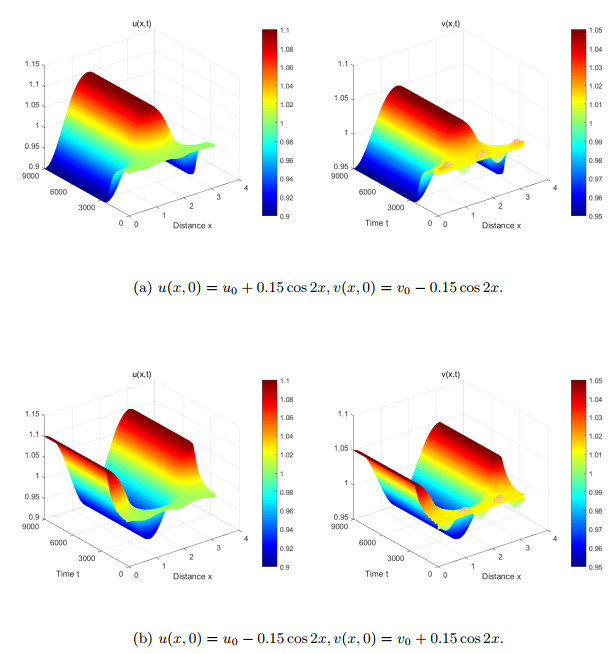
Figure 10.
When
$ (\varepsilon_1, \varepsilon_2)=(-0.1, -0.08) $ $ u(x, 0)=u_0+0.1\cos2x, v(x,0)=v_0+0.1\cos2x $ $ E_0 $ $ E_2 $ -
Figure 11.
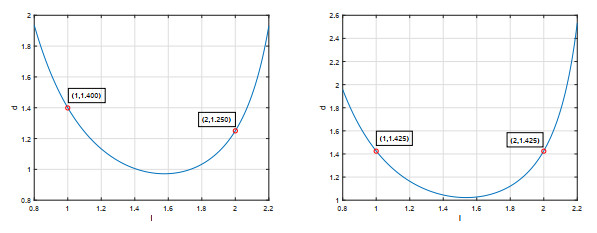
The neutral curves
$ d $ $ i\in R $ $ b=6 $ $ b=5.7 $ -
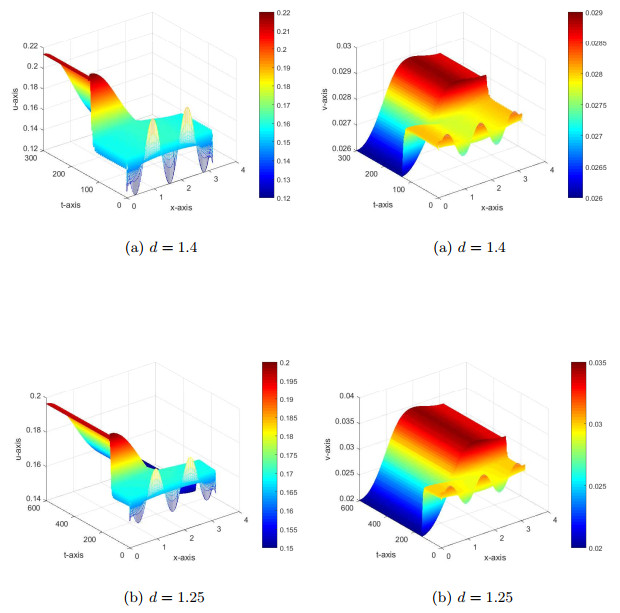
Figure 12.
Steady state bifurcation solutions at the simple eigenvalue for
$ b=6 $ $ d=1.4 $ $ d=1.25. $ $ u $ $ v $ -
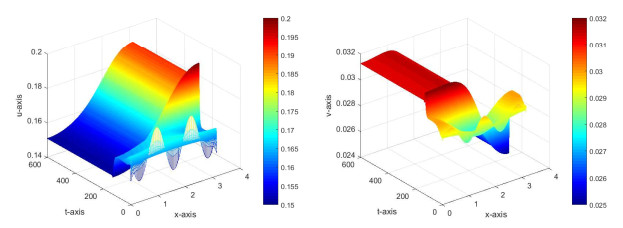
Figure 13.
Steady state bifurcation solution at the double eigenvalue for
$ b=5.7 $ $ d=1.425. $ $ u $ $ v $ -
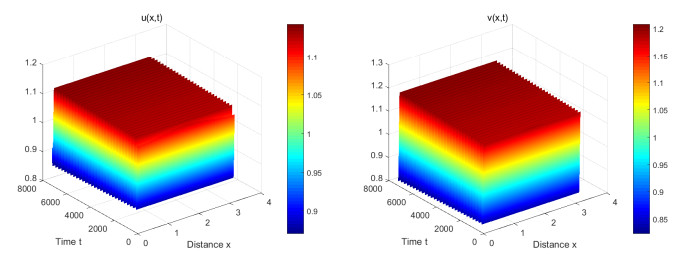
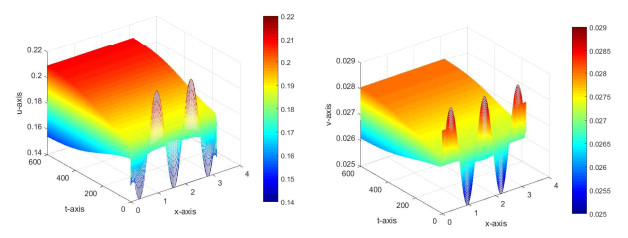
Figure 14.
Positive periodic solution of (1.2) for b=6. Here, d=1.1 and the solution tends to a spatially homogeneous time periodic orbit. Left: u; right: v.