

| Citation: |
Yanxia Hu, Xiaofang Meng, Zhouhong Li, Jinde Cao. QUASI-SYNCHRONIZATION OF COMPLEX-VALUED NEUTRAL-TYPE INERTIAL NEURAL NETWORKS WITH PROPORTIONAL DELAYS[J]. Journal of Applied Analysis & Computation, 2026, 16(3): 1276-1297. doi: 10.11948/20250262

|
QUASI-SYNCHRONIZATION OF COMPLEX-VALUED NEUTRAL-TYPE INERTIAL NEURAL NETWORKS WITH PROPORTIONAL DELAYS
-
Abstract
This article explores the quasi-synchronization of complex-valued neutral-type inertial neural networks with proportional delays. By constructing appropriate Lyapunov functions and utilizing inequality techniques, sufficient conditions for the quasi-synchronization of the error system are derived. The entire analysis employs a non-reduced order approach and a non-separation method, it is directly concerned with the original system. A control law is designed, and it is proven that, under certain conditions, the error between the response system and the driving system can be bounded, thereby achieving quasi-synchronization. Finally, the effectiveness of these findings is thoroughly validated through numerical examples, and the research results are applied to the processes of image encryption and decryption. In terms of innovation, this paper focuses on models with parameter mismatch. It can provide theoretical references for the research on parameter-mismatched systems, and its analysis methods can also be applied to parameter-matched systems. At the same time, it provides more efficient analysis tools for complex-valued neural networks and further advances the theoretical foundations of quasi-synchronization control.
-

-
References
[1] K. Babcock and R. Westervelt, Stability and dynamics of simple electronic neural networks with added inertia, Physica D: Nonlinear Phenomena, 1986, 23(1–3), 464–469. [2] R. Boriga, A. C. Dăscălescu and I. Priescu, A new hyperchaotic map and its application in an image encryption scheme, Signal Processing: Image Communication, 2014, 29(8), 887–901. doi: 10.1016/j.image.2014.04.001 [3] R. W. Brause, Medical analysis and diagnosis by neural networks, Medical Data Analysis, 2001, 1–13. [4] F. Chowdhury, P. Wahi, R. Raina and S. Kaminedi, A survey of neural networks applications in automatic control, Proceedings of the 33rd Southeastern Symposium on System Theory (Cat. No. 01EX460), Athens, OH, USA, 2001, 349–353. [5] J. Chu, M. Gao, X. Liu, et al., Channel estimation based on complex-valued neural networks in IM/DD FBMC/OQAM transmission system, Journal of Lightwave Technology, 2022, 40(4), 1055–1063. doi: 10.1109/JLT.2021.3128891 [6] T. L. Clarke, Generalization of neural networks to the complex plane, 1990 IJCNN International Joint Conference on Neural Networks, San Diego, CA, USA, 1990, 435–440. [7] R. Guo, S. Xu and C. K. Ahn, Dissipative sliding-mode synchronization control of uncertain complex-valued inertial neural networks: Non-reduced-order strategy, IEEE Transactions on Circuits and Systems Ⅰ: Regular Papers, 2022, 70(2), 860–871. [8] R. Guo, S. Xu and J. Guo, Sliding-mode synchronization control of complex-valued inertial neural networks with leakage delay and time-varying delays, IEEE Transactions on Systems, Man, and Cybernetics: Systems, 2022, 53(2), 1095–1103. [9] J. Han, G. Chen, L. Wang, et al., Direct approach on fixed-time stabilization and projective synchronization of inertial neural networks with mixed delays, Neurocomputing, 2023, 535, 97–106. doi: 10.1016/j.neucom.2023.03.038 [10] W. He, F. Du and S. Zhang, Non-separation method-based finite-time synchronization of discrete-time fractional-order complex-valued neural networks with time-varying delays, Neurocomputing, 2025, 130732. [11] S. Jia and L. Zhou, Fixed-time stabilization of fuzzy neutral-type inertial neural networks with proportional delays, ISA Transactions, 2024, 144, 167–175. doi: 10.1016/j.isatra.2023.10.032 [12] G. Jiang, L. Wang, X. Zong, et al., Practically predefined-time stabilization of stochastic fuzzy memristive neural networks under deception attacks, IEEE Transactions on Cybernetics, 2025. DOI: 10.1109/TCYB.2025.3621274. [13] J. Jin, J. Fang, C. Chen, et al., A complex-valued time varying zeroing neural network model for synchronization of complex chaotic systems, Nonlinear Dynamics, 2025, 113(6), 5471–5491. doi: 10.1007/s11071-024-10528-8 [14] A. Kumar, S. Singh, S. Das and Y. Cao, Projective quasi-synchronization of complex-valued recurrent neural networks with proportional delay and mismatched parameters via matrix measure approach, Engineering Applications of Artificial Intelligence, 2023, 126, 106800. doi: 10.1016/j.engappai.2023.106800 [15] S. Lakshmanan, M. Prakash, C. P. Lim, et al., Synchronization of an inertial neural network with time-varying delays and its application to secure communication, IEEE Transactions on Neural Networks and Learning Systems, 2016, 29(1), 195–207. [16] C. Lee, H. Hasegawa and S. Gao, Complex-valued neural networks: A comprehensive survey, IEEE/CAA Journal of Automatica Sinica, 2022, 9(8), 1406–1426. doi: 10.1109/JAS.2022.105743 [17] H. Li, L. Wang and Q. Lai, Synchronization of a memristor chaotic system and image encryption, International Journal of Bifurcation and Chaos, 2021, 31(16), 2150251. doi: 10.1142/S0218127421502515 [18] H. Li, L. Wang, X. Wan and C.-K. Zhang, Error transmission of chaos-based image encryption: Application to smart grid, IEEE Transactions on Industrial Informatics, 2025. DOI: 10.1109/TII.2025.3609139. [19] W. Li, X. Gao and R. Li, Stability and synchronization control of inertial neural networks with mixed delays, Applied Mathematics and Computation, 2020, 367, 124779. doi: 10.1016/j.amc.2019.124779 [20] X. Li, X. Li and C. Hu, Some new results on stability and synchronization for delayed inertial neural networks based on non-reduced order method, Neural Networks, 2017, 96, 91–100. doi: 10.1016/j.neunet.2017.09.009 [21] H. Lin, Y. Shi, J. Guo and X. He, Non-decomposition method for event-triggered finite-time synchronization control of complex-valued memristive neural networks, Cognitive Neurodynamics, 2025, 19(1), 115. doi: 10.1007/s11571-025-10306-1 [22] Y. Liu, Z. Zhang, X. Wang, et al., Finite-time stabilization for fuzzy complex-valued neural networks with mixed delays via comparison approach, IEEE Transactions on Fuzzy Systems, 2023, 32(2), 621–633. [23] C. Long, G. Zhang and J. Hu, Fixed-time synchronization for delayed inertial complex-valued neural networks, Applied Mathematics and Computation, 2021, 405, 126272. doi: 10.1016/j.amc.2021.126272 [24] A. G. Mullissa, C. Persello and J. Reiche, Despeckling polarimetric SAR data using a multistream complex-valued fully convolutional network, IEEE Geoscience and Remote Sensing Letters, 2021, 19, 1–5. [25] A. Y. Niyat, M. H. Moattar and M. N. Torshiz, Color image encryption based on hybrid hyper-chaotic system and cellular automata, Optics and Lasers in Engineering, 2017, 90, 225–237. doi: 10.1016/j.optlaseng.2016.10.019 [26] M. Egmont-Petersen, D. de Ridder and H. Handels, Image processing with neural networks-a review, Pattern Recognition, 2002, 35(10), 2279–2301. doi: 10.1016/S0031-3203(01)00178-9 [27] J. Schmidhuber, Deep learning in neural networks: An overview, Neural Networks, 2015, 61, 85–117. doi: 10.1016/j.neunet.2014.09.003 [28] L. Shanmugam, P. Mani, R. Rajan and Y. H. Joo, Adaptive synchronization of reaction-diffusion neural networks and its application to secure communication, IEEE Transactions on Cybernetics, 2018, 50(3), 911–922. [29] Y. Sheng, H. Gong and Z. Zeng, Global synchronization of complex-valued neural networks with unbounded time-varying delays, Neural Networks, 2023, 162, 309–317. doi: 10.1016/j.neunet.2023.02.041 [30] Q. Song, L. Yang, Y. Liu and F. E. Alsaadi, Stability of quaternion-valued neutral-type neural networks with leakage delay and proportional delays, Neurocomputing, 2023, 521, 191–198. doi: 10.1016/j.neucom.2022.12.009 [31] Z. Tang, J. H. Park and J. Feng, Impulsive effects on quasi-synchronization of neural networks with parameter mismatches and time-varying delay, IEEE Transactions on Neural Networks and Learning Systems, 2017, 29(4), 908–919. [32] B. B. Traore, B. Kamsu-Foguem and F. Tangara, Deep convolution neural network for image recognition, Ecological Informatics, 2018, 48, 257–268. doi: 10.1016/j.ecoinf.2018.10.002 [33] P. Wan and Z. Zeng, Quasi-synchronization of timescale-type delayed neural networks with parameter mismatches via impulsive control, IEEE Transactions on Systems, Man, and Cybernetics: Systems, 2023, 53(7), 4254–4266. doi: 10.1109/TSMC.2022.3228105 [34] L. Wang, Y. Hu, C. Hu, et al., Finite-time synchronization of delayed fuzzy inertial neural networks via intermittent control, Neurocomputing, 2024, 574, 127288. doi: 10.1016/j.neucom.2024.127288 [35] Z. Wang, D. W. Ho and X. Liu, State estimation for delayed neural networks, IEEE Transactions on Neural Networks, 2005, 16(1), 279–284. doi: 10.1109/TNN.2004.841813 [36] K. Wu, M. Tang and H. Ren, Mittag-Leffler projective synchronization of caputo fractional-order reaction-diffusion memristive neural networks with multi-type time delays, Communications in Nonlinear Science and Numerical Simulation, 2025, 149, 108934. doi: 10.1016/j.cnsns.2025.108934 [37] Z. Wu, G. Chen and X. Fu, Synchronization of a network coupled with complex-variable chaotic systems, Chaos: An Interdisciplinary Journal of Nonlinear Science, 2012, 22(2). [38] S. Yan, Z. Gu, J. H. Park and X. Xie, Synchronization of delayed fuzzy neural networks with probabilistic communication delay and its application to image encryption, IEEE Transactions on Fuzzy Systems, 2022, 31(3), 930–940. [39] J. Yang, H.-L. Li, J. Yang, et al., Quasi-synchronization and complete synchronization of fractional-order fuzzy BAM neural networks via nonlinear control, Neural Processing Letters, 2022, 54(4), 3303–3319. doi: 10.1007/s11063-022-10769-x [40] H. Zhang and X. Wang, Complex projective synchronization of complex-valued neural network with structure identification, Journal of the Franklin Institute, 2017, 354(12), 5011–5025. doi: 10.1016/j.jfranklin.2017.05.031 [41] Z. Zhang, M. Chen and A. Li, Further study on finite-time synchronization for delayed inertial neural networks via inequality skills, Neurocomputing, 2020, 373, 15–23. doi: 10.1016/j.neucom.2019.09.034 [42] Z. Zhang, S. Wang, X. Wang, et al., Event-triggered synchronization for delayed quaternion-valued inertial fuzzy neural networks via nonreduced order approach, IEEE Transactions on Fuzzy Systems, 2023, 31(9), 3000–3014. doi: 10.1109/TFUZZ.2023.3241151 [43] L. Zhou, Q. Zhu and T. Huang, Global polynomial synchronization of proportional delayed inertial neural networks, IEEE Transactions on Systems, Man, and Cybernetics: Systems, 2023, 53(7), 4487–4497. doi: 10.1109/TSMC.2023.3249664 [44] L. Zhu, Y. Jiang, Y. Li, et al., Conductivity prediction and image reconstruction of complex-valued multi-frequency electrical capacitance tomography based on deep neural network, IEEE Transactions on Instrumentation and Measurement, 2021, 71, 1–10. -
-
Figures(8) / Tables(2)
Export File
Citation
Yanxia Hu, Xiaofang Meng, Zhouhong Li, Jinde Cao. QUASI-SYNCHRONIZATION OF COMPLEX-VALUED NEUTRAL-TYPE INERTIAL NEURAL NETWORKS WITH PROPORTIONAL DELAYS[J]. Journal of Applied Analysis & Computation, 2026, 16(3): 1276-1297. doi: 10.11948/20250262
Format
Content
 DownLoad:
-
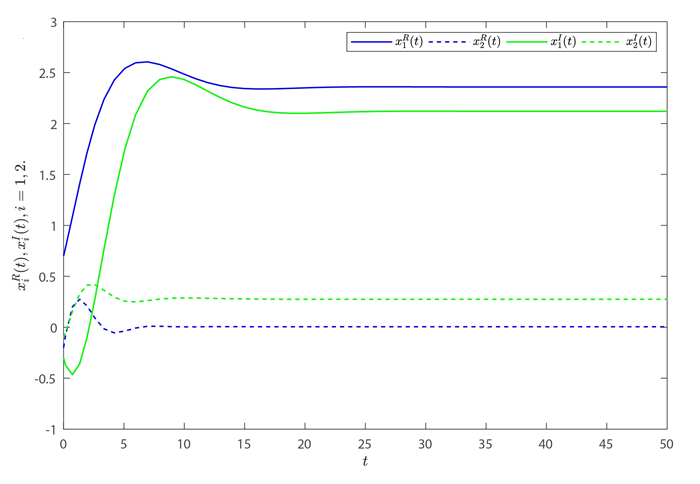
Figure 1.
Trajectory diagram of the state variables
$ x_{i}^{R}(t) $ $ x_{i}^{I}(t) $ -
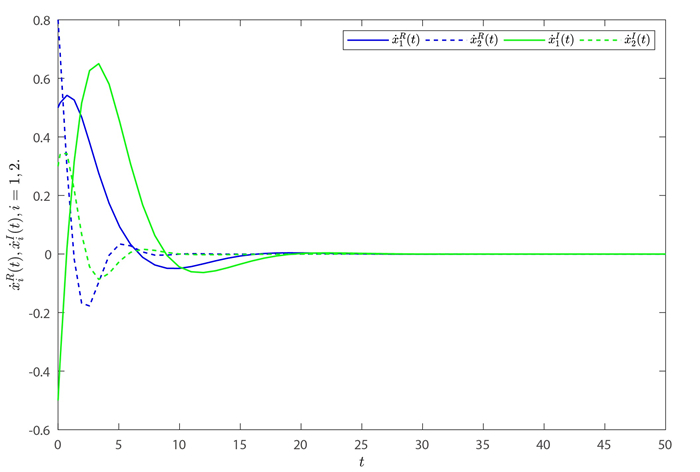
Figure 2.
Trajectory diagram of the first-order state variables
$ \dot{x}_{i}^{R}(t) $ $ \dot{x}_{i}^{I}(t) $ -
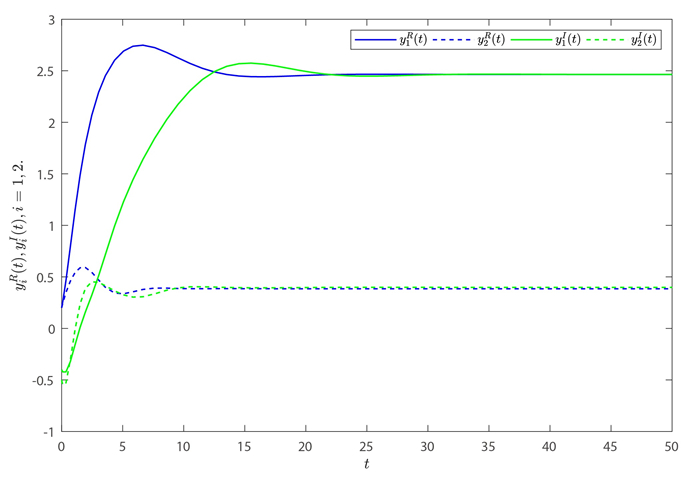
Figure 3.
Trajectory diagram of the state variables
$ y_{i}^{R}(t) $ $ y_{i}^{I}(t) $ -
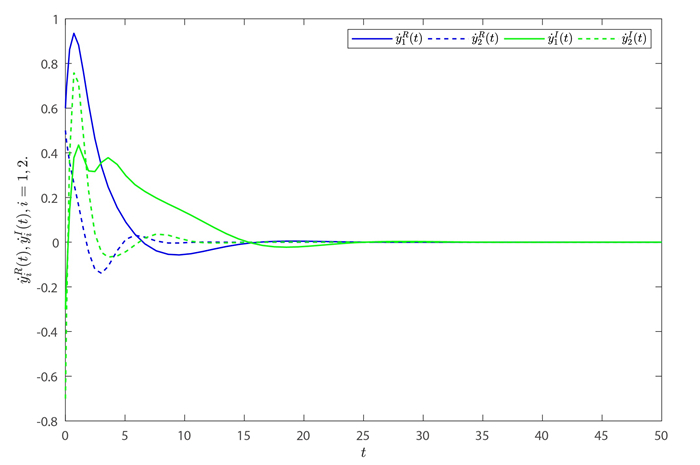
Figure 4.
Trajectory diagram of the first-order state variables
$ \dot{y}_{i}^{R}(t) $ $ \dot{y}_{i}^{I}(t) $ -
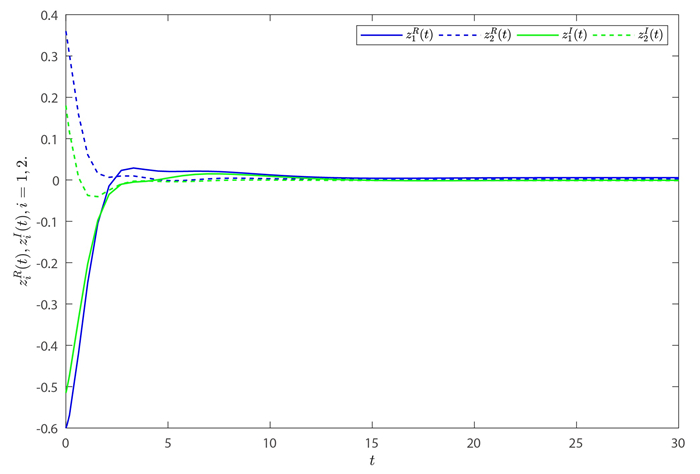
Figure 5.
Trajectory diagram of the state variables
$ z_{i}^{R}(t) $ $ z_{i}^{I}(t) $ -
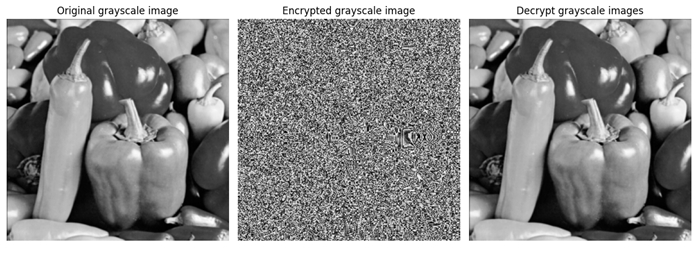
Figure 6.
Original image, encrypted image, decrypted image.
-
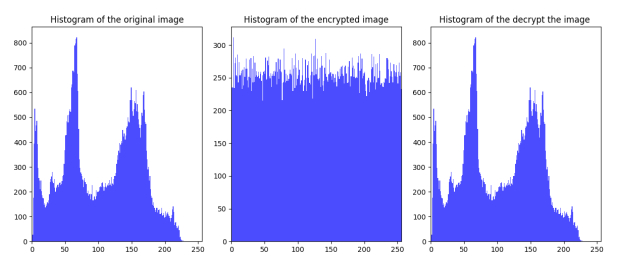
Figure 7.
The histograms corresponding to the original image and the encrypted image.
-
Figure 8.
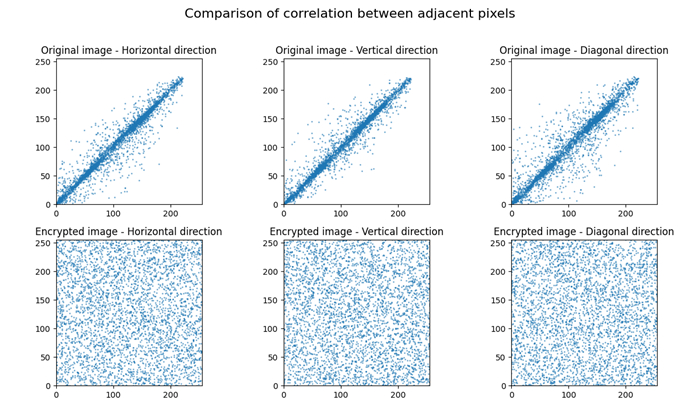
The correlation between the original image and the encrypted image in the horizontal, vertical, and diagonal directions.