

| Citation: |
Zhennan Hu, Zhong Li, Fengde Chen, Mengxin He. DYNAMICS OF A LESLIE-GOWER PREDATOR-PREY MODEL WITH SMITH GROWTH AND ALLEE EFFECT[J]. Journal of Applied Analysis & Computation, 2026, 16(4): 1884-1922. doi: 10.11948/20250264

|
DYNAMICS OF A LESLIE-GOWER PREDATOR-PREY MODEL WITH SMITH GROWTH AND ALLEE EFFECT
-
Abstract
In this paper, considering constant environment and changing environment, we study the bifurcation and transient dynamics of a Leslie-Gower predator-prey model incorporating Smith growth and Allee effect. In a constant environment, we show that the origin is an attractor, and the system admits at most two positive equilibria: One is a saddle and the other can be a weak focus of order four. The unique equilibrium is a saddle-node or a cusp of codimension three. As system parameters vary, the system undergoes a sequence of bifurcations, including saddle-node bifurcations, degenerate Bogdanov-Takens bifurcations of codimension three, and a degenerate Hopf bifurcation of codimension four. In a changing environment, by comparing these transient dynamics with the bifurcation structure of the corresponding constant environment system. We show that the system has rich transient dynamics, such as tracking of unstable equilibria or limit cycles, delay or avoid extinction, and slow and fast regime shifts. We show that low Smith growth or Allee effect is conducive to the stable coexistence of species, while the high Smith growth or Allee effect can eventually lead to the extinction of species.
-
Keywords:
- Leslie-Gower /
- Allee effect /
- Smith growth /
- bifurcation /
- changing environment
-

-
References
[1] W. C. Allee, Animal aggregations, The Quarterly Review of Biology, 1927, 2, 367–398. doi: 10.1086/394281 [2] R. Arumugam, F. Guichard and F. Lutscher, Persistence and extinction dynamics driven by the rate of environmental change in a predator–prey metacommunity, Theoretical Ecology, 2020, 13, 629–643. doi: 10.1007/s12080-020-00473-8 [3] R. Arumugam, F. Lutscher and F. Guichard, Tracking unstable states: Ecosystem dynamics in a changing world, Oikos, 2021, 130, 525–540. doi: 10.1111/oik.08051 [4] D. Bai, J. Zheng and Y. Kang, Global dynamics of a predator–prey model with a Smith growth function and additive predation in prey, Discrete and Continuous Dynamical Systems–B, 2024, 29, 1923–1960. doi: 10.3934/dcdsb.2023161 [5] J. Cao, L. Ma and P. Hao, Bifurcation analysis in a modified Leslie–Gower predator–prey model with Beddington–DeAngelis functional response, Journal of Applied Analysis & Computation, 2023, 13, 3026–3053. [6] Q. Cao, X. Bao and X. Yi, Dynamics of a predator–prey model with Allee effect and herd behavior, Journal of Nonlinear Modeling and Analysis, 2024, 6, 392–412. [7] X. Chen and W. Yang, Complex dynamical behaviors of a Leslie–Gower predator–prey model with herd behavior, Journal of Nonlinear Modeling and Analysis, 2024, 6, 1064–1082. [8] X. Chen and W. Zhang, Decomposition of algebraic sets and applications to weak centers of cubic systems, Journal of Computational and Applied Mathematics, 2009, 232, 565–581. doi: 10.1016/j.cam.2009.06.029 [9] F. Dumortier, R. Roussarie and J. Sotomayor, Generic 3-parameter families of vector fields on the plane, unfolding a singularity with nilpotent linear part. The cusp case of codimension three, Ergodic Theory and Dynamical Systems, 1987, 7, 375–413. doi: 10.1017/S0143385700004119 [10] X. Feng, X. Liu, C. Sun and Y. Jiang, Stability and Hopf bifurcation of a modified Leslie–Gower predator–prey model with Smith growth rate and Beddington–DeAngelis functional response, Chaos, Solitons & Fractals, 2023, 174, 113794. [11] X. Fu and H. Jiang, Turing–Hopf bifurcation in a diffusive predator–prey model with schooling behavior and Smith growth, Applied Mathematics Letters, 2025, 159, 109257. doi: 10.1016/j.aml.2024.109257 [12] M. He and Z. Li, Global dynamics of a Leslie–Gower predator–prey model with square root response function, Applied Mathematics Letters, 2023, 140, 108561. doi: 10.1016/j.aml.2022.108561 [13] J. Huang, Y. Gong and J. Chen, Multiple bifurcations in a predator–prey system of Holling and Leslie type with constant-yield prey harvesting, International Journal of Bifurcation and Chaos, 2013, 23, 1350164. doi: 10.1142/S0218127413501642 [14] J. Huang, Y. Gong and S. Ruan, Bifurcation analysis in a predator–prey model with constant-yield predator harvesting, Discrete and Continuous Dynamical Systems–B, 2013, 18(8), 2101–2121. doi: 10.3934/dcdsb.2013.18.2101 [15] J. Huang, M. Lu, C. Xiang and L. Zou, Bifurcations of codimension four in a Leslie-type predator–prey model with Allee effects, Journal of Differential Equations, 2025, 414, 201–241. doi: 10.1016/j.jde.2024.09.009 [16] J. Huang, S. Ruan and J. Song, Bifurcations in a predator–prey system of Leslie type with generalized Holling type Ⅲ functional response, Journal of Differential Equations, 2014, 257(6), 1721–1752. doi: 10.1016/j.jde.2014.04.024 [17] N. Martinez-Jeraldo and A. Pablo, Allee effect acting on the prey species in a Leslie–Gower predation model, Nonlinear Analysis: Real World Applications, 2019, 45, 895–917. doi: 10.1016/j.nonrwa.2018.08.009 [18] A. Korobeinikov, A Lyapunov function for Leslie–Gower predator–prey models, Applied Mathematics Letters, 2001, 14, 697–699. doi: 10.1016/S0893-9659(01)80029-X [19] V. Kumar, Pattern formation and delay-induced instability in a Leslie–Gower type prey–predator system with Smith growth function, Mathematics and Computers in Simulation, 2024, 225, 78–97. doi: 10.1016/j.matcom.2024.05.004 [20] P. H. Leslie, Some further notes on the use of matrices in population mathematics, Biometrika, 1948, 35, 213–245. doi: 10.1093/biomet/35.3-4.213 [21] P. H. Leslie, A stochastic model for studying the properties of certain biological systems by numerical methods, Biometrika, 1958, 45, 16–31. doi: 10.1093/biomet/45.1-2.16 [22] S. Li, S. Yuan, Z. Jin and H. Wang, Bifurcation analysis in a diffusive predator–prey model with spatial memory of prey, Allee effect and maturation delay of predator, Journal of Differential Equations, 2023, 357, 32–63. doi: 10.1016/j.jde.2023.02.009 [23] Y. Li, M. He and Z. Li, Dynamics of a ratio-dependent Leslie–Gower predator–prey model with Allee effect and fear effect, Mathematics and Computers in Simulation, 2022, 201, 417–439. doi: 10.1016/j.matcom.2022.05.017 [24] Z. Li and M. He, Hopf bifurcation in a delayed food-limited model with feedback control, Nonlinear Dynamics, 2014, 76, 1215–1224. doi: 10.1007/s11071-013-1205-0 [25] Y. Liu, Z. Zhang and Z. Li, The impact of Allee effect on a Leslie–Gower predator–prey model with hunting cooperation, Qualitative Theory of Dynamical Systems, 2024, 23, 88. doi: 10.1007/s12346-023-00940-7 [26] M. Lu, J. Huang and H. Wang, An organizing center of codimension four in a predator–prey model with generalist predator: From tristability and quadristability to transients in a nonlinear environmental change, SIAM Journal on Applied Dynamical Systems, 2023, 22, 694–729. doi: 10.1137/22M1488466 [27] M. Lu, C. Xiang, J. Huang and S. Ruan, Dynamics of the generalized Rosenzweig–MacArthur model in a changing and patchy environment, Physica D: Nonlinear Phenomena, 2024, 465, 134197. doi: 10.1016/j.physd.2024.134197 [28] Z. Lu, B. He, Y. Lou and L. Pan, An algorithm of real root isolation for polynomial systems with application to the construction of limit cycles, Symbolic–Numeric Computation, 2007, 232, 131–147. [29] Y. Ma and R. Yang, Bifurcation analysis in a modified Leslie–Gower model with nonlocal competition and Beddington–DeAngelis functional response, Journal of Applied Analysis & Computation, 2025, 15, 2152–2184. [30] E. González-Olivares, J. Mena-Lorca, A. Rojas-Palma and J. D. Flores, Dynamical complexities in the Leslie–Gower predator–prey model as consequences of the Allee effect on prey, Applied Mathematical Modelling, 2011, 35, 366–381. doi: 10.1016/j.apm.2010.07.001 [31] D. Pal, D. Kesh and D. Mukherjee, Pattern dynamics in a predator–prey model with Smith growth function and prey refuge in predator poisoned environment, Chinese Journal of Physics, 2024, 92, 366–386. doi: 10.1016/j.cjph.2024.09.015 [32] P. J. Pallav and K. M. Prashanta, Bifurcation analysis of a modified Leslie–Gower predator–prey model with Beddington–DeAngelis functional response and strong Allee effect, Mathematics and Computers in Simulation, 2014, 97, 123–146. doi: 10.1016/j.matcom.2013.08.007 [33] L. Perko, Differential Equations and Dynamical Systems, Springer, New York, 1996. [34] F. E. Smith, Population dynamics in Daphnia magna and a new model for population growth, Ecology, 1963, 44, 651–663. doi: 10.2307/1933011 [35] Y. Tian and Y. Pei, An explicit recursive formula for computing the normal forms associated with semisimple cases, Communications in Nonlinear Science and Numerical Simulation, 2014, 19, 2294–2308. doi: 10.1016/j.cnsns.2013.11.019 [36] Y. Tian and Y. Pei, An explicit recursive formula for computing the normal form and center manifold of general $n$-dimensional differential systems associated with Hopf bifurcation, International Journal of Bifurcation and Chaos, 2013, 23, 1350104. doi: 10.1142/S0218127413501046 [37] H. Wu, Z. Li and M. He, Bifurcation analysis of a Holling–Tanner model with generalist predator and constant-yield harvesting, International Journal of Bifurcation and Chaos, 2024, 34, 2450076. doi: 10.1142/S0218127424500767 [38] C. Xiang, J. Huang and H. Wang, Linking bifurcation analysis of Holling–Tanner model with generalist predator to a changing environment, Studies in Applied Mathematics, 2022, 149, 124–163. doi: 10.1111/sapm.12492 [39] W. Yin, Z. Li, F. Chen and X. He, Modeling Allee effect in the Leslie–Gower predator–prey system incorporating a prey refuge, International Journal of Bifurcation and Chaos, 2022, 32, 2250086. doi: 10.1142/S0218127422500869 [40] M. Zhang, Z. Li, F. Chen and L. Chen, Bifurcation analysis of a Leslie–Gower predator–prey model with Allee effect on predator and simplified Holling type Ⅳ functional response, Qualitative Theory of Dynamical Systems, 2025, 24, 131. doi: 10.1007/s12346-025-01291-1 [41] Z. Zhang, T. Ding, W. Huang and Z. Dong, Qualitative Theory of Differential Equations, American Mathematical Society, 1992. -
-
Figures(17) / Tables(1)

Export File
Citation
Zhennan Hu, Zhong Li, Fengde Chen, Mengxin He. DYNAMICS OF A LESLIE-GOWER PREDATOR-PREY MODEL WITH SMITH GROWTH AND ALLEE EFFECT[J]. Journal of Applied Analysis & Computation, 2026, 16(4): 1884-1922. doi: 10.11948/20250264
Format
Content
 DownLoad:
-
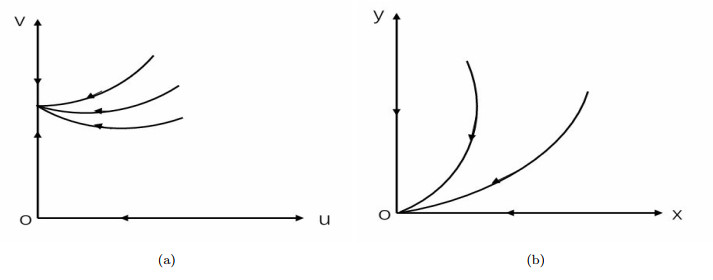
Figure 1.
(a) For system (2.3),
$ (0,0) $ $ (0,\frac{m+s}{s}) $ -
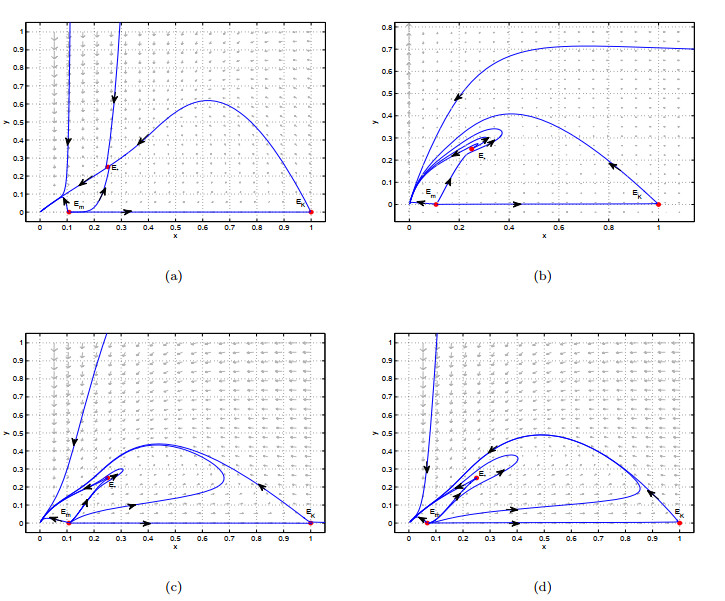
Figure 2.
(a)
$ {E_*} $ $ m=\frac{3}{28},\,q=\frac{1}{4},\,s=\frac{1}{2},\,a=\frac{20}{7} $ $ {E_*} $ $ m=\frac{3}{28},\,q=\frac{1}{4},\,s=\frac{1}{30},\,a=\frac{20}{7} $ $ {E_*} $ $ m=\frac{3}{28},\,q=\frac{1}{4},\,s=\frac{1}{16},\,a=\frac{20}{7} $ $ {E_*} $ $ m=\frac{3}{44},\,q=\frac{23}{44},\,s=\frac{23}{176},\,a=\frac{4}{23} $ -
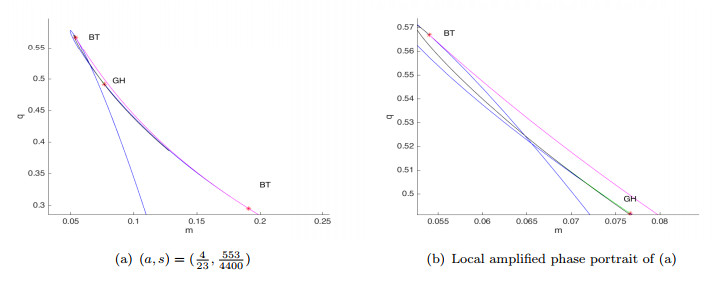
Figure 3.
Bifurcation diagram of cusp type degenerate Bogdanov-Takens bifurcation of codimension 3 for system (2.1) in the (
$ m,q $ -
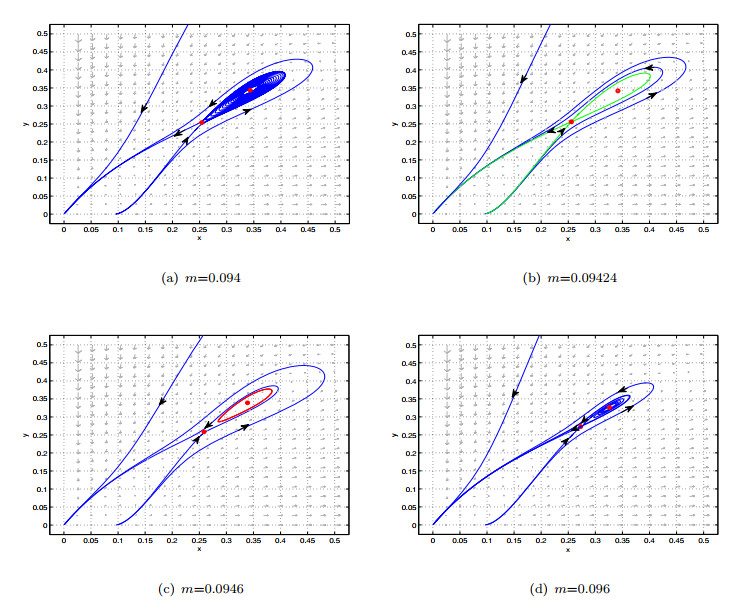
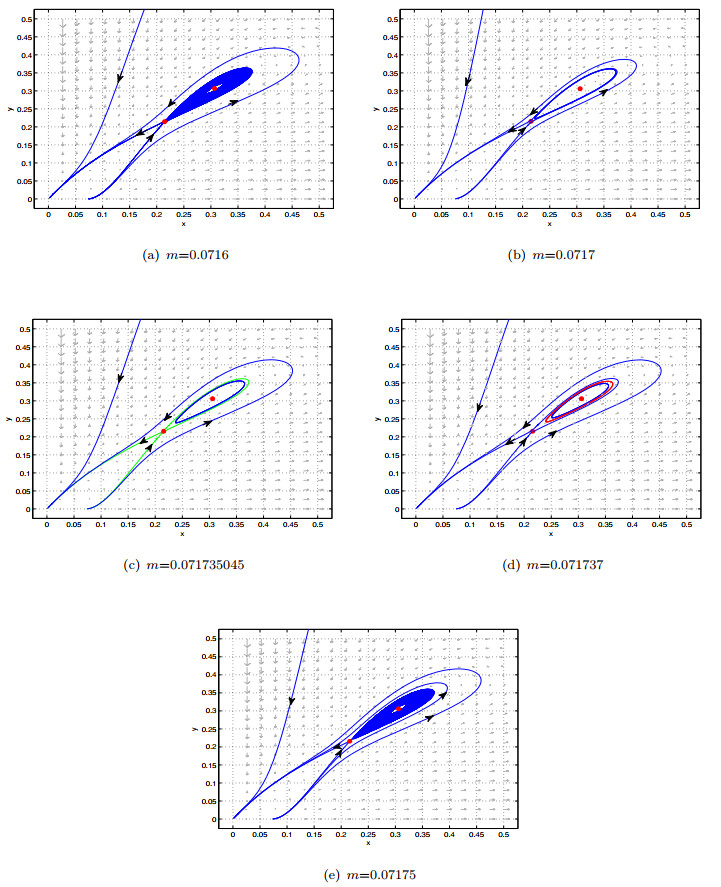
Figure 4.
Phase portraits of system (2.1) with
$ (a, s,q) = \left( \frac{4}{23}, \frac{553}{4400},0.45\right) $ -
Figure 5.
Phase portraits of system (2.1) with
$ (a, s,q) = \left( \frac{4}{23}, \frac{553}{4400},0.5045 \right) $ -
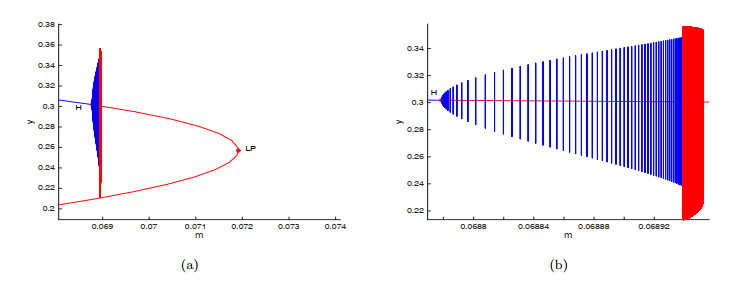
Figure 6.
(a) Bifurcation diagram of system (2.1) in the
$ (m,y) $ $ (a, q, s)=(0.17391,0.5122,0.12568) $ -
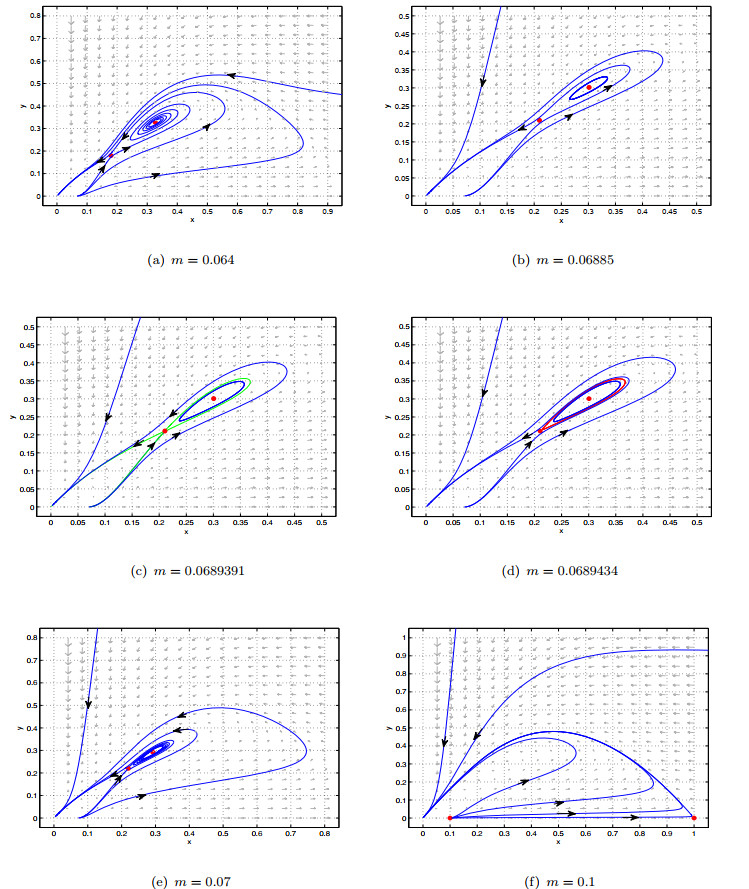
Figure 7.
Phase portraits of system (2.1) with
$ a=0.17391,q=0.5122,s=0.12568 $ -
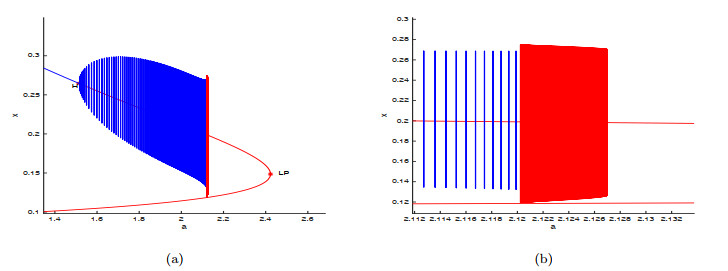
Figure 8.
(a) Bifurcation diagram in the
$ (a,x) $ $ (m,q,s)=(0.04534,0.435, $ $ 0.06455) $ -
Figure 9.
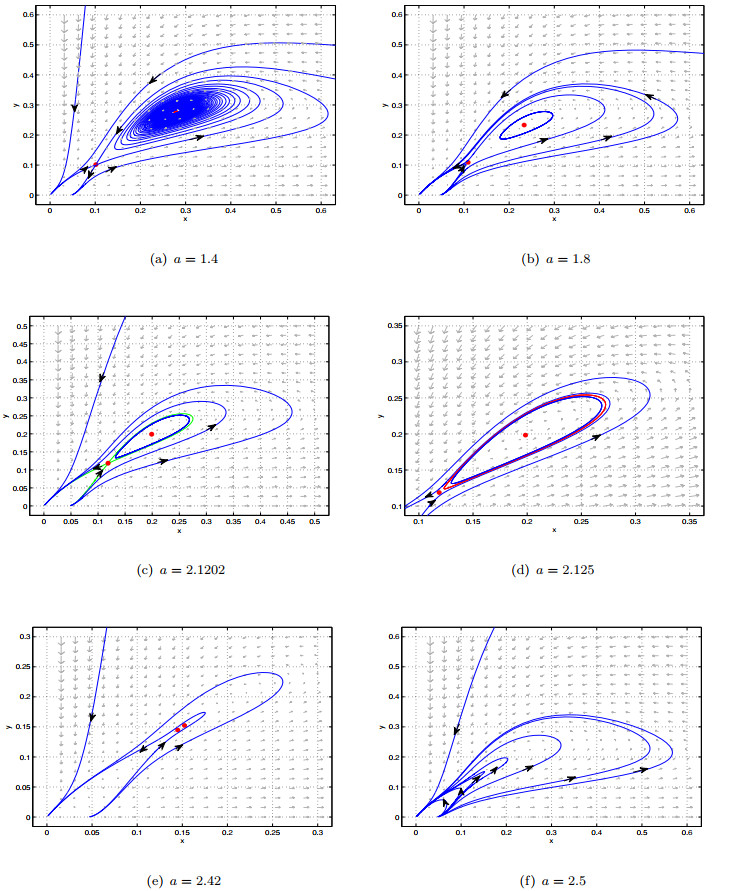
Phase portraits of system (2.1) with
$ (m,q,s)=(0.04534,0.435,0.06455) $ -
Figure 10.
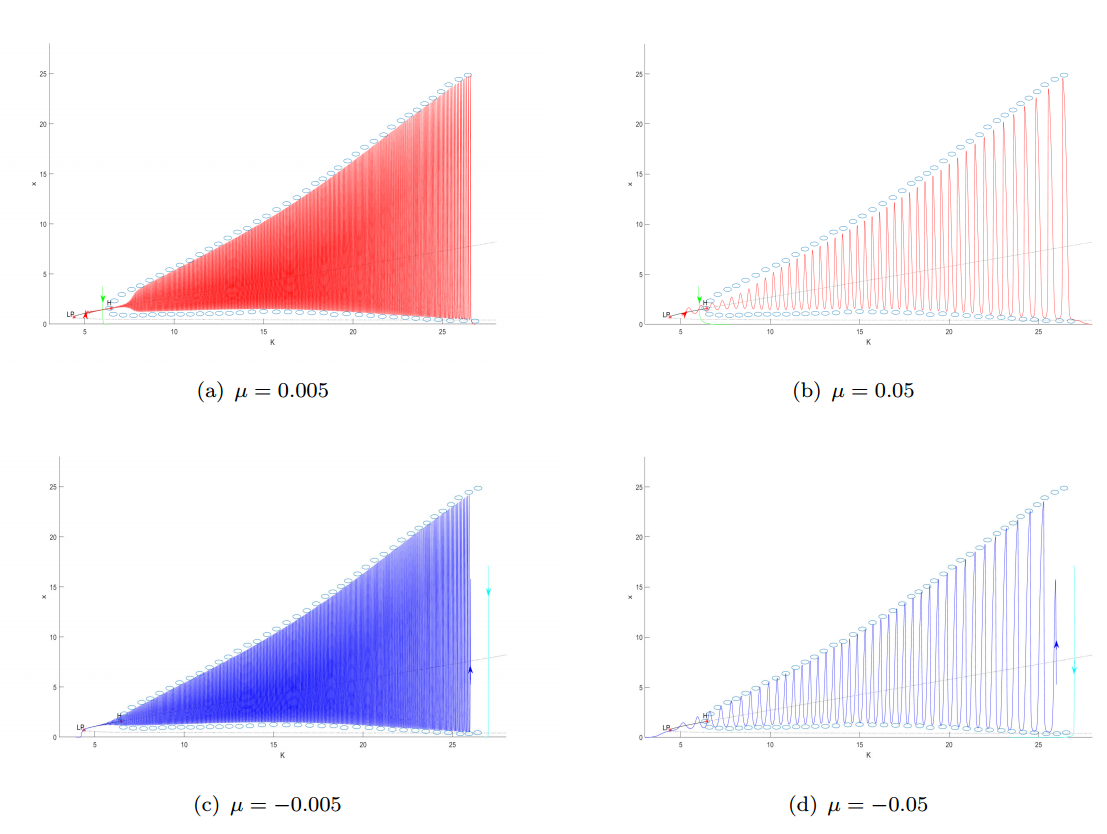
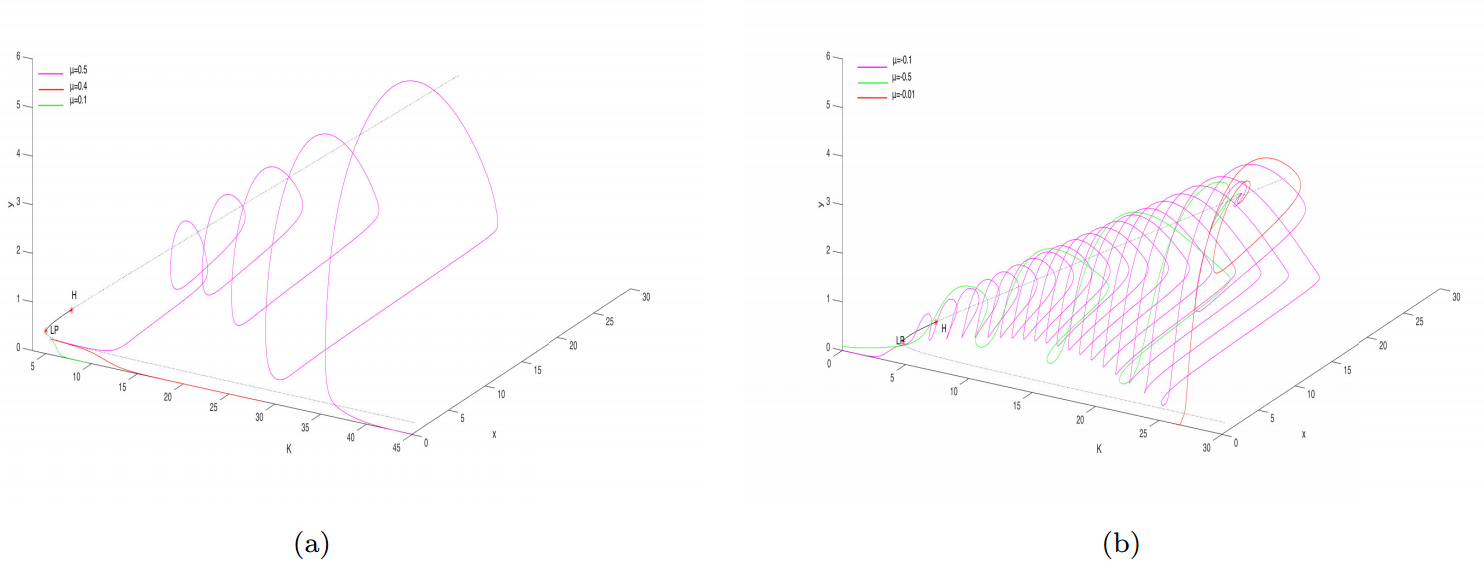
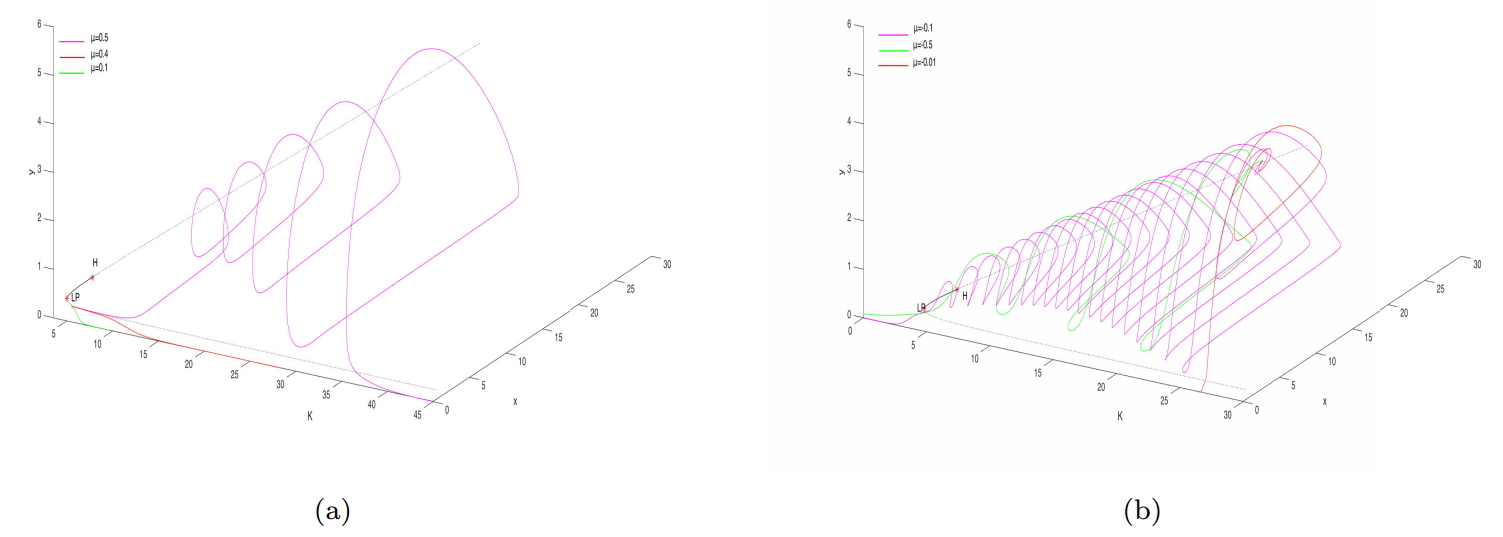
Dynamics in system (1.4) for different rate of environmental change with
$ n=0.5 $ $ s=0.525 $ $ m=0.225 $ $ q=1.3 $ $ r=1.5 $ $ a=2 $ $ (x(0),y(0),K(0))=(4,2,6),\, (0.8,0.4,5),\, (5,2.5,26) $ $ (18,9,27) $ -
Figure 11.
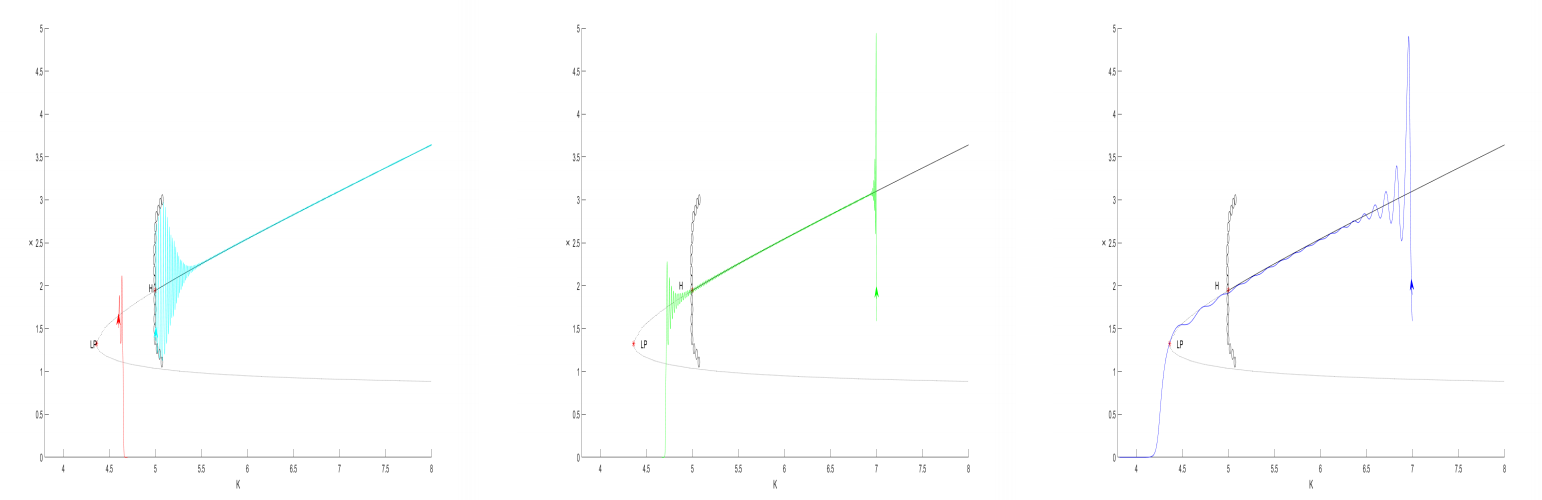
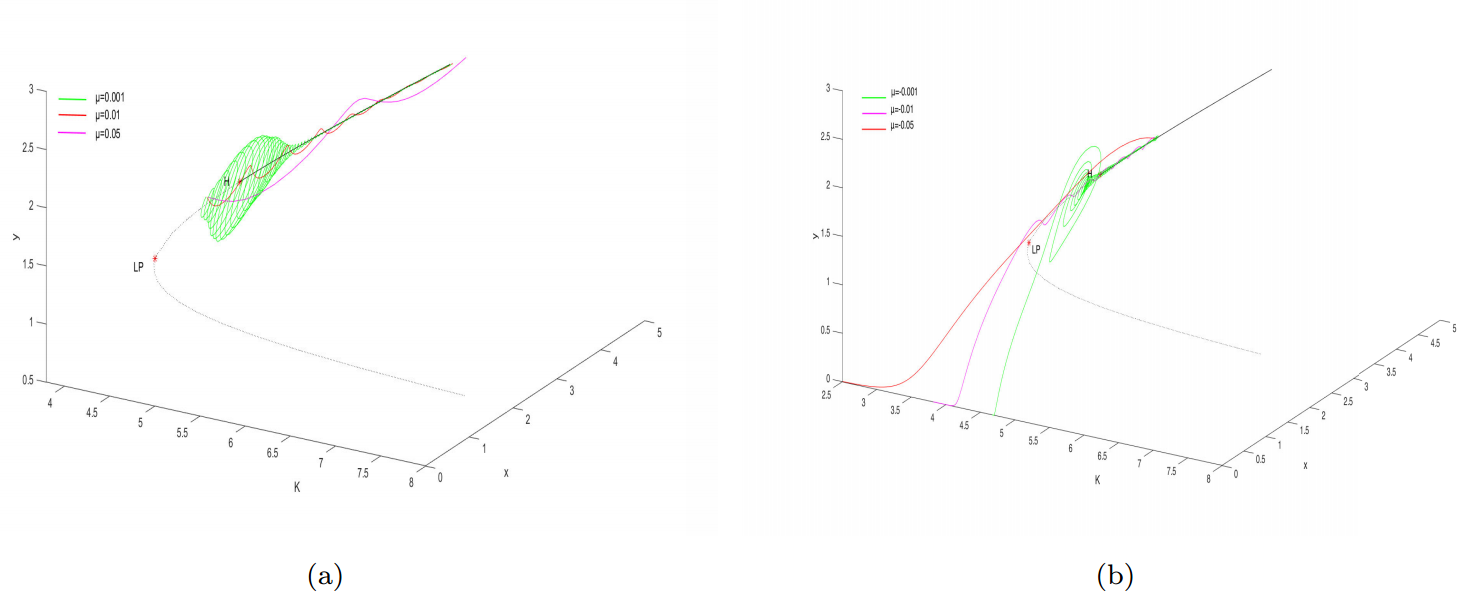
Dynamics of system (1.4) for different rates of environmental change with
$ n=1 $ $ s=0.176133 $ $ m=0.5 $ $ q=0.18 $ $ r=0.5 $ $ a=0.67211 $ $ (x(0),y(0),K(0))=(1.5,1.5,4.6),\,(1.5,1.5,5) $ $ (x(0),y(0),K(0))=(1.5,1.5,7) $ -
Figure 12.
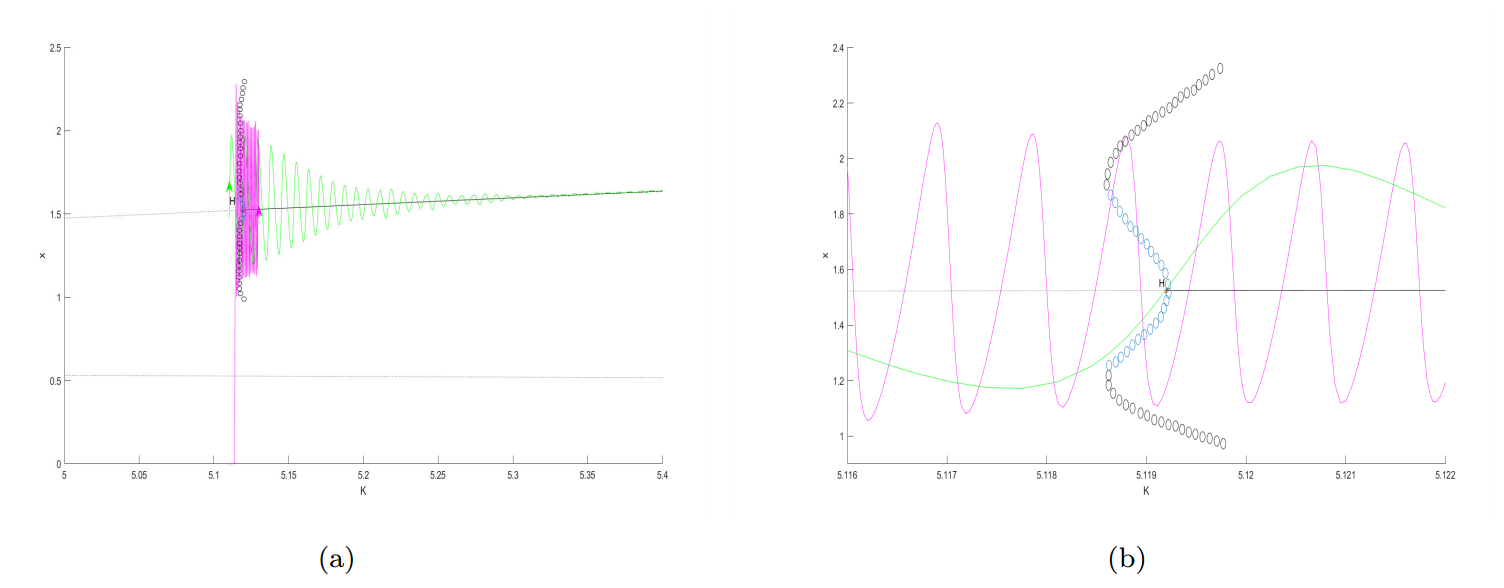
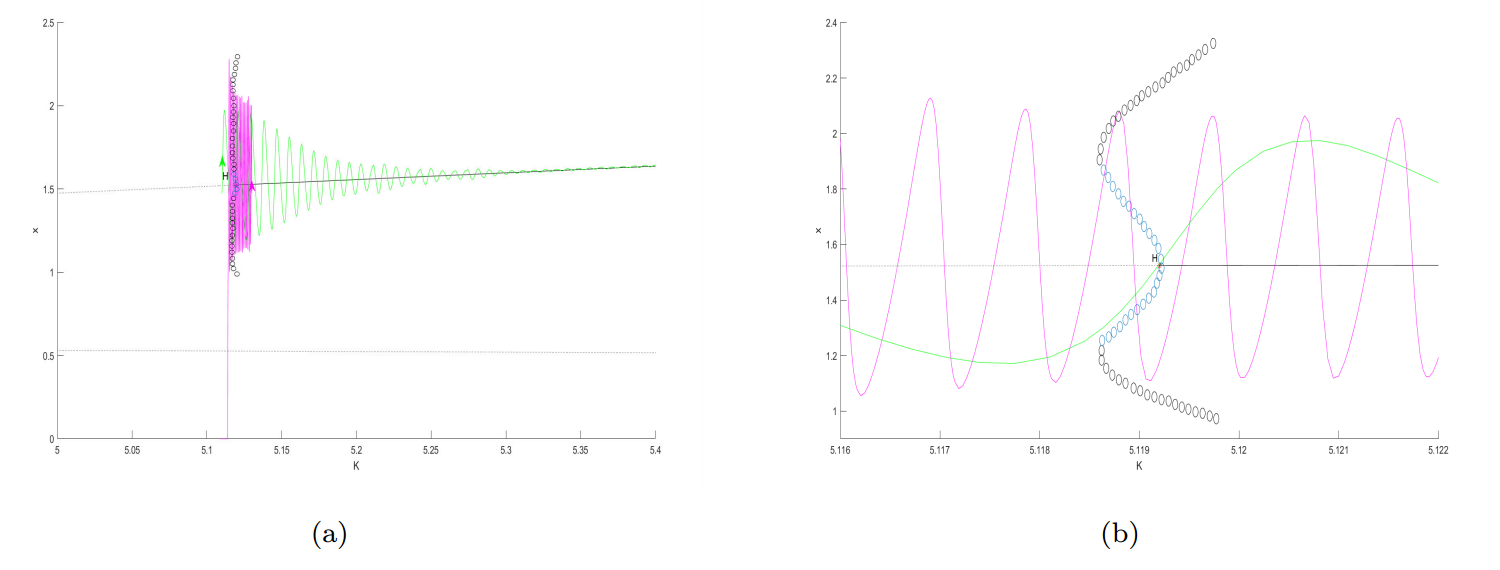
Dynamics of system (1.4) for different rate of environmental change
$ \mu $ $ \mu=0.00005 $ $ \mu=-0.000005 $ $ n=1 $ $ s=0.0016 $ $ m=0.4 $ $ q=0.0268 $ $ r=0.483 $ $ a=28 $ -
Figure 13.
Dynamics of system (1.4) in
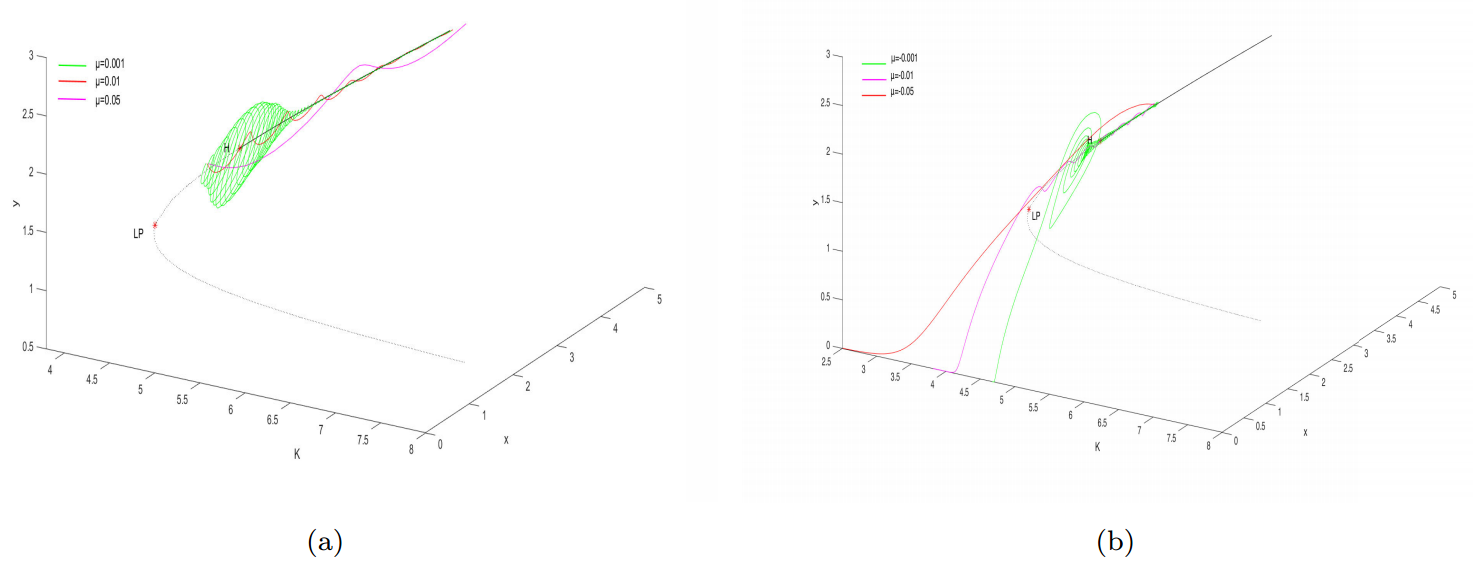
$ K $ $ x $ $ y $ $ \mu $ $ n=0.5 $ $ s=0.525 $ $ m=0.225 $ $ q=1.3 $ $ r=1.5 $ $ a=2 $ $ (x(0),y(0),K(0))=(0.5,0.25,4.9) $ $ (x(0),y(0),K(0))=(8,4,27) $ -
Figure 14.
Dynamics of system (1.4) in
$ K $ $ x $ $ y $ $ \mu $ $ n=1 $ $ s=0.176133 $ $ m=0.5 $ $ q=0.18 $ $ r=0.5 $ $ a=0.67211 $ $ (x(0),y(0),K(0))=(1.8,1.8,4.7) $ $ (x(0),y(0),K(0))=(2.3,2.3,5.6) $ -
Figure 15.
Dynamics of system (1.4) for different rate of environmental change
$ \mu $ $ \mu=0.00005 $ $ \mu=-0.000005 $ $ n=1 $ $ s=0.0016 $ $ m=0.4 $ $ q=0.0268 $ $ r=0.483 $ $ a=28 $ -
Figure 16.
Dynamics of system (1.4) in
$ K $ $ x $ $ y $ $ \mu $ $ n=0.5 $ $ s=0.525 $ $ m=0.225 $ $ q=1.3 $ $ r=1.5 $ $ a=2 $ $ (x(0),y(0),K(0))=(0.5,0.25,4.9) $ $ (x(0),y(0),K(0))=(8,4,27) $ -
Figure 17.
Dynamics of system (1.4) in
$ K $ $ x $ $ y $ $ \mu $ $ n=1 $ $ s=0.176133 $ $ m=0.5 $ $ q=0.18 $ $ r=0.5 $ $ a=0.67211 $ $ (x(0),y(0),K(0))=(1.8,1.8,4.7) $ $ (x(0),y(0),K(0))=(2.3,2.3,5.6) $