

| Citation: |
Wenjie Gu, Qianqian Zheng, Jianwei Shen. INSTABILITY-DRIVEN PATTERN FORMATION IN A NETWORK SIR MODEL WITH INDIRECT TRANSMISSION AND QUASI-LAPLACIAN DIFFUSION[J]. Journal of Applied Analysis & Computation, 2026, 16(4): 1860-1883. doi: 10.11948/20250348

|
INSTABILITY-DRIVEN PATTERN FORMATION IN A NETWORK SIR MODEL WITH INDIRECT TRANSMISSION AND QUASI-LAPLACIAN DIFFUSION
-
Abstract
This study investigates how indirect transmission and diffusion asymmetry shape epidemic dynamics in a network-organized SIR model. Using linear stability analysis and eigenmode decomposition, we derive explicit conditions for Hopf bifurcation, Turing instability, and their interaction. The results show that indirect transmission significantly shifts epidemic thresholds, while asymmetric diffusion across network nodes promotes the activation of additional eigenmodes and the emergence of spatially heterogeneous infection patterns. Numerical simulations on random and quasi-Laplacian networks reveal transitions among stable equilibria, periodic outbreaks, and mixed Hopf-Turing regimes, with the specific pattern determined jointly by biological parameters and network topology. To validate the theory, the model was calibrated using real influenza surveillance data from 44 countries. The observed periodicity and spatial clustering closely match the model predictions, demonstrating that instability-driven mechanisms can explain real-world influenza oscillations and heterogeneity. These findings provide a unified theoretical and data-supported framework for understanding epidemic pattern formation and designing interventions that target indirect transmission and mobility-induced spatial instabilities.
-

-
References
[1] R. M. Anderson and R. M. May, Infectious Diseases of Humans: Dynamics and Control, Oxford Univ. Press, 1991. [2] M. Asllani, J. D. Challenger, F. S. Pavone, L. Sacconi and D. Fanelli, The theory of pattern formation on directed networks, Nat. Commun., 2014, 5, 4517. doi: 10.1038/ncomms5517 [3] M. Chen and X. Li, Stability analysis and Turing pattern of an enzyme-catalyzed reaction model, Nonlinear Anal. Real World Appl., 2025, 94(1), 195–214. [4] W. Gou, Z. Jin and H. Wang, Hopf bifurcation for general network-organized reaction-diffusion systems and its application in a multi-patch predator-prey system, J. Differ. Eqs., 2023, 346, 64–107. doi: 10.1016/j.jde.2022.11.026 [5] R. Khan, I. L. Popa, E. A. A. Ismail and others, Deterministic and fractional-order modeling of measles dynamics with harmonic mean incidence rate and quarantine impact, Sci. Rep., 2025, 15, 30597. doi: 10.1038/s41598-025-15253-9 [6] Y. A. Kuznetsov, Elements of Applied Bifurcation Theory, Springer, New York, 1995. [7] N. M. Manshouri, Identifying COVID-19 by using spectral analysis of cough recordings: A distinctive classification study, Cogn. Neurodyn., 2022, 16(1), 239–253. doi: 10.1007/s11571-021-09695-w [8] H. Nakao and A. S. Mikhailov, Turing patterns in network-organized activator-inhibitor systems, Nat. Phys., 2010, 6, 544–550. doi: 10.1038/nphys1651 [9] L. Pei, Prediction of numbers of the accumulative confirmed patients (NACP) and the plateau phase of 2019-nCoV in China, Cogn. Neurodyn., 2020, 14(3), 411–424. doi: 10.1007/s11571-020-09588-4 [10] L. Pei and M. Zhang, Long-term predictions of current confirmed and dead cases of COVID-19 in China by the non-autonomous delayed epidemic models, Cogn. Neurodyn., 2022, 16(1), 229–238. doi: 10.1007/s11571-021-09701-1 [11] A. M. Turing, The chemical basis of morphogenesis, Philos. Trans. R. Soc. B, 1952, 237, 37–72. [12] Z. Wang, C. Xia, Z. Chen and G. Chen, Epidemic propagation with positive and negative preventive information in multiplex networks, IEEE Trans. Cybern., 2021, 51(3), 1454–1462. doi: 10.1109/TCYB.2019.2960605 [13] S. Zhai, J. Zhang, J. Ma and Z. Xiang, Cluster synchronization of individuals during an epidemic: A contraction-based analysis, IEEE Trans. Syst. Man Cybern. Syst., 2025, 55(10), 6868–6878. doi: 10.1109/TSMC.2025.3585121 [14] H. Zhang, J. Gao, C. Gu, C. Shen and H. Yang, Transition and coexistence of Turing pattern, Turing-like pattern and spiral waves in a discrete-time predator-prey model, Chaos Solitons Fractals, 2024, 189, 115591. doi: 10.1016/j.chaos.2024.115591 [15] X. Zhang and Z. Liu, Hopf bifurcation for a susceptible-infective model with infection-age structure, J. Nonlinear Sci., 2020, 30, 317–367. doi: 10.1007/s00332-019-09575-y [16] Y. Zhang, S. Ruan and T. Zhang, Turing-Hopf bifurcation in diffusive epidemic models, J. Differ. Eqs., 2017, 263(12), 8541–8576. [17] Y. Zhang and X. Wu, Dynamic behavior and sliding mode control on a stochastic epidemic model with alertness and distributed delay, Commun. Nonlinear Sci. Numer. Simul., 2023, 124, 107299. doi: 10.1016/j.cnsns.2023.107299 [18] Q. Zheng and others, Pattern dynamics in the epidemic model with diffusion network, EPL, 2022, 137, 42002. doi: 10.1209/0295-5075/ac58bd [19] Q. Zheng and others, Network topology and double delays in Turing instability and pattern formation, J. Phys. A: Math. Theor., 2024, 57, 395203. doi: 10.1088/1751-8121/ad75d7 [20] Q. Zheng and others, Pattern selection mechanism from the equilibrium point and limit cycle, Chaos, 2024, 34, 023124. doi: 10.1063/5.0187810 [21] Q. Zheng and others, Spatiotemporal dynamics of periodic waves in SIR model with driving factors, New J. Phys., 2023, 25, 063028. doi: 10.1088/1367-2630/acdb91 [22] Q. Zheng, J. Shen, V. Pandey, L. Guan and Y. Guo, Turing instability in a network-organized epidemic model with delay, Chaos Solitons Fractals, 2023, 168, 113205. doi: 10.1016/j.chaos.2023.113205 [23] L. Zhu, Y. Ding and S. Shen, Green behavior propagation analysis based on statistical theory and intelligent algorithm in data-driven environment, Math. Biosci., 2025, 379, 109340. doi: 10.1016/j.mbs.2024.109340 [24] L. Zhu, G. Guan and Y. Li, Nonlinear dynamical analysis and control strategies of a network-based SIS epidemic model with time delay, Appl. Math. Model., 2019, 70, 512–531. doi: 10.1016/j.apm.2019.01.037 [25] L. Zhu and Y. Li, Dynamic propagation and control of a West Nile virus model based on higher-order temporal network structure, Phys. Rev. E, 2025, 112, 044409. doi: 10.1103/xwt2-f1d3 [26] L. Zhu, Y. Li, L. He and S. Shen, Pattern formation of network epidemic model and its application in oral medicine, Comput. Methods Programs Biomed., 2025, 264, 108688. doi: 10.1016/j.cmpb.2025.108688 [27] L. Zhu and T. Zheng, Pattern dynamics analysis and application of West Nile virus spatiotemporal models based on higher-order network topology, Bull. Math. Biol., 2025, 87, 121. doi: 10.1007/s11538-025-01501-6 -
-
Figures(9)

Export File
Citation
Wenjie Gu, Qianqian Zheng, Jianwei Shen. INSTABILITY-DRIVEN PATTERN FORMATION IN A NETWORK SIR MODEL WITH INDIRECT TRANSMISSION AND QUASI-LAPLACIAN DIFFUSION[J]. Journal of Applied Analysis & Computation, 2026, 16(4): 1860-1883. doi: 10.11948/20250348
Format
Content
 DownLoad:
-
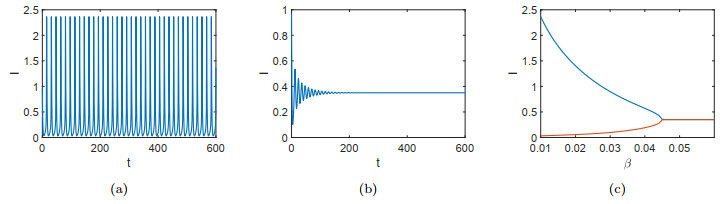
Figure 1.
The stability of system (2.1) without network. (a) Hopf bifurcation occurs and system is periodic when
$ \beta=0.01 $ $ \beta=0.05 $ $ \beta $ -
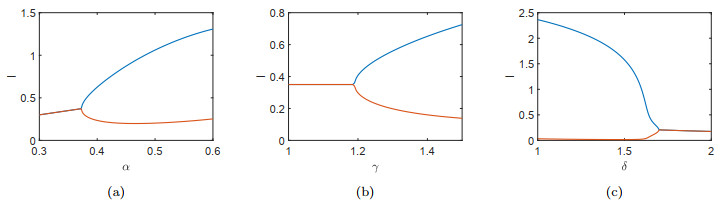
Figure 2.
The bifurcation of system (2.1) without network. (a) The bifurcation about
$ \alpha $ $ \gamma $ $ \delta $ -
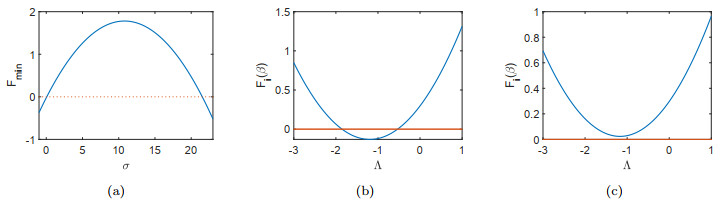
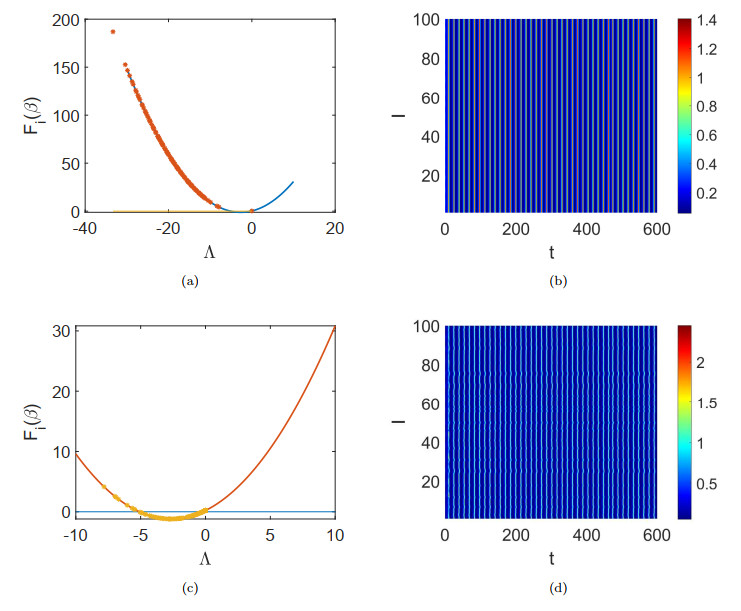
Figure 3.
The instability condition of system (2.1). (a) The minimum with
$ \sigma=\frac{d_S}{d_I} $ $ F_i(\beta) $ $ \Lambda $ $ d_S=3,d_I=0.1 $ $ F_i(\beta) $ $ \Lambda $ $ d_S=2,d_I=0.1 $ -
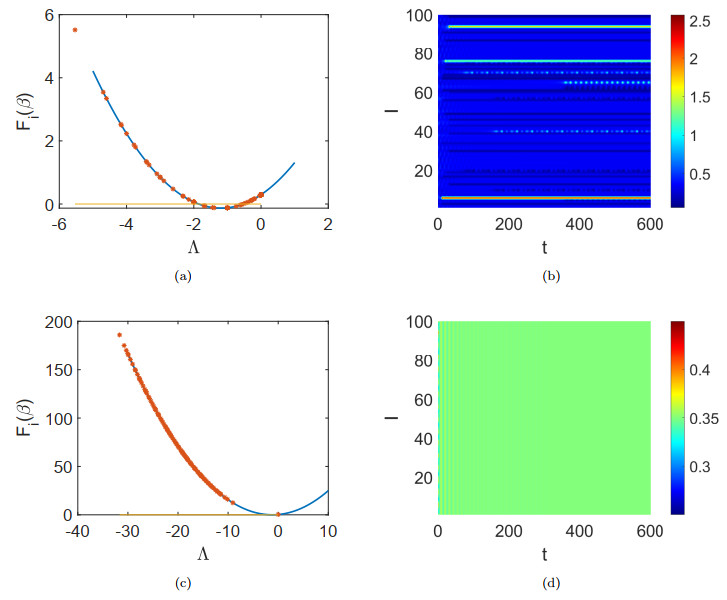
Figure 4.
Turing instability and pattern formation of system (2.1) when
$ d_I=0.1 $ $ \Lambda $ $ d_S=3,p=0.01 $ $ d_S=3,p=0.01 $ $ \Lambda $ $ d_S=2,p=0.2 $ $ d_S=2,p=0.2 $ -
Figure 5.
The instability and pattern formation of system (2.1) when
$ \beta=0.02,d_S=2,d_I=0.1 $ $ \Lambda $ $ p=0.2 $ $ p=0.2 $ $ \Lambda $ $ p=0.02 $ $ p=0.02 $ -
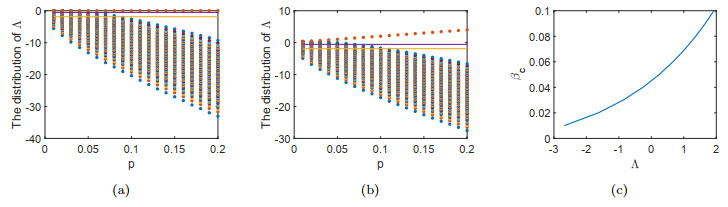
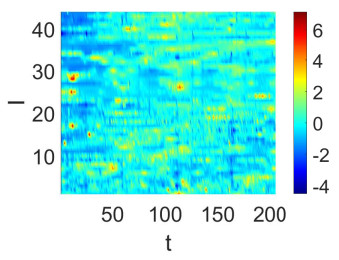
Figure 6.
The distribution of
$ \Lambda $ $ \Lambda $ $ \varepsilon=1 $ $ \Lambda $ $ \varepsilon=0.8 $ $ \Lambda $ $ \beta_c $ -
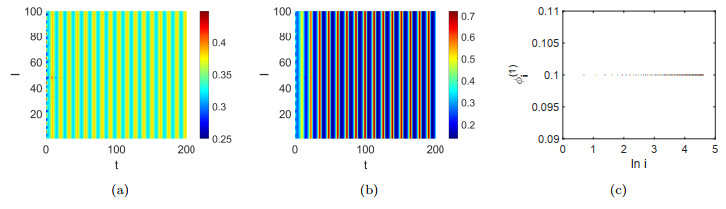
Figure 7.
The pattern formation and the distribution of
$ \phi^{(1)}_i $ $ \varepsilon=1,\beta=0.0449 $ $ Re(c_1(\beta))=-0.0070<0 $ $ \varepsilon=1,\beta=0.035<\beta_c $ $ Re(c_1(\beta))=-0.0038<0 $ $ \phi^{(1)}_i $ $ \varepsilon=1 $ -
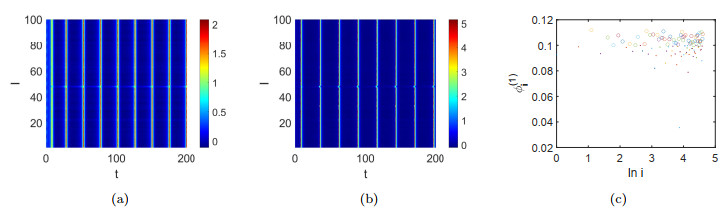
Figure 8.
The pattern formation and the distribution of
$ \phi^{(1)}_i $ $ \varepsilon=0.8,\beta=0.035 $ $ Re(c_1(\beta)) = 0.0017>0 $ $ \varepsilon=0.8,\beta=0.01 $ $ Re(c_1(\beta))=0.0137>0 $ $ \phi^{(1)}_i $ $ \varepsilon=0.8 $ -
Figure 9.
The new confirmed cases about influenza in Africa, Eastern Mediterranean and Western Pacific regions from 11.14.2021 to 10.12.2025. Data source: FluNet (
https://www.who.int/tools/flunet ).