

| Citation: |
He Wang, Haichuan Ma, Luoyi Shi, Yasong Chen. A NOVEL RELAXATION PROJECTION METHOD FOR SOLVING SPLIT EQUALITY PROBLEMS AND ITS APPLICATION IN SIGNAL PROCESSING[J]. Journal of Applied Analysis & Computation, 2026, 16(5): 2751-2770. doi: 10.11948/20260048

|
A NOVEL RELAXATION PROJECTION METHOD FOR SOLVING SPLIT EQUALITY PROBLEMS AND ITS APPLICATION IN SIGNAL PROCESSING
-
Abstract
The split equality problem(SEP) finds significant applications in fields including image reconstruction, language processing, and seismic exploration, all of which often demand real-time processing. Thus, how to effectively enhance the convergence speed of algorithms has long been a core concern for researchers and engineers. To address this challenge, this paper proposes a novel relaxed projection approach for solving the split equality problem in real Hilbert spaces. Specifically, the relaxed projections introduced herein are computed via simple operations at each iteration step. On one hand, the relaxation technique accelerates the algorithm's convergence; on the other hand, it mitigates the computational difficulty associated with general metric projections. Under mild conditions, we analyze the weak convergence of the proposed algorithm. Finally, two numerical experiments, one involving an application to signal recovery and another to image deblurring are conducted to demonstrate the advantages of the proposed method over a recently developed related algorithm.
-

-
References
[1] H. Bauschke and P. Combettes, Convex Analysis and Monotone Operator Theory in Hilbert Spaces, Springer, 2011. [2] H. H. Bauschke and J. M. Borwein, On projection algorithms for solving convex feasibility problems, SIAM Review, 1996, 38(3), 367–426. doi: 10.1137/S0036144593251710 [3] C. Byrne, Iterative oblique projection onto convex sets and the split feasibility problem, Inverse Problems, 2002, 18(2), 441. doi: 10.1088/0266-5611/18/2/310 [4] C. Byrne, A unified treatment of some iterative algorithms in signal processing and image reconstruction, Inverse Problems, 2003, 20(1), 103. [5] Y. Censor and T. Elfving, A multiprojection algorithm using bregman projections in a product space, Numerical Algorithms, 1994, 8, 221–239. doi: 10.1007/BF02142692 [6] Y. Censor, T. Elfving, N. Kopf and T. Bortfeld, The multiple-sets split feasibility problem and its applications for inverse problems, Inverse Problems, 2005, 21(6), 2071. doi: 10.1088/0266-5611/21/6/017 [7] S. -S. Chang and R. P. Agarwal, Strong convergence theorems of general split equality problems for quasi-nonexpansive mappings, Journal of Inequalities and Applications, 2014, 2014(1), 367. doi: 10.1186/1029-242X-2014-367 [8] Y. Dang, J. Sun and H. Xu, Inertial accelerated algorithms for solving a split feasibility problem, Journal of Industrial and Management Optimization, 2017, 13(3), 1383–1394. doi: 10.3934/jimo.2016078 [9] Q. -L. Dong, S. He and J. Zhao, Solving the split equality problem without prior knowledge of operator norms, Optimization, 2015, 64(9), 1887–1906. doi: 10.1080/02331934.2014.895897 [10] B. Halpern, Fixed points of nonexpanding maps, Bulletin of the American Mathematical Society, 1967, 957–961. [11] S. He and C. Yang, Solving the variational inequality problem defined on intersection of finite level sets, Abstr. Appl. Anal, 2013, 1–8. [12] V. T. Huong, H. -K. Xu and N. D. Yen, Stability analysis of split equality and split feasibility problems, Journal of Global Optimization, 2025, 92(2), 411–429. doi: 10.1007/s10898-025-01469-6 [13] A. Moudafi, A relaxed alternating CQ-algorithm for convex feasibility problems, Nonlinear Analysis: Theory, Methods and Applications, 2013, 79, 117–121. [14] A. Moudafi, Alternating CQ-algorithms for convex feasibility and split fixed-point problems, J. Nonlinear Convex. Anal., 2014, 15(4), 809–818. [15] B. OuYang, Y. Wang, X. Ju and W. Yu, Neurodynamic optimization algorithm for split equality problems and application to sparse signal recovery, Communications in Nonlinear Science and Numerical Simulation, 2025, 147, 108822. doi: 10.1016/j.cnsns.2025.108822 [16] D. Qiaoli, Y. Peng and Y. Yao, Alternated inertial projection methods for the split equality problem, J. Nonlinear Convex. Anal., 2021, 22(1), 53–67. [17] B. Qu and N. Xiu, A note on the CQ algorithm for the split feasibility problem, Inverse Problems, 2005, 21(5), 1655. doi: 10.1088/0266-5611/21/5/009 [18] S. Reich and T. M. Tuyen, A new approach to solving split equality problems in Hilbert spaces, Optimization, 2022, 71(15), 4423–4445. doi: 10.1080/02331934.2021.1945053 [19] L. Y. Shi, R. Chen and Y. Wu, Strong convergence of iterative algorithms for the split equality problem, Journal of Inequalities and Applications, 2014, 2014(1), 478. doi: 10.1186/1029-242X-2014-478 [20] T. Tian, L. Shi and R. Chen, Linear convergence of the relaxed gradient projection algorithm for solving the split equality problems in Hilbert spaces, Journal of Inequalities and Applications, 2019, 2019(1), 80. doi: 10.1186/s13660-019-2026-6 [21] T. M. Tuyen, Regularization methods for the split equality problems in Hilbert spaces, Bulletin of the Malaysian Mathematical Sciences Society, 2022, 46(1), 44–46. [22] T. M. Tuyen and N. S. Ha, Explicit iterative algorithms for solving the split equality problems in Hilbert spaces, Optimization Letters, 2025, 19(5), 931–954. doi: 10.1007/s11590-024-02144-7 [23] P. T. Vuong, J. J. Strodiot and V. H. Nguyen, A gradient projection method for solving split equality and split feasibility problems in Hilbert spaces, Optimization, 2015, 64(11), 2321–2341. doi: 10.1080/02331934.2014.967237 [24] Y. Wang, X. Li and B. Jiang, Two new inertial relaxed gradient CQ algorithms on the split equality problem, Journal of Applied Analysis & Computation, 2022, 12(1), 436–454. [25] H. -K. Xu, A variable Krasnosel'skii-Mann algorithm and the multiple-set split feasibility problem, Inverse Problems, 2006, 22(6), 2021. doi: 10.1088/0266-5611/22/6/007 [26] Q. Yang, The relaxed CQ algorithm solving the split feasibility problem, Inverse Problems, 2004, 20(4), 1261. doi: 10.1088/0266-5611/20/4/014 [27] Q. Yang and J. Zhao, Generalized KM theorems and their applications, Inverse Problems, 2006, 22(3), 833. doi: 10.1088/0266-5611/22/3/006 -
-
Figures(5) / Tables(5)

Export File
Citation
He Wang, Haichuan Ma, Luoyi Shi, Yasong Chen. A NOVEL RELAXATION PROJECTION METHOD FOR SOLVING SPLIT EQUALITY PROBLEMS AND ITS APPLICATION IN SIGNAL PROCESSING[J]. Journal of Applied Analysis & Computation, 2026, 16(5): 2751-2770. doi: 10.11948/20260048
Format
Content
 DownLoad:
-
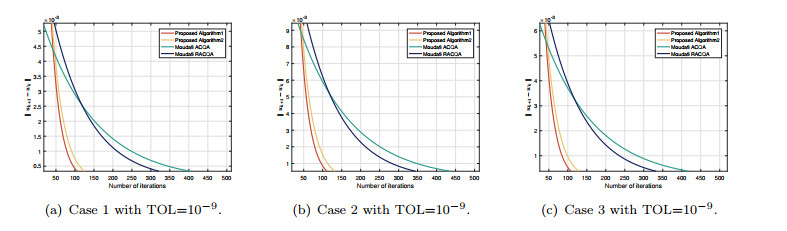
Figure 1.
From left to right:
$ {\text{Case}} $ -
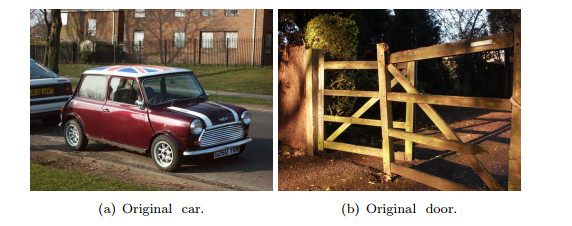
Figure 2.
Original images.
-
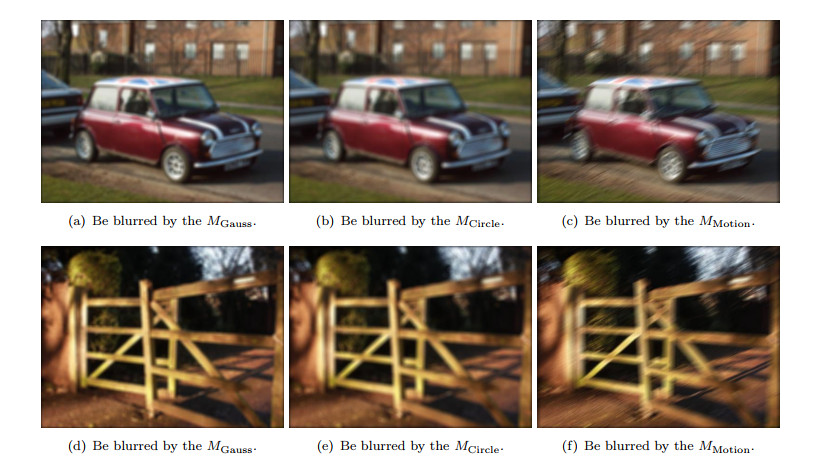
Figure 3.
Images that have been blurred by the matrices
$ M_{\text{Gauss}} $ $ M_{\text{Circle}} $ $ M_{\text{Motion}} $ -
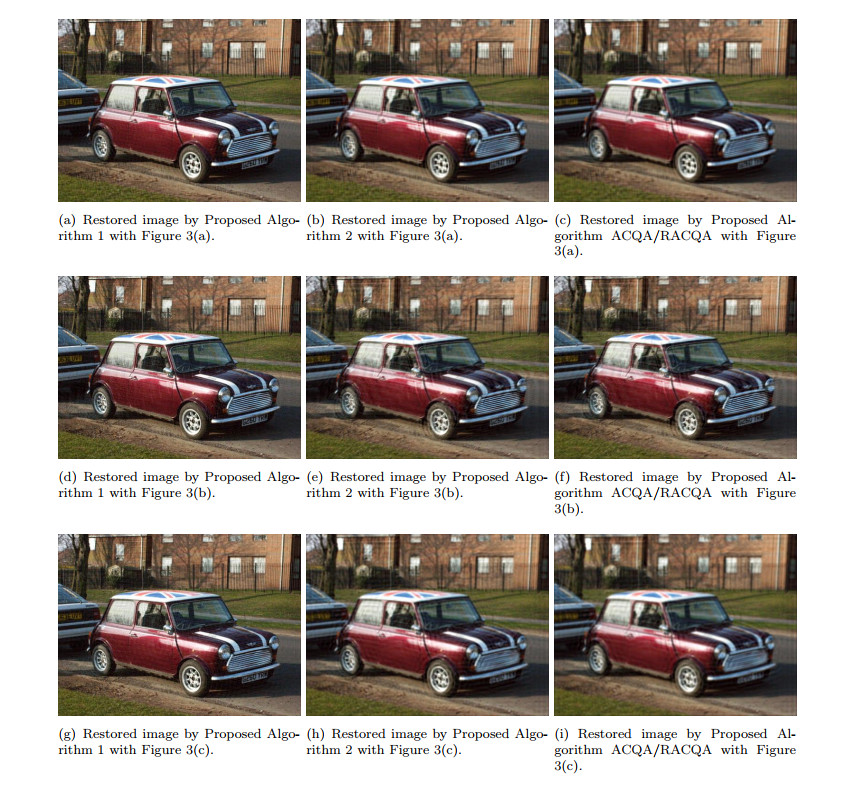
Figure 4.
Images that have been restored by the Proposed Algorithm 1, Algorithm 2 and Modafi ACQA/RACQA, where the oringinal image is Car.tif and all the algorithm's iteration number k=3200.
-
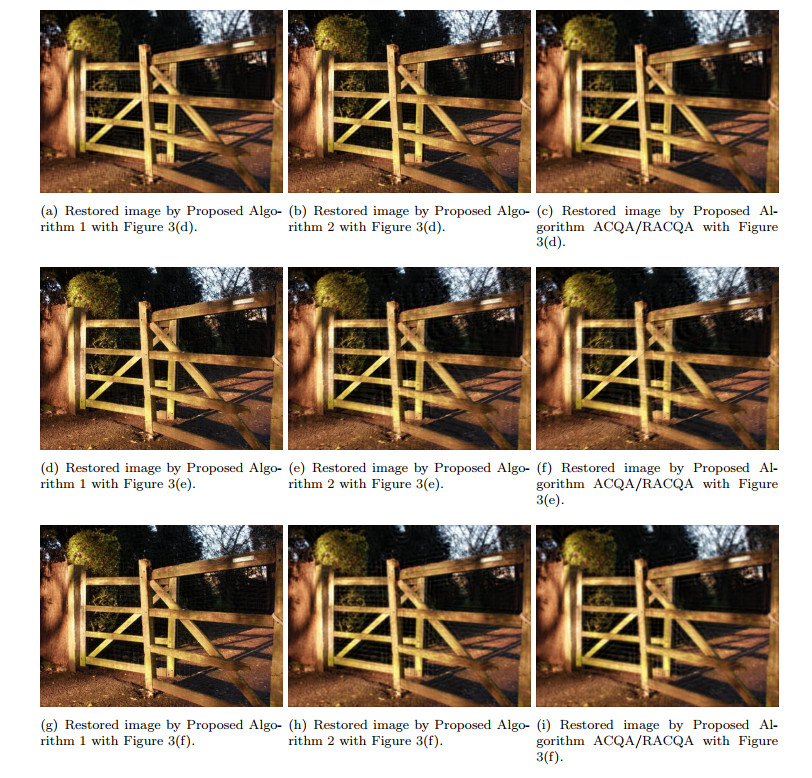
Figure 5.
Images that have been restored by the Proposed Algorithm 1, Algorithm 2 and Modafi ACQA/RACQA, where the oringinal image is Door.tif and all the algorithm's iteration number k=3200.