

| Citation: |
Yuxuan Yang, Li Xu. BIFURCATION ANALYSIS AND CHAOS CONTROL FOR A DISCRETE SPACE–TIME LOKTA–VOLTERRA DIFFUSION EQUATION WITH NEUMANN BOUNDARY CONDITIONS[J]. Journal of Applied Analysis & Computation, 2027, 17(2): 1623-1648. doi: 10.11948/20260099

|
BIFURCATION ANALYSIS AND CHAOS CONTROL FOR A DISCRETE SPACE–TIME LOKTA–VOLTERRA DIFFUSION EQUATION WITH NEUMANN BOUNDARY CONDITIONS
-
Abstract
This paper investigates a discrete Lotka–Volterra competition diffusion system subject to Neumann boundary conditions. By employing normal form theory and center manifold reduction, we show that the system exhibits a flip bifurcation at the unique positive equilibrium, whereas neither a Neimark–Sacker nor a fold bifurcation is observed, moreover, a Turing bifurcation is identified. To regulate the bifurcation behavior, both direct and indirect state feedback control strategies are implemented. Under appropriate parameter conditions, these control schemes effectively stabilize the system by suppressing chaos and bifurcation-induced instabilities. Extensive numerical simulations are conducted to validate the theoretical results. The bifurcation analysis framework developed herein is generalizable to other discrete diffusion systems with different boundary configurations.
-
Keywords:
- Bifurcation /
- chaos control /
- stability /
- center manifold reduction
-

-
References
[1] E. Beretta, V. Capasso and F. Rinaldi, Global stability results for a generalized Lotka Volterra system with distributed delays: Applications to predator–prey and to epidemic systems, J. Math. Biol., 1988, 26, 661–688. doi: 10.1007/BF00276147 [2] M. Biswas and N. Bairagi, On the dynamic consistency of a two-species competitive discrete system with toxicity: Local and global analysis, J. Comput. Appl. Math., 2020, 33, 145–155. [3] D. M. Chen and X. Y. Li, Complex bifurcation phenomena seized in a discrete ratio–dependent Holling–Tanner predator–prey system, Adv. Contin. Discrete Models, 2024, 2024, 58. doi: 10.1186/s13662-024-03855-y [4] Q. Din, Complexity and chaos control in a discrete-time prey–predator model, Commun. Nonlinear Sci. Numer. Simul., 2017, 49, 113–134. doi: 10.1016/j.cnsns.2017.01.025 [5] X. X. Du and X. L. Han, Dynamics analysis of a discrete diffusion predator–prey model with prey refuge, J. Comput. Appl. Math., 2025, 470, 116706. doi: 10.1016/j.cam.2025.116706 [6] H. Fort, Lotka-Volterra at 100: How predator-prey modeling became a universal framework, Ecol. Model., 2025, 508, 111237. doi: 10.1016/j.ecolmodel.2025.111237 [7] K. Gopalsamy and P. X. Weng, Feedback regulation of logistic growth, Int. J. Math. Math. Sci., 1993, 16(1), 177–192. doi: 10.1155/S0161171293000213 [8] T. S. Huang, H. Y. Zhang and H. J. Yang, Spatiotemporal complexity of a discrete space-time predator–prey system with self–and cross–diffusion, Appl. Math. Model., 2017, 47, 637–655. doi: 10.1016/j.apm.2017.03.049 [9] M. F. Li, B. Han, L. Xu and G. Zhang, Spiral patterns near Turing instability in a discrete reaction diffusion system, Chaos Solitons Fractals, 2013, 49, 1–6. [10] Y. N. Li, L. L. Liu, Y. J. Chen and Z. H. Yu, Bifurcations and Marotto's chaos of a discrete Lotka–Volterra predator–prey model, Physica D, 2025, 472, 134524. doi: 10.1016/j.physd.2025.134524 [11] P. Z. Liu and S. N. Elaydi, Discrete competitive and cooperative models of Lotka–Volterra type, J. Comput. Anal. Appl., 2001, 3, 53–73. [12] A. J. Lotka, Elements of Physical Biology, Williams and Wilkins, New York, 1925. [13] M. S. Peng, X. Y. Yi and R. R. Cheng, Rich dynamics caused by diffusion, Nonlinear Dyn., 2023, 111, 9201–9213. doi: 10.1007/s11071-023-08307-y [14] A. V. Platonov, Analysis of the dynamical behavior of solutions for a class of hybrid generalized Lotka–Volterra models, Commun. Nonlinear Sci. Numer. Simul., 2023, 119, 107068. doi: 10.1016/j.cnsns.2022.107068 [15] M. Qurban, A. Khaliq, M. Saqib and T. Abdeljawad, Stability, bifurcation, and control: Modeling interaction of the predator-prey system with Alles effect, Ain Shams Eng. J., 2024, 15, 102631. doi: 10.1016/j.asej.2024.102631 [16] S. M. Salman, A. M. Yousef and A. A. Elsadany, Stability, bifurcation analysis and chaos control of a discrete predator–prey system with square root functional response, Chaos Solitons Fractals, 2016, 93, 20–31. doi: 10.1016/j.chaos.2016.09.020 [17] J. G. Skellam, Random dispersal in theoretical populations, Biometrika, 1951, 38, 196–218. doi: 10.1093/biomet/38.1-2.196 [18] Y. Takeuchi, Global Dynamical Properties of Lotka–Volterra Systems, World Scientific Publishing, Singapore, 1996. [19] X. S. Tang, J. X. Shen, X. C. Wang, Z. Y. Zeng and J. W. Zhu, Spatiotemporal dynamics deduced by nonlocal delay competition in a diffusive Lotka–Volterra population model, Comput. Math. Appl., 2025, 196, 172–182. doi: 10.1016/j.camwa.2025.07.008 [20] A. M. Turing, The chemical basis of morphogenesis, Philos. Trans. R. Soc. B, 1953, 237, 37–72. [21] V. Volterra, Variazionie fluttuazioni del numero d' individui in specie animali conviventi, Mem. R. Accad. Naz. Lincei, 1926, 2, 31–113. [22] M. Y. Wen, G. Zhang and Y. B. Yan, Turing instability of a discrete competitive single diffusion–driven Lotka–Volterra model, Chaos Solitons Fractals, 2025, 194, 116146. doi: 10.1016/j.chaos.2025.116146 [23] S. Wiggins, Introduction to Applied Nonlinear Dynamical Systems and Chaos, Springer–Verlag, New York, 2003. [24] L. Xu, Bifurcation analysis for a discrete space–time model of Logistic type, J. Nonlinear Funct. Anal., 2022, 2022, 29. [25] L. Xu, J. Y. Liu and G. Zhang, Pattern formation and parameter inversion for a discrete Lotka–Volterra cooperative system, Chaos Solitons Fractals, 2018, 110, 226–231. doi: 10.1016/j.chaos.2018.03.035 [26] L. Xu, S. S. Lou, P. Q. Xu and G. Zhang, Feedback control and parameter invasion for a discrete competitive Lotka–Volterra system, Discrete Dyn. Nat. Soc., 2018, Article ID 7473208, 8 pp. [27] Y. Yamamoto, T. Yamamoto, T. Kuroiwa, K. Oka, E. Ishiwata and M. Iwasaki, Discrete Lotka–Volterra systems with time delay and its stability analysis, Physica D, 2025, 474, 134562. doi: 10.1016/j.physd.2025.134562 [28] G. Yuan and Q. G. Yang, Bifurcation, invariant curve and hybrid control in a discrete–time predator–prey system, Appl. Math. Model., 2015, 39(8), 2345–2362. doi: 10.1016/j.apm.2014.10.040 [29] G. Zhang, R. Zhang and Y. Yan, The diffusion–driven instability and complexity for a single–handed discrete Fisher equation, Appl. Math. Comput., 2020, 371, 124946. -
-
Figures(8) / Tables(1)
Export File
Citation
Yuxuan Yang, Li Xu. BIFURCATION ANALYSIS AND CHAOS CONTROL FOR A DISCRETE SPACE–TIME LOKTA–VOLTERRA DIFFUSION EQUATION WITH NEUMANN BOUNDARY CONDITIONS[J]. Journal of Applied Analysis & Computation, 2027, 17(2): 1623-1648. doi: 10.11948/20260099
Format
Content
 DownLoad:
-
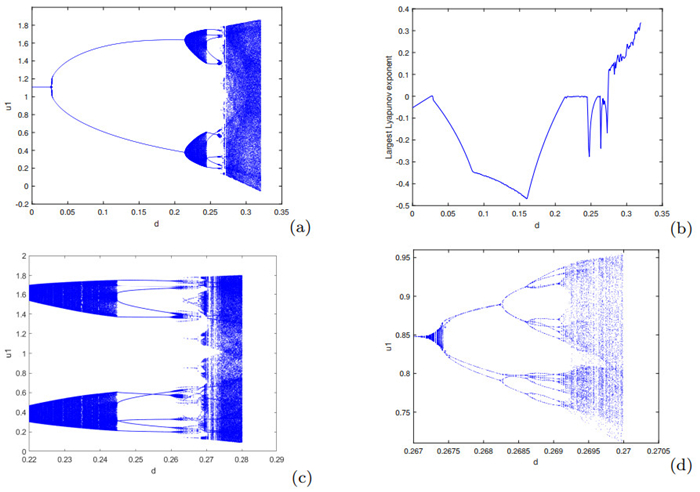
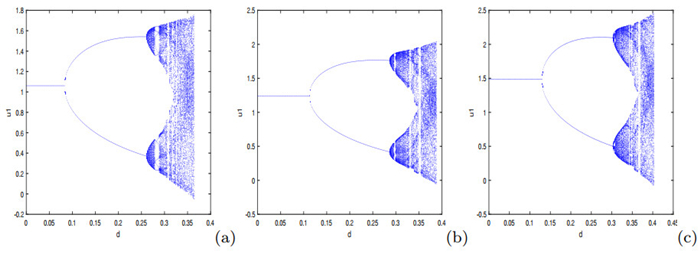
Figure 1.
Flip bifurcation diagram and maximum Lyapunov exponent for
$ u_{1} $ -
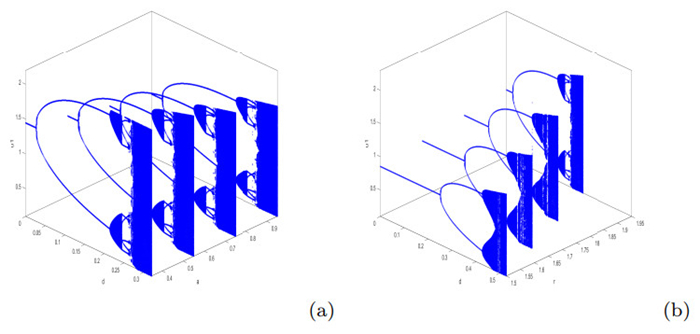
Figure 2.
The 3-dimensional bifurcation diagram for
$ (u_{1},d,a) $ $ (u_{1},d,r) $ -
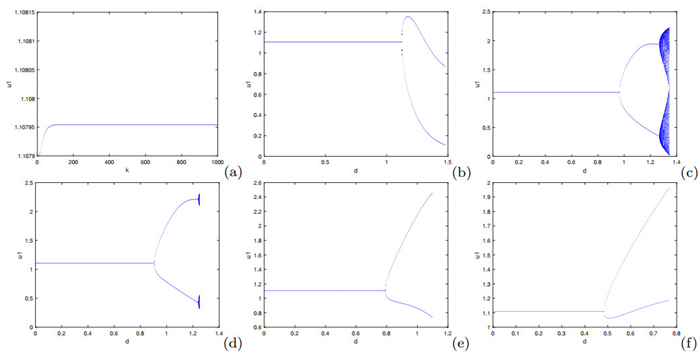
Figure 3.
The sequence diagram or bifurcation diagram on direct control for
$ u_{1} $ $ r=1.95,a=0.76 $ $ s_{1}=0.2,s_{2}=0.2 $ $ s_{1}=0.5,s_{2}=0.45 $ $ s_{1}=0.5,s_{2}=0.53 $ $ s_{1}=0.5,s_{2}=0.56 $ $ s_{1}=0.5,s_{2}=0.62 $ $ s_{1}=0.5, s_{2}=0.82. $ -
Figure 4.
The bifurcation diagram on indirect control for
$ u_{1} $ $ b_{1}=0.1,e_{1}=0.1,e_{2}=0.1,eta _{1}=0.1,\eta _{2}=0.1 $ $ b_{2}=0.11 $ $ b_{2}=0.31 $ $ b_{2}=0.75 $ -
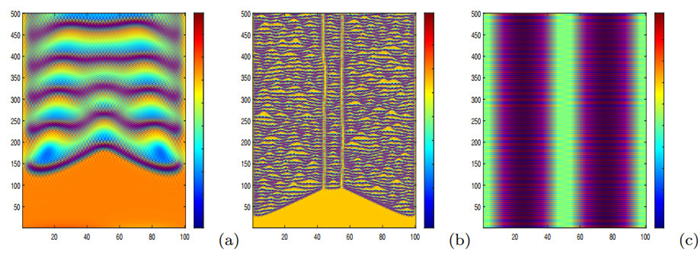
Figure 5.
The selected patterns. (a)
$ r=0.1,a=0.1,d=0.5 $ $ r=1.3,a=0.2,d=0.3 $ $ r=1.99,a=0.3,d=0.01 $ -
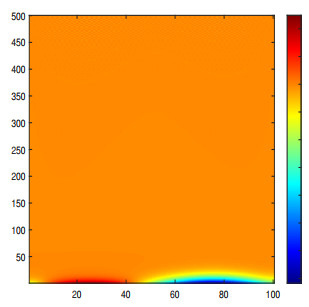
Figure 6.
The stable patterns on direct control when
$ r=0.1,a=0.1,d=0.5 $ $ s_{1}=s_{2}=0.1. $ -
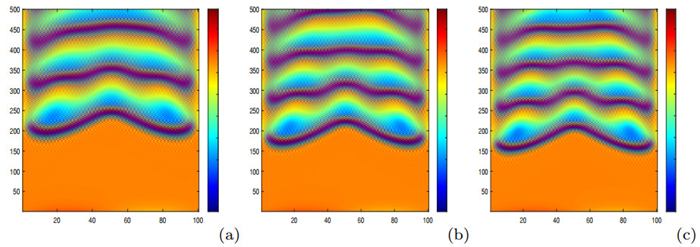
Figure 7.
The selected patterns on direct control when
$ r=0.1,a=0.1,d=0.5 $ $ s_{1}=s_{2}=0.71 $ $ s_{1}=s_{2}=0.81 $ $ s_{1}=s_{2}=0.88 $ -
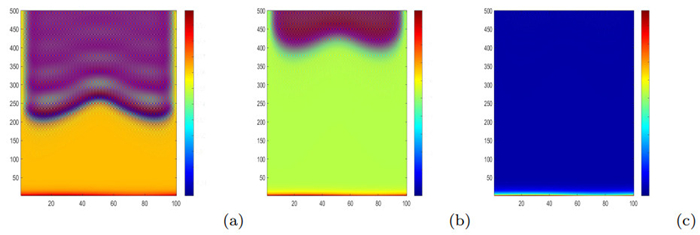
Figure 8.
The selected patterns on indirect control when
$ r=0.1,a=0.1,d=0.5 $