

| Citation: |
Zeyu Xu, Liang Wang, Daqing Jiang. THE THRESHOLD OF A STOCHASTIC SIR EPIDEMIC MODEL WITH LOGISTIC GROWTH[J]. Journal of Applied Analysis & Computation, 2026, 16(3): 1187-1206. doi: 10.11948/20250208

|
THE THRESHOLD OF A STOCHASTIC SIR EPIDEMIC MODEL WITH LOGISTIC GROWTH
-
Abstract
In this paper, we propose and study a stochastic SIR epidemic model with logistic growth. The threshold dynamics of the stochastic model are governed by a parameter $ R_0^S $. Precisely, the disease goes to extinction at an exponential rate and the distribution of susceptible individuals converges weakly to a unique invariant probability measure provided that $ R_0^S<1 $; whereas if $ R_0^S>1 $, we show that there is a unique ergodic stationary distribution of the positive solutions to the model by constructing a suitable stochastic Lyapunov function. Numerical simulations are introduced to illustrate our theoretical results. The aim of the work is to investigate the impact of environmental noise on the transmission of infectious diseases.
-
Keywords:
- SIR epidemic model /
- logistic growth /
- stationary distribution /
- ergodicity /
- extinction /
- threshold
-

-
References
[1] M. Ahmad, A. Zada, M. Ghaderi, R. George and S. Rezapour, On the existence and stability of a neutral stochastic fractional differential system, Fractal Fract., 2022, 6(4), 203. doi: 10.3390/fractalfract6040203 [2] I. Ahmed, G. U. Modu, A. Yusuf, P. Kumam and I. Yusuf, A mathematical model of Coronavirus Disease (COVID-19) containing asymptomatic and symptomatic classes, Results Phys., 2021, 21, 103776. doi: 10.1016/j.rinp.2020.103776 [3] M. H. Akrami and A. Atabaigi, Hopf and forward bifurcation of an integer and fractional-order SIR epidemic model with logistic growth of the susceptible individuals, J. Appl. Math. Comput., 2020, 64(1), 615–633. [4] M. Barczy and G. Pap, Portmanteau theorem for unbounded measures, Stat. Probab. Lett., 2006, 76(17), 1831–1835. doi: 10.1016/j.spl.2006.04.025 [5] J. R. Beddington and R. M. May, Harvesting natural populations in a randomly fluctuating environment, Sci., 1977, 197(4302), 463–465. doi: 10.1126/science.197.4302.463 [6] E. Beretta, V. Kolmanovskii and L. Shaikhet, Stability of epidemic model with time delays influenced by stochastic perturbations, Math. Comput. Simul., 1998, 45(3–4), 269–277. doi: 10.1016/S0378-4754(97)00106-7 [7] Z. Cao, W. Feng, X. Wen and L. Zu, Dynamical behavior of a stochastic SEI epidemic model with saturation incidence and logistic growth, Phys. A, 2019, 523, 894–907. doi: 10.1016/j.physa.2019.04.228 [8] M. Carletti, On the stability properties of a stochastic model for phage-bacteria interaction in open marine environment, Math. Biosci., 2002, 175(2), 117–131. doi: 10.1016/S0025-5564(01)00089-X [9] S. Chávez-Vázquez, J. E. Lavín-Delgado, J. F. Gómez-Aguilar, J. R. Razo-Hernández, S. Etemad and S. Rezapour, Trajectory tracking of Stanford robot manipulator by fractional-order sliding mode control, Appl. Math. Model., 2023, 120, 436–462. doi: 10.1016/j.apm.2023.04.001 [10] N. Dalal, D. Greenhalgh and X. Mao, A stochastic model of AIDS and condom use, J. Math. Anal. Appl., 2007, 325(1), 36–53. doi: 10.1016/j.jmaa.2006.01.055 [11] J. E. Lavín-Delgado, J. E. Solís-Pérez, J. F. Gómez-Aguilar, J. R. Razo-Hernández, S. Etemad and S. Rezapour, An improved object detection algorithm based on the Hessian matrix and conformable derivative, Circuits Syst. Signal Process., 2024, 43(8), 4991–5047. doi: 10.1007/s00034-024-02669-3 [12] A. Din, The stochastic bifurcation analysis and stochastic delayed optimal control for epidemic model with general incidence function, Chaos An Interdiscip. J. Nonlinear Sci., 2021, 31, 123101. doi: 10.1063/5.0063050 [13] N. H. Du, D. H. Nguyen and G. G. Yin, Conditions for permanence and ergodicity of certain stochastic predator-prey models, J. Appl. Probab., 2016, 53(1), 187–202. doi: 10.1017/jpr.2015.18 [14] R. Z. Has'minskii, Stochastic Stability of Differential Equations, Sijthoff and Noordhoff, Alphen aan den Rijn, The Netherlands, 1980. [15] D. J. Higham, An algorithmic introduction to numerical simulation of stochastic differential equations, SIAM Rev., 2001, 43(3), 525–546. doi: 10.1137/S0036144500378302 [16] S. Hussain, E. N. Madi, H. Khan, H. Gulzar, S. Etemad, S. Rezapour and M. K. A. Kaabar, On the stochastic modeling of COVID-19 under the environmental white noise, J. Funct. Spaces, 2022, 2022(1), 4320865. [17] N. Ikeda and S. Watanabe, Stochastic Differential Equations and Diffusion Processes, North-Holland, Amsterdam, 1981. [18] L. Imhof and S. Walcher, Exclusion and persistence in deterministic and stochastic chemostat models, J. Differ. Equ., 2005, 217(1), 26–53. doi: 10.1016/j.jde.2005.06.017 [19] K. A. Kabir, K. Kuga and J. Tanimoto, Analysis of SIR epidemic model with information spreading of awareness, Chaos Solitons Fractals, 2019, 119, 118–125. doi: 10.1016/j.chaos.2018.12.017 [20] T. Kanwal, A. Hussain, İ. Avcı, S. Etemad, S. Rezapour and D. F. M. Torres, Dynamics of a model of polluted lakes via fractal-fractional operators with two different numerical algorithms, Chaos Solitons Fractals, 2024, 181, 114653. doi: 10.1016/j.chaos.2024.114653 [21] W. O. Kermack and A. G. McKendrick, Contributions to the mathematical theory of epidemics–I, Bull. Math. Biol., 1991, 53(1–2), 33–55. [22] H. Khan, K. Alam, H. Gulzar, S. Etemad and S. Rezapour, A case study of fractal-fractional tuberculosis model in China: Existence and stability theories along with numerical simulations, Math. Comput. Simul., 2022, 198, 455–473. doi: 10.1016/j.matcom.2022.03.009 [23] H. Khan, M. Aslam, A. H. Rajpar, Y. M. Chu, S. Etemad, S. Rezapour and H. Ahmad, A new fractal-fractional hybrid model for studying climate change on coastal ecosystems from the mathematical point of view, Fractals, 2024, 32(02), 2440015. doi: 10.1142/S0218348X24400152 [24] H. Khan, A. H. Rajpar, J. Alzabut, M. Aslam, S. Etemad and S. Rezapour. On a fractal-fractional-based modeling for influenza and its analytical results, Qual. Theor. Dyn. Syst., 2024, 23(2), 70. [25] M. N. Khan, Z. Wang, N. A. Ahammad, S. Rezapour, M. Shutaywi, N. B. Ali and M. A. Elkotb, Mixed convective flow analysis of a Maxwell fluid with double diffusion theory on a vertically exponentially stretching surface, Appl. Water Sci., 2024, 14(8), 172. doi: 10.1007/s13201-024-02235-x [26] T. Khan, A. Khan and G. Zaman, The extinction and persistence of the stochastic hepatitis B epidemic model, Chaos Solitons Fractals, 2018, 108, 123–128. doi: 10.1016/j.chaos.2018.01.036 [27] D. Li, F. Wei and X. Mao, Stationary distribution and density function of a stochastic SVIR epidemic model, J. Frankl. Inst., 2022, 359(16), 9422–9449. doi: 10.1016/j.jfranklin.2022.09.026 [28] Q. Liu and D. Jiang, Threshold behavior in a stochastic SIR epidemic model with logistic birth, Phys. A, 2020, 540, 123488. doi: 10.1016/j.physa.2019.123488 [29] Q. Liu, D. Jiang, N. Shi, T. Hayat and A. Alsaedi, Periodic solution for a stochastic nonautonomous SIR epidemic model with logistic growth, Phys. A, 2016, 462, 816–826. doi: 10.1016/j.physa.2016.06.052 [30] X. Liu, Y. Takeuchi and S. Iwami, SVIR epidemic models with vaccination strategies, J. Theor. Biol., 2008, 253(1), 1–11. doi: 10.1016/j.jtbi.2007.10.014 [31] Y. Liu, J. Li and D. Kuang, Dynamics of a stochastic SIR epidemic model with logistic growth, J. Nonlinear Model. Anal., 2023, 5(1), 73–94. [32] C. Lu, H. Liu and D. Zhang, Dynamics and simulations of a second order stochastically perturbed SEIQV epidemic model with saturated incidence rate, Chaos Solitons Fractals, 2021, 152, 111312. doi: 10.1016/j.chaos.2021.111312 [33] G. Mani, B. Ramalingam, S. Etemad, İ. Avcı and S. Rezapour, On the menger probabilistic bipolar metric spaces: Fixed point theorems and applications, Qual. Theory Dyn. Syst., 2024, 23(3), 99. [34] X. Mao, Stochastic Differential Equations and Applications, second ed., Horwood, Chichester, United Kingdom, 2008. [35] H. Mohammadi, S. Kumar, S. Rezapour and S. Etemad, A theoretical study of the Caputo-Fabrizio fractional modeling for hearing loss due to Mumps virus with optimal control, Chaos Solitons Fractals, 2021, 144, 110668. doi: 10.1016/j.chaos.2021.110668 [36] A. Mwasa and J. M. Tchuenche, Mathematical analysis of a cholera model with public health interventions, Biosyst., 2011, 105(3), 190–200. doi: 10.1016/j.biosystems.2011.04.001 [37] B. Øksendal, Stochastic Differential Equations: An Introduction with Applications, Springer, Heidelberg, New York, 2000. [38] N. Privault and L. Wang, Stochastic SIR Lévy jump model with heavy-tailed increments, J. Nonlinear Sci., 2021, 31, 1–28. doi: 10.1007/s00332-020-09667-0 [39] A. Qazza and R. Saadeh, On the analytical solution of fractional SIR epidemic model, Appl. Comput. Intell. Soft Comput., 2023, 2023(1), 6973734. [40] S. Rezapour, M. I. Abbas, S. Etemad and N. M. Dien, On a multi-point $p$-Laplacian fractional differential equation with generalized fractional derivatives, Math. Methods Appl. Sci., 2023, 46(7), 8390–8407. doi: 10.1002/mma.8301 CrossRef $p$-Laplacian fractional differential equation with generalized fractional derivatives" target="_blank">Google Scholar
[41] S. Rezapour, S. T. M. Thabet, I. Kedim, M. Vivas-Cortez and M. Ghaderi, A computational method for investigating a quantum integrodifferential inclusion with simulations and heatmaps, AIMS Math., 2023, 8(11), 27241–27267. [42] S. Rezapour, S. T. M. Thabet, A. S. Rafeeq, I. Kedim, M. Vivas-Cortez and N. Aghazadeh, Topology degree results on a G-ABC implicit fractional differential equation under three-point boundary conditions, PLOS One, 2024, 19(7), e0300590. [43] H. Serrai, B. Tellab, S. Etemad, İ. Avcı and S. Rezapour, $\Psi$-Bielecki-type norm inequalities for a generalized Sturm-Liouville-Langevin differential equation involving $\Psi$-Caputo fractional derivative, Bound. Value Probl., 2024, 2024(1), 81. [44] S. Spencer, Stochastic Epidemic Models for Emerging Diseases, PhD thesis, University of Nottingham, Nottingham, United Kingdom, 2008. [45] S. T. M. Thabet, S. Al-Sa'di, I. Kedim, A. S. Rafeeq and S. Rezapour, Analysis study on multi-order $\rho$-Hilfer fractional pantograph implicit differential equation on unbounded domains, AIMS Math., 2023, 8(8), 18455–18473. doi: 10.3934/math.2023938 CrossRef $\rho$-Hilfer fractional pantograph implicit differential equation on unbounded domains" target="_blank">Google Scholar
[46] E. Tornatore, S. M. Buccellato and P. Vetro, Stability of a stochastic SIR system, Phys. A, 2005, 354, 111–126. doi: 10.1016/j.physa.2005.02.057 [47] J. E. Truscott and C. A. Gilligan, Response of a deterministic epidemiological system to a stochastically varying environment, Proc. Natl. Acad. Sci., 2003, 100(15), 9067–9072. doi: 10.1073/pnas.1436273100 [48] H. Waheed, A. Zada, I. L. Popa, S. Etemad and S. Rezapour, On a system of sequential Caputo-type $p$-Laplacian fractional BVPs with stability analysis, Qual. Theory Dyn. Syst., 2024, 23(3), 128. doi: 10.1007/s12346-024-00988-z CrossRef $p$-Laplacian fractional BVPs with stability analysis" target="_blank">Google Scholar
[49] W. Wei, W. Xu, J. Liu, Y. Song and S. Zhang, Dynamical behavior of a stochastic regime-switching epidemic model with logistic growth and saturated incidence rate, Chaos Solitons Fractals, 2023, 173, 113663. doi: 10.1016/j.chaos.2023.113663 [50] G. Zaman, Y. H. Kang and I. H. Jung, Stability analysis and optimal vaccination of an SIR epidemic model, Biosyst., 2008, 93(3), 240–249. doi: 10.1016/j.biosystems.2008.05.004 [51] Z. Zhang, A. Zeb, S. Hussain and E. Alzahrani, Dynamics of COVID-19 mathematical model with stochastic perturbation, Adv. Differ. Equ., 2020, 2020, 1–12. doi: 10.1186/s13662-019-2438-0 [52] Y. Zhao and D. Jiang, The threshold of a stochastic SIS epidemic model with vaccination, Appl. Math. Comput., 2014, 243, 718–727. -
-
Figures(4) / Tables(1)

Export File
Citation
Zeyu Xu, Liang Wang, Daqing Jiang. THE THRESHOLD OF A STOCHASTIC SIR EPIDEMIC MODEL WITH LOGISTIC GROWTH[J]. Journal of Applied Analysis & Computation, 2026, 16(3): 1187-1206. doi: 10.11948/20250208
Format
Content
 DownLoad:
-
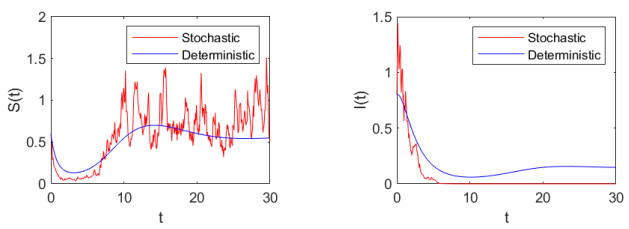
Figure 1.
The left and right figures represent the paths of
$ S(t) $ $ I(t) $ $ (S(0), I(0))=(0.6, 0.8) $ $ \sigma_1^2=0.35 $ $ \sigma_2^2=0.4 $ -
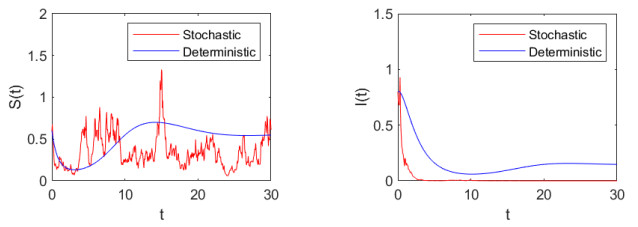
Figure 2.
The left and right figures represent the paths of
$ S(t) $ $ I(t) $ $ (S(0), I(0))=(0.6, 0.8) $ $ \sigma_1^2=0.6 $ $ \sigma_2^2=0.6 $ -
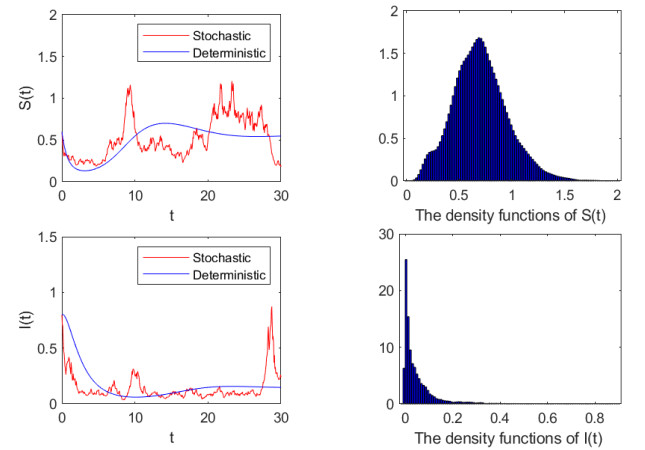
Figure 3.
The left column shows the paths of
$ S(t) $ $ I(t) $ $ (S(0), I(0))=(0.6, 0.8) $ $ \sigma_1^2=0.1 $ $ \sigma_2^2=0.3 $ $ S(t) $ $ I(t) $ $ \sigma_1^2=0.1 $ $ \sigma_2^2=0.3 $ -
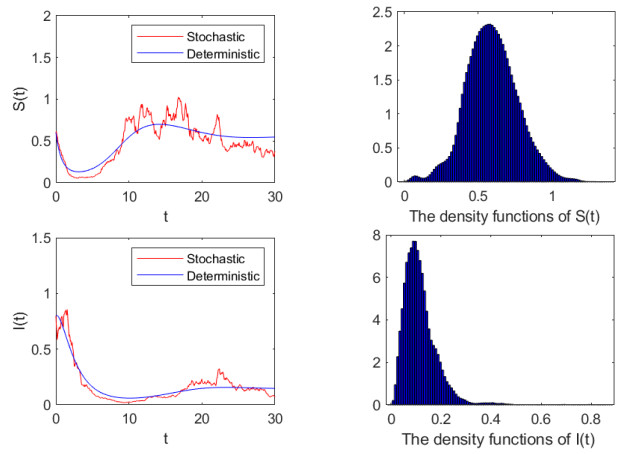
Figure 4.
The left column displays the paths of
$ S(t) $ $ I(t) $ $ (S(0), I(0))=(0.6, 0.8) $ $ \sigma_1^2=0.05 $ $ \sigma_2^2=0.05 $ $ S(t) $ $ I(t) $ $ \sigma_1^2=0.05 $ $ \sigma_2^2=0.05 $